
The U.S. Army's post-Cold War mission was a study in institutional contradiction. A military force undergoing its most rapid demobilization since the 1940s was simultaneously tasked with mastering a new form of warfare where the enemy was not a state actor, but instability itself.
Archival records show the intellectual architecture for 1993 psychological operations rested on Field Manual 33-1 and the joint doctrine publication, JP 3-53. This framework, refined after Operation Desert Storm, treated PSYOP as a non-lethal force multiplier for influencing foreign audiences. The process was systematic. Planners identified target audiences, analyzed their vulnerabilities, and crafted specific messages. These products, from leaflets to radio scripts, required stringent chain-of-command approval to ensure alignment with U.S. policy. The 4th Psychological Operations Group at Fort Bragg was the central production house, printing millions of leaflets and providing technical broadcast expertise. The entire doctrine was built on conveying selected information to alter emotions and actions without firing a shot.
This doctrinal focus was amplified by the post-Soviet drawdown. Between 1987 and the mid-1990s, active-duty force strength was slashed by hundreds of thousands. The Army alone cut its active component by 25 percent between 1990 and 1993. This smaller force was then assigned an expanding portfolio of Military Operations Other Than War (MOOTW). These were complex interventions in places like Somalia and the Balkans, centered on peacekeeping and humanitarian aid. With fewer soldiers on the ground, PSYOP was elevated. It was expected to manage populations and de-escalate situations previously handled by larger combat formations. Communication became a primary operational tool.
Two goals crystallized. The first was stabilizing volatile civilian populations. The second was managing post-conflict resource distribution. In a failed state, this meant PSYOP teams were on the front lines of humanitarian efforts. Their tasks were tactical and immediate. They used vehicle-mounted loudspeakers to broadcast instructions for queues at food distribution points, preventing riots. They disseminated newspapers, like the RAJO newspaper in Somalia, to explain the presence of UN forces and counter warlord propaganda. This was information warfare at its most granular level. Tactical loudspeaker teams from units like the 9th Psychological Operations Battalion were attached directly to maneuver units, providing commanders a direct communication channel to the local populace.
At the heart of the PSYOP teams' inventory was the AN/UIQ-10 sound system. Its design specifications reveal a machine built for a different conflict. The AN/UIQ-10 was a high-power, vehicle-mounted loudspeaker, conceptually descended from systems developed for the massive fronts of World War II. Its purpose was amplification on a colossal scale, projecting a voice or recording across kilometers. A typical configuration on a 2.5-ton truck chassis consisted of a bank of horn-style loudspeakers, an operator's console, and a series of amplifiers. It was a tool for one-way communication to mass audiences, designed for overwhelming sonic presence from a static position.
The power requirements of the system dictated its logistical footprint. To achieve its advertised effective range of over 3,000 meters, the AN/UIQ-10 demanded a massive electrical current. It could not run from the host vehicle’s standard electrical system. Operational logs show the system required a dedicated gasoline-powered generator, a cumbersome unit weighing several hundred pounds. This generator was its operational anchor and greatest vulnerability. It consumed large quantities of fuel, tethering the loudspeaker truck to the supply chain. Its mechanical roar could be heard for hundreds of meters, compromising the tactical position of any attached unit.
In conventional scenarios, the role of the AN/UIQ-10 was clearly defined. Doctrinal manuals detail its use in high-intensity combat, like Operation Desert Storm, where teams broadcast surrender appeals near enemy lines. In stability operations, like those in Haiti, the system directed crowds at humanitarian aid points. It could warn civilians to clear an area or broadcast messages from local leaders to quell unrest. These scenarios were all predicated on battlefield control and a clearly identifiable audience. The system excelled where a powerful, authoritative voice needed to deliver a simple message from a position of relative safety.
Operational logs show the 301st PSYOP Battalion’s deployment into the Republic of Danuvia, a fictionalized stand-in for an area within the former Yugoslavia, began in spring 1993. The environment actively defeated their equipment. The deep, winding valleys and dense forests of the region’s Dinaric Alps created an acoustic nightmare. Sound waves were attenuated by vegetation and distorted by terrain. Unpredictable temperature inversions bent broadcasts in baffling directions. The conflict was a chaotic patchwork of isolated villages and roving paramilitary bands. This was not the theater for which the AN/UIQ-10 was built. A broadcast that carried 3,000 meters in Kuwait was found to be unintelligible beyond 800 meters in a Danuvian valley.
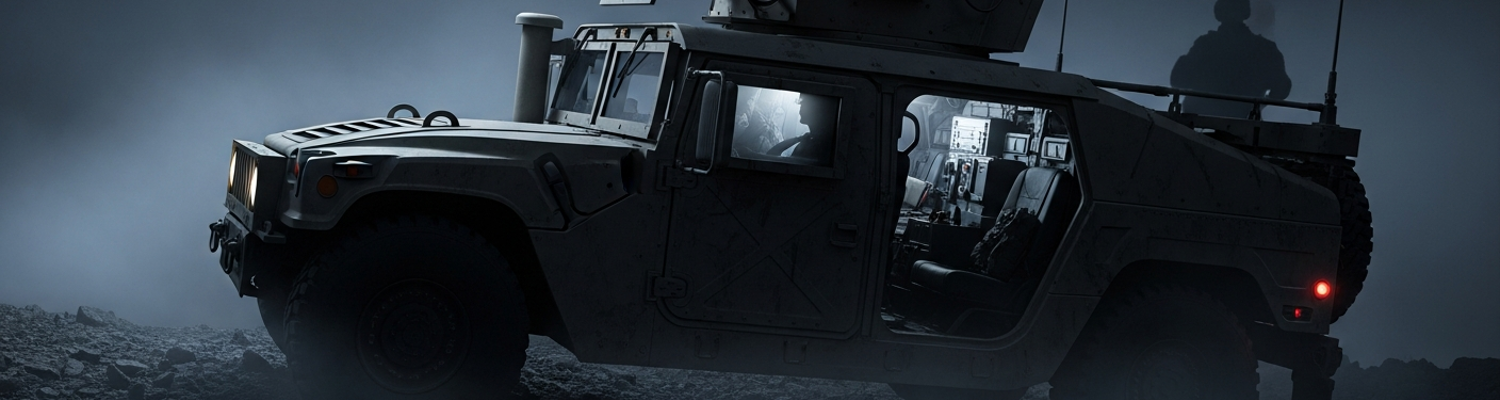
Critical equipment shortages made the environment worse. The drawdown of U.S. forces in Europe meant units like the 301st received third or fourth-hand equipment. Archival evidence shows the battalion’s assigned AN/UIQ-10 systems were not the robust 5-ton truck-mounted variants, but were hastily fitted onto HMMWVs ill-suited for the weight and power demands. Maintenance records from the period catalog constant failures. Generators, worn from years of neglect in German depots, broke down. Spare parts were almost nonexistent. Teams were forced to cannibalize wiring harnesses and capacitors from one broken system to keep another barely operational. The supply chain, prioritizing combat arms, treated PSYOP as a low-priority afterthought. A request for a generator drive belt could take weeks, leaving a team silent.
The terrain demanded power, but the supply depots delivered decay.
This combination of a hostile acoustic environment and decaying equipment created an impossible tactical problem. Command elements, located miles from the front, issued orders based on the doctrinal capabilities of the equipment, not its actual field performance. A brigade headquarters might task a PSYOP team to broadcast a surrender appeal to a village on the opposite side of a 4-kilometer-wide valley, a distance technically feasible according to the field manual. On the ground, operators knew it was impossible. To achieve the required volume, they would need to push their amplifiers far beyond designed limits. This necessity for extended range, born from unforgiving geography, became the central, unresolved challenge. The teams were caught between the physical limitations of failing equipment and the unyielding demands of a command structure expecting by-the-book results.
The pressure to adapt fell on Tactical Loudspeaker Team 3-Alpha, a three-man detachment from the 301st PSYOP Battalion. Operational taskings from May 1993 show the team was ordered to conduct a broadcast into the Gradač valley. The objective was to broadcast conflicting surrender instructions to two rival paramilitary factions, timed with an infantry feint, to sow confusion and protect a civilian evacuation corridor. The mission was doctrinally sound but physically impossible. The team’s HMMWV-mounted AN/UIQ-10, plagued by a faulty generator and underpowered amplifiers, could not project an intelligible message across that chasm. Faced with mission failure, the team’s NCO made a decision that does not appear in any official log but is corroborated by anecdotal after-action interviews. They would rebuild the system.
The first problem was power. The dedicated generator was useless, and the HMMWV's standard 60-amp alternator could not sustain the amperage draw. The team’s vehicle operator, a Specialist with pre-service experience rebuilding truck engines, located a disabled M939 5-ton cargo truck in a maintenance collection point. Its Cummins NHC250 engine was destroyed, but its heavy-duty 80-amp alternator was intact. Over two nights, the team performed an unauthorized transplant. Using a blowtorch and scrap angle iron, they fabricated a crude mounting bracket to affix the larger alternator to the HMMWV’s engine block. They modified the tensioner pulley to accept a belt from a different vehicle. The Specialist bypassed the HMMWV’s voltage regulator and fuse panel, running heavy-gauge copper wire directly from the alternator’s battery terminal to a makeshift junction box that fed the AN/UIQ-10’s amplifier rack. This provided raw current but eliminated every safety feature.
With a surplus of electrical current available, the AN/UIQ-10’s stock amplifier modules became the weak link. The units were not designed to handle the power being fed to them. During tests, the amplifiers would overheat and trip their internal thermal breakers. After burning out two primary amplifier boards, the team’s PSYOP sergeant initiated a search for replacement components. He turned to a depot for condemned electronics. There, they stripped parts from a variety of sources, including high-capacity electrolytic capacitors from a damaged field radar power supply and robust power transistors from a Soviet-era radio transmitter found in a captured bunker. The sergeant, using a soldering iron powered by the HMMWV’s inverter, replaced the AN/UIQ-10’s standard components with these scavenged, oversized parts. They bypassed the amplifier’s internal thermal protection circuits, removing the system’s ability to shut itself down.
The result was a hybrid system that bore only a superficial resemblance to a standard AN/UIQ-10. The new alternator allowed the amplifiers to draw an unprecedented amount of current, and the modified amplifier boards could handle that power without shutting down. Volume and projection range increased by an estimated 40 percent in initial tests. But the system was unstable. The amplifiers, lacking thermal safeties, ran incredibly hot. The unregulated power draw placed an enormous strain on the HMMWV’s engine. The audio output was heavily distorted. It was a dangerous machine, built out of desperation.
The mission's operational directive, OPORD 93-14, detailed a complex, two-part psychological trap. The first part, aimed at the two opposing paramilitary groups in the Gradač valley, consisted of two distinct and contradictory messages. The initial transmission, TX-ALPHA, was to be broadcast on a frequency monitored by Zmaj leadership. It contained a direct address from a fabricated defector, using authentic Zmaj callsigns and claiming a secret deal had been struck with Task Force Talon. The message detailed an offer of safe passage and amnesty for all Zmaj fighters who moved to a rally point at the valley’s western pass within ninety minutes. It explicitly named the rival Vukovi battalion as the target of a planned UN-backed strike.
Moments later, the second message, TX-BRAVO, would be broadcast on a frequency used by the Vukovi. Its content was a mirror image of the first. A different voice, claiming to be a sympathetic UN military observer, would warn the Vukovi that their Zmaj rivals had sold them out and were coordinating with American forces for a combined assault. It described the Zmaj’s planned movement as a repositioning to help encircle the Vukovi forces. The message urged the Vukovi to hold their positions.
The second part of the broadcast was a stark pivot, directed at the civilian population. This message, TX-CHARLIE, was stripped of all military jargon. The script was written in three common local dialects and recorded by a female interpreter to project a non-threatening tone. The instructions were simple. All non-combatants were to immediately proceed to one of two designated assembly areas: the ruins of the Stari Most stone bridge or the red-roofed schoolhouse in the village of Kovač. They were instructed to carry no bags and display a piece of white cloth. The broadcast provided a precise timeline for a UN-supervised evacuation corridor.
The overarching objective, as outlined in Task Force Talon’s mission summary, was tactical paralysis through information overload. The conflicting surrender appeals were intended to psychologically fix the paramilitary command structures in a state of confusion and mutual suspicion. This induced paralysis was intended to create a three-hour window where the Zmaj and Vukovi units would be too busy to interfere with the civilian evacuation or react to the infantry feint. The evacuation of non-combatants was a primary humanitarian goal, but it also served the military objective of clearing the battlespace.
At 22:05 local time, Tactical Loudspeaker Team 3-Alpha initiated the broadcast. From their overwatch position, the team’s PSYOP sergeant selected the tape for TX-ALPHA and pressed play. The first seconds were deceptively clear. Then the system began to fail. The unregulated current drawn by the modified amplifiers placed a load on the HMMWV’s engine that its internal governor could not manage. The engine RPMs began to surge and dip erratically. This unstable engine speed was transmitted to the oversized alternator, which fed wildly fluctuating voltage into the amplifier rack. The effect on the audio was immediate. The steady voice of the supposed defector began to pulse and waver, the pitch sliding up and down.
This power instability triggered a disastrous feedback loop. The sheer volume required to cross the 5-kilometer valley meant the loudspeakers were projecting sound at an immense decibel level. The sound waves, reflecting off the rock faces of the opposing ridge, bounced back toward the team’s position. The microphone, still connected to the console, began to pick up this faint, delayed echo of the system’s own output. This signal was fed back into the overdriven amplifiers, which amplified it and blasted it back out. Within seconds, a low-frequency hum escalated into a gut-vibrating bass tone that physically shook the HMMWV. The jury-rigged system, devoid of its original grounding and isolation circuits, had no way to filter out the parasitic signal. It was now amplifying its own distorted echo.
The carefully crafted words of TX-ALPHA were the first casualty. The fluctuating power and escalating feedback transformed the message into an unrecognizable wave of sound. Declassified audio analyses describe a complete shredding of the source signal. The scavenged Soviet-era power transistors, mismatched with the American amplifier boards, introduced severe harmonic distortion, turning the recorded voice into a high-pitched, metallic shriek. The failing high-capacity capacitors, unable to smooth the erratic voltage, caused the audio to clip violently, rendering consonants as explosive bursts of static and stretching vowels into long, garbled howls. The message of betrayal was lost, replaced by a layered cacophony of a high-frequency scream and a low-end growl.
This garbled roar filled the Gradač valley with a form of auditory threat. For the entrenched fighters below, the sound was not identifiable as a human broadcast. Intercepted radio traffic from both factions reveals a timeline of confusion followed by panic. Lacking any frame of reference, paramilitary commanders interpreted it as the herald of a new type of weapon. The intended psychological effect of paralysis was replaced by a more primal response: fear of an incomprehensible threat. Before the team sergeant could switch to the civilian evacuation message, the primary amplifier board arced with a flash of blue light. The hand-wired connections to the alternator began to smoke, filling the HMMWV’s cabin with the acrid smell of burning insulation. The transmission ended.
The direct causal link between the loudspeaker failure and the civilian reaction is detailed in after-action interviews with UN observers. The civilian population in the Gradač valley, conditioned by weeks of shelling, had been expecting communication. Leaflets had hinted at a UN-led evacuation. When the broadcast began, it was not the promised voice of TX-CHARLIE, but the inhuman shriek of the failing AN/UIQ-10. Survivor accounts describe the sound not as a message, but as an attack. The layered noise was interpreted as the sonic signature of a new weapon.
It was a universal trigger for a primal need to escape. In the village of Kovač, families who had gathered their belongings scattered in every direction. The social cohesion that had allowed the community to survive dissolved in moments. Individuals, separated from their families, simply ran. The intended evacuation routes were not yet known, as the TX-CHARLIE message never aired. There was no focal point for the flight.
This mass of disorganized, terrified people converged on the valley’s natural choke points. The primary escape vector for those in the south was the old logging road leading towards the ruins of the Stari Most stone bridge. This narrow dirt track, hemmed in by a steep rock face and a deep ravine, became a fatal funnel. As hundreds of panicked civilians surged onto the path, the crowd density reached a critical point. Those who stumbled were trampled. Archival evidence from the International Red Cross details the consequences: crush injuries, trauma from falls, and asphyxiation. A UN after-action report estimates that over two hundred civilians died on the logging road and in the immediate vicinity in less than an hour. No shots were fired.
The immediate operational impact of the Gradač valley incident was total mission failure. Task Force Talon’s internal communications from that night reveal a command structure descending into chaos. Instead of inducing paralysis, the sonic assault prompted both paramilitary factions to assume the worst-case scenario. Intercepted radio traffic shows both commanders ordering their units to full alert. The fire in the HMMWV, though quickly extinguished, rendered the vehicle and its communications suite useless, leaving Team 3-Alpha stranded and silent. The formal after-action report, or AAR, shows the team sergeant took responsibility, but noted that the mission as assigned was impossible with standard-issue equipment.
This was a failure born of a systemic breakdown. The unauthorized field modifications were a direct consequence of that breakdown. The team’s decision to scavenge parts was the final step in a long chain of failures that began in stateside depots. Declassified interviews conducted as part of the subsequent investigation highlight the pressure on tactical teams to achieve objectives set by commanders operating from doctrinal specifications, not the condition of the equipment on the ground. This created a culture of improvisation. The modification of the AN/UIQ-10 was seen not as a violation of orders, but as the only possible way to execute them.
A formal inquiry was convened within 72 hours. The post-incident reevaluation of PSYOP procedures was swift. A key finding, detailed in a classified annex to the Task Force AAR, was the unsuitability of high-power, vehicle-mounted broadcast systems for complex, mountainous terrain. Recommendations were drafted for the expedited procurement of smaller, more mobile loudspeaker systems. This included man-portable units and smaller, modular systems that could be mounted on lighter vehicles without requiring dedicated generators. The inquiry also led to a stringent revision of field maintenance protocols. Explicit directives were issued forbidding any non-standard alteration of power-amplifying equipment without engineering-level approval. A review of supply-chain data from the following months shows a marked increase in the priority given to spare parts for PSYOP units, correcting a long-standing deficiency.