Full Calendar
THIS DAY IN U.S. MILITARY HISTORY • NOVEMBER 12 1942 U.S. Navy World War II

Task Force 67 Intercepts Imperial Japanese Warships in Ironbottom Sound

Rear Admiral Daniel Callaghan leads an outnumbered cruiser and destroyer force into furious close-quarters night combat off Guadalcanal.
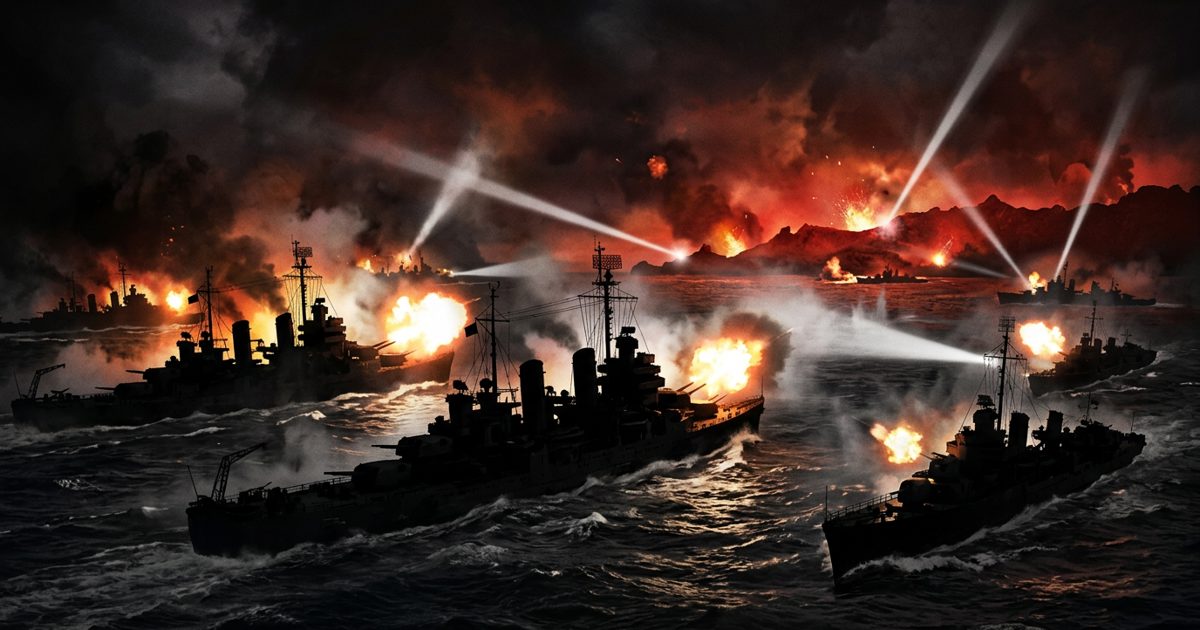
Task Force 67 Intercepts Imperial Japanese Warships in Ironbottom Sound

Japanese aircraft struck American transports unloading critical supplies off Guadalcanal on the afternoon of November 12, 1942, signaling the approach of a massive Imperial Japanese Navy bombardment force. Allied reconnaissance confirmed that Vice Admiral Hiroaki Abe steamed southward toward Ironbottom Sound with two battleships, a light cruiser, and eleven destroyers to bombard Henderson Field. Rear Admiral Richmond Kelly Turner dispatched Rear Admiral Daniel J. Callaghan with Task Group 67.4, comprising five cruisers and eight destroyers, to block the enemy approach and protect the Marines ashore.

Callaghan formed his warships into a single battle line and steamed westward into the darkness between Guadalcanal and Savo Island shortly before midnight. Radar operators on USS Helena acquired the approaching Japanese fleet at 0124 hours, yet the two opposing columns closed rapidly before either commander gained full tactical control. The encounter dissolved into an intense melee fought at distances under 3,000 yards, where heavy naval rifles and torpedo batteries traded point-blank volleys into hulls and bridge superstructures.

Shellfire killed both Rear Admiral Callaghan aboard USS San Francisco and Rear Admiral Norman Scott aboard USS Atlanta during the opening minutes of the night action. Surviving officers and sailors fought on through intense gunfire, inflicting fatal damage on the Japanese battleship Hiei and sinking two destroyers while losing four American destroyers and two cruisers. This resolute defense forced Admiral Abe to abort his bombardment of Henderson Field, preserving Allied air operations over Guadalcanal during a critical phase of the campaign.

CHRONOLOGICAL RECORD

November 12 Across U.S. Military History

8 Verified Events
1864 U.S. Army Landmark Event • Civil War

Sherman Cuts Communications to Begin March to the Sea

Major General William Tecumseh Sherman severed military telegraph lines linking his 62,000-man army to northern headquarters. Demolition teams began systematic destruction of Atlanta military rail yards and industrial depots, commencing an operational advance across Georgia toward Savannah without external logistics.

1864 U.S. Army • Civil War

Cavalry Trooper Captures Confederate Battle Standard at Nineveh

Private James F. Adams of Company D, 1st West Virginia Cavalry, charged Confederate positions during the cavalry action at Nineveh, Virginia. Adams captured the regimental battle flag of the 14th Virginia Cavalry during hand-to-hand fighting, earning the Medal of Honor.

1912 U.S. Navy Landmark Event • Pre-WWI

Ellyson Completes First Successful Naval Catapult Launch

Lieutenant Theodore Gordon Ellyson piloted a Curtiss hydroaeroplane mounted on a compressed-air catapult atop a stationary barge at the Washington Navy Yard. Compressed air propelled the launching carriage forward, sending the aircraft safely over the Anacostia River and establishing the technical viability of shipboard catapult launches.

1943 U.S. Navy Landmark Event • World War II

President Roosevelt Embarks on USS Iowa for Tehran

President Franklin D. Roosevelt boarded the battleship USS Iowa at Hampton Roads, Virginia, to travel overseas for high-level Allied war conferences in Cairo and Tehran. Escorted by cruisers and destroyers, the battleship maintained wartime radio silence and strict defensive readiness while crossing Atlantic waters patrolled by German U-boats.

1944 U.S. Navy • World War II

Kamikaze Strikes Target Support Ships off Leyte

Kamikaze aircraft struck American amphibious support vessels anchored in San Pedro Bay off Leyte, heavily damaging the landing craft repair ships USS Achilles and USS Egeria. Damage control teams and repair crews fought intense fires on open decks to safeguard repair facilities supporting the Sixth Army.

1950 U.S. Air Force • Korean War

Reserve Aircrews Enter Combat Flying B-26 Invaders

Pilots of the 728th Bombardment Squadron flew their unit first combat sorties of the Korean War following mobilization from California reserve status. Aircrews carried out low-level interdiction and close air support strikes against North Korean logistics hubs and troop staging corridors.

1951 U.S. Army Landmark Event • Korean War

Eighth Army Halts Offensives to Establish Active Defense

General Matthew B. Ridgway directed General James Van Fleet to cease general offensive operations across the Korean front and construct a fortified active defense. Eighth Army units shifted into fixed defensive positions anchored by artillery outposts and local security patrols while armistice discussions proceeded at Panmunjom.

1960 U.S. Air Force • Cold War

Thor-Agena Booster Launches Discoverer 17 Spy Satellite

Air Force missile crews launched the Discoverer 17 satellite into polar orbit from Vandenberg Air Force Base using a Thor-Agena B launch vehicle. Discoverer 17 operated under the classified Corona reconnaissance program, carrying high-resolution panoramic cameras designed to collect photographic intelligence of strategic installations.

MEDAL OF HONOR ACTION 1944

Sergeant Forrest Everhart Stands Alone at Kerling

German armor and infantry units launched a predawn counterattack against American bridgehead positions along the Moselle River near Kerling, France, on November 12, 1944. Technical Sergeant Forrest E. Everhart of Company H, 359th Infantry Regiment, 90th Infantry Division, observed enemy panzers pierce his left flank and threaten to overrun an isolated machine-gun crew. Everhart covered 400 yards of timber under heavy artillery fire, reached the gun pit, and helped the crew direct intense defensive fire into the approaching assault wave.

Ammunition ran low as German infantry pressed within close range, prompting Everhart to charge forward alone with grenades. Everhart conducted a fifteen-minute grenade battle that killed thirty enemy troops and broke the attack before he crossed exposed terrain again to assist an endangered gun crew on his right flank. His individual actions repulsed the counterattack, protected the Moselle crossing site, and earned him the Medal of Honor.