Full Calendar
THIS DAY IN U.S. MILITARY HISTORY • NOVEMBER 13 1942 U.S. Navy World War II

Night Melee in Ironbottom Sound Halts Japanese Fleet

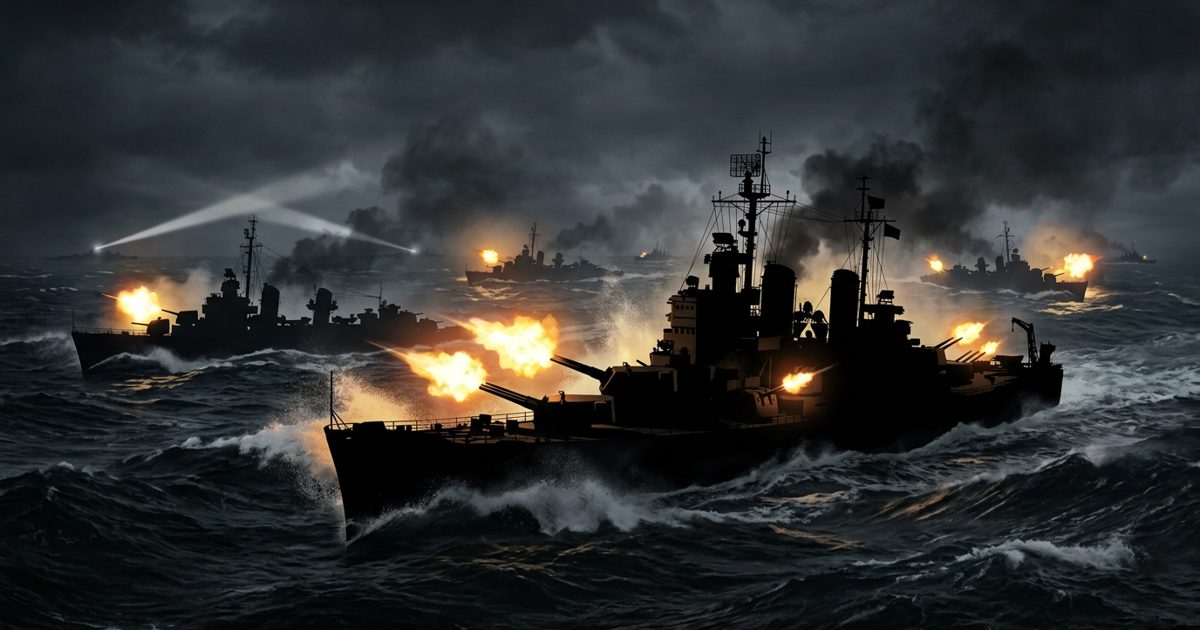
Rear Admiral Daniel Callaghan leads thirteen cruisers and destroyers into a point-blank battle against Japanese battleships off Guadalcanal in 1942.
Night Melee in Ironbottom Sound Halts Japanese Fleet

Callaghan led Task Group 67.4 into the dark waters between Savo Island and Guadalcanal shortly after midnight on November 13, 1942. His formation of five cruisers and eight destroyers had orders to block a Japanese bombardment force heading to smash Henderson Field. Vice Admiral Hiroaki Abe commanded the incoming Japanese armada, centering his line around the battleships Hiei and Kirishima. Radar operators on several American ships tracked the enemy ships at long range, but communication delays kept the cruisers from firing early. Both formations closed at high speed until the opposing lines intermingled at point-blank range.

Searchlights from the battleship Hiei illuminated the light cruiser USS Atlanta and ignited violent gun battles across the sound. American and Japanese destroyers exchanged torpedo salvos and point-blank shell fire at distances under two thousand yards. Heavy shells tore through the cruiser USS San Francisco, while gunfire from multiple ships crippled the destroyer USS Laffey as it swept past the enemy flagship. Japanese gunners focused devastating salvos on the American flagships, killing Rear Admiral Norman Scott aboard Atlanta and setting secondary decks ablaze. Gunfire from both sides struck friend and foe alike in the claustrophobic melee.

Artillery salvos tore away the bridge of USS San Francisco, killing Callaghan and Captain Cassin Young. Lieutenant Commander Bruce McCandless assumed command of the shattered flagship and kept the formation fighting through the night. American torpedoes and heavy naval guns inflicted fatal damage on Hiei's steering mechanisms and upper works, forcing Vice Admiral Abe to abandon his bombardment run and withdraw northward. Morning light revealed four sunken American destroyers and the crippled cruisers Atlanta and Juneau, with Juneau later falling to a Japanese submarine torpedo. American sailors prevented the bombardment of the airfield and forced the Japanese crew to scuttle Hiei before sunset.

CHRONOLOGICAL RECORD

November 13 Across U.S. Military History

8 Verified Events
1775 Continental Army Landmark Event • American Revolutionary War

Continental Soldiers Occupy the City of Montreal

Montgomery led Continental Army troops into Montreal on November 13, 1775. British forces under Guy Carleton evacuated the town to avoid encirclement, abandoning river vessels and military supplies. Montgomery secured the administrative post without resistance before advancing down the Saint Lawrence River toward Quebec City.

1776 Continental Navy • American Revolutionary War

Captain John Paul Jones Captures Armed Transport Mellish

John Paul Jones commanded the Continental ship Alfred alongside the armed sloop Providence during a commerce raiding cruise off Cape Breton on November 13, 1776. American sailors intercepted and boarded the British armed transport Mellish. The prize crew captured ten thousand British winter uniforms that subsequently supplied soldiers in General George Washington's Continental Army.

1864 Union Army • American Civil War

Union Troops Withdraw from the Battle of Bulls Gap

Gillem ordered Union cavalry and infantry brigades to abandon their positions at Bulls Gap, Tennessee, late on November 13, 1864. Three days of Confederate assaults and artillery fire directed by Major General John C. Breckinridge had depleted Union ammunition supplies. The night withdrawal collapsed into a disorganized retreat toward Russellville under persistent Confederate pursuit.

1943 U.S. Army Air Forces • World War II

Seventh Air Force Bombers Strike Tarawa Atoll

Aircrews of the Seventh Air Force initiated sustained aerial strikes against the Gilbert Islands on November 13, 1943. Consolidated B-24 Liberators operating from advance staging fields on Funafuti bombed Japanese fortifications and runways across Tarawa. The bombing operations degraded enemy airfield defenses one week before the amphibious assault by the Second Marine Division.

1944 U.S. Navy • World War II

American Escorts Destroy Japanese Submarine I-12

Warships USS Rockford and USS Ardent detected a submerged enemy contact between California and Hawaii on November 13, 1944. The patrol frigate and minesweeper executed coordinated Hedgehog mortar attacks that sank the long-range submarine I-12 with underwater detonations. The engagement destroyed an enemy raider responsible for the recent sinking of an Allied merchant cargo vessel.

1966 U.S. Army • Vietnam War

Captain Joseph Xavier Grant Rescues Wounded Soldiers

Captain Joseph Xavier Grant led Company A of the 1st Battalion, 14th Infantry Regiment, during intense combat near Plei Djereng on November 13, 1966. Hostile forces assaulted the company perimeter with heavy mortar barrages and infantry charges. Grant reorganized unit defenses and repeatedly braved intense fire to haul wounded soldiers to safety before an enemy mortar round ended his life.

1982 Joint Service Landmark Event • Cold War

Vietnam Veterans Memorial Dedicated in Washington

Veterans and military families dedicated the Vietnam Veterans Memorial on the National Mall in Washington, D.C., on November 13, 1982. Designed by architect Maya Lin, the black granite memorial walls displayed the engraved names of 57,939 fallen and missing American service members. The dedication marked the culmination of a weeklong national gathering that formally recognized the service of Vietnam combat veterans.

2001 U.S. Army Landmark Event • War on Terror

Special Forces and Allied Troops Liberate Kabul

Soldiers from U.S. Army Special Forces entered the Afghan capital of Kabul alongside Northern Alliance partners on November 13, 2001. Operational Detachment Alpha teams coordinated precision air strikes from coalition aircraft to destroy Taliban defensive positions north of the city. The advance collapsed Taliban military control over northern Afghanistan five weeks after combat operations began.

MEDAL OF HONOR ACTION 1944

Staff Sergeant Junior Spurrier Clears Achain Alone

Spurrier attacked the German-held village of Achain, France, alone on the afternoon of November 13, 1944. Company G of the 134th Infantry Regiment, 35th Infantry Division, launched an assault against the eastern edge of the village, encountering stubborn enemy machine gun positions. Spurrier moved around the outskirts and entered the western side of the town by himself with a Browning Automatic Rifle. He killed three enemy soldiers at an outpost and pressed directly into the streets, breaching the defensive perimeter from the rear.

Rifles, rocket launchers, and hand grenades collected from American casualties and captured enemy stockpiles kept Spurrier supplied throughout the afternoon. He sprinted between buildings under continuous small-arms and automatic-weapons fire, routing strongpoints and taking prisoners. Spurrier killed twenty-five German soldiers and captured four others during his solo assault, enabling his battalion to secure the village before dark. Lieutenant General William H. Simpson presented Spurrier with the Medal of Honor four months later in western Germany.