Joint Special Operations Force Raids the Son Tay Compound
Army Special Forces and Air Force commandos launch an audacious deep-penetration rescue raid near Hanoi in 1970.
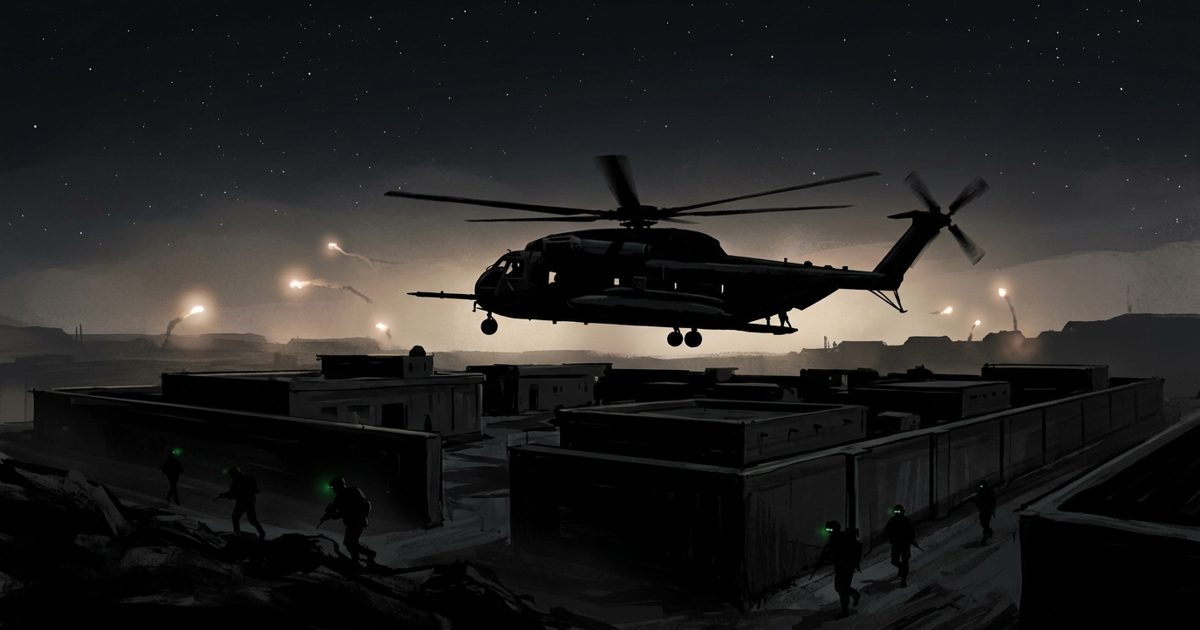
Helicopters carrying fifty-six handpicked Army Special Forces soldiers crossed into North Vietnamese airspace in the early morning darkness of November 21, 1970. Brigadier General Leroy Manor commanded the joint task force from an operations center, while Colonel Arthur Bull Simons directed the ground assault elements. Specially modified HH-53 Super Jolly Green Giant helicopters escorted a single HH-3E transport dubbed Banana 1 straight toward the objective. Air Force pilots deliberately crash-landed the HH-3E inside the small courtyard of the Son Tay prisoner-of-war camp, twenty-three miles west of Hanoi. Rotor blades sliced through tall trees and severed power lines as commandos scrambled out of the aircraft to secure the central courtyard.
Assault team leader Captain Richard Meadows raised a megaphone to alert any captive Americans that rescuers had arrived. Special Forces teams swept through the cell blocks, suppressing guards and clearing secondary buildings under brisk enemy fire. Support elements eliminated a neighboring training school barracks containing foreign military advisers and hostile infantrymen. Soldiers searched every holding cell and compound bunker across twenty-seven minutes of coordinated room-to-room combat. Intelligence officers had tracked the facility for months, yet every lock yielded empty rooms because the captors had evacuated all prisoners weeks earlier due to local flooding.
Colonel Simons signaled the evacuation order once his sweep confirmed no American personnel remained inside the compound. Demolition experts detonated explosive charges to scuttle the damaged crash-landed helicopter and deny equipment to North Vietnamese forces. Extraction helicopters touched down on the perimeter LZ right on schedule, lifting all fifty-six raiders out under tactical air cover from A-1 Skyraiders. American losses totaled one minor gunshot wound and a fractured ankle sustained in the initial hard landing. Defense leaders later utilized the operational coordination and joint tactics proven at Son Tay to restructure modern United States special operations doctrine.