Full Calendar
THIS DAY IN U.S. MILITARY HISTORY • NOVEMBER 27 1950 U.S. Marine Corps Korean War

Marines and Soldiers Withstand Massive Ambush at Chosin Reservoir

The 1st Marine Division and the 7th Infantry Division faced sudden encirclement by Chinese forces in the frozen mountains of North Korea in 1950.
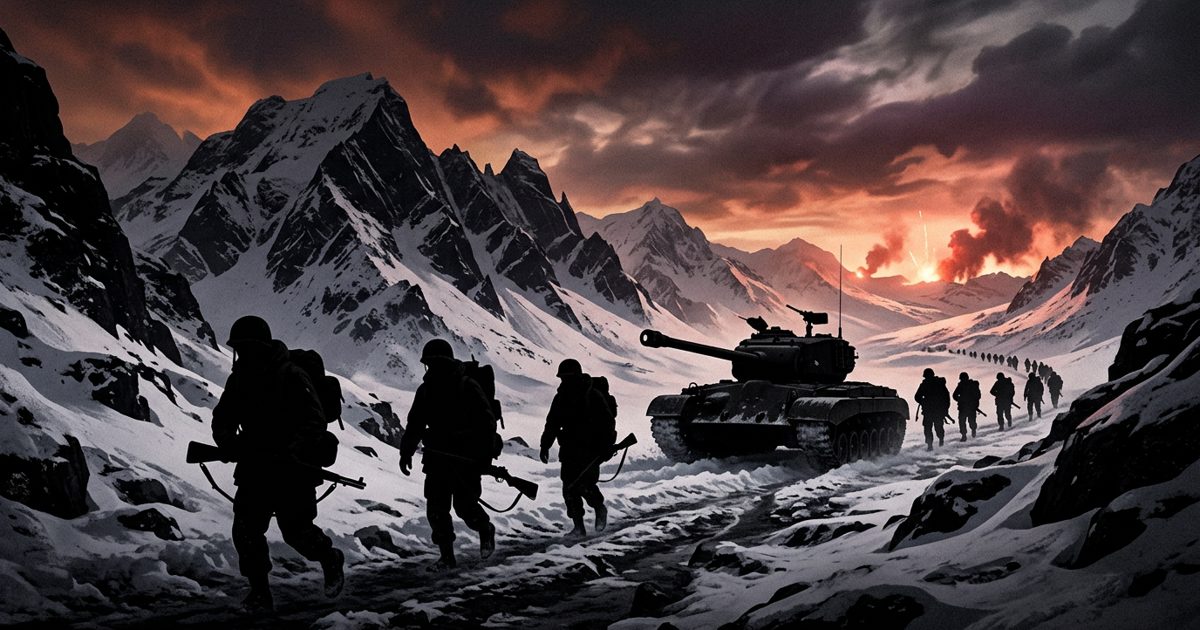
Marines and Soldiers Withstand Massive Ambush at Chosin Reservoir

Chinese infantry divisions launched a massive coordinated counterstroke against United Nations forces across northeastern North Korea on the freezing night of November 27, 1950. Approximately 120,000 soldiers of the Chinese 9th Army secretly slipped through the high mountain passes of the Changjin region to surround American positions. General Douglas MacArthur had driven his commands north toward the Yalu River under the belief that the war was nearing its conclusion. Troops of the 1st Marine Division and the Army 7th Infantry Division instead walked into an elaborate trap set along the rugged ridges encircling the Chosin Reservoir.

Temperatures plunged below minus twenty degrees Fahrenheit as thousands of Chinese soldiers swarmed the isolated Marine perimeters at Yudam-ni and Hagaru-ri. Marine riflemen struggled to cycle frozen weapons while mortar shells detonated in the heavy snowdrifts. East of the reservoir, soldiers of the 31st Regimental Combat Team absorbed furious attacks that shattered their defensive perimeter near Sinhung-ni. Company outposts held their ridgelines with rifles, hand grenades, and bayonets throughout hours of continuous night assaults.

Major General Oliver P. Smith immediately halted the planned offensive westward and ordered his scattered commands to consolidate into defensible strongpoints. Marine and Army logistics teams worked through the darkness to build defensive perimeters around the rough airstrip at Hagaru-ri to receive supplies and evacuate hundreds of frostbite and combat casualties. American forces refused to break, establishing the defensive foundation that allowed them to execute a fighting withdrawal over seventy miles of icy mountain roads back to the port of Hungnam. The initial clashes around the reservoir marked the start of seventeen consecutive days of intense arctic ground combat.

CHRONOLOGICAL RECORD

November 27 Across U.S. Military History

8 Verified Events
1863 U.S. Army • American Civil War

Union Forces Clash at Paynes Farm

Major General George G. Meade led the Army of the Potomac across the Rapidan River to strike Confederate defenses along Mine Run, Virginia, on November 27, 1863. Major General William French encountered Confederate forces under Major General Edward Johnson at Paynes Farm, resulting in fierce fighting through dense woods. Meade halted general assaults after discovering fortified Confederate earthworks.

1864 U.S. Navy / U.S. Army • American Civil War

Confederate Coal Torpedo Destroys Steamer Greyhound

Explosions ripped through the engine room of Major General Benjamin Butler headquarters steamer Greyhound on the James River, Virginia, on November 27, 1864. Confederate secret service agents had concealed a coal torpedo bomb inside the ship coal supply. Major General Benjamin Butler and Rear Admiral David Dixon Porter escaped onto an accompanying dispatch boat before the burning steamer sank.

1868 U.S. Army Landmark Event • American Indian Wars

Seventh Cavalry Attacks Cheyenne at Washita River

Lieutenant Colonel George Armstrong Custer led eight hundred troopers of the 7th U.S. Cavalry in a dawn attack on the camp of Chief Black Kettle along the Washita River on November 27, 1868. Soldiers overran the Cheyenne village in deep snow, killing dozens of villagers and losing twenty-one cavalrymen. The engagement marked the opening major strike of General Philip Sheridan winter campaign.

1901 U.S. Army Landmark Event • Progressive Era

War Department Establishes Army War College

Secretary of War Elihu Root signed War Department General Order 155 on November 27, 1901, officially creating the U.S. Army War College. Root established the institution at Washington Barracks to train senior officers in strategic planning and military doctrine following logistical problems identified during the Spanish-American War. Brigadier General Tasker Bliss assumed leadership as its first president.

1933 U.S. Army Air Corps • Interwar Period

Army Accepts First Martin B-10 Bomber

Officers in the U.S. Army Air Corps formally accepted the first production Martin B-10 bomber at Wright Field, Ohio, on November 27, 1933. The twin-engine monoplane featured an all-metal airframe, enclosed cockpits, rotating turrets, and internal bomb bays. Its top speed surpassed contemporary fighter pursuit aircraft, fundamentally modernizing American heavy bombardment doctrine during the interwar era.

1941 U.S. Navy Landmark Event • World War II

Admiral Harold Stark Issues War Warning Dispatch

Admiral Harold R. Stark, Chief of Naval Operations, dispatched an urgent war warning message to Pacific Fleet commanders on November 27, 1941. Stark advised Admiral Husband Kimmel in Hawaii and Admiral Thomas Hart in the Philippines that Japanese negotiations had ended and hostile aggressive moves were imminent. Naval commanders were instructed to execute defensive deployments while awaiting overt hostile acts.

1944 U.S. Army / U.S. Marine Corps Landmark Event • World War II

Allied Forces Secure Island of Peleliu

Major General Paul J. Mueller of the 81st Infantry Division officially declared the island of Peleliu secured on November 27, 1944. Soldiers and Marines spent seventy-three days clearing entrenched Japanese defenders from fortified cave networks throughout the coral ridges of the Umurbrogol Pocket. The victory secured staging grounds for Allied naval operations in the western Pacific.

1965 Joint / Defense Policy Landmark Event • Vietnam War

Pentagon Proposes Major Vietnam Force Increase

Pentagon strategists submitted a detailed defense assessment to President Lyndon B. Johnson on November 27, 1965, requesting a massive escalation of American ground forces. Military leaders concluded that existing deployments of 120,000 soldiers could not halt North Vietnamese infiltration, urging an increase to 400,000 troops. President Johnson weighed the recommendations before authorizing major deployments throughout the following year.

MEDAL OF HONOR ACTION 1944

Marcario Garcia Assaults Two German Machine Gun Nests

Staff Sergeant Marcario Garcia, then serving as an acting squad leader in Company B, 22nd Infantry Regiment, 4th Infantry Division, found his squad pinned down near Grosshau, Germany, on November 27, 1944. Concentrated German machine-gun and artillery fire from a wooded hill halted the American advance across open ground. Garcia sustained painful bullet wounds to his shoulder and foot but refused medical evacuation to remain with his trapped squad. Moving forward alone through meager brush, he crawled directly into the German defensive perimeter.

Garcia stormed the first fortified machine-gun bunker with rifle fire and hand grenades, killing three enemy gunners and taking four prisoners. Gunfire from a second German position immediately opened up on the squad, prompting Garcia to crawl forward a second time to assault the bunker and eliminate the crew. Company B surged forward into the gap created by his actions and secured the hill objective before nightfall. President Harry S. Truman later presented Garcia with the Medal of Honor, recognizing him as the first Mexican immigrant to receive the decoration.