Full Calendar
THIS DAY IN U.S. MILITARY HISTORY • NOVEMBER 8 1942 Joint (U.S. Army and U.S. Navy) World War II

Allied Forces Launch Operation Torch Across French North Africa

American and British troops storm ashore in Morocco and Algeria to open the Mediterranean offensive.
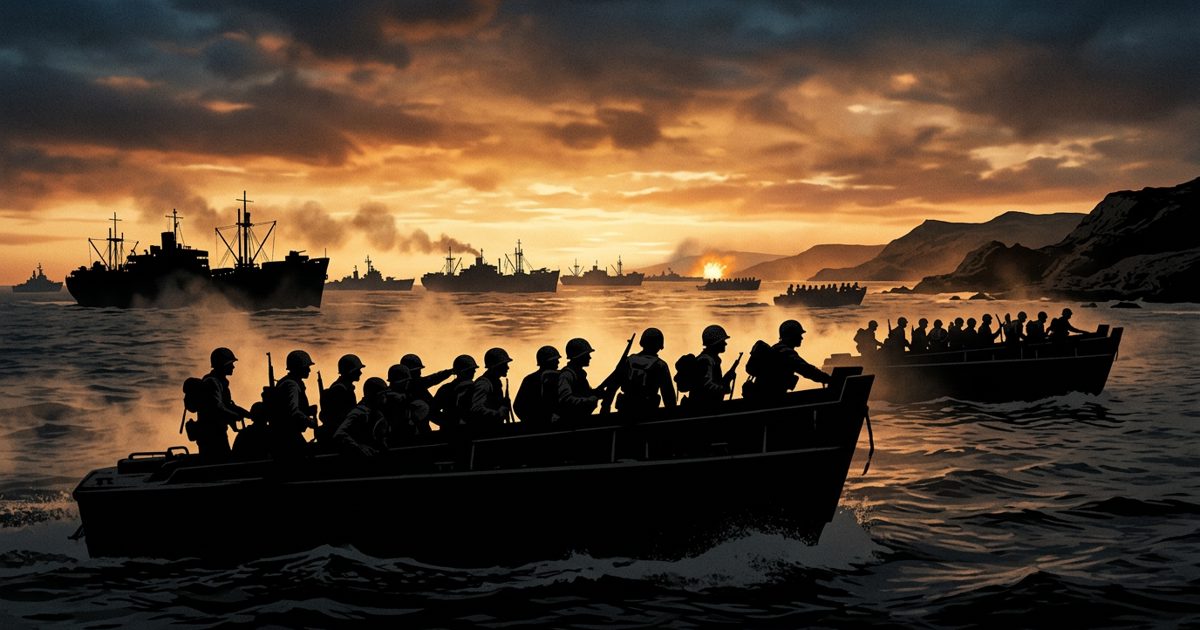
Allied Forces Launch Operation Torch Across French North Africa

Soldiers and sailors of the United States Armed Forces stormed the beaches of French North Africa before dawn, executing three coordinated amphibious landings across Morocco and Algeria. Lieutenant General Dwight D. Eisenhower directed the operation, committing over one hundred thousand troops to open a Mediterranean front against Axis forces. Major General George S. Patton Jr. led the Western Task Force ashore in Morocco, while Major General Lloyd Fredendall and Major General Charles Ryder assaulted Oran and Algiers. Naval gunfire from Rear Admiral Henry Kent Hewitt suppressed Vichy coastal batteries and protected transport ships discharging infantry into heavy surf.

Resistance from Vichy French defenders materialized quickly at sea and ashore as coastal artillery contested the landing zones. Battleship USS Massachusetts engaged the French battleship Jean Bart in Casablanca harbor, neutralizing the vessel with sixteen-inch shell fire while carrier aircraft from USS Ranger struck harbor targets. Ground units of the 3rd Infantry Division and 2nd Armored Division pushed inland despite high waves that swamped landing craft. Paratroopers from the 509th Parachute Infantry Battalion carried out the first American combat airborne drop near Oran after flying from airfields in England.

French authorities yielded within three days as Allied columns secured major airfields and ports across Northwest Africa. Admiral Francois Darlan ordered a regional ceasefire on November 11, ending resistance and allowing American logistics teams to establish supply depots for the drive into Tunisia. Operations secured vital sea routes through the Mediterranean and forced Axis commanders to divert divisions to southern Europe. Victory in Operation Torch cost the United States 556 dead and 837 wounded while establishing essential joint amphibious doctrine for future European landings.

CHRONOLOGICAL RECORD

November 8 Across U.S. Military History

8 Verified Events
1775 Continental Army • American Revolutionary War

Arnold Reaches the Saint Lawrence River

Colonel Benedict Arnold led six hundred Continental Army soldiers out of the Maine wilderness to the southern bluffs of the Saint Lawrence River opposite Quebec. Troops endured a grueling 350-mile march through freezing swamps and raging rivers after departing Fort Western in September. Arnold established camp at Point Levis to procure river craft for crossing.

1861 U.S. Navy Landmark Event • American Civil War

Captain Wilkes Intercepts British Mail Steamer Trent

Captain Charles Wilkes commanded the Union screw sloop USS San Jacinto as it intercepted the neutral British mail packet RMS Trent in the Old Bahama Channel. Armed boarding parties arrested Confederate diplomats James Mason and John Slidell as contraband of war. Seizure of the envoys sparked the international diplomatic standoff known as the Trent Affair.

1918 U.S. Army Landmark Event • World War I

American First Army Reaches the Meuse River

Doughboys of the American Expeditionary Forces pushed forward along the western banks of the Meuse River, consolidating positions overlooking the vital rail junction at Sedan. Major General Joseph T. Dickman directed I Corps units through heavy fog and German artillery fire to sever critical enemy lateral supply lines. German commanders initiated retreat preparations three days before the armistice.

1944 U.S. Army Landmark Event • World War II

Third Army Launches the Lorraine Campaign Offensive

Lieutenant General George S. Patton Jr. launched the Third Army November offensive across northeastern France following a massive artillery bombardment at dawn. Major General Manton Eddy led XII Corps across the swollen Seille River despite severe autumn floods and muddy roads that stalled heavy armor. Infantry divisions advanced five miles into fortified German positions guarding the approaches to Metz.

1965 U.S. Army Landmark Event • Vietnam War

Paratroopers Battle Ambush in Operation Hump

Soldiers of the 1st Battalion, 503rd Infantry, 173rd Airborne Brigade engaged an entrenched Viet Cong regiment in War Zone D near Bien Hoa. Specialist Five Lawrence Joel, an unarmed medical aidman, crawled through intense machine gun fire for over twenty-four hours to treat wounded comrades despite taking bullets to both legs. Joel earned the Medal of Honor for his actions.

1966 U.S. Army • Vietnam War

Captain Euripides Rubio Marks Enemy Positions

Captain Euripides Rubio served as communications officer for 1st Battalion, 28th Infantry, 1st Infantry Division when Viet Cong forces attacked their defensive perimeter in Tay Ninh Province during Operation Attleboro. Rubio braved intense rifle and mortar fire while repeatedly wounded to distribute ammunition and aid casualties. He grabbed a misplaced smoke grenade, threw it into hostile lines to guide incoming airstrikes, and fell mortally wounded.

1986 U.S. Navy • Cold War

Nuclear Attack Submarine Louisville Joins Fleet

Shipbuilders delivered USS Louisville, a Los Angeles-class nuclear-powered fast attack submarine, for formal commissioning into the United States Navy at Groton, Connecticut. Captain Charles E. Ellis assumed command of the boat, designed for antisubmarine warfare and precision strike capabilities. Louisville later achieved naval history during Operation Desert Storm as the first submerged submarine to launch Tomahawk cruise missiles in combat.

2004 U.S. Marine Corps Landmark Event • Iraq War

Coalition Forces Breach Fallujah in Phantom Fury

Marines of Regimental Combat Team 1 and Regimental Combat Team 7 crossed the northern line of departure alongside U.S. Army armored task forces to assault Fallujah. Coalition units breached railroad embankments and defensive minefields under cover of precision airstrikes and AC-130 gunships. Ground troops fought through fortified residential districts to clear entrenched insurgent strongholds during the opening night.

MILITARY AVIATION 1950

Air Force Lieutenant Russell Brown Scores First Jet Aerial Victory

Air Force pilot First Lieutenant Russell J. Brown engaged in history's first jet-versus-jet aerial dogfight over the Korean Peninsula. Brown flew a Lockheed F-80C Shooting Star with the 16th Fighter Interceptor Squadron, patrolling near the Yalu River following a strafing run at Sinuiju. Enemy MiG-15 fighters swept across the border at high altitude, diving toward the American formation at over four hundred miles per hour. Brown turned hard into the interceptors, maneuvering aggressively to counter the superior climb rate of the swept-wing Soviet aircraft.

Machine gun fire from Brown's six fifty-caliber guns struck the fleeing MiG-15 as it entered a steep dive. Brown matched the target descent at six hundred miles per hour, firing volleys into the enemy fuselage until flames erupted. The American pilot pulled out of the dive two thousand feet above ground and observed the hostile aircraft crash. Air Force commanders credited Brown with the first verified jet victory in combat history, accelerating the deployment of F-86 Sabre fighters to Korea.