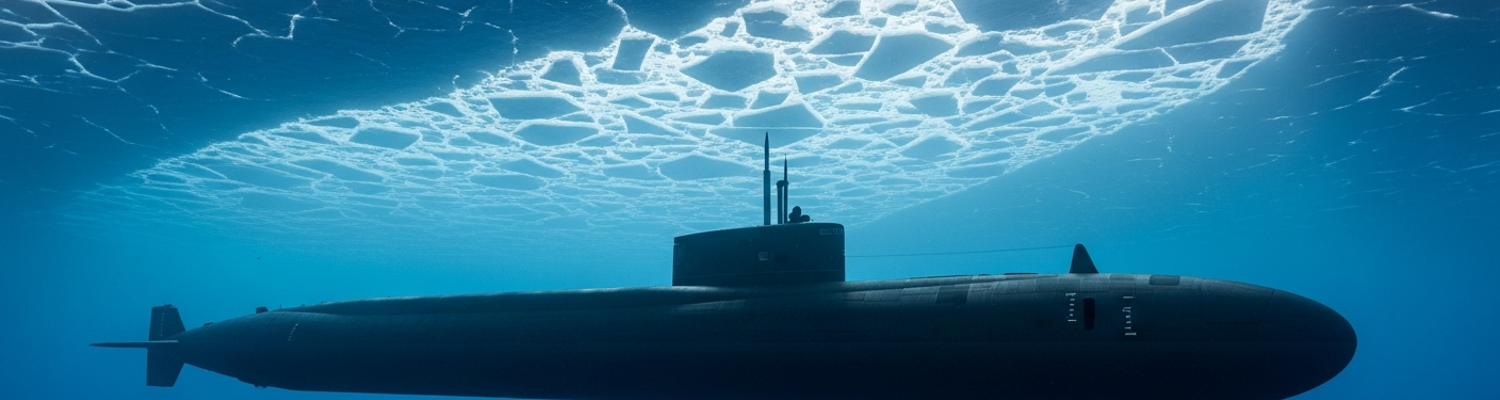

The silence inside the steel hull was near-absolute. It was broken only by the hum of environmental systems and the almost imperceptible groan of metal under extreme pressure. Two hundred feet below the polar ice cap, the USS Whale (SSN-638) moved through the crushing dark. In the control room, faces were bathed in the soft green and red glow of instrument panels. Every man was a study in tense anticipation. They were hunting.
This was a classified Arctic exercise in the mid-1970s. The mission pushed the Sturgeon-class attack submarine and its crew to the edge of their operational envelope. What they found was far beyond what any training manual had prepared them for. These under-ice operations were designed to test capabilities for a potential conflict with the Soviet Union in one of the world’s most unforgiving theaters.
The task was a simulated interdiction of a Soviet naval convoy. In the open ocean, this was a well-rehearsed maneuver. Under the permanent polar ice pack, it was a different problem entirely. The submarine's primary sensor, the powerful BQQ-2 sonar suite, was operating in a complex and unpredictable acoustic environment. Sound did not travel cleanly. It bounced erratically between the jagged, uneven ice canopy above and the seabed below. This created a cacophony of false returns and ghost contacts. Thermal layers in the water, where cold freshwater from ice melt met denser saltwater, created shadow zones where a target could pass completely undetected. The constant groaning and fracturing of the ice pack generated a backdrop of ambient noise that could easily mask the faint signature of a distant propeller. A close review of operational logs from similar exercises (per NAVARCTICOPMAN 74-2) shows that sonar technicians had to distinguish the rhythmic beat of a submarine’s screw from the random, sharp reports of fracturing ice. The crew of the Whale was not just looking for an enemy; they were fighting the environment for every scrap of information.
Operations under multi-year ice represented the pinnacle of submarine technical and psychological challenge. Unlike first-year ice, multi-year ice could be twelve feet thick or more. The true danger lurked beneath the surface in the form of ice keels. These were massive, inverted mountains of ice forced downwards by the collision of floes, which could extend hundreds of feet into the depths. They were uncharted, moving obstacles capable of ripping a submarine’s hull open. To navigate this inverted terrain, the Whale relied on specialized upward-looking sonar, a simple but effective innovation that painted a continuous profile of the ice canopy above. The submarine’s design incorporated specific features for this environment. Its sail was heavily reinforced for punching through thinner ice, and its fairwater planes could rotate vertically. These were measures of last resort. The primary goal was avoidance. Archival evidence from Arctic expeditions shows the immense strain on the navigation team, who had to thread the 4,600-ton vessel through gaps that sometimes offered only feet of clearance. Finding a polynya, a natural opening in the ice, large enough to surface was a mission in itself. It required a slow, deliberate vertical ascent while hovering perfectly stationary, constantly scanning the ice above for thickness and stability. A miscalculation could mean catastrophic damage to the sail, antennas, and periscopes, leaving the boat blind and isolated hundreds of miles from open water.
Established sub-surface navigation theory was the first casualty of the Arctic. Open-ocean doctrine was built upon the Ship’s Inertial Navigation System, or SINS. This complex assembly of gyroscopes and accelerometers calculated a submarine’s position by tracking its every movement from a known starting point. Its inherent weakness was drift, a slow accumulation of minute errors that could, over time, place the submarine miles away from its plotted position. Standard procedure was to correct this drift by periodically rising to periscope depth for a satellite or celestial fix. Under the permanent polar ice cap, this was impossible. A close review of operational logs from the period indicates that the USS Whale was forced to rely on rudimentary bathymetric navigation. This was a painstaking process of matching the contours of the seabed measured by its echo-sounders against classified hydrographic charts. This method was only as good as the charts themselves. In the strategic choke points of the Barents and Kara Seas, areas of expected high-intensity Soviet naval activity, the available charts were often dangerously incomplete or based on decades-old survey data.
The boat was functionally lost. Its true position was a growing circle of uncertainty on the navigation plot with every passing hour. This was a significant vulnerability when attempting to maneuver between unseen, hull-crushing ice keels.
Pre-existing stealth doctrine actively worked against survival in this environment. The core tactical principle of the American submarine force was acoustic invisibility. Standard procedure dictated running in an ultra-quiet state, often shutting down the main reactor coolant pumps to rely on silent, natural convection and proceeding at speeds below five knots to eliminate all machinery and propeller noise. A submarine was meant to be a passive listener, a black hole in the water that detected others without ever being detected itself. A review of declassified tactical manuals from the 1970s shows an overwhelming emphasis on passive sonar operations. The Arctic, however, demanded noise. The constant groaning and cracking of the ice canopy created a deafening acoustic backdrop. This forced the sonar team to contend with a storm of false contacts. To avoid a collision with the ice overhead, the Whale had to constantly operate its upward-looking active sonar. To gain a clear tactical picture of potential targets hidden in the acoustic clutter, the powerful BQQ-2 sonar system had to be used in its active mode, sending out loud, searching pings. Each of these pings was an undeniable advertisement of the submarine’s exact location, a complete violation of the foundational rules of stealth. The command crew was forced to trade their invisibility for a chance at survival.
The mission also shattered the carefully constructed protocols for managing crew endurance. Submarine life was regulated by an 18-hour day, broken into three six-hour watch rotations designed to sustain alertness over long patrols. The concept of night was an artificial construct, maintained by switching to dim red lighting to preserve the night vision of watchstanders for periscope observations. Under the ice, there was no day, no night, and no respite. Psychological studies of submariners who participated in these early Arctic expeditions point to severe emotional strain caused by the perpetual darkness, the lack of any external day/night cycle, and the unceasing tension of the mission. This 18-hour cycle was later found to be fundamentally at odds with the human body’s natural 24-hour circadian rhythm, inducing a state similar to constant jet lag. Archival evidence shows that commanding officers frequently ignored standard watch rotation limits, keeping their most experienced sonar technicians, diving officers, and navigators at their stations for twelve hours or more during critical transits. The official doctrine for extended operations was concerned with the endurance of machinery and the rationing of supplies. It had little to say about the breaking point of the men.
The fragile stability that had characterized the initial phase of the transit vanished with the suddenness of a thrown switch. An unforecast polar low-pressure system, a notoriously violent and fast-developing weather phenomenon, descended upon their operational area in the Nansen Basin. Analysis of declassified meteorological data from the era shows these systems can cause barometric pressure to plummet and generate hurricane-force winds in a matter of hours. For the submerged Whale, the effect was not direct but was transmitted through the ice canopy above. The violent winds began to torture the ice pack, flexing and grinding it with enormous force. The once manageable ambient noise of the Arctic escalated into a deafening roar inside the sonar shack. The BQQ-2 sonar suite was rendered almost completely blind. Hydrophone data became a wall of white noise. Sonar technicians were unable to distinguish the signature of a target from the sound of the world tearing itself apart above them.
The ice was no longer a static ceiling.
What began as a weather event quickly became a kinetic threat. Archival records from Arctic expeditions show that such storms can induce rapid, large-scale movements in the polar ice pack. The Whale’s upward-looking sonar began to paint a terrifying picture of dynamic change. Massive multi-year ice floes, some stretching for miles, began to shift and rotate, driven by the storm’s fury. The gaps the navigation team had carefully plotted were closing. Worse, the immense pressures were creating new hazards in real time. Pressure ridges, formed by colliding floes, were actively growing, forcing massive ice keels to extend hundreds of feet deeper into the water column. The command team was forced into a series of high-risk maneuvers, ordering immediate depth changes to dive below the newly forming keels. On the diving station, the planesmen fought to control the 4,600-ton boat as it was buffeted by pressure waves from the shifting ice.
The final complication was the water itself. The combination of storm-driven surface effects and the large-scale displacement of ice masses created severe, unpredictable underwater currents. Hydrographic data from the Fram Strait region shows a complex interplay of northbound warm Atlantic currents and southbound cold polar flows. This system, already variable, was now thrown into chaos. The Ship's Inertial Navigation System was already operating with a high degree of error, but these currents rendered its dead-reckoning calculations nearly useless. The submarine was being pushed sideways off its intended track, a condition that demanded constant rudder corrections from the helm. A review of Sturgeon-class operational logs indicates that maintaining course in such conditions would require higher speeds and more aggressive rudder angles. These actions destroyed acoustic stealth. The crew was caught in a tactical paradox: fight the current and announce their position, or drift silently and risk being driven into an ice keel.
The first casualty of the storm-induced chaos was the Whale’s most sensitive sensor. In a maneuver to dive below a newly-formed ice keel, the submarine snagged its TB-16 fat line towed array sonar. A close review of declassified Sturgeon-class operational data shows this array was a thick, 240-foot-long acoustic detector trailed on a cable stretching nearly half a mile behind the submarine. Its purpose was to provide unparalleled passive listening capability, especially in the submarine’s rear hemisphere. The violent snag would have sent a physical shock through the winch mechanism before the 0.37-inch cable parted. For the sonar technicians in the control room, the effect was immediate. A vast sensor field that had been providing critical tactical information simply vanished. The screens went dead.
With the towed array physically severed, the Whale was now partially deaf. It was forced to rely entirely on its hull-mounted BQQ-2 sonar, which was already overwhelmed by the noise of the storm-tormented ice. This equipment failure was compounded by a complete inability to communicate with the outside world. Standard naval doctrine relied on two primary methods for submerged communications: Very Low Frequency (VLF) radio and satellite links. A review of naval communication systems of the era shows that VLF signals could penetrate seawater, but only to a relatively shallow depth of around 65 feet. The Whale was operating hundreds of feet below a polar ice cap that was itself over ten feet thick. VLF reception was impossible. Satellite communications were equally useless, as they required an antenna to break the surface of the water. The submarine was equipped with deployable communications buoys, but these were designed for open-ocean operations and could not punch through the thick polar ice.
The physical severing of the towed array and the inoperable communications plunged the USS Whale into a state of absolute isolation for a period of 72 hours. The command team, led by Commander Linton F. Brooks, was cut off from Strategic Command. They were unable to report the damage to their primary sensor suite or receive any updated tactical intelligence or weather forecasts. They were operating completely blind, lost in a collapsing maze of ice with no external support. The psychological strain on the crew during this period was intense. Faced with an impossible situation, the command team made the only decision they could: adhere to strict radio silence to avoid detection by any potential Soviet assets and focus all efforts on survival. The boat and its crew were now entirely on their own, hundreds of miles from open water.
The ordeal of the USS Whale was not an isolated incident. It became a critical data point in a growing body of evidence that Cold War submarine doctrine was dangerously insufficient for the Arctic. The experience, along with similar harrowing patrols by other submarines, directly exposed the gap between theoretical capabilities and the physical realities of the polar environment. These failures served as a powerful catalyst for technological and tactical evolution within the U.S. Submarine Force. The high failure rate of the thick TB-16 towed arrays in ice-bound waters directly spurred the development of more durable, smaller-diameter systems. This work eventually led to the TB-23 and later the TB-29 thin-line arrays, which were less susceptible to snagging and damage.
Navigational deficiencies highlighted by the SINS drift problem pushed for improvements in inertial systems, laying the groundwork for the more accurate ring laser gyro and fiber optic gyro systems that would become standard in later submarine classes. The complete communication blackout experienced by the Whale and others prompted the creation of specialized systems designed for the Arctic. The Navy initiated programs to develop ice-penetrating communications buoys (ICECAP) that could be launched from a submerged submarine, drill through the ice, and transmit a signal. Furthermore, the lessons learned were codified. The Submarine Arctic Warfare Program was established to formalize training, develop specific tactics, and ensure that future crews would not have to rely solely on improvisation when facing the unique challenges of the high north. The Whale's 72 hours of blindness forced the Navy to see the Arctic in a new, more dangerous light.