
The Italian Front's Winter Campaign
A corporal with the 34th Infantry Division’s combat engineers felt the shudder before he heard it. His bulldozer’s blade, straining against a slurry of mud and rock on a narrow mountain track, had struck something unyielding. The engine whined, its steel tracks churning uselessly in the mire. It was November 1943, high in the Italian Apennines. The rain had not stopped for weeks.
Every cleared meter of road seemed to slide back down the mountainside. This was a Sisyphean task performed under the constant threat of German artillery that used the noisy machine as a registration point. He was trying to open a path for a column of Sherman tanks meant to support an attack. The machine was failing. The road was dissolving. The offensive was stalling before it began.
Following the Allied landings at Salerno in September 1943, the divisions of General Mark Clark’s U.S. Fifth Army began a grinding northward advance. The strategic expectation for a rapid push to Rome dissolved as German forces under Field Marshal Albert Kesselring executed a masterful fighting withdrawal into defensive belts anchored in the peninsula’s mountainous spine. By late October, American units like the 3rd, 34th “Red Bull,” and 45th “Thunderbird” Infantry Divisions found themselves funneled into the Apennine range. Their objective was to breach the Bernhardt Line, a formidable precursor to the even stronger Gustav Line.
The push was concentrated into narrow corridors like the Mignano Gap, a pass flanked by imposing peaks such as Monte Camino and Monte la Difensa. Operational logs from the period detail the difficulty of moving men and materiel up steep, winding roads that were often little more than cart tracks, all while under observation from German artillery spotters on the high ground. The advance of the 34th and 45th Divisions across the Volturno River in early November put them directly into this unforgiving landscape. Every mountain and hill had been transformed by the 15th Panzer Grenadier Division into a fortified strongpoint with interlocking fields of fire.
The autumn rains of 1943 bled into one of the harshest winters the region had seen in decades. What began as a logistical challenge posed by mud escalated into a full-blown crisis as temperatures plummeted. Rain turned to sleet, then to heavy snow that blanketed the peaks and choked the valleys. The constant precipitation turned rivers like the Volturno and Rapido into swollen, fast-flowing torrents of icy water, making assault crossings exceedingly hazardous. Dirt roads, already saturated, first became impassable quagmires that could swallow vehicles whole, and then froze into treacherous, rutted sheets of ice.
A close review of operational logs indicates that vehicle losses due to accidents and mechanical failures caused by the environment often rivaled those from enemy action. The cold was a constant enemy. A report from December noted that the Fifth Army suffered 5,020 wounded, but hospital admissions totaled 22,816. The difference was made up of non-battle injuries like trench foot, frostbite, and jaundice.
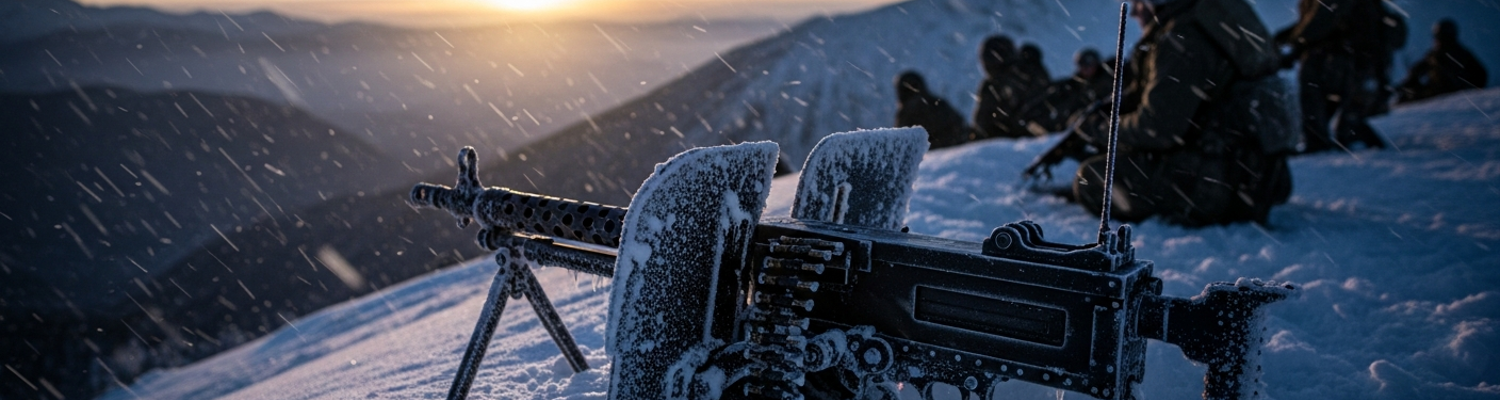
American forces were unprepared for this kind of warfare. The standard-issue equipment of the U.S. Army in 1943 was not designed for sustained combat in a wet, freezing, mountain environment. The standard combat boot was not waterproof. The failure to issue adequate waterproof overshoes or shoepacs led to an epidemic of trench foot that crippled entire units. Soldiers were still largely issued wool overcoats, which, once soaked, provided little insulation and became incredibly heavy. Specialized gear like the M-1943 field jacket, which offered better protection, was not in general issue. Archival evidence shows that logistical priorities, set miles away from the front, were slow to adapt. Requisitions for ammunition took precedence over emergency requests for winter clothing. The cold had a direct impact on weaponry. Lubricants on machine guns and rifles congealed, causing stoppages, and the water in water-cooled machine guns froze solid. For the men of the 34th Division fighting for objectives like Monte Pantano in late November, survival was a daily struggle against both the German defenders and the elements.
Apennine Mountain Logistical Breakdown
The mechanical backbone of the U.S. Fifth Army’s advance snapped under the combined weight of German demolitions and an Italian winter. Engineer units, tasked with keeping arteries like Highway 6 open, discovered their standard-issue equipment was insufficient. Bulldozer blades, designed for earth and rock, proved ineffective against the thick, hard-packed layers of snow and the underlying sheets of ice that glazed the narrow mountain roads. A review of operational logs shows that graders would scrape away snow only to expose a polished surface of ice that was even more treacherous for the wheeled and tracked vehicles that followed. The constant cycle of freezing and thawing turned cleared sections back into impassable slides of mud and rock.
The entire supply chain was dependent on these fragile routes. Every washed-out culvert and every immobilized truck created a bottleneck that rippled for miles, halting the flow of ammunition, food, and medical supplies.
Forward infantry units were left stranded. Their connection to the rear was severed. A historical analysis of the 1st Battalion, 168th Infantry of the 34th “Red Bull” Division during its assault on Mount Pantano in late November 1943 reveals the direct consequences. The battalion was cut off, clinging to a captured knob of the mountain while under constant German counter-attack. Ammunition became so scarce that after exhausting their grenades, the soldiers resorted to throwing rocks and C-ration cans at the attacking German forces. For two days, the only available drinking water was rainwater collected in helmets and shelter halves. Casualty evacuation became a life-threatening ordeal. Bringing a single wounded man down the steep, mortar-shelled trail took a team of four to six men several hours. This isolation was a repeating pattern across the front.
The American military machine, built for mechanized speed, was forced to revert to the most primitive form of transport. The breakdown of vehicle-based supply lines necessitated a massive, improvised reliance on pack animals. Provisional pack troops were hastily formed within each division, drawing personnel from service companies who were often unfamiliar with handling animals. The 3rd Division brought mules from Sicily, but other units had to source them locally. Supplying a single infantry regiment in the line required a train of 250 mules, each guided by a handler, often an Italian civilian. These mule trains were slow, vulnerable to artillery fire, and grossly inefficient. They could only carry a fraction of what a single 2.5-ton truck could haul, and their own needs for fodder added another layer to the logistical strain. Archival evidence shows mule trains struggling for hours up rain-soaked, frozen trails, sometimes only able to get one-third of the way to their objective. This forced infantrymen to haul supplies the final, most dangerous, leg of the journey by hand.
The Headquarters Bubble: A Command Disconnect
The nervous system of the U.S. Fifth Army in the Apennines was a fragile web of copper wire and vacuum-tube radio sets. It was failing. A review of operational logs from the Winter Line battles reveals a near-constant state of communication breakdown between the rifle companies on the slopes and the headquarters elements miles to the rear. The primary tool for company-to-battalion communication, the SCR-300 “walkie-talkie,” had a typical range of three to five miles. This distance was drastically reduced by the dense rock and deep ravines of the Italian mountains. Batteries drained with punishing speed in the sub-zero temperatures, and the 35-pound units were a significant burden in terrain where every ounce mattered. The alternative, EE-8 field telephones, depended on telephone wire spooled out by hand, a line that was perpetually severed by German artillery, rolling rocks, or the simple friction of being dragged over sharp stone.
An examination of after-action reports from the 34th and 45th Divisions during the assaults on Monte Pantano and Monte la Difensa shows a repeating pattern. Units would reach an objective only to be cut off, unable to report their status, request artillery support, or coordinate with adjacent units. The information that did trickle back, often via runners risking their lives over shell-swept ground, was hours old and filtered through the exhaustion and confusion of small-unit leaders.
Far from the front, Lieutenant General Mark W. Clark commanded the Fifth Army from the opulent Royal Palace of Caserta, a baroque masterpiece north of Naples. This physical and psychological distance bred a profound disconnect. Strategic decisions, driven by the overarching Allied goal of a rapid capture of Rome, were made based on maps that could not convey the verticality of the terrain or the debilitating effects of the weather. The pressure to maintain offensive momentum resulted in orders for repeated frontal assaults against heavily fortified German positions on commanding heights. The battles for the Bernhardt Line from November 1943 to January 1944 became a litany of costly attacks against the same mountain objectives. Divisions were thrown against peaks like Monte Camino and Monte la Difensa time and again. Clark’s headquarters demanded progress that the terrain and the enemy’s skillful defense made nearly impossible. The six-week struggle to advance just seven miles through the Bernhardt Line defenses cost the Fifth Army 16,000 casualties, a consequence of strategic impatience overriding the conditions reported from the front.
This fundamental misunderstanding of the environment had its most devastating impact on troop welfare. To a commander in a heated palace reviewing a map, a mountain was an obstacle and a river was a line to be crossed. To the infantryman of the 36th Division, the Rapido River in January 1944 was a fast-flowing channel of freezing water, its banks a muddy, mine-filled killing zone swept by German machine guns. Orders were issued for attacks without a full appreciation for the state of the men who had to carry them out. Archival evidence shows units were kept on the line for weeks, their ranks thinned more by trench foot, frostbite, and sickness than by enemy fire. By the end of December 1943, the Fifth Army was forced to pause operations in part because so many soldiers were incapacitated by non-battle injuries like jaundice and fever. The command structure, focused on delivering a breakthrough, was slow to grasp that the primary battle for many soldiers was against the cold and wet. Requisitions for ammunition and replacement weapons took precedence over cries for waterproof boots and winter clothing, a failure of prioritization born in the headquarters bubble, miles from the frozen mountain slopes.
Frozen Weapons and Field-Expedient Solutions
The standard-issue lubricants supplied by the U.S. Army Ordnance Department failed in the Apennine winter. The primary lubricant, a general-purpose oil designated as “Oil, Lubricating, Preservative, Light,” was engineered for temperate climates. Its chemical properties were unsuited for the sub-zero temperatures routinely encountered on the Italian front. Archival evidence shows that as temperatures dropped, the oil congealed, transforming from a thin, protective film into a thick, viscous paste that acted more like an adhesive than a lubricant. The pour point of some standard oils was around -22°F, a temperature that was approached in the mountains, but the thickening began long before that point, causing sluggishness and eventual failure. This congealing lubricant was the direct cause of countless weapon stoppages at the worst possible moments.
The mechanical actions of the primary American infantry weapons seized solid. For the M1 Garand, the congealed oil would cause the operating rod to become sluggish or freeze entirely, preventing the bolt from cycling after a round was fired. Soldiers would get a single shot, followed by a dead trigger. The Browning Automatic Rifle (BAR), a weapon prized for its mobile firepower, was rendered inert as its gas piston assembly, choked with thickened lubricant, lacked the force to cycle the action. The crew-served M1919 Browning machine guns were perhaps the most severely affected. The heavy bolt of the M1919 required a smooth recoil path to function; when the standard lubricant turned to the consistency of molasses, the bolt would fail to travel its full distance, resulting in failures to feed, eject, or fire. A close review of operational logs from units like the 34th and 45th Divisions details the frantic efforts of machine gunners to clear stoppages under fire, often discovering their weapons were simply too cold to function.
Out of desperation, infantrymen developed a suite of unauthorized but effective field-expedient solutions. The most common method was to strip every last drop of official lubricant from their weapons. They would clean the actions, bolts, and operating rods with gasoline, scarce cleaning solvent, or even just a dry rag until the metal was completely bare. Running a weapon “dry” caused increased wear and a grinding, metal-on-metal action, but it prevented the adhesive-like seizures caused by frozen oil. To combat icing from condensation or melted snow, soldiers used whatever was available. Some accounts describe using captured German-issue kerosene to de-ice and lightly lubricate actions. In extreme cases, men would urinate on the frozen receivers of their machine guns to thaw them out. This was a temporary fix that often led to rapid rust but could mean the difference between silence and covering fire. Another common practice was to keep critical components, like the bolt of an M1 Garand or BAR, inside a pocket or under an armpit to keep them warm with body heat before a patrol or expected attack.
The Cold Injury Epidemic: A Medical Crisis
A large-scale epidemic of non-battle cold injuries swept through the ranks of the U.S. Fifth Army, disabling thousands and crippling combat effectiveness at the platoon level. Archival evidence shows that between September 1943 and April 1944, the Fifth Army recorded over 5,700 cases of trench foot alone. The condition, a non-freezing cold injury, resulted from prolonged exposure of the feet to damp, cold, and unsanitary conditions inside the standard-issue, non-waterproof leather combat boots. The constant immersion in mud and icy water caused peripheral blood vessels to constrict, starving the tissue of oxygen and leading to decay. The foot would become numb and turn white or blue. Upon warming, it would swell and become excruciatingly painful, often developing blisters, infections, and gangrene.
The numbers were debilitating. A review of medical logs indicates that for every five battle casualties evacuated from the front, one additional soldier was evacuated for trench foot. In a single week during the intense fighting of February 1944, over 900 men were removed from the line due to this preventable injury.
This flood of non-combat casualties descended upon a medical system already strained to its breaking point. Battalion Aid Stations, typically located in a shell-pocked farmhouse or a hastily dug shelter about a mile from the front lines, were designed for the rapid stabilization of trauma. Medics and surgeons there were equipped to handle shrapnel wounds, stop bleeding, administer plasma, and prepare men for the next stage of evacuation. They were unequipped for the volume and type of care demanded by cold injuries. A soldier with trench foot did not need a suture; he needed to be taken to a warm, dry environment, have his wet gear removed, and undergo a slow, painful rewarming process that could take days or weeks. These men clogged the limited space in the aid stations, which were often little more than tents. They consumed blankets, space, and the time of medics who were simultaneously trying to treat men with critical combat wounds. Medical records from the period show that evacuation hospitals like the Fifty-sixth were constantly busy, inundated with a combination of wounded, sick, and trench foot cases that stretched their 750-bed capacity past 1,000 patients.
Getting a casualty from his foxhole to the aid station was an operational nightmare that often sealed his fate. The terrain made evacuation by vehicle impossible. Jeeps and ambulances could not navigate the narrow, ice-covered mule tracks or the steep, muddy slopes that constituted the front. This forced an almost total reliance on litter bearers and pack mules. A single litter carry, bearing one wounded man, required a team of four to six soldiers to struggle for hours over treacherous, exposed ground that was frequently targeted by German mortar and artillery fire. A review of after-action reports shows that it was sometimes deemed safer to hold casualties at forward aid stations rather than risk the evacuation, further overwhelming the facilities. This delay was often a death sentence. For a soldier with a severe combat wound, the hours spent on a litter in sub-zero temperatures could induce fatal shock or hypothermia. For a man with trench foot, the prolonged exposure meant the injury could progress from treatable to a condition requiring amputation, a permanent loss to the Army and a lifelong disability for the soldier.
The Evolution of Winter Warfare Doctrine
The institutional shock of the Italian winter campaign forced a deep and painful reassessment within the U.S. Army’s high command. Archival evidence shows that the cascade of equipment failures, cold weather casualties, and logistical paralysis in the Apennines directly led to a large-scale overhaul of operational planning for mountain and winter combat. The hard lessons from the stalled Bernhardt and Gustav Line offensives demonstrated that conventional forces and doctrine were inadequate for sustained operations in such environments. In response, the Army began to formalize a body of knowledge that had previously been neglected.
Specialized training became a priority. The Mountain Training Center, first established at Camp Hale, Colorado, in 1942 to train the 10th Mountain Division, saw its mission validated and its lessons codified. After the war, its functions were moved to Camp Carson, Colorado, and later expanded with the creation of the Army Arctic School in Alaska. These institutions were tasked with developing specific tactics, techniques, and procedures for fighting in extreme cold, ensuring the institutional memory of the Italian ordeal would not be lost. Post-war doctrinal manuals began to incorporate specific chapters on topics that had been learned through bloody trial and error in Italy: casualty evacuation in snow, the use of pack animals for supply, and small-unit infiltration tactics in vertical terrain.
This doctrinal shift was built on a revolution in equipment. The Quartermaster Corps, reacting to the high incidence of trench foot and freezing troops, accelerated the development and issuance of a layered, scientific system of cold-weather clothing. The inadequate wool overcoat and non-waterproof service shoe were systematically replaced. The centerpiece was the M-1943 Field Uniform, a versatile, multi-layered system built around a windproof and water-resistant cotton sateen field jacket and trousers. This uniform was designed to be worn over various insulating layers, allowing soldiers to adapt to changing temperatures and manage moisture. The footwear problem was addressed by the development and widespread issue of the “shoepac,” a rubber-soled, leather-uppered boot far more resistant to water than its predecessor, and the two-buckle combat boot which could be better waterproofed. A review of quartermaster reports from late 1944 onward reveals a new understanding of environmental realities. Dry socks were reclassified as a critical combat supply item, pushed to the front with the same priority as ammunition. This change was not merely about comfort; it was a direct acknowledgment that a soldier with rotting feet was as much a casualty as one hit by shrapnel.
The experience in Italy forced the Army to recognize that strategic objectives could not be dictated by maps alone, divorced from the intelligence coming directly from the front. The disastrous frontal assault across the Rapido River in January 1944, ordered against the advice of subordinate commanders who understood the conditions on the ground, underscored the fatal consequences of ignoring tactical intelligence. After-action reports from the Italian campaign were filled with critiques of a command structure that was slow to react to reports from the field. This led to a postwar doctrinal emphasis on improving the flow of information from the lowest echelons to the highest. There was a new-found respect for the reports of platoon leaders and forward observers. Planners learned that understanding the terrain, the weather, and the state of their own troops was not a secondary consideration but a primary factor in any operational design, a lesson that would be carried forward into the planning for future conflicts and codified in manuals like the post-war FM 72-20, Jungle and Mountain Warfare.