
Closing General Headquarters at Casernes Damremont
Chalk dust coated the rutted supply roads across the limestone plateau of Haute-Marne. Blinding August heat baked the deep mud channels carved out by two years of heavy military traffic. Baldwin steam locomotives idled along the rail spurs at Is sur Tille, venting gray exhaust over deadlined Holt artillery tractors and rows of weathered freight cars packed with salvaged trench equipment waiting for clearance orders. Heavy summer humidity settled over the valley, rotting the damp canvas covers on open flatbeds and swelling wooden crates filled with corroded Springfield rifles. Broken rail lines throughout northeastern France had punished the logistical corps during the autumn offensives and now slowed the retreat of surplus gear back toward the coast. Supply sergeants spent long shifts in sweltering corrugated warehouses, coughing in the stagnant air as they attempted to match handwritten property tags against incomplete manifests.
Manifests failed to account for entire trainloads of field equipment, stranding ordnance clerks in an administrative gridlock of missing dog tags and duplicate requisition forms. Depot commanders thirty miles to the north struggled against the exact same paperwork collapse as orders arrived to shut down the primary command post of the American Expeditionary Forces. Headquarters personnel crated administrative maps, operation logbooks, and central communications files for transfer back to the War Department. Clerks shoved thick folios of field orders and codebooks into iron banded pine chests, sealing up the tactical records of every offensive from Cantigny to the Meuse Argonne. Carpenters nailed these wooden shipping crates shut inside the stone barracks of Casernes Damremont, filling the drafty administrative halls with the sound of hammers and the bitter smell of green lumber. Orderlies carried the finished crates down wide stone staircases toward waiting motor trucks, leaving the vacant offices stripped down to bare plaster walls and stained floorboards.
Plaster dust and discarded cable tags littered the deserted corridors as General John J. Pershing prepared to strike his flag at Casernes Damremont in Chaumont on July 11, 1919. Pershing walked across the central courtyard where staff cars and couriers on Indian motorcycles had arrived day and night through nineteen months of continuous war. French civilian workers and a small rearguard of American doughboys gathered along the perimeter gravel to observe the formal end of an expeditionary command that had swelled from a few dozen officers to millions of men. Buglers took their places near the base of the white flagpole as an army band tuned brass horns in the dry afternoon air. Officers in service dress stood rigidly along the perimeter, watching the four star personal flag flutter against the gray limestone facade of the old French cavalry post.
Halyards creaked against the metal staff as color sergeants lowered the four star banner and folded the wool into a tight triangle. Pershing returned a final salute, turned on his heel, and climbed into an open staff car that immediately sped through the arched stone gates toward the railroad station. Sentries pulled the iron gates shut behind the convoy, locking the empty compound and handing the brass keys back to the French garrison authorities. Motorcycle dispatch riders delivered the departure notices down the telegraph line to Is sur Tille, alerting the yardmasters that all command authority had officially transferred to the port of embarkation at Brest. Supply sergeants on the loading platforms used the telegrams to stamp their final clearance sheets, signaling switch crews to hook up the lead locomotives and drag the crated archives down the main line toward the sea.
Command Transition to American Forces in France
Boxcars rumbled away from the Is sur Tille classification yards, leaving behind miles of open air storage parks that still required legal and physical clearance. The formal dissolution of General Headquarters, American Expeditionary Forces, became effective on September 1, 1919, terminating the wartime command structure that had directed millions of soldiers across the European theater. Residual operational command and liquidation oversight in theater were assigned to the newly designated American Forces in France under Brigadier General William D. Connor. Connor assumed immediate responsibility for sorting through millions of dollars in surplus property, clearing American troop billets, and resolving outstanding land claims with local French authorities. Staff officers under Connor unpacked fresh binders in stripped down offices, establishing operational sections to manage the physical handoff of barracks, repair parks, and railroad terminals. Clerks set up typewriters on bare wooden tables to draft disposal schedules for hundreds of warehouses, tracking every remaining unit still stationed along the old lines of communication.
Telephone wires carried disposal orders directly to isolated detachments guarding ammunition dumps, salvage depots, and cemetery details across eastern France. Liquidation officers worked alongside representatives from the United States Liquidation Commission and the French government to inventory enormous quantities of heavy machinery, motor trucks, and raw engineering supplies. French appraisal commissions inspected muddy storage compounds item by item, contesting equipment values and rejecting damaged gear that doughboys had abandoned in open fields during demobilization. American quartermaster teams had to sort through rotting duckboards, rusted barbed wire spools, and broken locomotive boilers to determine what could be sold for scrap and what needed to be shipped home through remaining ocean ports. Mechanics worked long shifts rebuilding worn truck engines and greasing artillery carriages so that rolling stock could meet the strict handover specifications demanded by French inspectors. Teamsters backed long strings of refurbished motor transports into park formations near depot gates, locking the steering columns and tagging each vehicle for final transfer to foreign civilian ministries.
Keys and title certificates passed to French officials only after claims officers settled disputed financial claims over land damage, timber cutting, and requisitioned railway trackage. French landowners presented folders full of receipts demanding compensation for flattened stone walls, crushed crops, and contaminated pasture lands where American camps had stood. Claims officers inspected every parcel of ground in person, walking the perimeters with local mayors to calculate cash settlements before American military jurisdiction expired. Doughboys assigned to cleanup details pulled up wooden tent floors, filled in latrine trenches, and dismantled miles of wire fencing to restore French farmland to working order. Bonfires burned day and night at the edges of abandoned cantonments as cleanup squads destroyed unserviceable uniform scraps, rotten cots, and unsalvageable packing lumber under the watchful eyes of French liaison officers. Smoke from these disposal fires drifted across the empty parade grounds while supply sergeants checked off the last parcels on their clearing rosters and signed formal land releases.
Land releases allowed rear detachment commanders to consolidate their remaining soldiers into a final small contingent centered around port embarkation camps and cemetery registration units. American Forces in France maintained strict accountability over the thousands of temporary grave markers scattered across the western front, keeping engineering squads working to register burial plots and maintain fencing until civilian commissions took over the duties. Supply depots gradually shut down their electrical power plants, silenced their machine shops, and padlocked the main warehouse doors as French custodial guards took up sentry posts along the outer fences. Soldiers packed their personal duffel bags and loaded into the final outbound passenger coaches, leaving behind only the small liquidation detachments needed to process late paperwork. Quartermasters gathered at the railway platforms to turn over the depot master keys to French commanders, stepping onto the rear vestibule of the outbound train as the engineer cracked open the throttle toward the sea.
Logistical Gridlock along the Is sur Tille Rail Spurs
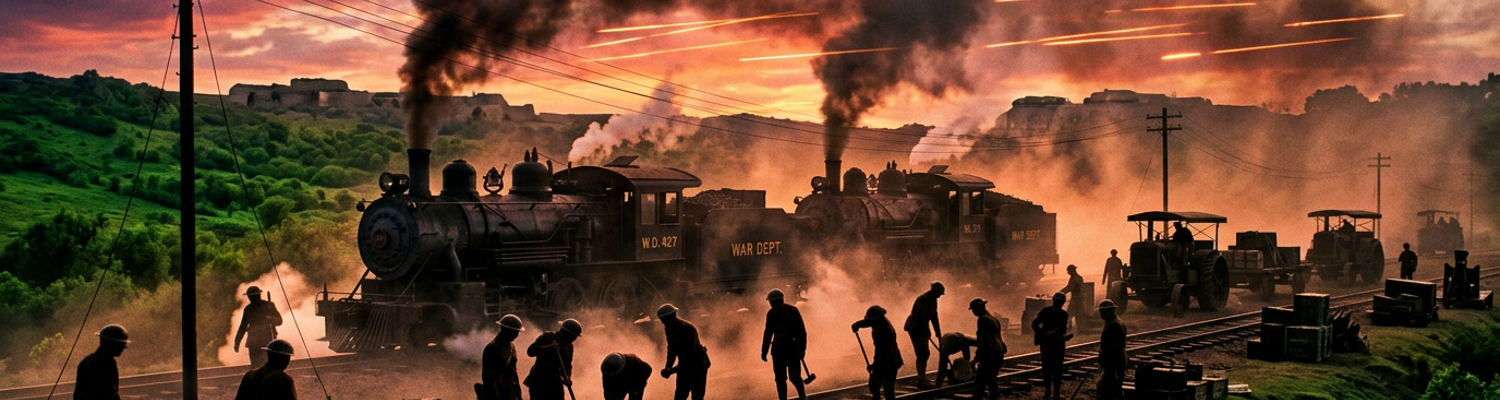
Steam from the departing train drifted across the classification yards, revealing long lines of stranded boxcars that blocked the outer classification switches. Scores of idling Baldwin steam locomotives and deadlined Holt artillery tractors occupied the rail siding network at the Advanced Depot in Is sur Tille, filling the air with heavy smoke and choking fuel fumes. These heavy Baldwin engines burned low fires on their grates to keep boiler pressure steady, waiting for track clearance that never came because clogged transfer yards farther west could not accept more traffic. Alongside the tracks, rows of heavy caterpillar tread Holt tractors sat with cracked cylinder heads, stripped drive sprockets, and dry radiator cores after months of hauling field guns through deep mud. Grease and drained motor oil pooled around the tractor treads, sinking into the crushed limestone ballast while maintenance squads scavenged spare magnetos and carburetors from dismantled machines to keep a handful of switch engines running. Yard crews had to route every shunting operation around these disabled machines, creating choke points that halted outbound movements for hours at a time.
Bottlenecks worsened as depot supply sergeants contended with missing manifests and uncoupled rolling stock loaded with unsorted frontline gear, ordnance, and salvage. Working with clipboards and chalk sticks, these noncommissioned officers climbed through strings of French and American freight cars to pry open sticky sliding doors and inspect unlabeled wooden crates. Many cars arrived without waybills or destination cards attached to their outer planks, leaving clerks unable to tell whether a sealed wagon held artillery shells, contaminated gas suits, or wet mess kits. Unsorted piles of entrenching tools, broken Stokes mortars, and tangled telephone wire lay jumbled together on car floors where combat units had dumped them during the hurried post armistice clearing operations. Sergeants spent hours uncoupling individual cars and routing them onto dead end sidings to prevent volatile ammunition from sitting beside flammable grease barrels and wooden packing crates. The absence of standard bills of lading forced inventory teams to break seals on hundreds of railcars, counting every loose shovel and bayonet by hand beneath the direct sun.
Clerks transcribed these hand counts into worn property ledgers, trying to match loose ordnance and unboxed clothing against demobilization quotas set by headquarters. Discrepancies in crate markings meant that clerks had to hold the entire train on the siding, tying up track space needed by incoming salvage runs from the frontline sectors. Quartermaster officers refused to sign property releases for unverified loads, fearing War Department audits that would hold them financially responsible for missing machine guns, blankets, or field ranges. This refusal stopped train assembly throughout the classification yard, as switchmen ran out of empty track space to build complete trains for the Atlantic ports. Switch crews left strings of loaded flatcars stranded on bypass tracks, forcing train crews to leave boilers burning while waiting for paperwork approvals that took days to secure. Coal supplies dwindled in the locomotive tenders as engines burned through their fuel reserves just maintaining steam while idling in place.
Switchmen shoveled raw coal into the fireboxes of the remaining functional switch engines, pushing uncoupled flatbeds onto outlying spurs to make room for fuel tenders. Yardmasters ordered mechanical repair squads to hook tow cables directly from the running Baldwin locomotives to the deadlined Holt tractors, dragging the disabled machines off the sidings and into muddy drainage ditches clear of the rails. Laborers stacked thousands of unmanifested wooden crates along the gravel embankments, covering open piles of grease cans and trench equipment with tarpaulins to protect them from rain while waiting for appraisal teams. Dispatchers then signaled switch crews to tie down the handbrakes on the uncoupled cars, locking the wheels with iron chocks so that the remaining operational tracks could carry the prioritized port trains westward.
Clerical Breakdown and Casual Companies at Brest
Locomotives pulled prioritized port trains directly toward the Atlantic coast, delivering tens of thousands of exhausted doughboys to the wet hills outside Brest. Camp Pontanezen processed hundreds of thousands of homeward bound troops through hastily assembled casual companies that scrambled organic unit rosters. Incessant Brittany rain turned the camp paths into deep mud, forcing engineering details to lay miles of wooden duckboards between endless rows of pyramidal canvas tents. Camp administrators stripped arriving combat regiments of their traditional company structures, pulling specialists, convalescents, and late replacements out of their original battalions to fill urgent transport vessel quotas. Clerks worked under bare electric bulbs in drafty wooden barracks, typing new passenger manifests on clattering machines while damp paper sheets tore in the rollers. Sergeants packed these provisional paperwork folders into galvanized iron boxes and carried them down to the assembly yards where newly formed casual companies waited in the drizzle.
Captains unlatched these iron boxes on the gravel parade grounds, shouting unfamiliar names into the wind to muster soldiers who had never served together before. Transfers between provisional transit units left thousands of individual doughboys missing from parent organization morning reports prior to embarkation. Men detached for delousing details, dental treatments, or hospital stays were routinely reassigned to whatever outward bound casual company had empty bunks to fill. Parent divisions sailed for home with morning reports showing hundreds of unaccounted for soldiers, leaving administrative officers back at Chaumont and Washington unable to determine who was dead, hospitalized, or already aboard a different vessel. Clerical staff attempted to resolve these discrepancies by scribbling penciled notes across service records, but frequent reshuffling between barracks blocks caused entire service packets to vanish into misplaced filing crates. Orderlies loaded these disputed personnel trunks onto flatbed Dodge trucks and drove them down the winding switchbacks toward the naval docks at the port.
Trucks backed up against the granite quay walls of Brest harbor, where dockmasters checked each arriving casual detachment against handwritten embarkation slips. Doughboys hoisted canvas seabags over their shoulders and filed past inspection desks where navy pursers scrutinized names that failed to match the master transport manifests. Port officers settled paperwork errors on the spot by issuing stamped white cards to unmanifested men, herding them into holding pens along the wet stone piers to prevent anyone from slipping away into the city. French stevedores and American supply squads worked along the wharf edges, wheeling handcarts loaded with duffel bags and salvaged footlockers to the edge of the boarding floats. Harbor cranes swung heavy cargo nets filled with personal baggage and crated clerical records over the open holds of moored steam lighters.
Lighters carried these packed casual companies and cargo nets through the harbor chop toward the gray hulls of ocean transports anchored in the outer roadstead. Soldiers climbed narrow wooden debarkation ladders up the steel sides of converted passenger liners, clutching their stamped paper passes while navy sentries tallied each arrival on mechanical clickers. Purser clerks stationed inside the ship passageways checked off names against incomplete rosters, assigning soldiers to three tier pipe bunks crammed deep inside the lower steerage decks. Quartermasters on the dock below stacked the remaining unassigned bags, unclaimed rifles, and orphaned equipment crates into warehouse bays to await liquidation disposal. Deckhands cast off the heavy hemp mooring lines from the lighters, allowing the naval transports to engage their propeller shafts and turn their bows toward the open Atlantic.
Personnel Reconciliation under the Statistical Division
Troopships cut through the coastal swell toward the open ocean, leaving port administrative officers with conflicting passenger manifests that failed to match the headcount tallies compiled along the piers. Telegraph operators at Brest tapped these raw embarkation tallies across the wire network to Chaumont, delivering thousands of conflicting entries onto the desks of the Adjutant General Statistical Division. The Adjutant General Statistical Division struggled to resolve wide discrepancies between embarkation headcounts, field hospital transfers, and active service rolls. Statistical officers discovered that thousands of doughboys appeared on active company rosters in France while simultaneously showing up on passenger lists of transports already docking in New York and Newport News. Evacuation hospitals scattered from the Meuse Argonne sector down through the Loire Valley had discharged convalescent soldiers directly into provisional casual battalions without sending duplicate transfer slips to central record rooms, leaving wounded men marked as missing combat casualties when they were simply recovering from mustard gas burns in rear wards. Clerks stacked red penciled discrepancy folders inside heavy oak sorting trays, attempting to track individual soldiers through fragmented medical logs that ended abruptly at railway triage points.
Folders filled the oak sorting trays as statistical teams began the slow task of comparing individual identification records across thousands of company files. Mismatched identification tags, misplaced service records, and typographical roster errors obstructed the balancing of final personnel accounts across France. Aluminum tags stamped in muddy trench aid stations frequently carried transposed serial numbers, omitted middle initials, or inverted letters that turned common family names into administrative errors. Typists working on worn carbon paper manifests had struck wrong keys under the pressure of rapid troop movements, creating double entries that showed one soldier serving in two different artillery regiments at the same time. Regimental adjutants had abandoned wooden footlockers of original service records in damp chateau basements during the final push to the Rhine, and hurried company clerks compounded the problem by swapping the serial numbers of soldiers who shared identical surnames. Noncommissioned officers grouped these unverified files into canvas mail sacks and dispatched couriers on sidecar motorcycles to cross check admissions books at regional convalescent depots.
Motorcycles sputtered into the courtyards of shuttered hospital compounds across Burgundy and the Vosges, carrying audit teams tasked with inspecting abandoned patient registers. Investigators walked through drafty brick wards, comparing bed charts and burial notices against the unlocated soldier lists compiled at headquarters. Base hospital superintendents pulled dusty daily registers from metal cabinets to confirm whether wounded infantrymen had died of pneumonia, boarded ambulance trains for Bordeaux, or simply walked out of recovery wards to rejoin their original companies. Audit teams handwrote corrected muster lists on blue ledger sheets and stamped verified names with official clearance marks, striking hundreds of false casualty reports from the active rolls each day. Clerks matched these confirmed hospital entries against the Brest embarkation sheets, finally identifying men who had sailed under misspelled aliases or temporary casual company numbers. Couriers hauled these verified tally sheets back to Chaumont, where statistical clerks bound the corrected pages into master ledgers and sealed the thick volumes into zinc lined wooden crates for shipment to the War Department.
Surplus Material Audits at Romorantin Air Depot
Freight cars carrying these sealed record crates rolled southwest toward the aviation yards in the Loir-et-Cher department, delivering final inventory directives to warehouse commanders. Ordnance and aviation personnel conducted property returns at Air Service Production Center No. 2 at Romorantin amidst thousands of crated Liberty engines and aircraft components. Mechanics and armory sergeants unbolted heavy pine shipping boxes to inspect engine serial stampings against depot stock ledgers, wiping away thick layers of cosmoline preservative grease from steel cylinders and distributor caps. Many of the crated twelve cylinder powerplants had arrived directly from American manufacturers without accompanying logbooks or carburetors, forcing inspection teams to turn crankshafts by hand to test internal compression before signing property release slips. Soldiers loaded cleared engines onto wooden pallets and stacked them three tiers high along the concrete apron, while unidentified motors remained parked along the railway siding where damp air corroded ungreased bolts.
Bolts and unpainted steel brackets rusted rapidly in the damp outdoor air, prompting depot officers to shift their labor details under the corrugated roofs of the main storage hangars. Supply detachments worked to classify vast warehouses of specialized airframe parts between functional stores and scrap stock before depot turnover. Airmen climbed wooden stepladders to examine stacks of spruce wing spars, fabric covered rudders, and linen control surfaces that had gathered dust during months of wartime storage. Sorters condemned warped wooden struts, cracked laminated propellers, and mildewed canvas panels to the scrap heaps, marking ruined components with yellow chalk before laborers hauled them out to disposal trenches behind the flight line. Usable fittings such as brass turnbuckles, aluminum fuel tanks, and copper tubing were packed into clean paper envelopes and counted into standardized bins for transfer to French receivers.
French receivers walked down the warehouse aisles beside American quartermasters, comparing bin counts against the newly completed ledger sheets. Discrepancies between physical tallies and handwritten shipping documents required clerks to climb into storage lofts with lanterns, recounting bundles of magneto wire and cases of spark plugs to clear the remaining property lines. American supply sergeants signed final clearance certificates on portable desks set up near the hangar exits, stamping each transfer voucher with red ink to release the Air Service from financial liability. Joint inspection teams tagged the remaining rows of crated engines with bilingual shipping placards that assigned whole warehouse blocks directly to the French Ministry of War. French custodial troops took possession of the depot keys, locking the sliding iron doors behind the departing American audit squads as the afternoon shift ended.
American audit squads loaded their canvas field desks and record chests onto flatbed trucks idling near the station platform. Drivers steered the convoy past the silent assembly buildings and empty testing stands, navigating rutted gravel roads toward the rail transfer depot. Mechanics and clerical workers climbed into open wooden boxcars, stowing their duffel bags under the bench seating as switch engines coupled to the passenger train. Yard switchmen pulled hand switches to clear the main line track leading toward the coast, setting the iron signals to green for the evening departure. Steam pressure built inside the locomotive boiler until the engineer released the brakes, hauling the final detachment of aviation personnel away from the Romorantin sidings toward the port of Saint Nazaire.
Bulk Asset Transfers under the Liquidation Commission
Passenger coaches rolled into the maritime terminals at Saint Nazaire behind the Romorantin locomotive, but the departure of these aviation mechanics left behind millions of tons of uncataloged property scattered across French soil. American supply sergeants in regional depots faced an administrative gridlock under traditional War Department regulations that demanded individual physical receipts for every piece of field gear, motor vehicle, and crate of canned rations. Shipping this vast mountain of worn expeditionary material back across the Atlantic threatened to cost far more in ocean freight and dock labor than the equipment was worth. French customs authorities prohibited piecemeal commercial auctions that could disrupt local post war markets. The United States Liquidation Commission concluded negotiations transferring surplus American infrastructure, rolling stock, and equipment to the French government for 400 million dollars. Commissioners signed the comprehensive transfer documents in Paris, packaging thousands of isolated camps, dock facilities, bakeries, ice factories, and railroad lines into a single bulk transaction covered by ten year French government bonds.
Telegraph wires carried news of the 400 million dollar agreement directly to depot commanders who were struggling to balance impossible property ledgers. The blanket settlement eliminated the requirement to execute individual serial number audits for millions of tons of dispersed military supplies across European depots. Supply sergeants who had spent weeks crawling over grease soaked Baldwin locomotives and deadlined Holt tractors tossed aside their itemized checklists and stopped logging chassis numbers. Clerks no longer had to climb into stifling warehouse lofts with oil lanterns to match factory stampings on crated Liberty engines, artillery caissons, and spare rifle barrels. Quartermasters abandoned the tedious task of balancing line item losses from combat operations, wiping out months of anticipated paperwork with a single administrative stroke. Depot commanders redrew their disposal plans around entire geographic zones, preparing to turn over complete complexes of trackage, barracks, and repair shops as single physical units.
Repair shops, warehouse bays, and rail yards across central France suddenly shifted from frantic counting operations to basic custodial maintenance. Supply sergeants organized their remaining working parties to sweep out empty storage bays, consolidate loose hardware into standard wooden bins, and paint depot building numbers on exterior doors. Clerks packed away their carbon paper and discrepancy forms, stacking thick binders of reconciled master registers into galvanized footlockers destined for the War Department archives in Washington. Ordnance teams drained fuel tanks on deadlined vehicles, greased open machinery gears to prevent further rust, and secured padlock hasps across hundreds of corrugated iron warehouse doors. Administrative officers then prepared bilingual handover certificates that listed entire supply depots by their geographic boundaries and estimated bulk valuations rather than individual inventory items.
French military inspectors arrived at the main depot gates to accept physical possession under the terms of the liquidation treaty. Joint appraisal delegations walked down the quiet classification spurs at Is sur Tille, Gievres, and Montierchaume, verifying boundary markers, utility plants, and rail switches alongside the last American garrison officers. American quartermasters signed the bilingual certificates on portable desks set up at the depot exits, handing over heavy rings of brass keys to French engineering commanders. French custodial sentries shouldered Lebel rifles and marched out to relieve the American guards stationed along the perimeter fences. Doughboys from the final liquidation details slung their canvas duffel bags over their shoulders, climbed into waiting passenger coaches, and watched the switchmen clear the rails for the run to the coast.
Quartermaster Clearance and Final Archival Closure
Steel rails hummed in the wake of the outbound passenger train, leaving behind isolated supply detachments inside drafty depot offices across the former intermediate and advance sectors. Remaining quartermaster detachments balanced residual ledger sheets and processed final liability write offs for abandoned field gear. Supply sergeants sat at unpainted wooden tables piled high with yellowing tally cards, reconciling thousands of missing haversacks, trench knives, rusted mess kits, and waterlogged wool blankets that combat units had cast aside during the autumn drives. War Department regulations traditionally held company commanders personally responsible for missing property, but combat conditions across the Meuse Argonne and Saint-Mihiel sectors had made strict individual accounting impossible after months of heavy shellfire and rapid maneuvers. Officers signed formal certificates of loss to strike unrecoverable infantry packs, shredded shelter halves, and ruined gas masks off the accountable rolls without penalizing frontline captains. Clerks entered the write offs in red ink across the debit columns, brought the property tallies down to zero, and stacked the cleared property folios and certificates of loss into wooden sorting bins for survey review.
Survey boards condemned unserviceable canvas and rotted leather straps as total property losses, ordering disposal details to burn the ruined gear in deep pits behind the supply warehouses. Survey officers walked the perimeter of the salvage dumps, inspecting piles of crushed trench mortars, punctured gas masks, and moldering wool tunics to sign final condemnation vouchers. Labor squads shoveled dirt over the extinguished ash trenches while clerks logged the destruction orders into the depot daybooks, matching the volume of incinerated material against unresolved property shortages. Mechanical repair parks stripped ruined trucks down to bare chassis frames, salvaging usable brass fittings and writing off cracked motor blocks as combat scrap. Quartermasters signed their names across the final clearance ledgers, officially absolving their units of fiscal liability before delivering the balanced balance sheets to the central administrative desks.
Clerks carried these balanced property folios into the central records rooms, where personnel specialists prepared to shut down the theater administrative network. The closing of final muster rolls across France terminated the expeditionary record keeping apparatus that had tracked more than two million mobilized troops. Company clerks compared daily morning reports against hospital admittance logs, cemetery registrations, and port casual rosters to ensure that no soldier remained unaccounted for on foreign soil. Every doughboy who had landed in Saint Nazaire, marched through the mud of the front lines, or recovered in a base hospital required a final status entry before headquarters could close his military account. Clerks dipped steel pens into black ink to enter the final overseas service notations, recording homeward transport names, port arrival dates, and unit demobilization clearances. Inspecting officers ruled double red lines beneath the final entries and applied the official clearance stamp to the bottom of each muster sheet.
Carpenters hauled heavy pine chests into the empty orderly rooms, lining the wooden interiors with sheets of zinc and water resistant tar paper to safeguard the stamped muster rolls. Supply sergeants stacked the thick leather bound registers into these boxes alongside property ledgers, ordnance books, and hospital casualty cards. Laborers hammered iron bands around the chest corners, securing the heavy lids with brass screws and padlocks before stenciling War Department shipping addresses onto the raw wood. Squads loaded the sealed trunks onto hand trucks, wheeled them down the concrete ramps, and hoisted them into the baggage car of a waiting locomotive. Yard switchmen coupled the baggage car to the engine tender, pushed the handbrake levers down on the rear platform, and signaled the engineer to open the regulator for the final run to the port.