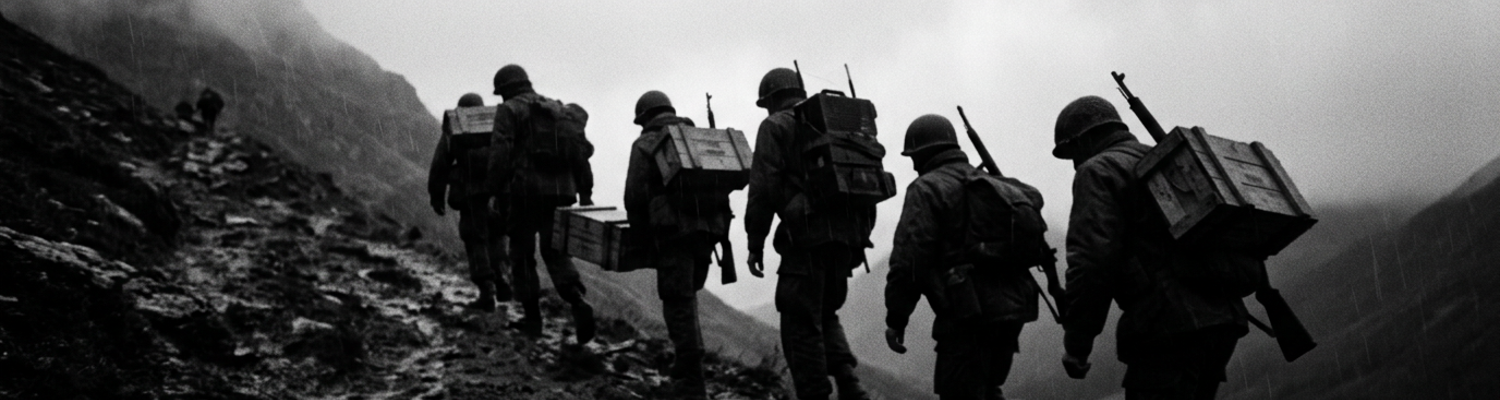

Villa Verde Trail Terrain and Combat Conditions
Archival evidence shows Major General William H. Gill committed the 32nd Infantry Division to clear the Villa Verde Trail in Northern Luzon during April 1945. Sixth Army staff officers sketched clean divisional axes of advance on tactical maps. Forward operational logs confirmed a different situation. Every hundred yards gained required frontal assaults against fortified cave networks dug directly into the rock. The topography favored the defending Japanese 10th Division completely. Originally surveyed as a nineteenth century missionary trail by a Spanish priest, this unpaved route wound twenty four miles eastward from assembly areas around San Nicolas, Pangasinan. It crossed the spine of the Caraballo Mountains toward the junction at Santa Fe. Moving three infantry regiments along a track barely four to eight feet wide eliminated any opportunity for broad front maneuvers.
American rifle companies could not deploy laterally along the corridor.
Terrain across the Caraballo range dictated physical constraints. Rimming the trail were steep razorback ridges with slopes dropping sixty to seventy degrees on either flank. Tangled bamboo, cogon grass, and mountain jungle covered these drops. Riflemen carried sixty pound combat loads while traversing narrow crests. A single misstep sent men tumbling hundreds of feet down sheer ravines. Company commanders found it impossible to deploy platoons into standard skirmish lines or wedge formations. Every unit had to march in exposed single file columns strung out along the ridge spine. Japanese spotters zeroed their Type 92 heavy machine guns and knee mortars directly down the trace of these files. They held fire until forty or fifty American soldiers entered clear fields of fire. Then they shot from mutually supporting reverse slope positions.
Movement forward meant walking directly into pre sighted kill zones.
A close review of operational logs from late April 1945 reveals the arrival of torrential seasonal rains. This weather paralyzed mechanical transport across the entire sector. Tropical downpours triggered massive mudslides. These slides obliterated forward staging points established by the 114th Engineer Combat Battalion (NARA Record Group 338). They repeatedly washed out supply dumps and ammunition caches along the Ambayabang River valley. Heavy clay mud churned to knee depth by thousands of boots stopped tracked vehicles from operating effectively. Medium tanks of the 716th Tank Battalion lost traction on the slippery forty percent grades. They threw tracks into ravines and burned out clutch assemblies. Bulldozers attempting to cut bypass roads around slide areas repeatedly rolled over the edge. This left forward elements without direct artillery support from their 105mm howitzers. Rations, plasma, and dry socks had to be strapped onto packboards. Filipino carrying parties carried them on foot over steep washed out paths.
Litter teams required sixteen hours of continuous labor through torrential downpours to evacuate a single wounded soldier from the forward ridgelines to the nearest clearing station at Santa Maria.
G-2 Intelligence Failures and Underestimated Japanese Defenses
Archival evidence shows Sixth Army G-2 intelligence summaries prepared in late March 1945 badly misjudged the enemy force distribution guarding access routes into the Cagayan Valley. Intelligence officers under Lieutenant General Walter Krueger projected the Japanese forces holding the Villa Verde Trail consisted of disorganized rear guard detachments carrying out temporary delaying actions. Staff planners calculated General Tomoyuki Yamashita was rapidly pulling all cohesive fighting formations back into the Asin Valley and the mountainous redoubt of the Shobu Group to the north. They assumed only starving stragglers remained to blow bridges and abandon roadblocks along the trail. Divisional planning documents issued to Major General William H. Gill reflected this assumption. They directed the 127th and 128th Infantry Regiments to clear the mountain track on an accelerated timetable. Engineers could then push a supply road through to Santa Fe. Patrolling reports warned of coordinated automatic weapons fire. Corps level staff dismissed these reports as contact with small security squads rather than organized defensive perimeters.
Rear headquarters planners operated on maps showing empty ridges.
When examining the historical record of Japanese unit deployments, the defensive line at Salacsac Pass was held by the veteran Imperial Japanese Army 10th Division under Lieutenant General Yasuyuki Okamoto. Okamoto deliberately transformed the twin choke points at Salacsac Pass No. 1 and Salacsac Pass No. 2 into an anchor for the entire southern approach to northern Luzon. The 10th Division deployed its 10th Infantry Regiment and 39th Infantry Regiment directly along the crest lines. They integrated engineering units and elements of the 10th Mountain Artillery Regiment into fixed combat groups. Japanese artillery spotters concealed atop the highest observation peaks directed accurate fire. They used Type 41 75mm mountain guns, Type 94 75mm mountain guns, and 105mm howitzers concealed in deep rock clefts overlooking every trail bend. Defensive sectors were organized to trade terrain slowly. American assault companies had to climb seventy degree ravines under direct observation to reach forward security outposts.
The division marched into a pre registered kill zone across an entire mountain range.
A close review of operational logs from the 32nd Division reveals Japanese defenders occupied hundreds of fortified subterranean caves and mutually supporting log and earth bunker complexes. These were blasted directly into the volcanic shale. Japanese combat engineers constructed these bunkers using double layered three foot thick tree trunks. They covered them with crushed rock, packed dirt, and living sod blending into the mountain brush. High explosive 105mm howitzer rounds detonated harmlessly on the earth packed roofs. They failed to penetrate the reinforced chambers beneath. Below the surface Japanese digging crews excavated multi level cave systems stretching twenty to sixty feet deep into the rock face. These contained ammunition magazines, sleeping quarters, and internal telephone links. Machine gun embrasures were cut flush with the natural contour of the slope. Type 92 heavy machine guns were oriented so their fire skimmed inches above the soil across the narrow razorback paths.
Satchel charges dropped onto the bunkers by American infantry patrols rarely neutralized the positions permanently. Japanese soldiers retreated down vertical connecting shafts into the lower rock galleries whenever American rifle squads brought white phosphorus grenades and flamethrowers to bear on the outer firing slits. Once American troops crested the parapets, hidden counter trench exits allowed Japanese counterattack squads to reoccupy upper firing pits from the rear. In the combat sector surrounding Hill 502, engineers of the 114th Combat Engineer Battalion used over two thousand pounds of C-2 plastic explosive across four consecutive days. They sealed twenty three interconnected adits along a single three hundred yard segment of ridge.
Forward Assaults of the 127th and 128th Regiments
Point blank machine gun fire stopped the advance within minutes.
Archival evidence shows in mid April 1945 the 127th and 128th Infantry Regiments initiated frontal drives directly into the fortified crest defenses guarding Salacsac Pass No. 1. Colonel James A. Lewis deployed the 1st and 3rd Battalions of the 127th up the razorback spurs below Hill 505 and Hill 506. The 128th assaulted the parallel ridge guarding the pass to the south. Soldiers crawled up sixty degree inclines of crumbly volcanic shale. They pulled their nine pound M1 Garand rifles through wet soil while balancing heavy ammunition bandoliers across terrain dropping off into sheer gorges. Japanese defenders from the 10th and 39th Infantry Regiments manned mutually supporting reverse slope trenches carved directly into the mountain rock. They stayed inside sheltered shafts during American preparatory artillery barrages. They emerged at the parapets seconds after the 105mm shells stopped falling. Lead elements of Company E, 128th Infantry, lost thirty four men in under twenty minutes. Three camouflaged machine gun revetments opened fire from a distance of seventy yards. The Americans were pinned against bare rock with zero natural cover.
Platoons disintegrated into isolated pockets of riflemen clinging to the slope.
When examining the historical record of these initial probing maneuvers, forward reconnaissance patrols sustained heavy casualties from pre sighted interlocking machine gun and knee mortar fire. Patrol leaders pushing five man scout teams through the ravines flanking Trail Marker 18 ran directly into interlocking fire lanes. These were laid down by Japanese Type 92 heavy machine guns. Defending gun crews had measured exact ranges to every distinct boulder, trail switchback, and tree stump along the ridge during the preceding months. They withheld fire until entire reconnaissance squads entered cleared kill zones before pulling their triggers. Type 89 50mm knee mortars dropped fragmentation projectiles into the surrounding mountain oak canopy. This showered lead scouts with lethal airburst splinters bypassing trench parapets and foxhole lips. Operational logs from the 1st Battalion, 127th Infantry, record seven separate reconnaissance patrols sent toward the forward outposts on Hill 506 suffered casualty rates exceeding fifty percent within their first ten minutes of movement.
Litter bearers were cut down before they could reach the wounded.
A close review of operational logs indicates infantry units had to reduce these positions through close quarters bunker fighting using M2 flamethrowers and satchel charges. Two man demolition details crawled within throwing distance under direct suppressive fire from Browning Automatic Rifles and M1 carbines. They sought blind spots in the Japanese interlocking sectors. Carrying an M2-2 chemical flamethrower up seventy degree clay inclines meant hauling seventy pounds of pressurized nitrogen tanks and thickened gasoline while exposed to sniper fire. A single fragment striking the cylinder assembly produced a catastrophic explosion incinerating the operator on the spot. Once within range teams directed forty foot streams of burning thickened fuel into firing slits cut flush with the terrain. This stripped the bunker interior of oxygen and disabled the machine gun crews. Combat engineers followed immediately. They slid forty pound satchel charges of Composition C-2 down ventilation pipes and rear crawlways. The concussive blasts collapsed the layered mahogany logs. This sealed the remaining occupants inside the rock chambers before external counterattack teams could emerge from reverse slope tunnels.
Radio Signal Attenuation Across Caraballo Ridge Formations
Static drowned out the divisional net.
Archival evidence shows the physical geography of the Caraballo Mountains dismantled U.S. Army radio doctrine within the first forty eight hours of combat along the Villa Verde Trail. Signal officers of the 32nd Division encountered an RF propagation environment where razorback crests rose at seventy degree angles. This created physical terrain masks completely cutting off both very high frequency line of sight paths and high frequency groundwaves. Wet vegetation formed a continuous blanket of signal absorbing material. The dense double canopy jungle, saturated daily by tropical rains and mist, produced severe dielectric absorption across the VHF and HF spectrums. This attenuated radio frequency transmissions by as much as twenty to thirty decibels per hundred yards of forest cover. High concentrations of volcanic basalt and iron bearing rock throughout the Salacsac ridges deflected RF energy away from receiver stations positioned in reverse slope ravines. Signal detachments attempting to bridge tactical links between the Ambayabang River basin and forward crest positions found radiated power dissipated directly into the sodden soil instead of propagating through the atmosphere.
Radio operators found themselves screaming into dead handsets.
A close review of operational logs indicates the standard infantry manpack transceiver, the SCR-300, failed catastrophically when pushed into the narrow draws around Hill 505. Operating in the 40.0 to 48.0 megahertz frequency modulated band, this thirty two pound radio set relied entirely on optical line of sight to achieve its rated five mile tactical range. When lead platoons of the 127th Infantry descended sixty feet into the ravines flanking Trail Marker 19, the physical earth mass between their whip antennas and the battalion command post severed communications instantly. Soldiers carried the AN-130 flexible steel whip and the longer AN-131 sectional whip. Stringing wire through the upper jungle canopy failed to overcome the terrain shielding. Humidity and water seepage short circuited the BA-70 dry battery assemblies within four to six hours. This left forward radiomen unable to transmit coordinates while their squads took sustained mortar fire. Rifle companies lost the ability to call for defensive artillery concentrations whenever their forward observers slipped below the crestline of Salacsac Pass No. 1.
Field runners sent back to restore contact were shot down along the trail.
When examining the historical record of regimental communications, the heavier SCR-284 radio sets proved incapable of maintaining reliable links across the deep mountain draws. Signal squads had to haul the hundred pound BC-654 transmitter receiver units, GN-45 hand crank generators, and lead acid storage batteries up sixty degree mud paths under constant sniper fire. Designed to operate on amplitude modulation between 3.8 and 5.8 megahertz, the SCR-284 depended on groundwave propagation. The vertical rock walls of the Caraballo gorge completely trapped and degraded these waves. The transmitter output of fifteen to twenty watts was insufficient to punch signals over the crest of Hill 506. Antenna crews attempted to string counterpoise wires and horizontal half wave doublets between towering mahogany trees. Overhead branches snapped copper lead in wires under heavy winds. The enclosing rock faces produced destructive multipath interference cancelling out outgoing signals. Battalion commanders of the 128th Infantry could not establish voice contact with regimental headquarters situated only three thousand yards west in the lowlands near San Nicolas. Hand crank generator teams exhausted themselves spinning the GN-45 dynamos in ninety degree humidity. They generated electrical power for transmitters producing nothing across the earphones except steady unbroken atmospheric static.
Severed Artillery Liaison and Telephone Wire Dependence
The guns fell silent whenever forward observers lost the net.
Archival evidence shows forward observer teams from the 121st and 126th Field Artillery Battalions could not transmit target grids through the mountain draws. Artillery spotters crawled with lead infantry companies into the ravines flanking Trail Marker 21. They packed portable SCR-610 and SCR-300 FM radios to register defensive fires against Japanese counterattacks. Heavy VHF signal absorption across the iron dense volcanic ridges blocked line of sight paths back to battery fire direction centers in the Ambayabang River valley. Company liaison officers watched Japanese infantry from the 39th Infantry Regiment form for flanking attacks less than two hundred yards away across open razorbacks. Battery computers waiting three miles to the west never received the azimuth adjustments or quadrant elevations required to lay 105mm M2A1 howitzers. Fire missions stalled completely or experienced operational delays of over forty five minutes while runners scrambled rearward through continuous sniper fire. Incoming defensive barrages regularly arrived long after Japanese assault platoons had breached forward infantry perimeters.
Battery fire direction centers waited for coordinates that never came through the static.
A close review of operational logs indicates the 32nd Division defaulted entirely to wire based communication. They relied on sound powered EE-8 field telephones to maintain tactical control. Wire sections from the 32nd Signal Company hauled heavy RL-39 reel units across the ridge spines. They strung twin conductor W-110 assault wire through dripping mountain brush and across muddy slopes. Technical limitations compromised these installations from the start. The thin rubber and cotton insulation on W-110 wire deteriorated rapidly when submerged in wet clay. This leaked the handset signal directly into the ground. Japanese artillery batteries operating Type 94 75mm mountain guns shelled the trail axis continuously. This fragmented the copper steel wire strands every few hundred feet. Night infiltrators from the Japanese 10th Division systematically targeted the exposed ground lines. Creeping into American battalion sectors after dark, Japanese saboteurs located wire runs along ravine trails. They used bayonets to sever the lines or removed inches of protective insulation to ground out telephone current during monsoon downpours. Signal linemen spent nights crawling along exposed ridgelines with splicing pliers and friction tape under direct knee mortar fire to restore broken loops.
Every wire team moving up the trail took casualties within hours of deployment.
When examining the historical record of assaults on Hill 505 and Salacsac Pass No. 1, infantry rifle platoons repeatedly advanced beyond the physical reach of the wire heads. Heavy spool equipment could not be carried up sixty degree mud faces under machine gun fire. Wire crews had to terminate lines hundreds of yards short of Japanese defensive perimeters. Forward rifle squads from the 127th Infantry pushed toward fortified log pillboxes with no direct method of requesting suppressing artillery fires. Field artillery doctrine required precise observer adjustments before walking high explosive shells close to friendly lines. Without wire or radio contact, battery commanders refused to fire into sectors where friendly locations were unconfirmed. Assault squads had to reduce interconnected cave complexes using only man portable weaponry. They dragged M1A1 bazookas and forty pound satchel charges across open shale within thirty yards of active Japanese Type 92 machine gun bunkers. Riflemen engaged in point blank fire fights without artillery preparation. They threw white phosphorus grenades into bunker embrasures while taking flanking fire from concealed secondary positions across the adjacent ravine.
Provisional Supply Trains and Indigenous Pack Carriers
The division ran out of roads before it reached the enemy.
Archival evidence shows by early May 1945 mechanized supply movement along the Villa Verde Trail collapsed completely past Trail Marker 22. Heavy GMC CCKW two and a half ton trucks and tracked M29 Weasels of the 32nd Quartermaster Company bogged down to their axles in volcanic clay. They burned out transfer cases, snapped winch cables, and slid off the narrow track into the Ambayabang River gorge. Major General William H. Gill faced an immediate supply cutoff for forward rifle battalions of the 127th and 128th Infantry Regiments battling across the crest lines near Salacsac Pass No. 1. Regimental supply officers organized provisional pack trains staffed by over eight hundred indigenous Igorot tribesmen from the Benguet mountain range alongside hundreds of lowland Filipino civilian volunteers. These civilian carrying parties took over the supply mission across twenty miles of ridge terrain where tracked vehicles could not advance. Organized into informal trail companies of fifty to one hundred men under local headmen, the indigenous carriers became the primary transport apparatus for divisional dumps. They moved cargo along greasy ledges cut into the Caraballo range between Santa Maria and forward assembly points.
Every round fired on the crest was brought up by hand.
A close review of operational logs indicates these civilian supply lines functioned with minimal formal oversight from Philippine Civil Affairs Units. Sixth Army administrative personnel remained miles behind the front in San Nicolas. They delegated route management and line security directly to ad hoc infantry non commissioned officers and local guerrilla liaisons. Carriers climbed without steel helmets or combat equipment. Equipped with woven rattan back baskets or wooden packboards lashed with discarded field telephone wire, individual men hauled forty to sixty pound loads up near vertical switchbacks inclined at sixty degree angles. Teams hauled wooden crates containing twelve hundred rounds of .30-06 ammunition, metal cans of 81mm mortar shells, ten in one ration boxes, and five gallon water cans across narrow trails slick with mud. Footing gave way constantly. A single slipped foot on the clay ledges bordering Hill 505 plunged civilian carriers and their cargo hundreds of feet down sheer ravines. Japanese mountain artillery units repeatedly shelled the exposed switchbacks with Type 94 75mm guns. This forced supply parties to sprint across open shale shelves under falling rock and fragmentation bursts.
Return trips were worse.
When examining the historical record of casualty evacuation, medical personnel found standard ambulance transport impossible across the Salacsac escarpments. Wounded soldiers suffering from sucking chest wounds, compound fractures, and burns from cave demolitions had to be evacuated rearward down vertical cliff faces. Indigenous carriers built improvised litters out of green bamboo poles, cross braced saplings, and heavy canvas shelter halves secured with copper assault wire. Teams of four to six carriers shouldered each stretcher. They lowered wounded infantrymen down seventy degree rock chimneys. Ropes anchored to tree roots supported the stretchers. The men descended rain slick rock chutes. Japanese snipers from the 39th Infantry Regiment concealed themselves in the oak canopy flanking the trail trace. They targeted the slow moving evacuation parties as they descended exposed crestlines. Carriers maintained balance on narrow shale shelves under rifle fire. They shielded casualties with their own bodies to prevent stretchers from tipping into the canyons below. Operational records of the 114th Medical Battalion confirm continuous litter relays required up to fourteen hours of hand lowering to transfer a single critically wounded soldier across the three mile drop from Salacsac Pass to the forward aid post at Trail Marker 19.
Subterranean Cave Clearing and Bunker Reductions
Archival evidence shows assault squads from the 127th and 128th Infantry Regiments encountered multi room subterranean networks excavated deep into the volcanic ridges flanking Salacsac Pass No. 2. Japanese combat engineers from the 10th Division carved these fortified labyrinths with pickaxes and black powder. They established interconnected complexes fifty feet beneath the surface. Horizontal galleries linked sleeping quarters, ammunition depots, and distinct machine gun emplacements through tight dog legged crawlways designed to deflect concussive shockwaves. Hidden vertical ventilation shafts masked by dense cogon grass and hollowed timber on the reverse slope vented toxic gas from internal cookstoves while drawing fresh air through the chambers. American infantrymen entering a front embrasure discovered the defenders had already slipped down secondary escape chutes. This left forward firing pits vacant.
Smoke drifted from vents located two hundred yards across the mountain face.
A close review of operational logs indicates Japanese rifle squads exploited these reverse slope escape routes to counterattack American rear echelons. Defending soldiers waited out artillery barrages in the deepest rock galleries before crawling back through lateral adits cut flush with the terrain. Lead American scouts moved past what appeared to be an empty cave entrance. Japanese riflemen re emerged behind them and opened fire from concealed counter trench portals. Clearing these positions required assault teams to identify the entire subterranean layout under fire. Forward squads dropped smoke pots into upper entryways. They tracked the escaping vapor across the brush to pinpoint the hidden exits before committing demolition teams to the rock portals.
Infantry squads suppressed these underground strongpoints by employing M15 white phosphorus grenades and pole mounted Composition C explosives. Grenadiers threw the burning chemical munitions directly into the firing slits. This consumed the chamber oxygen and forced defenders back down the narrow escape corridors. To destroy the rock walled bunkers permanently, two man demolition teams lashed twelve to twenty pound blocks of Composition C-2 to fifteen foot bamboo spars using friction tape. Riflemen provided continuous covering fire with Browning Automatic Rifles. An engineer crawled across open shale. He slid the explosive tipped pole into the subterranean aperture. Non electric blasting caps spliced to short lengths of safety fuse detonated the C-2 deep past the outer blast baffles. The resulting concussive overpressure fractured inner stone walls, tore down heavy mahogany timber framing, and detonated stored boxes of Type 91 grenades.
The concussive shock ruptured the eardrums of the demolition men clinging to the ridge.
When examining the historical record along the steep escarpments near Hill 504, combat engineers from Company B, 114th Engineer Combat Battalion, deployed armored bulldozers onto razorback ledges to seal remaining cave mouths. Mechanics bolted half inch armor plate salvaged from disabled light tanks across the cabs and engine cowlings of Caterpillar D7 tractors. Operators worked these twelve ton machines across four foot shelves cut into sixty degree mountain slopes. They took continuous fire from Japanese snipers and knee mortars concealed in the surrounding brush. Lowering the heavy front blades under fire, the drivers rammed tons of crushed shale, split timber, and mud directly into open firing slits and cave mouths to suffocate the occupants. Mechanical failures occurred constantly on the steep slopes. Extreme thirty percent grades burned out transmission clutch linings. Jagged volcanic rock shredded track pads and snapped steering linkages under direct observation.
Mechanics used field cables to lash the disabled tractors to mahogany stumps so the machines would not slide off the ledge into the canyon.
Medical Evacuation Challenges and Infantry Attrition
Rifle companies lost more men to waterlogged soil than to enemy bullet wounds.
Archival evidence shows non battle casualties inside the 32nd Division outpaced gunshot and shrapnel injuries across sixty five days of continuous frontline combat. Soldiers lived in water filled slit trenches dug into volcanic clay. They were stripped of dry clothing by unbroken monsoon rains pouring inches of water into forward foxholes every afternoon. The prolonged tactical stress and round the clock artillery harassment eliminated any possibility of deep sleep. This reduced frontline riflemen to shivering exhausted wrecks within two weeks of deployment. Standing for weeks in soaked M-1943 combat boots caused rampant trench foot. Soldiers removed their boots to find dead grayish white skin sloughing off down to the nerve endings. This rendered whole platoons unable to walk. Surface runoff contaminated by rotting corpses along the steep draws swept directly into company canteens. Water purification squads ran out of Halazone tablets. This triggered severe bacillary dysentery and amoebic infections sweeping through every battalion. Enlisted men suffered continuous crippling abdominal cramping while trying to hold perimeter outposts under mortar fire. They lost twenty to thirty pounds of body weight within three weeks on the line.
Men evacuated on stretchers were often too weak to lift an empty canteen.
A close review of operational logs indicates forward aid stations operated under direct observation from Japanese artillery positions atop the crest lines. Battalion surgeons established primary casualty clearing points on exposed mountain shelves barely six feet wide near Trail Marker 19. These were wedged between vertical cliff faces and drops falling hundreds of feet into the gorge. Japanese gunners targeted these open ledges with pre sighted Type 41 mountain guns. Medical teams treated shrapnel injuries under tarpaulins. Splinters chipped the rock shelves around them. Whole blood was almost completely unavailable at these forward points. Mechanical refrigeration units could not be hauled up sixty degree mud trails. Portable insulated coolers failed within twenty four hours in the tropical heat. This spoiled whole blood units before they reached the ridge. Medics relied on dried blood plasma reconstituted with sterile distilled water. This substitute could not replace lost red blood cells in soldiers suffering from catastrophic arterial hemorrhages. Continuous torrential downpours penetrated waxed shipping crates. This soaked cardboard packaging and reduced sterile compressed gauze pads to gray mold infested mush. Surgeons dressed sucking chest wounds and compound fractures using soaked cotton field dressings. This exposed raw bone and open muscle tissue to rampant bacterial infection.
Clean gauze did not exist above three thousand feet.
When examining the historical record of the 127th and 128th Infantry Regiments, prolonged attrition gutted divisional fighting strength before troops secured the twin choke points of Salacsac Pass. Rifle companies authorized for one hundred and ninety three officers and enlisted men routinely fought with twenty five to forty functional soldiers by mid May. Company K of the 128th Infantry was reduced to thirty one riflemen. Regimental headquarters consolidated shattered platoons into composite squads commanded by junior corporals following the death or evacuation of every experienced company officer. Soldiers killed in forward assault waves could not be replaced. Green replacements assigned to the 127th were frequently wounded by knee mortar airbursts within hours of reaching the ridge, before their squad leaders learned their names. The 1st and 3rd Battalions of the 127th expended hundreds of men reducing the fortified cave complexes guarding the northern shoulder of Salacsac Pass No. 1. The 128th battered against the reverse slope pillboxes flanking Salacsac Pass No. 2. Surviving riflemen scraped together ad hoc assault teams to storm the last Japanese reverse slope bunkers with white phosphorus and satchel charges. They finally broke through both bottlenecks on May 24, 1945.
By the morning the pass fell, the 32nd Division had recorded eight thousand two hundred non battle casualties alongside over two thousand combat dead and wounded.