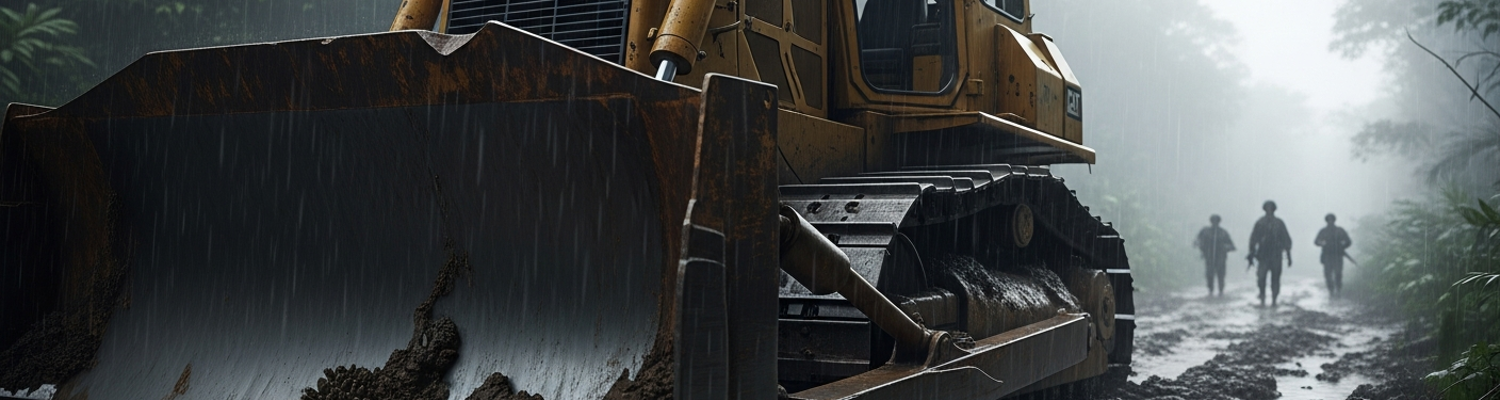

Popular history compresses the Pacific War into a series of violent clashes focused on infantry assaults. The campaign for Biak is often framed this way. A brutal but linear fight for three airfields. This view omits the attritional contest that defined the operation. A close review of logs from the U.S. 41st Infantry Division, the Jungleers, reveals a battle fought as much against the island as the Japanese. The ground was not sand. It was ancient, uplifted coral reef, forming sharp, terraced ridges covered in jungle. This terrain destroyed equipment. The tires of DUKW amphibious trucks, needed to move supplies from ship to shore, were torn apart. Bulldozers of the 116th Engineer Combat Battalion, tasked with carving roads inland from the Bosnek beaches, suffered constant mechanical failures. Their tracks and undercarriages were brutalized by the abrasive coral. Moving a single artillery piece of the 121st Field Artillery Battalion from the beach to a firing position became a multi-day engineering project. Water was another opponent. With few surface streams, soldiers were restricted to one canteen per day in the equatorial heat. A dangerously inadequate supply.
Initial Allied intelligence assessments compounded these physical challenges. General MacArthur’s G-2 section, under Brigadier General Charles A. Willoughby, miscalculated the defenders’ strength. Official estimates placed Japanese troop numbers between 4,400 and 5,625. The actual figure was over 11,000 men under Colonel Kuzume Naoyuki. Intelligence failed to anticipate the sophistication of Kuzume’s defensive plan. Allied planners assumed the Japanese would contest the beaches, leading to a quick engagement. Colonel Kuzume allowed the 41st Division to land unopposed. He lured them into a pre-prepared kill zone dominated by a labyrinth of fortified caves overlooking the Mokmer airfield complex. The most significant intelligence error was dismissing Japan’s ability to reinforce Biak. Allied Naval Forces command did not believe the enemy would risk major fleet units to aid the garrison. This was proven wrong. The Japanese initiated Operation KON, a large-scale attempt to run reinforcements to Biak. The plan involved heavy cruisers, destroyers, and the super-battleship Musashi. While these attempts were disrupted by Allied action, notably B-25s sinking the destroyer Harusame, they forced a diversion of Allied resources. The threat drew heavy cruisers and destroyers under Rear Admiral William Fechteler’s command away from direct support of ground troops. Despite the failure of major naval sorties, Japanese forces landed approximately 1,200 additional troops via barges throughout June. This unexpected resilience prolonged the fight, stretching the 41st Division’s supply lines to their breaking point and turning a battle projected to last days into a two-month campaign.
A close review of Hurricane Task Force logs shows the primary battle on Biak was for a single, primitive coastal track. The advance from Bosnek toward the Mokmer drome complex depended entirely on the ability of U.S. Army engineers to carve a usable road. This task fell to the men of the 116th Engineer Combat Battalion. Their primary tool was the Caterpillar D-series bulldozer. The island’s geology fought them for every foot. The ground was jagged, uplifted coral, a material so abrasive it shattered bulldozer blades and chewed through steel tracks. Progress was agonizingly slow. Engineer teams, supported by infantrymen of the 162nd and 186th Regiments acting as laborers, would spend a day clearing a few hundred yards of trail. Their equipment would then break down. The route was hemmed in by steep, cave-pocketed coral ridges running parallel to the coast, creating a narrow corridor for the American advance. Every vehicle, artillery piece, and crate of supplies traversed this single, vulnerable path.
The cleared ground did not remain secure.
Colonel Kuzume Naoyuki’s defensive strategy was designed to exploit this logistical vulnerability. A key component was the continuous sabotage of the American supply route. Each night, Japanese troops from the 222nd Infantry Regiment emerged from hidden cave positions overlooking the trail. Moving with near-total stealth, these small infiltration parties worked to undo the engineers' progress. They felled trees across the roadway, dug trenches, and planted mines. The objective was to sever the logistical artery and isolate American forward elements. Patrols and work details from the 116th Engineers were frequently ambushed. This incessant, nocturnal activity transformed the American rear area into a contested front.
The cycle of construction and destruction created a non-linear struggle. The battle for the Mokmer airfields could not be won by infantry alone. It was a contest between American engineers and Japanese saboteurs. A road cleared on Tuesday might be impassable by Wednesday morning. This forced combat operations to halt while engineers and infantry cleared it again under the threat of sniper fire from the overlooking cliffs. General Fuller had to commit an enormous number of man-hours not to fighting, but to maintaining the path to the fight. For soldiers of the 162nd Infantry, the intermittent flow of supplies created localized crises, with units running low on water and ammunition. Kuzume’s plan successfully turned the American logistical tail into a weapon against itself, bleeding the 41st Division of resources, time, and momentum.
An examination of Hurricane Task Force logistical records from Biak exposes a campaign defined by unanticipated consumption rates. The battle was won by the capacity to replace materiel at a pace that could withstand both the island’s geology and Colonel Kuzume’s strategy of logistical warfare. Quartermaster reports show a startling expenditure of specialized bridging materials. The advance from the Bosnek beaches was channeled into narrow corridors defined by steep coral escarpments. These routes were bisected by deep, jagged ravines impassable to vehicles. Bailey bridge sets, intended for conventional stream crossings, were pressed into service by the 116th Engineer Combat Battalion to span these gaps. These chokepoints became registered targets for Japanese mortar units in the overlooking caves. A bridge erected one day would be destroyed or damaged overnight, requiring its replacement. This cycle led to a consumption of bridge panels, transoms, and bearers far exceeding initial projections, forcing emergency requisitions from supply depots in Hollandia.
The 116th Engineers’ primary tools, Caterpillar D-series bulldozers and graders, were savaged by the island. The coral aggregate wore down steel bulldozer blades in days and repeatedly fractured the track links and drive sprockets of the vehicles. Maintenance logs (NARA Record Group 407) detail a constant struggle to keep machinery operational. Cannibalization of downed vehicles became standard practice. Mechanics stripped broken bulldozers for parts to keep a dwindling number of units functioning. Colonel Kuzume’s infiltration tactics amplified this mechanical attrition. Each night, Japanese sabotage teams from the 222nd Infantry Regiment would crater the newly cut roads. The result was a disproportionate expenditure of man-hours and an insatiable demand for spare parts, track pins, cutting edges for blades, and welding supplies, that placed a severe strain on the supply chain.
Planners had underestimated the medical burden. Combat casualties were high. They were eventually eclipsed by losses to sickness. An epidemic of scrub typhus, a mite-borne disease, swept through the American ranks, causing over 1,000 casualties. This was compounded by thousands of other cases diagnosed as fevers of undetermined origin, a catch-all for various tropical ailments including dysentery. Initial medical supply projections, based on a short battle, proved inadequate for a prolonged siege where sanitation was difficult. Demand for specific treatments surged. Supplies of sulfa drugs for infections, Atabrine for malaria suppression, and intravenous plasma for treating dehydration ran low. The outbreak, which began on Owi Island before spreading to Biak, degraded the combat effectiveness of frontline infantry regiments. This health crisis forced the medical supply chain into an emergency footing, diverting shipping space to deliver medicines not expected to be needed in such volume.
A review of signal traffic logs from the Hurricane Task Force reveals a persistent, one-way flow of alarm. Radio operators supporting forward elements of the 162nd and 186th Infantry Regiments transmitted a constant stream of reports detailing ground conditions. These were specific and technical. Messages from the 116th Engineer Combat Battalion detailed precisely how the coral substrate was shattering bulldozer blades and shearing track pins on their D-series tractors. They reported the exact coordinates of ravines wider than their available Bailey bridge sets could span. From aid stations, medical personnel transmitted urgent requests for plasma and sulfa drugs, reporting that cases of scrub typhus were outpacing combat wounds. These messages, painting a clear picture of logistical collapse, were received, logged, and condensed. As they moved up the chain of command from battalion to the division headquarters of Major General Horace H. Fuller, and then to Lieutenant General Walter Krueger’s Alamo Force, the raw detail was lost. Specific reports of impassable terrain became “difficult.” Catastrophic equipment failure rates were smoothed into “mechanical issues.”
This disbelief was most pronounced regarding Japanese resistance. General MacArthur's intelligence chief, Brigadier General Charles A. Willoughby, had provided an estimate of 4,400 to 5,625 Japanese troops. The actual figure was over 11,400, dug into a complex defensive system of fortified caves designed by Colonel Kuzume Naoyuki. When company and platoon leaders from the 41st Infantry Division reported immense volumes of coordinated fire from unseen positions in the cliffs, their reports were treated with skepticism. Higher echelons, including General Fuller’s staff, operated under the assumption that the Japanese would conduct a conventional defense. They believed initial reports were the product of exhausted junior officers exaggerating the scope of isolated enemy pockets. The tactical reality was that Colonel Kuzume had intentionally lured the Americans into a pre-sighted kill zone where his 222nd Infantry Regiment could bleed them through attrition. The frantic radio calls from forward observers describing an endless network of interlocking pillboxes were inconsistent with Willoughby’s intelligence summary. For a time, the summary was considered more reliable than the direct observations of the men under fire.
This disconnect created a fatal feedback loop. Information regarding the impassable supply route and continuous Japanese infiltration was consistently downplayed. General Fuller was under immense pressure from Krueger and MacArthur to seize the Biak airfields on a strict timetable to support the upcoming Marianas invasion. A report from the 116th Engineers stating the main road to the Mokmer drome was severed was an unacceptable obstacle. The command response was not to adjust the plan, but to apply more pressure on the combat units to adhere to the original schedule, even if it meant advancing without tank or artillery support. This led to disastrous tactical decisions, such as the initial unsupported infantry pushes into the Ibdi Pocket and toward the West Caves. American units were savaged by an enemy whose existence command had refused to fully acknowledge. The persistent downplaying of these field reports eventually led to General Fuller’s relief, but not before the gap between the perceived situation at headquarters and the lethal conditions on the ground had cost the Hurricane Task Force dearly.
An audit of field messages from the 162nd and 186th Infantry Regiments reveals a battle dictated by deprivation. Forward companies advancing on the Mokmer drome complex operated on the edge of logistical collapse. The restriction to a single canteen of water per man per day in the equatorial heat was insufficient, leading to widespread heat exhaustion that depleted combat strength before contact with the enemy. Ammunition for crew-served weapons, particularly 60mm and 81mm mortars, was severely rationed. This inhibited the infantry’s ability to suppress Japanese defenders concealed in the coral caves. A platoon pinned down by machine-gun fire from an unseen bunker could not call for the sustained mortar barrage needed to cover a flanking maneuver. Squads were forced into costly frontal attacks. Food became a secondary concern to water and ammunition. Troops often went for extended periods with minimal C-rations, a situation made worse as heat turned rations rancid. This supply deficit was a direct consequence of the single, vulnerable coastal road, which Japanese infiltration teams severed almost nightly.
The advance stopped.
The deployment of M4 Sherman tanks of the 603rd Tank Company was compromised by the island’s structure. The same uplifted coral that shredded bulldozer blades also wrecked the tanks’ running gear. Maintenance records show a constant demand for replacement track pins, bogie wheels, and drive sprockets as the abrasive ground chewed through steel. The terrain denied tactical flexibility. The tanks were confined to the single, engineer-cleared coastal track, unable to maneuver off-road to flank Japanese strongpoints. This turned them into predictable targets for concealed 37mm and 47mm anti-tank guns. A 37mm shell could lock a Sherman’s turret, rendering its main gun useless. The inability to deploy tanks in coordinated attacks meant that infantry assaults on key positions, such as the West Caves and the Parai Defile, were often unsupported by armor. An entire regimental advance would halt for days while engineers labored to clear a few hundred yards of trail, only for a single tank to throw a track and block the path for all subsequent vehicles.
A review of medical after-action reports shows that on Biak, the distance from the front line to a surgical table was measured in hours, not miles. Medical evacuation became a desperate, manpower-intensive struggle. The jagged, ravine-cut terrain made routes impassable for standard wheeled vehicles like jeeps. A wounded soldier, once stabilized by a company aid man, had to be hand-carried by a team of four to six stretcher-bearers. This journey, often under fire from Japanese positions in the overlooking ridges, could take over six hours to cover a single mile. These delays were fatal. Wounds that would have been survivable with prompt surgical intervention became lethal due to shock and blood loss. The evacuation chain itself became a target. Stretcher parties were frequently ambushed. The 92nd Evacuation Hospital, set up near Bosnek, was well-equipped, but the primary obstacle was getting casualties there. This difficulty was compounded by the scrub typhus epidemic that caused over 1,000 non-combat casualties, further straining medical resources. For the soldiers of the 41st Division, the sight of a wounded comrade beginning a long journey to the rear was a constant reminder of their isolation.
The cost of Biak was calculated in man-hours squandered and bodies broken by non-combat causes. The battle inflicted a deep drain on logistical manpower that planners failed to anticipate. For every infantryman on the firing line, multiple soldiers were locked in a contest with the island itself. Men from the 116th Engineer Combat Battalion worked in punishing equatorial heat, their efforts to carve a supply road from the coral rock resulting in widespread heat exhaustion and dehydration. The water discipline of one canteen per man per day degraded physical performance across the entire force. Infantrymen from the 162nd and 186th Regiments were regularly pulled from combat rotations not for rest, but to serve as manual laborers, hauling crates of ammunition by hand over impassable terrain. This diversion of combat strength to logistical labor was a constant drag on offensive momentum. The greatest personnel loss came from disease. An epidemic of scrub typhus, along with waves of dysentery and fevers of unknown origin, swept through the American ranks, incapacitating thousands and overwhelming the medical evacuation chain.
The island consumed machines as readily as it consumed men. An examination of after-action reports from the 116th Engineers details a rate of equipment failure that crippled the American advance. The ground, composed of uplifted, abrasive coral, acted like a grinding wheel on all metal equipment. The steel cutting edges of Caterpillar D-series bulldozer blades were worn down to uselessness in days. The constant stress of moving over the jagged rock led to a high incidence of fractured track links and shattered drive sprockets on both bulldozers and the M4 Sherman tanks of the 603rd Tank Company. Maintenance crews worked around the clock, cannibalizing destroyed vehicles for spare parts to keep a fraction of their heavy equipment operational. Tires on DUKW amphibious trucks and GMC supply trucks were shredded by the sharp coral lining the beaches and the primitive road, leading to a bottleneck in ship-to-shore supply operations. This mechanical attrition was amplified by Colonel Kuzume’s strategy. Each night, Japanese infiltration teams from the 222nd Infantry Regiment would mine the road, fell trees across it, and dig new tank traps, ensuring the engineers’ work was never finished. This brutal cycle epitomized the desperate nature of quartermaster operations on Biak. Supply projections formulated at General Headquarters in Hollandia, based on a swift battle, proved disconnected from the situation. The quartermaster was not executing a pre-planned supply schedule, but reacting to a cascade of emergencies. The unanticipated need to repeatedly bridge the same ravines after Japanese mortar fire destroyed the crossings led to a depletion of Bailey bridge components, forcing emergency air-drops. The scrub typhus outbreak created a sudden demand for Atabrine, sulfa drugs, and intravenous fluids that displaced shipments of ammunition. For the quartermaster units, the campaign became a chaotic triage, constantly shifting shipping priority to stave off the next collapse, whether it was a lack of mortar rounds for the infantry, plasma for the aid stations, or track links for the bulldozers.