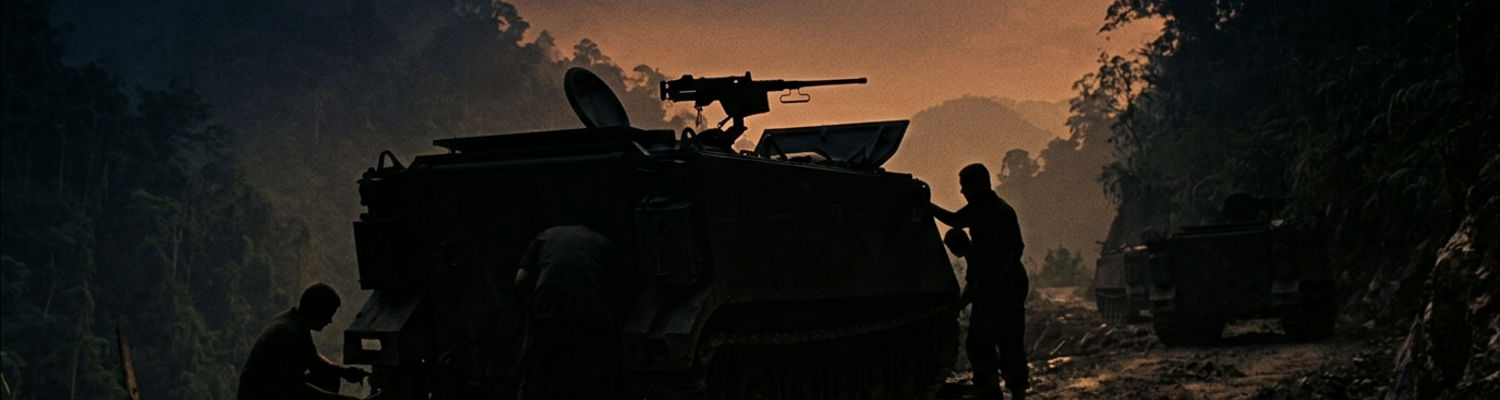

Task Force Sabre Operations in Que Son
Red laterite clay turned into a deep adhesive sludge under relentless monsoon downpours. This trapped anything heavier than a foot soldier. Temperatures routinely spiked above 100 degrees Fahrenheit during brief dry spells. The heat baked the mud into jagged ruts. Dense triple canopy jungle blocked circulating air. This created a suffocating greenhouse environment at ground level. Freezing rain fell upon the valleys at night. Core temperatures dropped. Exposed equipment rotted.
Archival records (NARA Record Group 338) show this terrain physically dismantled mechanized units before they ever made contact with enemy forces.
In May 1968, the 1st Squadron, 1st Cavalry of the Americal Division deployed into the southern sector of I Corps. Operational logs indicate the squadron operated under the designation Task Force Sabre. They received orders to push out from the coastal enclaves near Chu Lai. The command element sought to disrupt North Vietnamese Army supply lines operating south of Da Nang. The squadron consisted of three armored cavalry troops relying heavily on tracked mobility. Pushing into I Corps required moving along unpaved secondary roads. These routes frequently washed out or collapsed under the weight of armored columns. Combat engineers worked continuously to reinforce wooden bridges spanning swollen rivers using pierced steel planking. The 1st Squadron advanced at a grinding pace of less than ten miles per day. Command detonated mines posed a constant threat.
The unit pushed directly toward the Que Son Mountains.
Commanders ordered Task Force Sabre to bring M48A3 tanks and M113 Armored Cavalry Assault Vehicles into these steep elevations. Their objective involved neutralizing entrenched NVA mortar positions. The North Vietnamese 2nd Division had established camouflaged firebases equipped with 82mm and 120mm mortars high on the ridgelines. These weapons fired high explosive shells onto American infantry patrols operating in the Que Son Valley below. Standard doctrine dictated using artillery or airstrikes to silence these tubes. Dense cloud cover and deeply dug bunkers forced a different approach. Americal Division leadership opted to drive direct fire armor straight up the mountain passes. The M48A3 Patton tank weighed 47 tons. It relied on an AVDS-1790 V12 diesel engine. Pushing this heavy vehicle up gradients exceeding thirty degrees put severe stress on the Allison CD-850 cross drive transmissions.
Track pins snapped under the extreme torque.
Mechanical attrition rates rapidly outpaced combat losses. The lighter thirteen ton M113 ACAVs struggled alongside the Pattons. Their flat aluminum hulls scraped against exposed granite boulders. This tore off suspension road wheels and damaged torsion bars. Drivers constantly downshifted to maintain traction in the slick laterite mud. Engine compartments overheated. The Chrysler 75M V8 engines inside the M113s frequently vapor locked or blew head gaskets. ACAV crews found the steep incline of the mountain trails severely restricted the upward elevation of their pintle mounted .50 caliber machine guns. Mechanics trailed the combat elements in M88 recovery vehicles. They attempted to winch immobilized tanks out of deep ravines using heavy steel cables.
NVA mortar crews watched this slow ascent from elevated vantage points.
They adjusted their base plates and calculated new firing coordinates based on loud diesel engine noise echoing up the valleys. The lead M48A3 tank of Alpha Troop threw its right track while attempting to crest a narrow switchback at Hill 435.
Mountain Gradients and M113 Engine Overheating
Maintenance logs from the 1st Squadron reveal the immediate mechanical crisis unfolding behind the stalled lead tank at Hill 435. Steep trails forced armor engines to run at high temperatures under heavy loads. The M113 Armored Cavalry Assault Vehicles operating in Task Force Sabre carried standard combat weights of thirteen tons. Field modifications pushed this figure past fifteen tons before the vehicles crossed the line of departure. Crews bolted heavy steel plates to the hull bellies for mine protection. They stacked hundreds of sandbags on the roof hatches. Thousands of rounds of extra .50 caliber and 7.62mm ammunition sat loaded inside the troop compartments. Pushing this excess mass up thirty degree gradients required drivers to lock their Allison TX-200-2X automatic transmissions into first gear. They pinned the throttles wide open.
The 209 horsepower Chrysler 75M V8 gasoline engines operated at maximum revolutions per minute for hours on end without mechanical relief.
Forward momentum dropped to less than two miles per hour. The tracks churned through wet laterite clay. Drive sprockets ground against the track blocks. Powerplants had to overcome both the severe angle of ascent and the deep adhesive suction of the mud.
The entire armored column stopped completely along a narrow ridgeline at grid coordinates AT 845 291.
Extreme ambient heat and steep inclines led to severe engine overheating issues across the entire formation. Mid afternoon temperatures in the Que Son Mountains reached 108 degrees Fahrenheit. Dense triple canopy jungle flanking the trails blocked all ambient wind. This trapped the engine exhaust and heat radiating from the aluminum hulls. The M113 cooling system relied on a belt driven fan. This component drew air through a top mounted intake grille, over the radiator, and out the sides of the engine compartment. Slow crawling speeds meant no ram air assisted this primary cooling process. Engine block temperatures rapidly exceeded the operational redline of 240 degrees. The severe upward tilt of the ACAVs caused engine oil to pool in the rear of the oil pans. Fluid displacement starved the front cylinders of lubrication. This dramatically increased internal friction and generated even more heat within the engine blocks. Belt tensioners slipped under the thermal expansion. Cooling fans slowed down just as the engines required maximum airflow.
Radiator caps violently detonated under the pressure.
Boiling coolant sprayed across the exterior armor. Mechanical failures compounded rapidly as the vehicles sat idling on the steep inclines. Extreme temperatures inside the engine compartments caused the 80 octane gasoline inside the uninsulated fuel lines to boil. This physical reaction created vapor lock. Carburetors starved. Engines stalled out completely. Drivers lost power steering and braking assistance the moment the engines died. Heavy ACAVs relied entirely on their mechanical parking brakes to prevent them from rolling backward down the mountain passes. Mechanics from the squadron maintenance detachments rushed forward on foot carrying five gallon jerry cans. They attempted to replace lost coolant under direct observation from NVA spotters. The sudden introduction of unheated water into the superheated cast iron engine blocks caused immediate thermal shock. Cylinder heads warped and cracked loudly. Head gaskets ruptured under the pressure differentials. Remaining engine oil mixed with coolant into a thick white sludge. This seized the pistons in their cylinders. Commanders ordered the heavier M88 recovery vehicles to tow the disabled ACAVs. Their Continental AVSI-1790-6A engines also overheated under the towing strain. The column became a static line of immobilized metal. They lacked the capability to advance or retreat. Platoon leaders ordered their crews to empty their personal canteens into the radiators. This failed to keep the remaining operational engines running.
Bravo Troop reported sixteen catastrophic engine failures within a span of forty five minutes.
Mechanical Bypasses of Dual Stage Air Filters
Maintenance detachments of Task Force Sabre resorted to unauthorized field modifications to counter the catastrophic overheating. Command elements heavily pressured their motor pool warrant officers to get the stalled armored column moving up the Que Son passes. They needed to advance before NVA artillery could register their static positions. Mechanics wielding heavy wrenches and pry bars climbed onto the engine decks of the M113 Armored Cavalry Assault Vehicles. These vehicles utilized a heavy duty Donaldson dual stage air filtration assembly. This unit sat bolted directly onto the upper aluminum hull. The specific assembly consisted of a primary cyclonic pre cleaner engineered to spin heavy dirt particles out of the intake stream. A dense replaceable dry paper element followed this stage. This paper trapped microscopic contaminants. Pulling ambient air through these thick physical barriers severely restricted the overall cubic feet per minute of oxygen reaching the internal combustion chambers.
Motor pool sergeants ordered their crews to unbolt the protective metal housings.
They completely bypassed the filtration units to lower operating temperatures. Stripping away the paper elements and disconnecting the heavy rubber intake hoses from the cyclonic separators created a direct unrestricted path for outside air. Removing this mechanical restriction immediately increased the volume of oxygen rushing into the Holley carburetors. These components fed the Chrysler 75M V8 engines.
Engine block temperatures dropped by roughly fifteen degrees across the armored formation.
This slight thermal relief allowed the drivers to restart their stalled vehicles. They resumed the grinding ascent toward the entrenched NVA mortar positions. Advancing up the steep gradients of Hill 435 required the thirteen ton ACAVs to spin their tracks constantly against the underlying bedrock. This maintained traction. The continuous friction of forged steel track shoes and tungsten carbide track pins slipping across exposed dry granite outcroppings pulverized the stone through sheer mechanical force. Heavy metal treads crushed the rocky top layer of the mountain trails under the weight of the armored chassis.
Track blocks ground the hard granite into an ultra fine suspended geological powder.
Bypassing the filters allowed this micro abrasive quartz silt to enter the engine compartments directly. The unrestricted carburetors drew in the suspended granite dust directly through the open intake manifolds. Quartz possesses a high rating on the Mohs hardness scale. This makes it physically harder than the cast iron engine blocks and forged steel internal components. Millions of microscopic jagged stone particles flooded into the combustion chambers of the Chrysler V8 engines on every single downward intake stroke. The raw silt violently wedged between the rapidly moving pistons and the stationary cylinder walls. Deep vertical gouges immediately scratched into the precisely machined metal surfaces. Piston rings designed to maintain explosive compression snapped. They wore down to useless jagged slivers within minutes of exposure to the abrasive rock dust.
Blowby gases escaped past the destroyed rings and rapidly pressurized the engine crankcases.
Mechanical degradation accelerated as the quartz silt slipped past the destroyed piston rings. It mixed directly with the internal engine oil reservoir. The standard OE-30 military grade lubricant rapidly transformed into a highly destructive lapping compound. High volume oil pumps circulated this contaminated slurry under extreme pressure through the narrow oil galleries of the engine blocks. The abrasive mixture tore through the soft babbitt metal of the main bearing shells. It ground down the hardened steel camshaft lobes regulating the engine valve timing. Oil pumps seized permanently as the crushed granite packed tightly into their internal gear teeth. Deprived of both lubrication and internal compression, the heavy engines tore themselves apart from the inside out at 3500 revolutions per minute. Forged steel connecting rods snapped under the intense friction. They punched jagged holes straight through the sides of the aluminum oil pans. Troopers from Alpha Troop abandoned nine completely destroyed M113s along a narrow 500 yard stretch of the mountain pass at grid coordinate AT 847 293.
Maintenance crews recorded zero salvageable engine blocks during the subsequent recovery operations at Hill 435.
Quartz Silt Ingress and Final Drive Seizures
A secondary and entirely distinct mechanical breakdown occurred simultaneously at the track level. The continuous spinning of forged steel track shoes against the dry granite outcroppings of Hill 435 generated a dense low hanging cloud of pulverized rock. This micro abrasive geological powder settled heavily around the lower front hulls of the advancing M113 Armored Cavalry Assault Vehicles. The final drive units responsible for transferring engine power to the track sprockets sat bolted directly to these lower aluminum hull plates. Inside each heavy cast iron housing, a complex planetary gear reduction system converted the high rotational speed of the Allison TX-200-2X transmissions into raw low speed torque. This torque pushed fifteen tons of armor up thirty degree inclines. The output shafts extending from these final drives relied on heavy neoprene double lip seals. These seals retained the internal SAE 50 gear oil and blocked external contaminants. The extreme angle of the mountain ascent shifted the vehicles center of gravity. This placed severe lateral stress on the drive sprockets and slightly deflected the output shafts out of their true center.
This microscopic deflection broke the seal integrity.
Suspended quartz powder packed tightly against the neoprene lips. The dry abrasive silt rapidly eroded the synthetic rubber seals down to their metal retaining rings. Once the physical barrier failed, the pulverized granite poured directly into the final drive housings. It mixed with the internal lubricant. This combination created a highly destructive lapping paste. The paste circulated aggressively through the planetary gear sets. Quartz ranks higher on the Mohs scale than the hardened steel used in the M113 drive components. The abrasive slurry ground down the precisely machined teeth of the central sun gears. It stripped the hardened surfacing off the surrounding planetary pinion gears. Internal clearances between the meshing gear teeth widened drastically within a matter of minutes. Drivers pinned their throttles to overcome the steep gradients. The compromised gear teeth could no longer handle the massive torque loads transferring from the engine. Metal teeth sheared off completely. Jagged steel shrapnel dropped directly into the path of the rotating planetary carriers.
Internal gear sets violently tore themselves apart under the rotational force.
Mechanical destruction culminated on a narrow exposed mountain shelf at grid coordinate AT 848 294. The command element of Alpha Troop had ordered the lead platoon to maintain a tight five meter interval between vehicles. This prevented North Vietnamese infantry from splitting the column. Operating within the exact same concentrated dust cloud under the exact same torque requirements, the final drives of the lead elements reached their physical breaking point in unison. Sheared gear teeth wedged firmly between the planetary carriers and the static outer ring gears inside the final drive housings. Internal components friction welded together. Output shafts locked solid instantly.
Six lead ACAVs suffered catastrophic final drive seizures at the exact same moment.
The sudden mechanical lockup violently halted the thirteen ton vehicles in their tracks. Drive sprockets stopped rotating instantly. Heavy steel tracks snapped tight and dug deep into the granite shelf. Drivers slammed into their steering laterals. Forward momentum dropped to zero in a fraction of a second. The narrow mountain pass measured less than twelve feet across. A sheer vertical rock face flanked the left side. A four hundred foot drop into a jungle ravine flanked the right. Six immobilized vehicles completely blocked the only viable route up Hill 435. M88 recovery vehicles positioned further down the column lacked the physical width to bypass the stalled ACAVs. Platoon mechanics climbing out to inspect the damage found the cast iron final drive housings glowing dull red from internal friction. Surface temperatures exceeded 400 degrees Fahrenheit.
Loss of the Tactical Radio Relay Track
Operational logs from Alpha Troop reveal the specific identity of the six vehicles seized at grid coordinate AT 848 294. Wedged directly in the center of the disabled column sat vehicle Alpha-Zero-Niner. This heavily modified M113 served as Task Force Sabre primary tactical radio relay track. Valley floor units relied entirely on this specific chassis. They bounced their frequency modulated signals over the Que Son peaks to maintain contact with the rear echelon at Chu Lai. Squadron commanders had deliberately positioned this communications node near the front of the armor formation. Pushing the vehicle to the highest possible elevation ensured its 29 foot AS-1729 whip antennas could establish clear line of sight transmission. Inside the cramped troop compartment, signal corps technicians operated a stacked array of AN/VRC-46 VHF radios alongside a high frequency AN/GRC-106 transceiver. Powering these heavy communication systems required a specialized high output 100 amp alternator. This unit ran continuously off the main Chrysler 75M engine belt. Pulverized quartz dust destroyed the final drive gears and locked the output shafts. The sudden violent stop threw the unsecured radio operators against the forward steel bulkheads. The engine stalled immediately under the sheer mechanical bind of the locked drives.
Deprived of alternator power, the heavy radio arrays drained the standard 24 volt lead acid vehicle batteries in less than twelve minutes.
The exact geographical layout of this specific mountain shelf blocked all physical movement. It prevented rapid vehicle extraction. Measuring exactly eleven feet across at its widest point, the trail at this elevation consisted of a weathered granite ledge. A sheer vertical rock wall rose eighty feet on the left side of the track path. This offered zero clearance for bypassing. To the right, the terrain dropped away into a 400 foot vertical gorge. Dense bamboo thickets and sharp limestone outcroppings filled the ravine. Standard M113 hulls possess a width of 105.75 inches. This physical footprint left less than thirteen inches of lateral clearance between the grinding steel tracks and the unstable edge of the precipice. Six disabled vehicles sat locked end to end in a static metal line. They spanned sixty yards of the narrow pass. Metal track blocks from the radio relay vehicle rested just three inches from a crumbling section of the cliff edge.
No mechanized asset could physically maneuver around the blockage.
Command elements ordered the squadron M88 Recovery Vehicles to advance from the rear guard and clear the bottleneck. Weighing 56 tons, these armored tow tractors measured 135 inches across their exterior track skirts. Physical dimensions of the M88 exceeded the total width of the granite shelf by nearly three inches. Drivers attempting to inch the heavy recovery vehicles up the pass found their right side track blocks hanging completely suspended in the air over the ravine. They lacked the space to bring the recovery vehicles alongside the disabled ACAVs. Mechanics hauled heavy steel snatch blocks up the incline on foot. Crews unspooled 1.25 inch thick steel winch cables from the M88s. They attempted to drag the seized radio relay track backward down the thirty degree slope. Friction welded final drives inside the stalled M113 refused to rotate. Locked steel tracks acted as heavy structural anchors dug deep into the granite topsoil. Dragging the fifteen ton vehicle against its own seized drivetrain caused the heavy recovery cables to stretch rapidly past their safe working load limit.
The primary winch wire snapped at 18000 pounds of tension.
It whipped backward into the M88 armored glacis plate.
Strategic Command Blackout Across Southern I Corps
The snapping of the M88 recovery cable triggered an immediate collapse of the local frequency modulated network. The 29 foot whip antennas mounted on the roof of vehicle Alpha-Zero-Niner stopped transmitting at exactly 1430 hours. The Que Son mountain range consists of solid granite peaks reaching 3000 feet in elevation. These dense geological formations physically block VHF radio waves from traveling line of sight to the coastal plains. The AN/VRC-46 radio systems inside the stalled M113 required an uninterrupted path to reach the tactical operations center at Chu Lai. This facility sat twenty eight miles to the east. Without the 100 amp alternator spinning on the seized Chrysler engine, the signal corps technicians watched their internal voltage meters drop rapidly. Four standard 6TN lead acid vehicle batteries attempted to power the heavy transmission equipment. The dials fell below the 20 volt minimum threshold required to power the transmitters in just twelve minutes.
The loss of the radio relay track created an eight hour command blackout.
An immediate tactical halt stopped Task Force Sabre. Platoon leaders attempting to call in fire missions against the entrenched North Vietnamese mortar positions received only static on their PRC-77 manpack radios. Americal Division headquarters in Chu Lai completely lost telemetry and status updates from the armored column. Major General Samuel Koster ordered his signal officers to re establish contact on secondary high frequency channels. Operators at the division command post spent two hours continuously broadcasting callsigns on 49.70 megahertz without receiving acknowledgment. The blackout extended far beyond the stalled Armored Cavalry Assault Vehicles on Hill 435. Alpha-Zero-Niner possessed the only AN/GRC-106 transceiver elevated high enough to clear the surrounding ridgelines. It provided the primary retransmission node for multiple subordinate commands operating inland.
Communications were disabled across southern I Corps until alternate relays could be established.
This single mechanical failure severed the command link for the 196th Light Infantry Brigade operating deep in the Hiep Duc Valley. These dismounted patrols relied directly on the armor column elevated position to retransmit their requests for medical evacuation and artillery support back to the coast. Forward observers attached to the infantry companies recorded zero response from the 11th Marine Regiment artillery batteries stationed at An Hoa. Total radio silence forced ground commanders to halt all offensive operations at grid coordinates AT 821 274. Officers ordered their men to dig defensive perimeters into the wet laterite valley floor. North Vietnamese spotters recognized the sudden cessation of American artillery fire. Enemy mortar crews began adjusting their 82mm high explosive rounds directly toward the static American positions without fear of counter battery fire.
Signal officers at Chu Lai scrambled to find a technological bypass.
Division command diverted four OH-6A Cayuse observation helicopters from the 1st Squadron aviation troop. They provided emergency airborne retransmission platforms. Mechanics at the Ky Ha heliport hurriedly strapped PRC-77 radios into the rear passenger compartments of the light helicopters. Technicians wired the flexible antennas directly to the exterior aluminum skids to maximize signal radiation. Pilots flew in tight circular holding patterns at 4000 feet over the Que Son Valley. They manually relayed coordinate data between the trapped infantry units and the coastal artillery bases. These aircraft carried a maximum fuel capacity of 61 gallons feeding their Allison T63-A-5A turboshaft engines. High fuel consumption restricted their operational loiter time to less than two hours before requiring a return trip to base. Aviation crews rotated constantly through the airspace to maintain an uninterrupted radio link. Heavy lift CH-47 Chinook helicopters transported a replacement communications element to a separate granite outcropping at Hill 510. Flight crews lowered a new M113 command variant onto the designated landing zone using external steel sling loads at exactly 2230 hours.