
Trident Conference Mandates and Grosvenor Square
Candle wax dripped across the wet graphite calculations in the basement of 20 Grosvenor Square while dispatch couriers stamped spilled diesel fuel from their boots onto the bare floor. The subterranean plotting room held the choking reek of damp service wool, spilled fuel oil, caustic ammonia blueprint paper, and the bitter crust of burnt black market coffee brewed on an overloaded hot plate. Logistical planners sat hunched over dockyard schematics, calculating British slipway berths and drydock tonnage by flickering candlelight because the May blackout regulations kept the steel window shutters bolted tight against the London night. Every priority teletype arriving from the courier pouches canceled another promised repair ship, floating crane, or machine shop tender, systematically erasing the operational assumptions that kept the cross Channel assault plan afloat. Weary Navy Department officers scraped grease pencils across revised tide tables and dockyard charts, watching months of assembly schedules unravel on paper as dockyard capacities dropped to zero.
Stark read new directives from Washington that multiplied these dockyard deficits overnight. Ahead of strategic directives hammered out during the Trident Conference in Washington, the formal activation of Allied Naval Command took effect on May 5, 1943. These sudden directives ordered Stark and his staff to prepare British ports for the reception, berthing, and continuous maintenance of thousands of ocean going landing ships and shallow draft assault craft. British harbors across southern England already groaned under the burden of Royal Navy warships and transatlantic cargo convoys, leaving almost no tidal basins, heavy cranes, or skilled yard workers to spare for an incoming armada of flat bottomed steel craft. Stark instructed his engineering officers to survey every commercial pier, hard bottomed slipway, and muddy river estuary from Plymouth to the Solent to find space for the projected fleet. Planners worked through the night drafting emergency berthing charts for Landing Ships Tank and Landing Craft Infantry, even as British dockyard masters warned that southern ports lacked the electrical lines, freshwater pumps, and repair berths required to keep thousands of temperamental diesel engines running.
Diesel mechanics, spare parts, and specialized repair ships required to maintain those engines vanished south toward the Mediterranean under urgent instructions from the Joint Chiefs of Staff. Strategic tension erupted across the staff at 20 Grosvenor Square as planners discovered that Washington was simultaneously stripping the European theater of amphibious vessels, skilled boat crews, and base maintenance units to supply Operation Husky, the invasion of Sicily. Navy Department directives in Washington diverted entire production runs of Landing Ships Tank, along with vital floating drydocks and repair personnel, directly to North African ports instead of the British Isles. This Mediterranean priority left Stark with vast operational mandates to prepare for an invasion of France, but almost no physical hulls, replacement parts, or qualified naval artisans to build the required infrastructure. Stark watched his maintenance margins drop to nothing as harbor masters from Bristol to Portsmouth reported empty quays where United States naval repair units were supposed to assemble. Planners shelved their master maintenance schedules and began hand drafting emergency requisitions for whatever commercial tugboats, hand tools, and scrap plating civilian yards could spare to prevent the surviving craft from deteriorating at their moorings.
Mediterranean Theater Diversions and Fleet Depletion
Shipwrights across southern England could not honor those emergency requisitions because commercial repair berths were already packed with damaged transatlantic cargo ships and Royal Navy destroyers. Navy Department planners in London had counted on American Auxiliary Repair Ships and sectional mobile drydocks steaming across the Atlantic to establish self sufficient maintenance bases along the English coast. Admiral Stark watched those vital support vessels turn south into the Mediterranean instead, following priority directives from the Joint Chiefs of Staff that diverted mobile machine shops and floating drydock pontoons to North African staging ports for the invasion of Sicily. Torpedo damaged merchant hulls and desert bound invasion craft in Algiers and Oran took precedence over every English anchorage, depriving southern England of the specialized equipment needed to overhaul salt crusted diesel engines. Master machinists, certified hull welders, and diesel engine mechanics boarding transports in New York received sudden route changes that sent their tool kits and technical manuals straight to Mediterranean bases rather than the repair shops planned for Devon and Cornwall.
Landing Ships Tank and Landing Craft Tank swung silently on their moorings across United Kingdom anchorages because these Mediterranean diversions left almost no specialized maintenance echelons behind. Saltwater corroded thin steel hull plating and silt clogged raw water intake lines as dozens of flat bottomed craft sat tied up along the muddy banks of the River Dart and Southampton Water. Routine engine overhaul deadlines passed without action while the few surviving Navy maintenance ratings scavenged gaskets, fuel injectors, and generator brushes from grounded hulls just to keep training flotillas moving. Boat crews lacked the heavy crane barges, mobile machine tools, and specialized welding equipment required to straighten twisted propeller shafts or patch buckled bow doors following rough channel exercises. Landing Craft Tank units based around Plymouth and Portsmouth accumulated hairline stress fractures across their welded ribs and suffered constant reverse gear failures that left entire squadrons stranded at their buoys.
COMNAVEU logistical planning cells in the Grosvenor Square basement tracked these stranded squadrons on grease pencil wall charts and struggled to calculate fleet maintenance capacities under severe equipment and manpower deficits. Planners calculated engine running hours and hull inspection cycles by candlelight, discovering that existing naval personnel in Britain could service less than one fifth of the amphibious hulls scheduled to arrive by autumn. Engineering officers slashed projected dockyard repair allowances to bare survival levels, erasing preventative overhauls from the planning books and writing off damaged craft that could not be repaired with simple hand wrenches. Staff officers repeatedly redrew their dockyard throughput tables, trying to balance hundreds of unserviced diesel engines against tiny maintenance units that lacked spare piston rings, replacement injectors, and battery charging generators. Stark dispatched urgent memoranda to naval authorities in Washington, warning that stripping the British Isles of repair assets disabled the amphibious fleet at its moorings.
Washington rejected these appeals and ordered London staff to solve their maintenance crises by using improvised British tidal mudflats instead of dedicated American repair ships. Navy engineers traveled to the muddy riverbanks of the Solent, the River Tamar, and Falmouth harbor to construct primitive concrete grounding hards and wooden gridirons where landing craft could sit high and dry at low tide. Shipfitters and apprentice mechanics waded knee deep through freezing English tidal mud with oxyacetylene torches, cutting away fouled rudders and welding cracked skegs during the brief hours between tides. Work crews bolted wooden timbers together in the mud to brace flat bottomed hulls against tipping over as the seawater receded, risking their lives under tilted steel plates to hammer out bent propeller blades by hand. Planners marked these muddy grounding hards as primary repair stations on their master base charts, staking the seaworthiness of the future invasion fleet on manual labor performed in open salt marshes.
Task Force 92 Hydrographic and Port Surveys
Task Force 92 logistics officers carried those salt marsh charts straight into the field alongside Navy Civil Engineer Corps planners to begin exhaustive port, slipway, and anchorage surveys throughout May 1943. Survey parties drove requisitioned utility trucks down narrow English country lanes, carrying lead lines, surveyor levels, and hydrographic charts to measure the true physical limits of every harbor. Civilian dock masters looked on while American engineers hammered wooden sounding stakes into the mud, recording river depths, pier load tolerances, and the structural decay of century old stone quays. Engineers quickly discovered that existing British harbor books listed maximum water depths that applied only to deep midstream channels rather than the shallow riverbanks where landing craft would actually tie up. Draft calculations revealed that standard Landing Ships Tank would scour their keels on jagged rocks and ballast stone if crews attempted to dock them against commercial bulkheads without extensive structural modifications.
Navy Civil Engineer Corps teams expanded their reconnaissance across coastal estuaries in Devon, Cornwall, and Northern Ireland to locate alternative assembly points away from those ruined stone bulkheads. Officers inspected the twisting channels of the River Dart, the Tamar estuary, and the sheltered reaches of Falmouth and Fowey, noting where tidal currents ripped around narrow bends at four knots. Planners then crossed the Irish Sea to test deep water assembly bays in Northern Ireland, charting mooring fields inside Belfast Lough and the River Foyle near Londonderry to see if remote northern ports could handle reserve assault craft. Surveyors found that while Northern Ireland offered deep water and secure anchorages, the long distance to the southern staging zones would burn too much marine diesel and exhaust green boat crews during transit. Logistics officers therefore had to pull their operational focus back to the crowded south coast, where every usable stretch of sheltered water was already under intense competition.
Berths across every major estuary between Plymouth and the Solent were already packed tight when the survey teams arrived. British harbor masters had assigned nearly all deepwater piers to transatlantic cargo freighters, coastal coal colliers, and Royal Navy anti submarine escorts that civilian dockers worked around the clock to unload. Commercial steamers were double banked along concrete quays, leaving no empty space for American supply tenders or fuel barges to tie up alongside. Port authorities refused to displace coal and grain shipments to accommodate incoming flat bottomed landing craft, forcing Task Force 92 officers to mark secondary riverbanks and exposed gravel spits as temporary staging berths. Officers drove steel mooring pins into river banks and calculated how many craft could pack into narrow creek beds before swinging hulls fouled passing ship traffic.
Tides reaching severe twenty foot ranges slammed into these narrow creek moorings twice a day, wrecking turnaround times for incoming landing craft. Ebbing water repeatedly drained the estuaries down to bare mud, leaving flat bottomed hulls stranded high above low water marks and cutting them off from fuel lines, freshwater hoses, and loading ramps. Landing craft engines could not draw cooling water while sitting dry in the silt, which paralyzed generator plants and halted battery charging for six hours out of every twelve. Task Force 92 planners realized that returning assault craft could not refuel, repair, or reload on any dependable timetable unless engineering units installed floating pontoon piers and offshore fuel buoys. Civil Engineer Corps officers pulled out their drafting boards and began sketching emergency offshore mooring networks, racing to turn volatile tidal mud into functional amphibious bases before thousands of American hulls arrived from overseas.
Decaying British Slipways and Estuary Constraints
Engineers pushed their survey teams past the drafting tables and into the field, only to find that the commercial slipways and ancient masonry quays of southwestern English harbors were falling apart. Decades of peacetime neglect and wartime bomb blast shockwaves had fractured the granite seawalls and rotted out the heavy wooden retaining piles from Falmouth and Fowey up to the shallow river mouths of the Dart and Tamar. Shallow bars of mud and gravel blocked the entrances to these tidal estuaries, preventing standard support vessels from entering except during brief windows of deep water at the crest of the flood tide. Port survey teams stepped through knee deep muck to inspect century old stone wharves built for small wooden sailing ketches and coal sloops, finding that the masonry mortar had washed away into the surf. Heavy American supply trucks and tracked repair equipment could not drive onto these hollow, crumbling quays without cracking the stone decks and tumbling directly into the harbor silt.
Landing Craft Mechanized suffered the worst damage when maintenance units attempted to haul them out of that thick estuary silt for bottom servicing. Macro tidal swings reaching twenty to twenty five feet across the Devon and Cornwall coasts made standard beaching operations almost impossible, because the receding water dropped too fast for crews to secure the fifty foot steel hulls on flat ground. Mechanics placed craft onto wooden tidal gridirons to inspect twin screws and patch thin steel plate, but sudden tidal surges and four knot currents slammed the hulls sideways across the timber beams, twisting rudder stocks and crushing bilge keels. Work crews had less than three hours of dry footing between tides to scramble underneath the stranded craft, scrape off thick marine fouling, and weld cracked engine intake fittings before the incoming sea drowned their work areas. Ebbing waters repeatedly caught these landing craft at uneven angles on sloping mudbanks, cracking structural frames and warping watertight ramp seals until entire flotillas of mechanized craft fell out of operational service.
Shipfitters desperately needed heavy construction supplies to rebuild those broken tidal gridirons and shore up the collapsing quay walls. Specialized structural timber, especially heavy twelve by twelve inch oak and Douglas fir balks needed to build stable grounding platforms, had disappeared from commercial lumber yards because British authorities reserved all seasoned wood for merchant convoy repairs. Sheet steel required for driving seawall pilings and revetting soft riverbanks was equally impossible to secure, since civilian supply boards routed every ton of rolled metal straight to tank assembly plants and aircraft factories in the Midlands. Crane machinery posed an even more severe bottleneck, leaving American maintenance detachments without the heavy lifting rigs needed to pull diesel engines, hoist bent loading ramps, or drive foundation piles into rocky river beds. Harbor masters refused to release their few fixed dockyard cranes for amphibious craft repairs because those aging steam derricks were booked day and night to unload priority food and ammunition ships.
Civil Engineer Corps officers responded to this equipment shortage by abandoning their standard dockyard construction manuals and improvising primitive repairs with whatever salvage materials they could scavenge along the coast. Construction crews hauled fieldstone from demolished buildings to pack underneath sunken quay walls, and they spiked together scrap railroad ties to form rough cribbing for grounded landing craft hulls. Mechanics mounted salvaged hand crank winches on wooden A frames to drag wounded craft up gravel beaches, using manual block and tackle gear instead of hydraulic shop machinery to swap out damaged propulsion shafts. Planners in London reduced their maintenance targets by half, recalculating the operational readiness of the assault force down to the bare number of hulls that could survive rough tidal drydocking without commercial repair facilities. Stark signed off on these reduced repair quotas at Grosvenor Square, instructing base commanders to accept warped bottom plates and sluggish engines as the normal condition of the invasion fleet while drafting urgent appeals for new vessels.
Administrative Friction with COMINCH and the Admiralty
Admiral Ernest J. King rejected these urgent appeals, insisting through blunt COMINCH dispatches that the European theater had to survive on its existing inventory. King's headquarters at the Navy Department in Washington held absolute authority over naval construction schedules and ship assignments, treating cross Channel amphibious buildup as a distant secondary project until Pacific and Mediterranean operations secured their objectives. King routinely struck out Stark's urgent requisitions for new Landing Ships Tank, oceangoing fleet tugs, and auxiliary repair ships, routing entire production lines from American inland shipyards directly to Pacific assault zones. Staff officers at Grosvenor Square drafted dozens of detailed operational rebuttals, proving that battered landing craft could not endure English Channel chop or carry heavy army divisions without dedicated maintenance hulls. King's staff dismissed these London cables as alarmist complaints and ordered European command to patch damaged vessels with local scrap instead of expecting new ships or supply convoys from the United States.
Admiralty officials in Whitehall blocked Stark's attempts to bypass Washington and secure local British supplies by strictly enforcing their sovereign legal control over United Kingdom ports. Royal Navy dockyard directors refused to surrender authority over facilities at Devonport, Portsmouth, and Chatham, insisting that British sovereign law gave local harbor masters supreme authority over every crane and wet basin. American supply officers spent entire days in Admiralty conference rooms, trying to establish joint port coordination so incoming transatlantic convoys would not idle in open water waiting for civilian harbor pilots. Port authority coordination broke down repeatedly over tugboat dispatches, civilian docker shifts, and local dockyard priority rules, leaving loaded cargo freighters sitting outside protected headlands for days. Fuel bunkering quotas caused constant friction because the British petroleum board strictly rationed all heavy furnace fuel oil and marine diesel across the British Isles. Royal Navy planners reserved bulk fuel reserves for their own convoy escort vessels, forcing American base commanders to negotiate for every barrel of diesel fuel needed to run training exercises and dockside generators.
Seabee engineering detachments trying to keep those maintenance generators and repair berths functioning collided directly with British dockyard doctrine over equipment standardization. American construction battalions arrived with blueprints for modular steel pontoon causeways, using standardized steel pontoon boxes that bolted together into floating piers and vehicle barges. British naval engineers rejected these American pontoon assemblies, insisting instead on their own rigid steel bridging gear that featured incompatible bolt spacings and lifting lugs. Civilian mechanics in English repair yards could not interchange replacement parts between the two allied systems, forcing machine shops to operate duplicate work benches that wasted scarce welding fuel and metal plate. Shared ordnance depots produced another dangerous split, because British port safety rules strictly prohibited storing American high explosive aerial bombs and naval artillery rounds in the same damp stone tunnels as British cordite charges. American ordnance detachments found themselves locked out of established coastal ammunition depots, forcing supply officers to stack sensitive explosive charges under canvas tarpaulins along open country roadsides and muddy rail spurs.
Officers from Stark's planning staff shuttled daily between Grosvenor Square, Whitehall, and coastal railheads to resolve the crisis surrounding those exposed munitions. British port authorities eventually granted American supply units restricted access to secondary commercial warehouses, but they required naval detachments to erect thick concrete blast walls and post full time armed fire watches at American expense. Mechanics in coastal boatyards abandoned efforts to standardize heavy gear, choosing instead to weld custom steel transition brackets so British harbor tugs could tow American pontoon assemblies through rough tidal water. Stark continually altered his theater base charts to fit these difficult local compromises, cutting equipment transfer targets to match the limited dock space and rationed fuel quotas. Planners in London filed their contested dockyard manifests alongside unfulfilled Washington requisitions, calculating that landing craft maintenance would fall forty percent behind schedule before the summer ended.
Subterranean Staff Exhaustion and Blackout Administration
Logistics planners absorbed those ruinous maintenance deficits by working grueling eighteen hour shifts inside subterranean London basements kept under continuous wartime blackout conditions. Heavy steel blast shutters stayed bolted over every subterranean window well day and night, trapping stagnant tobacco smoke, damp coal dust, and the stench of sulfur matches within the crowded plotting rooms. Incandescent bulbs hung from exposed ceiling pipes on frayed cords, buzzing constantly as voltage dipped and casting harsh yellow glare across rows of sweat stained workbenches. Junior and mid level officers stripped off their wool service blouses, pushed back oilcloth map rolls, and hunched over wooden desks to recalculate cross Channel tonnage quotas that fell apart with every new courier pouch. Telephone operators clamped heavy bakelite headsets to their ears for whole nights without relief, relaying frantic inquiries between coastal base officers and the administrative desks at Grosvenor Square.
Manifests piled up at those desks in contradictory stacks, forcing officers into painstaking manual reconciliation of paper records that never matched between Washington and London. Navy clerks cross referenced three conflicting sets of numbers for every marine diesel bunkering allocation, trying to align British petroleum board delivery vouchers with Commander, Naval Forces Europe consumption logs and American cargo manifests. Modular steel pontoon causeways caused equal administrative paralysis when records listed thousands of assembly boxes arriving at Bristol Channel quays, while harbor masters on the docks reported only empty railway flatcars and missing crates of coupling pins. Advanced ammunition dumps scattered along southern English country lanes generated hundreds of handwritten transfer receipts with mismatched ordnance lot numbers, leaving planners unable to verify whether high explosive artillery shells or small arms rounds filled the roadside revetments. Weary planners corrected these discrepancies line by line with dip pens and steel erasers, scratching out duplicated tonnage entries on heavy linen ledger pages until their fingers cramped around wooden penholders.
Officers endured this endless clerical grind on meager civilian food rations that left grown men dizzy and shivering in the damp London basements. Cold tins of fatty corned beef, powdered dried eggs, and watery cabbage soup from the basement galley failed to provide the calories required for continuous day and night labor. Chronic sleep deficits compounded the physical breakdown as mid level planners caught ninety minutes of restless sleep on canvas folding cots wedged between filing cabinets before sirens or courier deliveries shook them awake. Institutional paralysis deepened the psychological toll, because weeks of exhausting calculation could be wiped out in seconds whenever a single telegraph cable from Admiral King diverted another scheduled supply convoy. Medical officers treated growing numbers of junior planners for bleeding stomach ulcers, pounding migraine headaches, and sudden nervous tremors caused by sheer overwork.
Planners brushed off medical warnings regarding this overwork and returned straight to their plotting tables, refusing to leave critical Channel supply gaps unaddressed. Administrative gridlock worsened across the European command when key supply specialists collapsed at their typewriters from physical exhaustion and had to be carried out on stretchers into the blacked out square. Replacement personnel arriving from the United States lacked training in British port procedures, forcing the remaining veterans on the staff to take over double duty while teaching newcomers how to navigate Whitehall protocols. Coffee pots simmered dry on hot plates while planners smoked cheap English cigarettes and scraped graphite pencils down to wooden nubs over revised invasion timelines. Senior logistics chiefs gathered up the revised stacks of corrected ledgers at dawn, locking the reconciled documents into leather courier satchels to present Stark with the true, diminished capacity of the theater.
Logistical Foundations of the Cross Channel Buildup
Stark unlocked those leather courier satchels across his desk at Grosvenor Square to confront the catastrophic arithmetic showing that informal emergency repairs had reached their limit. Months of scrounging civilian replacement parts and grounding landing craft on freezing British mudflats had left engines ruined and repair quotas forty percent behind theater requirements. Stark recognized that European naval logistics could not handle the pending arrival of thousands of American assault craft without replacing improvised arrangements with uniform dockyard administration. Navy Department leaders accordingly directed a full transition from ad hoc crisis management to standardized Advanced Amphibious Base maintenance units across southern England in late 1943. These new units replaced haphazard local repair cells with fixed organization tables, providing identical machine shop toolkits, specialized diesel mechanics, and standardized parts supply lines to every operational harbor. Civil Engineer Corps planners immediately dispatched construction battalions to southwestern coastal ports to convert primitive mud anchorages into permanent industrial staging facilities.
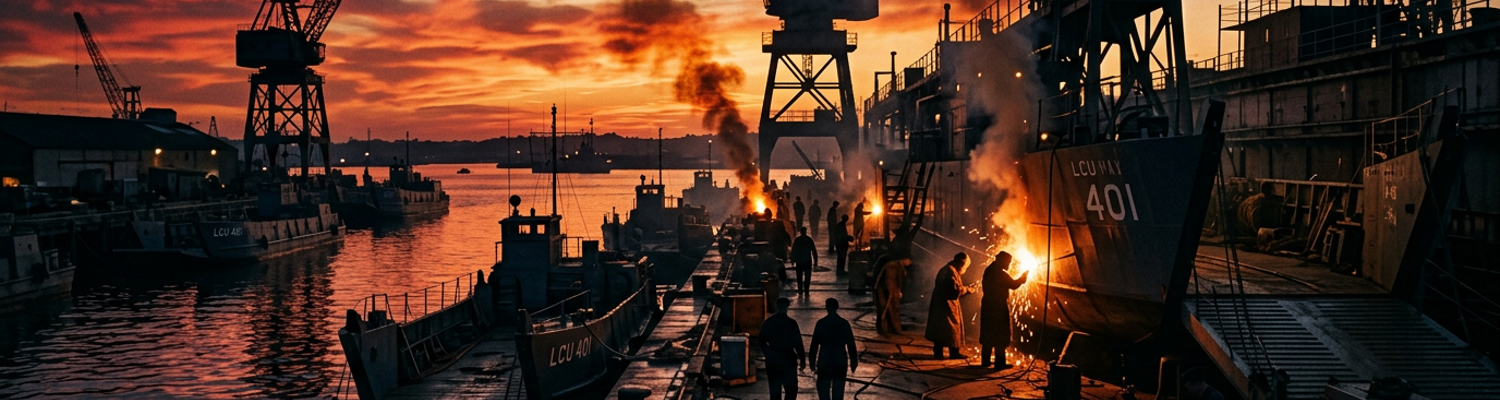
Seabees moved heavy bulldozers and pile drivers into coastal estuaries to establish these permanent United States Navy repair and supply bases at surveyed anchorages such as Falmouth, Dartmouth, and Salcombe. Construction crews reinforced crumbling stone quays, dredged shallow channels, and poured solid concrete grounding hards so flat bottomed landing vessels could sit safely through the severe twenty foot tidal shifts. Work parties at Falmouth expanded existing commercial waterfronts into heavy repair depots, while detachments at Dartmouth and Salcombe built extensive Quonset shop complexes and anchored rows of offshore mooring buoys along the riverbanks. Engineers installed floating pontoon piers and high capacity fuel lines to let Landing Craft Tank and Landing Ships Tank load, refuel, and discharge equipment without scouring their keels on rocky shallows. Supply officers erected sprawling corrugated steel storehouses along newly cut access roads, stacking thousands of crated engine blocks, transmission gears, and electrical assemblies that matched the exact blueprints of incoming American amphibious craft.
Mechanics uncrated those standardized parts inside well lighted repair shops, ending the desperate reliance on hand forged scrap and makeshift British fittings. Shipfitters hauled damaged landing craft onto dry timber slipways with electric winches, replacing cracked propellers and damaged rudder skegs using industrial welding torches instead of manual hammers. Diesel engine technicians overhauled clogged Gray Marine propulsion units on calibrated test benches, swapping out worn injectors and fuel pumps with identical factory replacements pulled directly from depot shelves. Waterfront crews replaced battered wooden fender piles and hooked up high pressure freshwater lines to flush salt deposits from vessel cooling systems before engines seized up. Base repair officers logged vessel turnarounds on standardized tracking boards, cutting landing craft overhaul times from three chaotic weeks in tidal mud down to five dependable days on dry concrete. Convoys of fully repaired assault craft steamed out of the estuaries on fixed schedules, filling English Channel assembly areas with seaworthy hulls ready for strenuous amphibious training exercises.
Landing craft cycling through those southwestern bases established the decisive strategic precedent that rear echelon repair and maintenance throughput dictated invasion feasibility over tactical frontline operational schedules. Ground commanders and tactical planners had spent months assuming that infantry troop assembly dates and tidal calendars alone would dictate the invasion D-Day timetable. Stark and his logistical staff used verifiable maintenance logs from Dartmouth, Salcombe, and Falmouth to prove that frontline operations would collapse within days if rear echelon repair berths could not process damaged hulls as fast as Channel chop and enemy fire broke them. Supreme Allied planners accepted this technical reality, subordinating tactical assault schemes to the maximum volume of vessels that base repair facilities could overhaul each week. Staff officers rewrote assault wave allocations across the cross Channel operational directives to align strictly with measured dockyard capacity rather than optimistic battle plans. Stark locked those finalized maintenance throughput figures into the theater war plan, forcing ground commanders to scale their cross Channel assault waves directly to the number of repaired craft Devon and Cornwall slipways could deliver to the staging moorings.