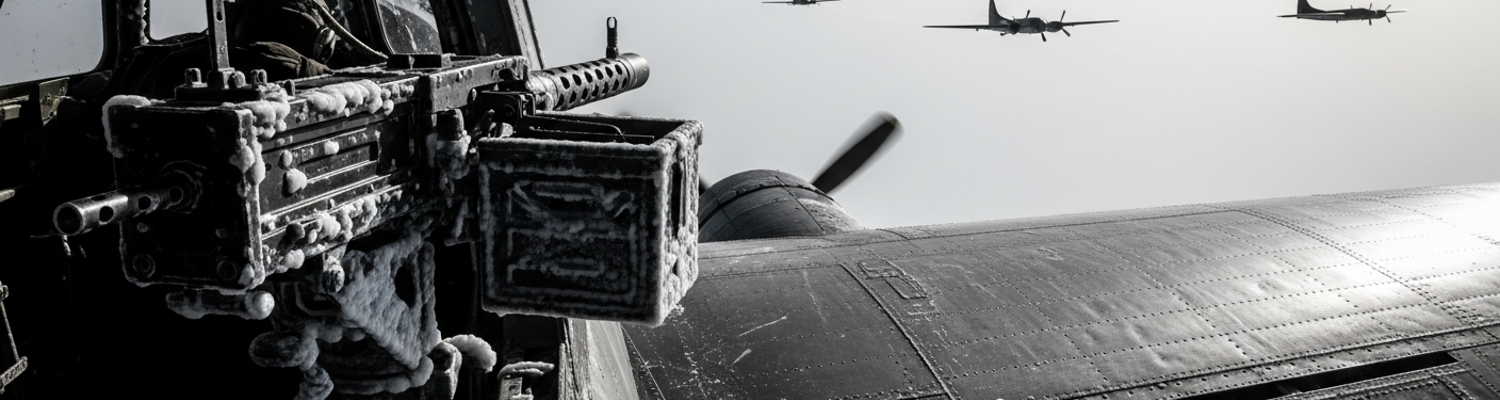

The popular memory of the American strategic air war over Europe is one of heroic defiance. It is a narrative built on tight formations of B-17 Flying Fortresses weathering storms of anti-aircraft fire, their gunners dueling with Luftwaffe fighters in the clear blue sky. This cinematic version of events, while containing elements of truth, omits a more persistent and insidious adversary.
A close review of Eighth Air Force operational records from the final year of the war paints a different picture. The greatest threats were often internal. They were found in the freezing oxygen lines, the congealed hydraulic fluid, and the flawed radio sets. The legend of the air war is one of combat against a determined enemy. The historical record shows a constant, grinding struggle against physics, physiology, and the limitations of a crew's own advanced, yet fragile, technology. The most significant losses were frequently not the result of enemy action, but of systemic mechanical and environmental failure at 25,000 feet.
This was a war against the cold.
Extreme High-Altitude Operational Limits
The core doctrine of the USAAF's strategic campaign relied on B-17 and B-24 bombers operating above 25,000 feet. At this altitude, they were theoretically beyond the reach of most light and medium flak. Strategic planning, however, failed to fully account for the devastating impact of the environment on both men and machines. Operational logs and physiological reports from Eighth Air Force bomber groups show a high number of mission aborts and in-flight emergencies were entirely unrelated to enemy contact. They were the direct result of failures in the equipment designed to sustain life in the thin, frigid air of the stratosphere.
Oxygen systems were a primary point of failure. The continuous-flow oxygen systems in B-17s and B-24s became notoriously unreliable. Moisture from a crewman's breath would freeze inside the delicate regulator valves. Ice would accumulate in the oxygen lines, cutting off the supply. In the unpressurized fuselage of a Fortress or Liberator, this was a death sentence. At 30,000 feet, a man deprived of oxygen would lose consciousness in under a minute. Death followed soon after. Periodic intercom checks, with each crewman sounding off in sequence, were a rudimentary method to monitor for the silent onset of hypoxia. A tail gunner who failed to respond was often beyond rescue.
Cold was a constant opponent. At a typical bombing altitude, ambient air temperatures frequently dropped to between -40 and -60 degrees Celsius. For waist gunners positioned by open windows, the wind chill produced an environment of extreme hostility. Electrically heated flight suits, like the F-2 and F-3 models, were a flawed solution. A 1943 bombardment division study concluded that 75% of frostbite cases were directly attributable to faulty equipment. The bomber’s electrical system, burdened by turrets, radios, and instruments, often failed to provide consistent power, leading to intermittent heating or total failure. A single break in a wiring element could render an entire suit cold.
The consequences were severe. Medical records from the Eighth Air Force show that until January 1944, frostbite accounted for half of all crew casualties, excluding those killed or missing in action. Waist gunners were most vulnerable, initially making up 50% of all frostbite cases. Exposed skin would freeze instantly to bare metal, tearing away flesh if contact was broken. A gunner attempting to clear a jammed .50 caliber machine gun with bare hands was guaranteed to lose fingertips. These were not minor injuries; severe frostbite led to amputations and permanently incapacitated thousands of experienced airmen.
The bombers' mechanical systems were just as susceptible. Hydraulic fluid, essential for critical components, degraded severely at operational temperatures. The standard mineral-based hydraulic oil (AN-VV-O-366) thickened into a gel-like sludge. This sluggishness had serious consequences. On the B-24 Liberator, which relied heavily on hydraulics, the impact was pronounced. Landing gear, bomb bay doors, and gun turrets would become slow to respond or fail entirely. Maintenance logs (NARA Record Group 18) contain frequent reports of turrets that could not traverse and bomb doors that refused to close after payload release. This created immense drag, burned precious fuel, and made the bomber an easy target on its return flight. The emergency hand pumps, designed for manual operation, were often insufficient to build the required pressure to overcome the congealed fluid.
Flawed Wartime Navigation Systems
Strategic bombing's success hinged on a crew's ability to find its target. A review of 1945 operational logs reveals a navigation battle fought not just against the enemy, but against the profound limitations of the era's technology. The British-developed Gee system, a radio navigation aid, was revolutionary but deeply flawed. Gee operated by receiving pulsed signals from ground stations in the UK. The navigator measured the time difference between signals to plot a position on a hyperbolic grid map. Its VHF signals were limited by line-of-sight, restricting its effective range to about 350-400 miles. This barely covered the Ruhr valley, leaving bombers blind on deeper penetration raids. The Germans also began successfully jamming Gee signals as early as August 1942, making the system unreliable over hostile territory.
This forced reliance on self-contained systems.
H2S, a ground-mapping radar housed in a ventral dome, allowed bombers to 'see' through clouds. It was a significant advance with its own set of drawbacks. The image on the navigator's screen was often a blurry, low-resolution collection of smudges that required immense skill to interpret. More critically, H2S was an active system that broadcast its presence. Its magnetron emissions were a beacon for German night fighters. By late 1943, the Luftwaffe had deployed the FuG 350 Naxos radar detector, which allowed fighters to home in on H2S transmissions and track bomber streams. German listening networks, known as 'Korfu', could detect H2S sets warming up on British airfields before takeoff. Every time a navigator switched on his set to get a fix, he was actively inviting attack.
Weather consistently defeated these electronic aids. Persistent, thick cloud cover over Europe made visual navigation impossible, forcing total reliance on compromised electronic systems. Atmospheric phenomena created havoc with radio signals. Electrical storms and temperature inversions could bend or block the VHF pulses used by Gee, leading to false fixes. While H2S could penetrate cloud, heavy rain or dense snowfall produced 'clutter' on the radar screen, a form of noise that could obscure ground returns. High-velocity air currents, later understood as the jet stream, could push a bomber formation hundreds of miles off its dead-reckoned course.
The equipment itself was a source of constant failure. The core of these systems, the vacuum tube, was extraordinarily fragile. Heavy vibration, turbulence, or the concussion from an anti-aircraft shell could break a filament and render a navigation set inert. The extreme cold caused metal components to contract, leading to broken solder joints. The H2S scanner, located in the unpressurized belly of the aircraft, was particularly susceptible to its drive motor freezing solid. Power supplies were another weak point. The rotary inverters needed to convert the aircraft’s DC electrical power to the specific AC voltages required by radar sets were a frequent point of mechanical failure. A navigator finding his set dead over enemy territory was left with only a map, a stopwatch, and celestial navigation.
German Jamming and Communication Chaos
The electronic ether over Germany was a contested battlefield. German radio intelligence, or Funkaufklärung, had evolved into a highly effective weapon system designed to sever the central nervous system of an American bomber formation: its VHF radio communications. German jamming operations were a coordinated effort to disrupt the specific VHF frequencies (100-156 MHz) used for voice transmission. A bomber pilot attempting to report a fighter attack would key his microphone only to have the transmission consumed by a wall of static. In other instances, German transmitters broadcast prerecorded engine noise or garbled speech onto the channel to mask legitimate calls.
A more disruptive tactic was also employed. German operators, often women with fluent, unaccented English, would break into USAAF command nets to issue false orders. A bomber group leader might hear a calm voice countermand a rally point or give a false vector away from the main bomber stream. This electronic spoofing was designed to peel away isolated squadrons for destruction. Flight leaders faced an impossible choice: trust a potentially compromised command channel or maintain radio silence and risk flying into an unknown threat. The air itself became a source of confusion.
The structure of Allied air defense was uniquely vulnerable. Ground-Controlled Interception (GCI) depended on a clear radio link between radar operators on the ground and the escort fighters they guided. GCI crews would track incoming Luftwaffe interceptors and broadcast precise vectors to Allied fighter squadrons. German signals intelligence actively monitored these GCI frequencies. Once a channel was identified, a network of powerful German ground transmitters, given codenames like Karl and Heinrich, would be directed to overwhelm it with noise. The effect was immediate. A P-51 Mustang pilot, moments from being vectored onto a closing formation of Me-262 jets, would suddenly find his headset filled with a deafening screech. The voice of the ground controller was gone.
Escort fighters were rendered blind and deaf. They were reduced to flying pre-planned routes, relying on visual contact alone to find and engage the enemy. This was a near impossibility in the vast, cloud-filled skies of winter over Europe. This electronic severing of command left bomber formations exposed. Post-mission reports are filled with accounts of escort fighters failing to engage, not through lack of will, but from a total lack of situational awareness imposed by German jamming.
This systematic degradation of communications created a cascading failure of command. The cohesion of a thousand-bomber raid would disintegrate. Bomber-to-bomber voice channels were essential for formation discipline. When these channels were rendered unusable, each B-17 or B-24 became an island. A lead navigator’s course correction might never be heard by the squadrons following him, causing entire groups to diverge. A wing commander seeing a group stray from the planned route had no way of knowing if they were responding to a legitimate threat or following a phantom order from a German spoofing transmission. A squadron that went silent was not necessarily destroyed; its radios may have simply been rendered inoperable. The result was a fragmented battlefield where commanders were often making decisions based on incomplete or deliberately falsified information.
Disproportionate Bomber Loss Factors
An examination of USAAF operational records from early 1945 reveals a fatal paradox. The very equipment intended to ensure a crew’s survival often led directly to their destruction. Official doctrine demanded strict radio silence from bomber formations to prevent German signals intelligence from tracking their route and altitude. This electronic quiet was frequently broken by the realities of high-altitude flight.
A bomber crippled by engine fire or battle damage and falling away from the formation presented its crew with a desperate choice. Obey orders and descend in silence, or break protocol and transmit a distress call. Many chose the latter. They filled the VHF frequencies with frantic calls detailing their position, damage, and intent to bail out. Navigational failures added to this electronic chatter. A crew uncertain of its position after hours above a solid undercast had little choice but to transmit, hoping for a directional fix.
Each transmission was a gift to the German defenses.
The German air defense system was an integrated network designed to capitalize on these transmissions. The Funkaufklärung was tasked with monitoring Allied voice communications. When a bomber crew broke radio silence, German direction-finding (D/F) stations could take bearings on the transmission. A cross-reference from two or more stations provided a precise geographic location of the vulnerable aircraft. This information was relayed immediately to a Jägerleitoffizier, a fighter control officer, at a regional command post. The controller, viewing the tactical situation on a large map table, could then vector nearby fighter assets directly to the coordinates of the transmitting bomber. Systems like the Y-Verfahren allowed a ground controller to guide a designated lead fighter (Leitjäger), equipped with a special FuG 16ZY radio, with exceptional precision.
The result was a systematic slaughter of isolated aircraft. A bomber crew calling for help was broadcasting its own death warrant. The speed of the German system was its most lethal quality. Post-war analysis of Luftwaffe records indicates that the time from an intercepted American transmission to a fighter attack could be mere minutes. An American crew that believed it was alone over occupied Europe would suddenly find a flight of Fw 190s descending upon them, guided not by radar, but by the crew’s own radio waves.
This exploitation of compromised radio discipline had consequences that extended far beyond the loss of a single aircraft. A distress call from a straggler could inadvertently betray the location, heading, and altitude of the main bomber stream to German fighter controllers. Flak batteries also benefited. Intelligence from radio intercepts provided a new level of accuracy. A flak commander, alerted to the precise path and altitude of an incoming formation, could adjust his batteries’ fire accordingly, dramatically increasing the lethality of the defensive belt. This created a cascade of losses. Bombers damaged by the newly accurate flak would fall out of formation, their crews then forced to make their own distress calls, which in turn would be intercepted, guiding more fighters to the struggling formation.