
The Revolutionary War Context
Training manuals promised formations of disciplined regulars, drilled to perfection. The troops received something else. They were farmers and tradesmen, not professional soldiers, often enlisted for punishingly long terms they had not fully understood. Instead of state-issued uniforms and reliable equipment, many arrived with the clothes on their backs and personal hunting muskets. They entered a world where disease was a more prolific killer than musket balls, where camp sanitation was an afterthought, and where political squabbling left the army perpetually on the brink of collapse.
Against this backdrop, the formation of the Maryland Line in early 1776 stands apart. While other states often sent untrained militia to fill their quotas, Maryland’s Provincial Convention made a deliberate choice to field a regiment of uniformed, paid, and drilled regulars. This investment in training before deployment would have profound consequences.
Their first major test came on August 27, 1776, at the Battle of Brooklyn. As the larger Continental Army was routed and faced annihilation, a contingent of Marylanders, now known as the Maryland 400, was ordered to conduct a rear-guard action. Led by Major Mordecai Gist, these men launched a series of desperate, disciplined charges against a numerically superior British force commanded by Lord Cornwallis. Their objective was not victory, but time for the main army to escape across Gowanus Creek. The action was a brutal success. While over half the Marylanders were killed or captured, their repeated charges stalled the British advance long enough for the bulk of Washington’s army to retreat, saving it from destruction.
This sacrifice forged the Maryland Line’s reputation. They were not militia who would break and run. They were regulars. This distinction earned them the moniker The Old Line, a title reflecting their reliability. Archival evidence shows that in subsequent engagements at Harlem Heights, White Plains, and later at Camden and Guilford Courthouse, commanders consistently placed the Maryland regiments in the most critical positions on the battlefield. At the disastrous Battle of Camden in August 1780, while the militia on the American flank collapsed, the Maryland and Delaware Continentals held their ground. Outnumbered and eventually surrounded, they engaged in a ferocious fight, executing a bayonet charge even as the battle was lost around them. This pattern of discipline under fire made them one of the most respected formations in the Continental Army.
The elite performance of the Maryland Line occurred within a context of systemic deprivation. The life of a soldier was one of constant hardship. Winters were the most dangerous enemy. During the encampments at Valley Forge (1777-1778) and Morristown (1779-1780), the army was ravaged by hunger, freezing temperatures, and disease. Soldiers lived in crude log huts, often without blankets or shoes. A close review of operational logs and letters from commanders like Washington reveals a constant, desperate plea for basic supplies. Food rations were inconsistent at best, and at worst, nonexistent for days, pushing units to the edge of mutiny. Sickness, particularly smallpox, typhus, and dysentery, swept through the poorly sanitized camps, killing far more soldiers than combat ever would.
Morale Crisis and the Chaplain's Role
The most lethal enemy the Maryland Line faced was not a British regular. It was an invisible antagonist in their own camps. A review of operational logs from the Continental Army (Record Group 93, War Department Collection) shows a catastrophic death toll from disease. For every one soldier killed in action, at least two died from sickness. The total number of American military personnel who perished from illness during the war, approximately 17,000, exceeded the entire population of Philadelphia at the time. The winter encampments were the primary killing fields. At places like Valley Forge, the Maryland regiments joined thousands of other soldiers in crude log huts where typhus, typhoid, and dysentery ran rampant. These were the direct results of crowding men into unsanitary spaces without adequate food, clothing, or shelter. Paymaster correspondence from the Maryland troops during the fall of 1776 details an unhappy situation, with hundreds of men unfit for duty and lacking medical assistance.
Men began to walk away.
Desertion was a constant drain on the Continental Army’s strength, a direct response to the conditions and lack of promised support. During the Valley Forge encampment, records indicate that desertions could reach a rate of nearly ten men per day. Soldiers listened to the chants of starving comrades and made a calculated decision. For many, capture by the British, who might at least offer food, seemed a better option than slowly dying of hunger and disease. The problem was so acute that Washington ordered frequent roll calls to track the losses. While punishments could be severe, including death by hanging for about a third of those caught, desperation often outweighed the fear of consequences. It represented a fundamental breakdown of the contract between the soldier and the state.
In this environment, the Continental Congress authorized a corps of chaplains in July 1775. General George Washington was a chief proponent, seeing a practical need for their presence to uphold morale and reinforce discipline. These men, numbering over 200 during the war, were far more than just preachers. They functioned as counselors and social leaders. In a military force plagued by illiteracy, chaplains often served as conduits for communication, reading letters from home and writing replies for soldiers who could not. They visited the sick and wounded, offering comfort in camp hospitals that were often little more than places to die. By ministering to individuals, they strengthened the bonds within the unit, reinforcing the sense of shared struggle.
The chaplains’ most significant function was to give meaning to the suffering. They consistently framed the war in moral and spiritual terms, reminding soldiers of the fight for liberty. In sermons delivered in camp, they connected the cause of independence with a divine purpose, animating the troops and impressing upon them the importance of the rights for which they were fighting. This ideological reinforcement was a direct countermeasure to the despair bred by starvation and sickness. By reminding each man why he was there, chaplains helped to sustain the individual resolve essential for unit cohesion.
Field Fortification Engineering Challenges
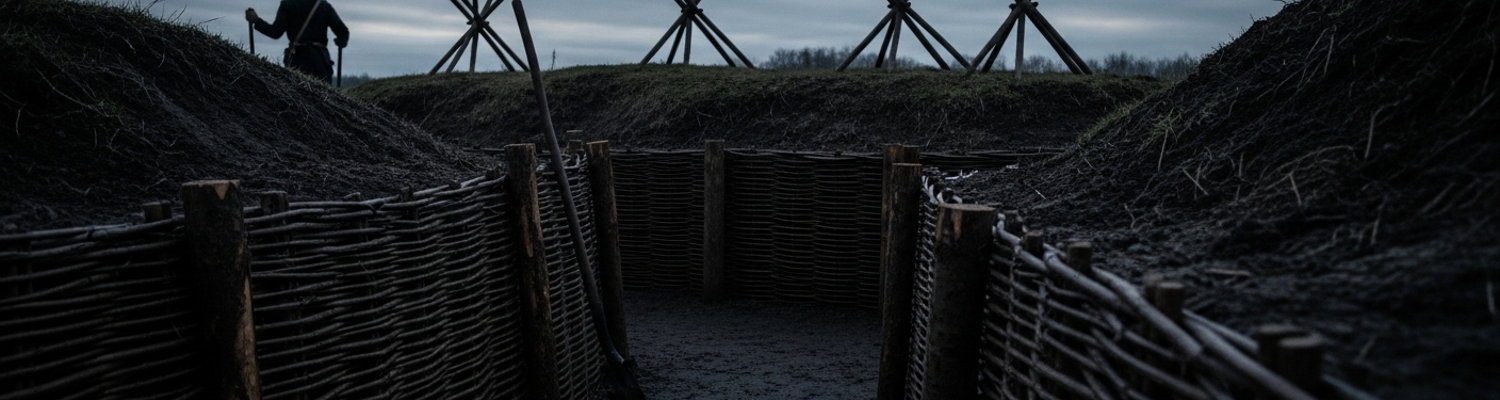
Operational logs from the Continental Army’s Corps of Engineers reveal a pattern of grueling labor foundational to the army’s survival. The construction of field fortifications, the redoubts and trench lines that defined sieges from Boston to Yorktown, was a science of earth and wood. Standard European engineering doctrine, found in manuals by Vauban, called for geometrically precise structures. These included earthen parapets of specific heights and thicknesses to absorb cannon fire, a firing step for defenders, and a deep outer ditch. Obstacles like abatis, felled trees with sharpened branches facing the enemy, and palisades of sharpened vertical logs were meant to break up attacking formations.
The physical act of creating these works involved thousands of man-hours of digging, often in sandy soil that collapsed or frozen ground that shattered tools. Rain was a constant enemy, eroding the packed earth of a parapet and turning ditches into moats of mud. This necessitated constant maintenance, with work parties dispatched to repair walls battered by artillery or washed out by weather, often under harassing fire from British skirmishers who specifically targeted the engineers.
Where proper tools and materials were absent, which was nearly always, raw ingenuity had to suffice. A chronic shortage of everything from spades to saws forced the companies of Sappers and Miners to improvise. They became masters of creating fascines and gabions. Fascines were dense bundles of sticks, typically six to eighteen feet long, bound tightly and used to shore up the interior walls of trenches or to help bridge a ditch during an assault. Gabions were large, bottomless wicker baskets, woven from whatever pliable green wood could be found, which were then placed in rows and filled with dirt and rocks to create a sturdy, bullet-absorbing wall. Their construction in the Continental Army was an exercise in resourcefulness; soldiers would strip nearby woods, tear down fences, and disassemble barns for materials. Quartermaster records show blacksmiths forging new pick-axes and shovel heads from scrap iron, while wheelwrights struggled to keep simple wooden wheelbarrows functioning with non-existent parts.
This work was performed by men pushed to the limit of human endurance. A soldier on a fortification detail could expect to spend hours digging and hauling dirt, often on a diet of little more than firecake and water. The physical toll was immense. They labored through freezing rain, suffocating southern humidity, and winter cold so deep it made swinging a pick-ax a jarring shock. This labor was performed under the constant threat of enemy action. Most heavy digging was done at night to avoid the attention of British artillery, but darkness offered only partial protection. The distinct sound of spades hitting rocky soil could draw sniper fire, and random cannon barrages were a constant danger.
Primitive Communication and Tactical Disarray
The command infrastructure of the Continental Army was a fragile system built on muscle, paper, and hope. A close review of operational logs reveals its core components were dispatch riders and battlefield signals, both profoundly unreliable. The dispatch rider, the army’s primary instrument for long-range communication, was a solitary figure pitted against weather, poor roads, and enemy action. A message from General Washington to the Southern Department had to survive a journey of hundreds of miles over rutted dirt tracks that turned to impassable mud. Riders and their mounts faced exhaustion, injury, and the threat of ambush by Loyalist partisans or British patrols. The capture of a single rider could mean the loss of intelligence, as Washington himself noted with alarm when dispatches arrived with their outer coverings broken. This physical vulnerability meant that orders were frequently delayed by days or weeks. The system was so precarious that Washington established dedicated Chains of Expresses, relay-style systems of riders, to ensure messages about British fleet movements could get through.
On the battlefield, communication was no better.
Audible and visual signals were the only tools available for maneuvering regiments under fire. Drummers beat specific cadences for advance or retreat, while officers on horseback used flags or hats on swords to signal intent. The system was rudimentary. Research into the period indicates there was no universally standardized tune for commands; signals were often chosen on a regiment-by-regiment basis, creating potential for chaos when units from different states fought side-by-side. The deafening roar of cannon and musket fire, combined with dense clouds of black powder smoke, could easily obscure these signals. A commander’s ability to direct his forces was limited by his line of sight. In the wooded, rolling terrain common to many battlefields, a regiment deployed in a valley was effectively deaf and blind to new orders. The vocabulary of these signals was also severely limited, failing to communicate complex maneuvers.
This systemic failure of command and control directly contributed to strategic disasters. The Battle of Camden on August 16, 1780, is a case study. Major General Horatio Gates, the American commander, positioned his headquarters some 200 yards behind the main line, too far to observe or react. He placed his most reliable troops, the Maryland and Delaware Continentals, on the right flank, while untested militia held the left. When the British regulars advanced, the American militia on the left flank fired a single ragged volley before breaking and fleeing. The command collapse was total. Gates himself was swept up in the retreat. This left the Maryland Line completely isolated. With no new orders and no support, Major General de Kalb was left on his own. The Marylanders performed with disciplined courage, even launching a bayonet charge against the British forces now closing in on them from three sides. Their professionalism could not overcome the tactical reality. Surrounded and overwhelmed, the Maryland Line was shattered, suffering more than 50 percent casualties. De Kalb himself was mortally wounded. The men of the Maryland Line were not defeated by superior British fighting ability; they were sacrificed by a command system that dissolved into chaos.
Improvised Solutions Under Duress
The breakdown of established military doctrine forced soldiers and engineers into a state of constant invention. A close analysis of the Corps of Engineers' activities, particularly during the southern campaigns, shows that fortifications were rarely built to specification. Where a Vauban manual demanded precise earthen walls, the men of the Maryland Line often contended with sandy soil that refused to hold a shape or ground frozen too hard for shoddy shovels. The solution was the mass production of fascines and gabions. Soldiers became weavers and woodcutters. They fashioned gabions from pliable green saplings and vines, setting the empty frames in rows and then filling them with dirt and rocks to create revetments that could absorb cannon fire. Fascines, dense bundles of sticks bound tightly, were used to shore up the interior faces of trenches or thrown into ditches to create a path for an assault. This was exhausting work, performed by soldiers on starvation rations who stripped forests and dismantled barns for raw materials.
A total failure of the supply chain was a constant condition. The response was adaptation at the lowest level. When cast-iron wagon wheels or axle pins broke on muddy tracks, there were no depots for replacements. Regimental blacksmiths and artificers, often working with crude portable forges, became masters of salvage. They would attempt to weld shattered iron parts or re-forge tools from whatever scrap could be scavenged. A review of quartermaster records reveals a constant effort to repair equipment with nonexistent parts, from wheelbarrows to artillery carriages. Ammunition shortages prompted similar innovations. Soldiers were ordered to pry spent lead musket balls from the earthen walls of their own fortifications after a firefight. Pewter dishes and spoons were collected from the civilian population and melted down for shot.
The unreliability of battlefield communication likewise necessitated tactical innovation. The command paralysis that doomed the Maryland Line at Camden demonstrated that relying on distant commanders was a recipe for disaster. Effective units developed localized solutions. A key adaptation was the expanded use of the aide-de-camp. These officers were more than messengers; they were trusted extensions of the commander’s will. During an engagement, an aide like Alexander Hamilton or John Laurens would not simply carry a written dispatch but would gallop through gunfire to a regimental commander, verbally relaying complex orders and providing clarification on the spot. This was exceptionally dangerous work, but it replaced the ambiguity of a drumbeat with direct, intelligent conversation. For larger, pre-planned operations such as the movements at the Siege of Yorktown, success depended on abandoning real-time signals altogether. Instead, commanders from the American and French forces conducted detailed face-to-face planning sessions, synchronizing their actions by watch before the battle began. This method created operational unity where the technology for it did not exist.
Legacy of Resilience and Adaptation
The performance of the Maryland Line forged an enduring legacy of battlefield tenacity. A post-war examination of command decisions reveals that after repeated demonstrations of discipline at Brooklyn and Camden, commanders consistently and deliberately used the Maryland regiments as the anchor for their line of battle. Their reputation for standing firm while militia units broke became a tactical asset. This reliability was a concrete factor in operational planning, allowing generals like Nathanael Greene to design more complex strategies knowing he had a dependable core that would not collapse. This battlefield performance had a direct impact on high-level military policy, providing a powerful argument in the ongoing debates within the Continental Congress about the value of professional, long-service regulars versus short-term militia levies. The Maryland Line became the prime exhibit for the effectiveness of investment in training and discipline.
From the quiet, desperate troubleshooting required to survive came a set of unwritten institutional lessons. The chronic lack of proper tools and materials forced a complete departure from established engineering doctrine. The improvised construction of fascines and gabions became standard practice out of necessity. Soldiers of the Maryland Line, alongside other regiments, became adept woodcutters and laborers, stripping the surrounding countryside to create fortifications from whatever they could find. This culture of improvisation gave rise to the American artificer, a specialized soldier-craftsman responsible for keeping the army functioning. These men, organized into companies of carpenters, blacksmiths, and wheelwrights, operated field forges to repair broken equipment and manufacture new components from scrap iron, embodying a form of localized problem-solving essential for the army’s survival. The successful construction of a sturdy hut or the repair of a vital supply wagon represented a small, tangible victory against decay and despair.
The aggregate of these improvised solutions made a direct contribution to the overall war effort. The lessons learned from tactical disasters like Camden were quickly absorbed. The army adapted by institutionalizing the use of aides-de-camp as extensions of a commander’s will, replacing the unreliable system of drum and flag signals with direct communication. This shift toward a more fluid and decentralized command culture allowed units to react to changing circumstances. The ultimate expression of the Maryland Line’s legacy came at the Battle of Cowpens on January 17, 1781. Having been shattered and then reconstituted after Camden, the Maryland Continentals formed the heart of Brigadier General Daniel Morgan’s third and final line. There, they executed a sophisticated and high-risk maneuver: a feigned retreat designed to lure Banastre Tarleton’s aggressive British forces into a trap. This tactic required absolute discipline, as the line had to withdraw in good order, turn, and deliver a decisive volley at point-blank range. The successful execution of this complex action, which led to one of the most complete American victories of the war, was a direct result of the hard-won experience and resilience that had become the hallmark of the Maryland Line.