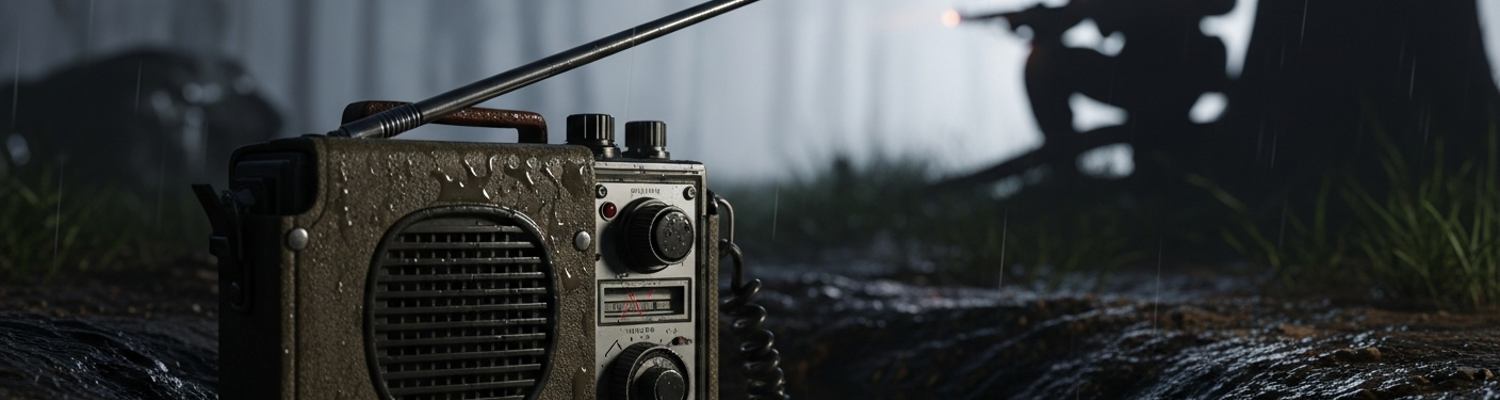

Training manuals promised a revolution in tactical communication. A portable radio, carried by a single soldier, would link squads and platoons directly to command. The lessons of the previous world war, however, were etched in mud and blood with broken telephone lines and desperate runners who never reached their destination. For the foot soldier of the late 1930s, reliable communication was still a matter of shouting, hand signals, or the hope that a fragile wire could withstand an artillery barrage.
The interwar period exposed a dangerous gap in U.S. Army doctrine. The static trench systems of World War I had relied on field telephones, but their thousands of miles of wire were a liability. They were easily severed by shellfire and entirely unsuited for the fluid, maneuver-based warfare concepts gaining favor. Military theorists, observing developments in Europe, recognized that coordinating infantry and armor required instantaneous voice communication at the lowest tactical levels. Below the battalion level, American units were effectively deaf, dependent on visual signals useless in dense terrain or at night, and human messengers who were tragically vulnerable. A close review of operational planning from the era indicates an urgent need for a man-portable radio system that could move with the infantry. Without it, the Army could not execute the complex fire-and-maneuver tactics that modern warfare demanded.
Archival evidence shows the U.S. Army Signal Corps formally initiated a project in 1940 to create a portable radio for frontline use. The contract went to the Galvin Manufacturing Corporation, the company that would later become Motorola. The design objectives were exceptionally ambitious. The device had to be a frequency modulated (FM) transceiver, a choice championed by engineer Daniel E. Noble to combat the static that plagued AM radios. It needed a consistent operational range of three to five miles, weigh no more than 35 pounds, and be entirely self-contained. The power source was a battery pack carried by the same operator. This backpack configuration led to its formal designation as Radio Set SCR-300. It became the first device widely known as a walkie-talkie. The engineering team had to build a unit that was not only electronically effective but also rugged enough for combat and simple enough for operation by soldiers with minimal training. The resulting BC-1000 transceiver and its accompanying BA-70 battery case represented a significant engineering achievement, designed for mass production.
The entire architecture of the SCR-300 was constrained by its reliance on vacuum tube technology. Solid-state transistors had not yet been invented. The radio’s functions depended on a set of 18 fragile, power-hungry vacuum tubes. Types like the 1T4 for amplification and the 3A4 for detection were miniature glass cylinders containing delicate filaments, grids, and plates. To function, these filaments had to be heated to incandescence, which drew a heavy, continuous current from the battery. The tubes also required high plate voltages, 90 volts for the receiver and 150 volts for the transmitter, to manage the flow of electrons. This dual power demand is what made the BA-70 battery pack such a large and heavy component. It weighed around 15 pounds by itself and occupied the entire lower section of the radio’s case. Each glass tube was a point of extreme vulnerability. A hard fall or the nearby concussion of an explosion could fracture the glass or snap a filament, silencing the radio instantly. Fragility, substantial weight, and high power consumption were built directly into the core of every single unit.
Signal Corps archival evidence shows the laboratory testing protocols for the SCR-300 focused primarily on two metrics: transmission range and signal clarity under ideal conditions. The final acceptance tests for Galvin Manufacturing Corporation’s production model were conducted across the temperate fields of Fort Knox, Kentucky. During these trials, engineers and Signal Corps officers methodically evaluated the BC-1000 transceiver’s performance. The core procedure involved establishing a baseline transmission, then moving the receiver to fixed intervals to measure signal strength and voice legibility. In one key demonstration, engineers placed prototype sets eight miles apart, more than double the required three-mile specification, and achieved clear communication. This success, achieved on a bright spring day with unobstructed line-of-sight, heavily influenced the Army’s enthusiastic approval. The benchmarks were purely electronic. Success was measured in miles and decibels, proving the superiority of Daniel Noble’s frequency modulation design over older, static-prone AM sets. The trials confirmed the 0.3-watt transmitter could, under these perfect circumstances, provide a clear signal across distances that exceeded all operational requirements. The resulting technical manuals presented these range figures not as optimistic possibilities but as baseline performance guarantees.
A critical examination of the testing records (NARA Record Group 111) reveals a significant blind spot. The trials lacked any simulation of prolonged heavy moisture combined with freezing temperatures. While the design was considered waterproofed and subjected to basic rain and immersion tests, these were short-duration events. Procedures from the period, which would later evolve into MIL-STD-810, included methods for testing against rain and humidity, but the concept of compound environmental stressors was not as developed. There was no protocol to replicate the conditions of a soldier lying for hours in freezing mud or enduring days of relentless, ice-cold rain followed by a hard freeze. The tests at Fort Knox verified the radio could survive a brief submersion. They never accounted for the slow, persistent seepage of water into the battery compartment seals or the canvas BG-174 carrying bag, which would then freeze and expand. The vulnerability was not a single component failure but a systemic one born from an incomplete understanding of the operational environment.
This focus on electronic performance in a controlled setting cultivated dangerously optimistic expectations. Signal Corps doctrine, updated based on the Fort Knox results, confidently promised a reliable three-to-five-mile range for infantry operations. The FM technology, with its crystal-controlled channels across the 40.0 to 48.0 MHz band and innovative squelch circuit, had proven its ability to deliver exceptionally clear voice communication. The successful trials led to a belief that the primary challenges of frontline communication had been solved. The radio functioned flawlessly on the test range. Its automatic frequency control locked onto the signal, and its BA-70 battery delivered its expected 20-25 hours of life. These results were logged and documented in manuals. They became the foundation for tactical planning ahead of deployments to Europe. The SCR-300 was a technological triumph that met or exceeded every specification laid out for it. It was rugged, its signal was clear, and its range was exceptional. The system had no known flaws because it had not yet been tested in conditions where its core assumptions would fail.
While the SCR-300 was designed with the infantry squad in mind, its capabilities immediately appealed to the specialized needs of U.S. Army Combat Engineer battalions. A review of their evolving tactical doctrine in 1943 and 1944 shows an increasing demand for reliable, real-time command and control over small, dispersed teams. Unlike infantry companies, which often fought as a cohesive whole, engineer platoons were frequently broken down into small squads. These teams were dispatched over a wide area to perform distinct, time-sensitive tasks. One squad might be preparing a bridge for demolition, another clearing a minefield a kilometer away, and a third constructing a defensive obstacle, all under the direction of a single platoon leader. Before the widespread availability of the SCR-300, this coordination depended entirely on wire telephone lines or on runners. The allocation of the SCR-300, initially one or two sets per engineer platoon, directly addressed this command vulnerability. It allowed an engineer lieutenant to remain in a covered position while directing multiple, simultaneous operations through the clear signal of the FM transceiver.
The radio’s most significant application for engineers was in the precise coordination of demolitions and the construction of tactical bridges. A standard demolition operation against a bridge required perfect synchronization between multiple elements. A close review of operational logs from engineer units in France, such as the 299th Engineer Combat Battalion, shows a clear methodology. A demolition team would place charges like M112 C4 blocks or satchels of TNT on the bridge’s structural supports. A security team would be positioned on the far bank to prevent an enemy force from rushing the bridge. The command element, with the SCR-300 operator, remained in a rearward observation post. The radio network was the nervous system of the entire operation. The security team could report the approach of enemy patrols. The demolition team could confirm the charges were set and primed. The platoon leader could give the final order to detonate at the exact moment of tactical advantage. Without the radio, the command to fire would have been given by a hand signal, a flare that would expose the team’s position, or a timed fuse that allowed no flexibility.
During the Allied breakout from Normandy and the subsequent advance across France in the late summer of 1944, the SCR-300 performed exactly as its designers had hoped. The weather was largely mild and dry. These benign operating conditions mirrored the successful trials at Fort Knox. The BA-70 batteries provided their expected operational life. The vacuum tubes were not yet subjected to the extreme shocks of prolonged artillery duels. The waterproofing seals were not challenged by persistent, freezing moisture. In the relatively open terrain of the French countryside, the radio’s three-to-five-mile range was consistently achieved. After-action reports from units like the 237th and 299th Engineer Combat Battalions during the push toward the Seine repeatedly noted the effectiveness of their radio communications. Teams clearing mines from road shoulders could instantly report their progress to the column commander, allowing convoys to maintain momentum. Squads assembling Bailey bridges over damaged culverts could coordinate the movement of heavy components from opposite banks, drastically reducing construction time. The SCR-300’s performance during this period was a clear success, validating the Army’s investment and building a fatal sense of confidence in the hardware’s resilience.
The successful summer advance bred a dangerous confidence in the SCR-300’s design. That confidence fractured in the autumn of 1944 as American forces entered the dense, perpetually damp Hürtgen Forest. Here, sustained heavy rainfall and pervasive dampness became the radio’s primary adversary. A close review of operational logs from units like the 28th Infantry Division, which suffered horrific casualties in the forest, reveals a consistent pattern of communication failures. The radio’s waterproofed construction, proven effective in short-duration tests, failed systemically under the slow, persistent assault of environmental moisture. Rain seeped past the rubber gaskets sealing the BA-70 battery case. The canvas BG-174 carrying satchel became saturated, holding a wet layer directly against the radio’s housing for days on end. This moisture eventually worked its way into the high-voltage connections for the 18 vacuum tubes. It caused intermittent short-circuiting that manifested as severe static or a complete loss of signal. In the claustrophobic terrain of the Hürtgen, where line-of-sight was often measured in feet, the loss of platoon and company-level radio contact was catastrophic, leaving small units isolated and vulnerable.
As the campaign transitioned from the Hürtgen to the Ardennes in December 1944, a second environmental factor emerged: extreme cold. The freezing temperatures of the Battle of the Bulge had a crippling effect on the SCR-300’s power source. Archival evidence from after-action reports of the 101st Airborne Division during their defense of Bastogne details the dramatic failure of the BA-70 dry-cell batteries. The chemical reaction necessary to produce electricity inside the batteries slowed drastically in the sub-zero conditions, slashing operational life. A battery pack that reliably provided 20 hours of power in temperate weather might now last only four or five. This forced radiomen to carry multiple heavy spare batteries or risk their sets going dead in the middle of an engagement. The frequent cycles of freezing and thawing created another insidious problem. Water that had seeped into the radio’s chassis during the autumn rains would freeze and expand, placing physical stress on delicate wiring and solder points. When temperatures rose slightly, this ice would melt. It created condensation directly on the fragile glass vacuum tubes and their high-voltage sockets, leading to permanent burnouts. For units like the 28th Infantry Division, already battered from the Hürtgen and now facing the brunt of the German offensive, these equipment failures compounded an already desperate situation.
Across the entire front, the combination of rain and shell-torn earth created a landscape of thick, inescapable mud. This environment subjected both the radio and its operator to immense physical stress. The SCR-300 already weighed a burdensome 35 pounds with its standard BA-70 battery. As the canvas carrying bag became caked with wet, freezing mud, the total weight could climb toward 50 pounds, utterly exhausting the soldier tasked with carrying it. A review of field maintenance logs shows that simple slips and falls on the treacherous, frozen ground became a primary cause of equipment failure. The impact was often enough to fracture one of the delicate filaments inside the 18 glass vacuum tubes, instantly silencing the set. The antenna systems were also highly vulnerable. The shorter AN-130 whip could be snapped off in a fall. The longer, more effective AN-131 whip antenna frequently snagged on the dense forest canopy, breaking the antenna or its base connector. Mud and grime worked their way into the multi-pin connectors for the handset and antenna, causing poor contacts and signal degradation. The promised three-mile range became a fiction, with reliable communication often reduced to a few hundred yards.
The operational architecture of the SCR-300 contained latent design vulnerabilities exposed by the European winter. A primary failure point was the BA-70 battery pack and its interface with the main BC-1000 transceiver unit. Testing protocols had certified the radio as waterproofed based on its resistance to brief immersion, but this proved insufficient for the conditions in the Hürtgen Forest. A review of after-action reports from units like the 28th Infantry Division shows a recurring pattern of failure directly linked to prolonged moisture exposure. The canvas BG-174 satchel that held the radio would become saturated with freezing rain and mud. This held a wet layer against the radio’s housing for days at a time. This persistent dampness defeated the rubber gaskets sealing the battery compartment. Water would slowly seep past the seals, creating a conductive film across the battery terminals. This infiltration often resulted in a direct short circuit between the high-voltage contacts, catastrophically draining the battery or causing electrical arcing that damaged the radio’s power input sockets. For a platoon pinned down under artillery fire, this was an abrupt and total communications blackout.
The second major vulnerability was the radio’s complete dependence on its 18 fragile vacuum tubes. These glass components, containing delicate heated filaments and grids, were inherently susceptible to physical shock. The simple act of a radioman slipping on icy ground or diving for cover during a shelling could generate enough impact force to fracture a tube’s internal structure, instantly disabling the radio. Field maintenance logs from the European Theater of Operations show a high rate of attrition for tubes due to such impacts. The extreme cold of the Ardennes introduced a more subtle but equally debilitating problem. The chemical reaction inside the BA-70 dry cell battery, which supplied the critical voltages for the tube filaments and plates, slowed drastically in sub-zero temperatures. A battery pack that reliably delivered over 20 hours of operation in temperate France might last only a few hours in the forests around Bastogne. This forced radiomen of the 101st Airborne to carry multiple 15-pound spare batteries, adding to an already punishing load. The alternative was to practice extreme power conservation, which limited their ability to monitor their nets. The cycle of freezing and thawing created condensation directly on the hot glass tubes and their sockets, leading to electrical shorts that could burn out the components permanently.
A third systemic weakness emerged from the slow degradation of internal wiring and external connections. The wiring looms inside the BC-1000 chassis used fabric-based insulation, a standard practice for the era. In the pervasive dampness of the Hürtgen and the Ardennes, this insulation would absorb moisture through microscopic breaches in the radio’s casing. This did not necessarily cause an immediate short circuit, but it altered the electrical properties of the circuits, changing capacitance and resistance values. Such shifts could cause the highly-tuned FM receiver to drift off frequency or lose sensitivity, making it unable to pick up faint signals. The external connectors were even more exposed. Mud, ice, and grime would foul the multi-pin plugs for the HS-30 headset and the antenna base. This contamination created poor electrical contacts, resulting in severe audio static, intermittent transmission, or a complete loss of signal. Field reports from the 116th Infantry Regiment noted that the standard AN-130 and AN-131 whip antennas were fragile and frequently broke when snagged on dense undergrowth, with replacements being difficult to acquire. Units resorted to field-expedient repairs, using lengths of scavenged telephone wire to fashion new antennas. These cumulative failures meant that the SCR-300’s promised three-mile range became a dangerous fiction.
The systemic failure of the SCR-300 forced soldiers into a desperate battle of wits against their own equipment. A review of after-action reports from the European Theater of Operations (ETO Field Report Q4-1944) shows that due to the absence of standard waterproof bags, on-the-spot improvisations became unofficial procedure. The factory-installed rubber gaskets and seals were no match for the slow, persistent seepage of water in the Hürtgen Forest. Engineer and infantry radiomen discovered that the issued BG-174 canvas satchel acted like a sponge, holding a layer of freezing water directly against the radio chassis. To counter this, they began to scavenge for any waterproof material they could find. Oilcloth and rubberized canvas stripped from captured German trucks or abandoned equipment were prized materials. Soldiers would fashion these into makeshift shrouds, wrapping them tightly around the battery case and the seam where it joined the BC-1000 transceiver. The primary goal was to protect the vulnerable seven-prong power connector cable linking the battery to the radio, as moisture here would cause immediate short-circuiting.
Where water was the enemy in the Hürtgen, extreme cold was the primary adversary in the Ardennes. The chemical reaction inside the BA-70 dry-cell battery slowed dramatically in sub-zero conditions, reducing a 20-hour operational life to as little as four or five. A close review of operational logs from the 101st Airborne Division at Bastogne indicates a common but risky solution was adopted: using body heat to keep the components functional. At night, a radioman would often detach the BA-70 battery pack and place it inside his greatcoat or even at the bottom of his sleeping bag. This kept the battery’s internal chemistry warm enough to deliver its required voltage the next day. Some men took the extreme step of sleeping with the entire 35-pound radio set. This practice served a dual purpose. It not only preserved battery life but also helped prevent the formation of condensation and ice on the 18 delicate vacuum tubes and their high-voltage sockets when moving from a cold foxhole to a warmer command post.
When supply lines for spare parts collapsed, particularly during the Battle of the Bulge, unauthorized technical modifications became necessary. A recurring point of failure was the whip antenna, either the shorter AN-130 or the longer AN-131. These frequently snapped off in the dense forests or during falls on icy ground. Field reports from units like the 29th Infantry Division note that soldiers would fashion field-expedient antennas using scavenged lengths of WD-1 infantry telephone wire. They learned to cut the wire to a specific length that approximated the electrical characteristics of the standard-issue antenna, a sophisticated act of field engineering. Other modifications targeted the power systems. As corrosion from moisture attacked the battery terminals, operators would bypass the connectors entirely. They scraped insulation off internal wires and hard-wired the battery directly to the transceiver’s power input leads. These battlefield alterations, while voiding any semblance of regulation, were often the only thing standing between a platoon and total isolation.
The collapse of SCR-300 functionality under environmental stress had immediate and severe consequences on the battlefield. A close review of operational methodology from units like the 291st and 299th Engineer Combat Battalions shows that radio was the central nervous system for complex tasks. For a bridge demolition, one team would place charges while another provided security, with the platoon leader coordinating from an observation post. The SCR-300 was meant to ensure perfect timing. In the frozen Ardennes, this system broke down completely. When a platoon from the 291st Engineers was tasked with blowing key bridges at Trois-Ponts to stall the advance of Kampfgruppe Peiper, their success came in spite of their equipment. Archival evidence of similar operations describes how the abrupt failure of a radio forced teams to abandon real-time command. They reverted to crude backups: timed fuses that offered no flexibility or visual signals like flares that dangerously exposed their positions to German armor. A delayed demolition, even by a minute, could mean the difference between dropping a bridge in front of an enemy column and having the position overrun.
The failure to synchronize also crippled rapid construction. This created logistical choke points that slowed the entire Allied advance. Building a Bailey bridge, a critical engineering task to replace spans destroyed in combat, required precise teamwork between squads working on opposite riverbanks. The SCR-300 was intended to allow the supervising officer to direct the placement of heavy steel panels and trusses, ensuring they aligned perfectly. When the radios failed, this process devolved into a frustrating exercise of shouting over engine noise and flowing water, or using hand signals that were easily misinterpreted. The operational tempo, once dictated by the speed of voice commands, was now governed by the speed of a runner scrambling across a half-finished pontoon bridge. This slowdown had cascading effects. Armored columns and supply trucks would stack up for miles behind an unfinished crossing, becoming stationary, vulnerable targets for German artillery. The momentum of the advance was lost, not to enemy action, but to the inability of one engineer squad to speak to another just a few hundred feet away.
The inability to communicate hamstrung forward reconnaissance and the direction of artillery fire. An artillery forward observer (FO), often a lieutenant positioned in an exposed forward location, was entirely dependent on his SCR-300 to connect with the fire direction center miles to the rear. The high casualty rates among FOs in the Ardennes reflect this vulnerability. A team from the 489th Armored Field Artillery Battalion, supporting the 7th Armored Division, would find its radio useless when the battery, designed for twenty hours of life, died in four. In the dense, snow-laden forests, line-of-sight was minimal, and the radio’s already-degraded signal struggled to penetrate the terrain. An FO team could spot a German tank concentration or an infantry assault forming but be unable to report it. The result was that enemy attacks often achieved complete surprise, emerging from the woods unmolested by preparatory artillery fire. Reconnaissance patrols faced the same danger. A small team could discover a critical enemy movement but be silenced when a fall on the ice fractured one of the radio’s vacuum tubes, leaving headquarters blind to the impending threat.
A close examination of Signal Corps procurement directives in the immediate post-war years reveals a radical shift in philosophy. This change was driven directly by the SCR-300’s litany of failures in the European winter. The concept of waterproofing, once satisfied by brief immersion tests in a laboratory setting, was aggressively redefined. New requirements mandated that equipment remain operational after prolonged exposure to driving rain and complete submersion. Archival evidence shows that post-war analysis explicitly cited the ingress of moisture past the SCR-300’s battery case gaskets and into its high-voltage connectors as a primary point of systemic failure. In response, designers of subsequent radio systems were ordered to prioritize fully sealed enclosures, with a particular focus on connectors, seams, and battery compartments. This led to the widespread adoption of O-rings and improved gasket materials over the simple rubber seals that had failed in the Hürtgen Forest.
Beyond weatherproofing, the physical shocks endured on the battlefield prompted a new focus on ruggedization. This became codified in developing military standards, the precursors to what would eventually become MIL-STD-810. The constant fracturing of the SCR-300’s 18 vacuum tubes from soldiers falling on icy ground or diving for cover forced engineers to design for impact. New testing protocols involved repeated drop tests onto hard surfaces and prolonged subjection to vibration. This simulated not just a single event but the cumulative stress of being carried in a moving vehicle or by a running soldier. The lesson was that a radio’s electronic performance was irrelevant if its physical components could not survive the realities of combat.
This shift directly influenced the obsolescence of the SCR-300’s entire design architecture. Its replacement, the AN/PRC-10, introduced in 1951, was a direct answer to these hard-won lessons. While still using vacuum tubes, the AN/PRC-10 was built into a fully submersible cast housing, a stark contrast to the SCR-300’s merely water-resistant construction. It featured fewer tubes, 16 instead of 18, and was significantly lighter, weighing around 26 pounds with its battery, a considerable reduction from the SCR-300’s 35-pound burden. The AN/PRC-10 also incorporated a continuously tunable dial instead of the SCR-300’s crystal-locked channels, offering greater operational flexibility. Though the SCR-300 remained in service with some units and allied nations into the 1950s, its technological course had reached a dead end. The future of military communications belonged to hardware that was not only electronically advanced but environmentally invincible. The failures in the Ardennes had ensured that from that point forward, every radio would be designed for the worst day of winter, not the best day of spring. The AN/PRC-10 was first deployed not to the active war in Korea, but to US forces in Europe, a clear indication that the primary goal was to prepare for another potential conflict on that continent, this time with equipment that would not fail.