
Amphibious Vehicle Failures and Terrain Degradation
The primary drive sprocket of the M29C amphibious Weasel sheared completely off its mounting axle. Metal fragments ground into the transmission housing. Gear oil sprayed across the stagnant swamp water. An immediate loss of hydraulic pressure followed. The vehicle sank permanently into three feet of mud. This mechanical failure trapped 500 pounds of copper wire on the rear RL-31 reel unit.
In May 1945, US Army forces advanced along the inundated Agusan River Valley on Mindanao.
The 31st Infantry Division pushed northward through a basin functioning as a natural drainage sink for the eastern mountains of the island. Archival evidence shows that seasonal monsoon rains had already submerged the primary approach routes. Infantry units crossed water depths exceeding five feet in sectors near the coordinates of 8 degrees north and 125 degrees east. The advance stalled. Standard two-and-a-half-ton supply trucks sank to their axles. Engines flooded. Tracked vehicles experienced rapid track-pin degradation from the constant friction of abrasive silt.
Forward observation posts lost all radio contact with rear echelon artillery batteries within the first forty-eight hours of the offensive.
A close review of operational logs indicates that the Agusan River had expanded miles beyond its normal banks. The resulting flooded corridor stretched entirely from the Davao Gulf to Butuan Bay. The 124th Infantry Regiment waded through thick sludge. The mud pulled the boots off the feet of the soldiers. X Corps command directed the advance toward the town of Waloe. This order required a continuous supply of rations and medical supplies over a completely submerged axis of advance. Quartermaster units abandoned motorized transport entirely. Supply sergeants resorted to loading shallow-draft native canoes with heavy crates of .30 caliber ammunition and M1 Garand spare parts.
The terrain dictated a crawling pace of less than one mile per day.
Men collapsed. Soldiers contracted immersion foot after standing in the contaminated floodwaters for consecutive weeks without dry socks. The 31st Signal Company received orders to establish 40 miles of continuous wire communications across the swamp terrain. Command decisions dictated this requirement. Dense triple-canopy vegetation and frequent atmospheric disturbances rendered the standard SCR-300 backpack radios inoperable. Wiremen hauled W-110-B field wire. They dragged it through the flooded basin.
This specific wire consisted of four galvanized steel strands for tensile strength and three copper strands for conductivity.
Rubber and a weather-resistant cotton braid insulated the metal. The 40-mile route required connecting hundreds of individual one-mile spools. Operators dragged 130-pound DR-4 drums through the water by hand after the amphibious Weasels suffered total mechanical failure. Signalmen utilized the RL-39 chest reel to pay out the lines. The heavy metal device dug painfully into their collarbones under the extreme weight of the wet copper.
The cotton braiding on the W-110-B wire rotted off within three days of constant submersion.
When examining the historical record, the specific mechanics of the communication failures become clear. The 31st Signal Company lacked adequate supplies of TL-192 friction tape to seal the hundreds of necessary splices across the 40-mile gap. Water seeped in. This caused rapid galvanic corrosion and short circuits across the entire network. Signalmen stood in chest-deep water attempting to strip wire insulation with standard-issue TL-29 pocket knives. They balanced the heavy copper lines above the surface. Japanese infantry patrols frequently severed the exposed lines during the night to disrupt American artillery coordination. Repair crews spent hours wading back through the dark sectors. They traced the dead lines by hand to find the exact point of separation. The 31st Signal Company recorded an average of fourteen distinct wire breaks per day between the command post at Talacogon and the forward combat elements. Each splice required a Western Union pigtail joint secured with square knots. This prevented the lines from snapping under their own tension in the moving river currents.
Field Wire Operations and Environmental Degradation
Archival evidence shows that by late May 1945, the 114th Field Artillery Battalion completely lost line-of-sight visual contact with forward infantry elements advancing toward Waloe.
X Corps command issued direct orders requiring the 31st Signal Company to establish hardline telephone networks across the inundated basin near the coordinates of 8 degrees 15 minutes north and 125 degrees 50 minutes east. Signal units utilized W-110 field wire to maintain artillery relay links through flooded vegetation. Radio frequencies bounced erratically off the dense canopy. The signals failed to penetrate the persistent monsoon rain squalls. Fire direction centers relied entirely on this physical copper connection to calculate trajectories for their M114 155mm howitzers. Artillery forward observers waded ahead of the main column in chest-deep water.
They dragged the heavy W-110 spools behind them.
The route required cutting through tightly packed clusters of submerged nipa palms and rotting sago trunks. A close review of operational logs indicates that the standard operating procedure of suspending wire overhead became physically impossible. Wiremen tied the communication lines directly to the exposed roots of swamp mahogany trees sitting two feet below the waterline. The W-110 wire featured a braided cotton sheath over a thin rubber insulator designed primarily for dry European theaters. Dragging this material through abrasive floodwaters stripped the outer protective casing away from the internal strands. Signalmen attempted to keep the lines elevated above the surface by stringing them through low-hanging branches. The accumulated weight of the waterlogged cotton braiding caused the lines to sag heavily back into the swamp.
High-tension snapping occurred when submerged logs drifted into the taut wire during flash floods.
Every severed connection required a manual field repair in the moving current. Constant submersion created wet splices in the wire. This grounded electrical signals and broke line communications. When a line snapped, signalmen stripped the remaining rubber insulation with standard-issue TL-29 pocketknives. They twisted the raw copper and steel strands together to form a field joint. Operators wrapped the exposed connection in TL-192 friction tape. Swamp water penetrated these adhesive tape seals within minutes of submersion. The resulting wet splices allowed the electrical current to bleed directly out of the wire and into the surrounding water.
This created a massive drop in voltage across the entire artillery relay circuit.
The standard EE-8 field telephones utilized by the 31st Infantry Division required a minimum of 90 volts to ring the bell at the receiving end of the line. The grounded splices reduced the line voltage to less than twelve volts. Forward observers cranking the handset generators produced absolute silence from the artillery batteries located ten miles to the rear. When examining the historical record, the specific chemical degradation at the splice points reveals a rapid onset of galvanic corrosion. The exposed copper and galvanized steel strands reacted violently with the mineral-rich swamp water. Green copper oxide formed heavily over the twisted joints. This oxidation created a physical barrier between the metal strands inside the splice.
Electrical resistance spiked across the network.
Signal technicians recorded resistance readings exceeding 5000 ohms on lines that normally operated at 150 ohms. The two BA-30 dry cell batteries inside each EE-8 telephone lacked the amperage to push a signal through this level of resistance. Fire direction centers received only static hiss and faint clicks instead of artillery grid coordinates. Repair crews waded out to locate the submerged faults by running the wire through their bare hands. They felt for the slight electrical tingle of a grounded splice leaking current into the Agusan River.
SCR-300 Radio Failures and Battery Corrosion
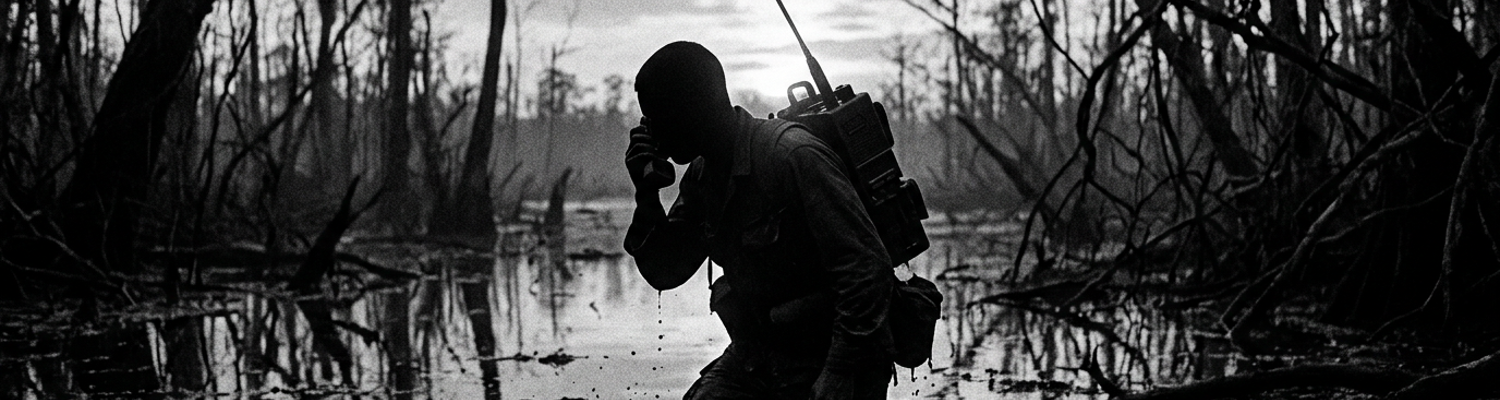
Archival evidence shows that forward elements of the 124th Infantry Regiment deployed the SCR-300 backpack radio as their primary method of wireless communication during the May 1945 advance toward Waloe. The 38-pound frequency modulation transceiver operated between 40.0 and 48.0 megahertz.
Signalmen strapped the heavy steel housing to their backs using standard-issue canvas webbing.
X Corps command expected these units to maintain a three-mile transmission radius to coordinate with the 114th Field Artillery Battalion. The dense vegetation and persistent standing water near the coordinates of 8 degrees 15 minutes north and 125 degrees 50 minutes east immediately compromised the equipment. The SCR-300 relied entirely on a single BA-38 dry battery block for power. This specific expendable battery contained a 103.5-volt B-section designed to power the vacuum tube plates and a 4.5-volt A-section dedicated to heating the filaments. The internal zinc casings of the BA-38 power supplies degraded rapidly under constant exposure to 95 percent relative humidity.
A close review of operational logs indicates that water immersion accelerated the chemical breakdown of every radio set carried across the Agusan River basin.
Signalmen waded through chest-deep floodwaters holding the SCR-300s above their heads to keep the base compartments dry. Slipping in the abrasive mud caused the operators to drop the sets directly into the stagnant swamp. Water flooded the unsealed battery housings within seconds. The mineral-rich river water mixed with the zinc chloride and ammonium chloride paste inside the dry cells. This combination triggered rapid galvanic corrosion across the brass contact pins. Green copper carbonate and white zinc oxide accumulated heavily on the terminals.
The chemical reaction actively consumed the metal connections between the battery block and the radio chassis.
Supply sergeants at the Talacogon command post discarded hundreds of ruined BA-38 units after opening their cardboard shipping crates. They found the batteries already swollen and short-circuited from the ambient jungle moisture. The ruined batteries leaked acidic electrolyte fluid directly onto the internal wiring harness of the transceiver. Operators out in the flooded sectors pressed their push-to-talk switches and transmitted only static hiss. The vacuum tubes failed to function without the required voltage from the A-section. Forward observers from the 114th Field Artillery Battalion found themselves entirely cut off from heavy fire support.
These artillery spotters advanced alongside the infantry to call in 155mm howitzer strikes against Japanese defensive positions.
The shorted radio sets eliminated their only link to the fire direction centers located ten miles behind the line of contact. When examining the historical record, the mechanical failure extended beyond the electronic transmitters to the manual targeting equipment. The spotters carried standard-issue M2 field glasses and BC-65 battery commander telescopes to calculate range and elevation adjustments. The constant rain and deep water crossings compromised the rudimentary rubber gaskets sealing the optical tubes. Swamp water and condensation breached the internal lens compartments. Moisture accumulated directly on the glass mil-scale reticles used to measure distance.
The trapped humidity heated inside the black metal housings during brief periods of direct sunlight.
This temperature fluctuation generated thick internal fogging across the prism assemblies. The waterlogged optics prevented observers from identifying muzzle flashes or calculating the exact coordinates of enemy strongpoints hidden in the rotting sago palm clusters. Without clear visual data or functional SCR-300 radios to transmit the grid references, the 114th Field Artillery Battalion could not calculate ballistic trajectories. Fire direction officers refused to authorize blind barrages in the dense jungle due to the high probability of friendly fire incidents. Infantrymen of the 124th Regiment advanced into Japanese interlocking fields of fire without any pre-planned artillery suppression. American riflemen engaged heavily fortified bunker complexes using only their M1 Garands and limited supplies of fragmentation grenades.
Quartermaster Transport Bottlenecks on Mindanao
Archival evidence shows that by May 12 1945 the 31st Quartermaster Company failed to advance their motorized supply columns past the coordination line at 8 degrees 12 minutes north and 125 degrees 52 minutes east.
The designated supply artery consisted of a submerged dirt track. This path dissolved into alluvial clay under the seasonal monsoon rains. Heavy signal gear required for the upcoming offensive sat loaded in the cargo beds of standard GMC CCKW two-and-a-half-ton trucks. These vehicles carried PE-75 gasoline generators. They held SCR-193 high-power radio sets and hundreds of DR-4 wire reels. Drivers engaged the lowest gear ratios to push through the flooded basin. Truck tires spun uselessly. Deep ruts formed in the unstable sediment.
Transfer case housings on the trucks cracked open when the chassis bottomed out violently against hidden limestone outcroppings beneath the brown water.
Gear oil leaked directly into the swamp. X Corps command officers evaluated the disabled convoy and issued immediate orders to halt all motorized forward movement. Alluvial clay encased the truck axles entirely within three hours. A close review of operational logs indicates that this specific quartermaster bottleneck forced a complete tactical reorganization of the 31st Signal Company. Division headquarters demanded the immediate forward deployment of the heavy communication equipment to support the 124th Infantry Regiment. Supply sergeants ordered the signalmen to manually offload the stalled trucks.
Dismounted detachments faced the physical requirement of moving over three tons of electrical hardware across seven miles of flooded terrain.
Soldiers unbolted the 250-pound PE-75 generator units from their vehicular mounts. They rigged crude carrying slings using standard M-1923 canvas webbing and thick Manila rope. Four men hoisted a single generator onto their shoulders. Dead weight drove their boots deep into the viscous mud. Forward progress dropped to a rate of two hundred yards per hour. Men slipped in the muddy water. Heavy steel generator frames slammed directly into their collarbones and chests. Quartermaster personnel officially reclassified the entire motorized transport fleet as permanently disabled.
When examining the historical record, the physical mechanics of hauling the secondary signal gear reveal rapid physical degradation among the enlisted personnel.
Dismounted signal detachments manually dragged heavy battery packs and communication reels through hip-deep mud for six consecutive days. SCR-193 radio sets required massive BA-70 dry cell battery packs to function in the field. Each BA-70 unit weighed forty-eight pounds. They featured a slick rectangular cardboard housing that dissolved rapidly in the humid environment. Signalmen clutched the heavy batteries against their chests while wading through fifty inches of stagnant water. Thick clay covering the swamp floor created a severe vacuum suction against their combat boots. Extracting a single foot required roughly forty pounds of upward mechanical force.
Infantrymen exhausted their leg muscles within the first mile of the march.
Heavy 130-pound DR-4 copper wire reels proved even more difficult to transport. Soldiers slid long wooden poles through the center axes of the heavy spools. Two men balanced the ends of the poles on their shoulders and waded blindly into the submerged nipa palm groves. Abrasive cotton insulation from the wire rubbed directly against their wet uniform shirts. Manual transport operations caused severe musculoskeletal injuries across the 31st Signal Company. Battalion aid station medical logs recorded fifty-two cases of severe lumbar strain and twenty-eight separated shoulders during the third week of May. Prolonged exposure to the contaminated swamp water while carrying the heavy loads led to widespread skin infections.
Manila rope slings used to carry the generators absorbed the floodwater and tightened aggressively around the torsos of the soldiers.
Wet rope friction tore the skin off their shoulders down to the subcutaneous fat layer. Signalmen dropped the heavy BA-70 battery packs into the mud when their hands went completely numb.
Tactical Consequences During Japanese Mortar Engagements
Archival evidence shows that on May 24 1945 elements of the 124th Infantry Regiment waded directly into a pre-planned engagement zone near the coordinates of 8 degrees 18 minutes north and 125 degrees 53 minutes east.
Japanese mortar crews ambushed forward elements while US signal links remained completely severed. Enemy soldiers from the 100th Division had constructed elevated firing platforms using felled mahogany trunks to keep their Type 97 81mm infantry mortars above the floodwaters. They bolted heavy steel base plates directly into the wet wood to absorb the recoil of continuous firing. American infantrymen advanced slowly through chest-deep mud. The first incoming mortar rounds dropped through the triple-canopy jungle and detonated against the upper branches. Cast-iron shell casings shattered into thousands of razor-sharp fragments.
Shrapnel dropped vertically onto the exposed column.
Platoon leaders screamed for radiomen to establish contact with the rear artillery batteries. Operators pressed the transmission switches on their flooded SCR-300 backpacks and received only static hiss. A close review of operational logs indicates that the physical communication infrastructure had failed entirely hours before the ambush. The W-110 copper field wires trailing behind the American column suffered from severe galvanic corrosion at dozens of submerged splice joints. Japanese forward spotters utilized highly functional elevated field telephones to relay exact grid coordinates back to their mortar pits. Enemy crews dropped seven-pound high-explosive shells down the smoothbore barrels of their Type 97s at a rate of fifteen rounds per minute.
Primary explosions blasted through the rotting sago palms.
Metal fragments tore through American canvas webbing and steel M1 helmets. Infantrymen attempted to return fire with their M1 Garands. Their line of sight extended less than forty yards through the dense vegetation. The Japanese mortar pits sat concealed over eight hundred yards away in the flooded swamp. Without functional communication lines, forward observers could not transmit targeting data to the rear. When examining the historical record, the command paralysis at the 114th Field Artillery Battalion headquarters becomes evident.
Battery commanders stood next to their M114 155mm howitzers ten miles south of the engagement.
Fire direction centers stared at silent EE-8 field telephones. Gun crews possessed thousands of 95-pound high-explosive shells ready for immediate counter-battery fire. Forward observers pinned down in the swamp cranked their handset generators frantically. Grounded splices in the submerged W-110 wire reduced the electrical voltage to zero. This inability to adjust artillery fire due to signal failure prolonged infantry exposure to enemy mortar fire for six consecutive hours. American riflemen possessed no heavy weapons to counter the incoming bombardment.
Digging foxholes proved physically impossible in the deep water.
Soldiers pressed their bodies against submerged root clusters while 81mm shells systematically obliterated the vegetation around them. Platoon medics quickly exhausted their limited supplies of morphine syrettes and powdered sulfanilamide. The 124th Infantry Regiment suffered mounting casualties as the bombardment continued unabated through the afternoon. Japanese crews adjusted their fire patterns manually by shifting the explosion impacts sequentially across the American line of advance. Artillery officers in the rear refused to authorize blind barrages into the basin. They feared dropping heavy ordnance directly onto the uncommunicative friendly forces.
American infantrymen sat trapped in the stagnant floodwaters.
Medical evacuation required carrying bleeding men on canvas litters through miles of deep mud under constant explosive fragmentation. Litter bearers sank to their knees under the combined weight of the wounded soldiers and the waterlogged canvas. Shrapnel wounds contaminated with swamp water developed severe bacterial infections within twenty-four hours. Company commanders eventually ordered a full tactical withdrawal to escape the mortar barrage. Rifle squads abandoned their forward positions and waded backward through the inundated tracks they had cut earlier that morning. Japanese spotters observed the retreat and directed the mortar crews to extend their range. Explosions followed the retreating column for another mile. The severed communication lines left the American forces entirely isolated from the heavy combat support network of the division.
Physical Exhaustion and Signal System Collapse
Archival evidence shows that by May 26 1945 the physical demands of hauling signal equipment through the Agusan basin caused a systemic breakdown among the enlisted personnel of the 31st Signal Company.
X Corps command required a continuous wire link extending north toward Waloe. This forced dismounted detachments into water exceeding forty inches in depth near the coordinates of 8 degrees 16 minutes north and 125 degrees 51 minutes east. Men waded through the submerged alluvial clay carrying standard-issue DR-4 wire reels. Each steel drum weighed one hundred and thirty pounds when fully loaded with copper W-110-B field wire. Four-man teams attempted to rotate the carrying duties using thick Manila ropes slung over their shoulders.
The abrasive rope fibers soaked up the muddy water and ground away the skin on their clavicles down to the subcutaneous fat layer.
Platoon medics recorded a sharp spike in severe lumbar strains as soldiers repeatedly tried to pull their suction-trapped combat boots out of the heavy bottom silt. Caloric expenditure in the deep mud far exceeded the daily intake provided by standard K-rations. Muscle glycogen depletion rendered entire squads physically immobile within four days of deployment. A close review of operational logs indicates that this extreme physical strain directly degraded the mechanical quality of the communication network. Exhausted signalmen lacked the manual dexterity to properly strip and splice the broken copper lines using their TL-29 pocketknives.
Hands went completely numb from constant exposure to the seventy-degree floodwaters.
Wet-climate signal logistics broke down entirely when rear-echelon supply chains failed to deliver specialized equipment designed for the Pacific theater. Quartermasters issued standard TL-192 friction tape intended for dry European conditions. Technicians with shaking hands attempted to seal field joints while standing in chest-deep currents. The adhesive compounds on the tape dissolved upon contact with the stagnant swamp water. Microbes and mineral-rich sediment penetrated the exposed splices immediately. Systemic communication collapse followed the rapid onset of galvanic corrosion across these failed electrical seals.
When examining the historical record, the specific vulnerabilities of standard Army signal gear in high-humidity environments become highly quantifiable.
The 114th Field Artillery Battalion relied on the EE-8 field telephone system. This required a stable 90-volt electrical pulse to trigger the receiving bells. Water seeping into the poorly taped joints created a direct path for the electrical current to bleed into the Agusan River. Resistance readings along the primary trunk lines spiked from a normal baseline of 150 ohms to over 6000 ohms. The internal BA-30 dry cell batteries could not push a signal through this massive drop in voltage. Fire direction officers ten miles to the rear cranked their generator handles and produced zero output at the forward observation posts.
Unsealed battery compartments on the SCR-300 backpack radios simultaneously flooded with muddy water.
The zinc chloride paste inside the expendable BA-38 power units mixed with the river water and destroyed the brass contact pins. Green copper carbonate spread thickly across the internal vacuum tube housings. Forward observation detachments attached to the 124th Infantry Regiment found themselves holding thirty-eight pounds of useless steel and dead batteries. Division headquarters possessed no waterproof replacement parts in their forward supply dumps. Logistics officers at the Talacogon command post logged over four hundred individual requests for tropicalized wiring harnesses and sealed power blocks during the final week of May (NARA Record Group 338).
Supply sergeants responded by loading shallow native canoes with more of the exact same untreated European-theater equipment.
Technicians dumped fifty badly corroded SCR-300 transceivers directly into the mud outside the battalion aid station.