
Pre-Dawn Rubber-Boat Assault at Umtingalu
In the red-lit hold of the high-speed transport USS Sands (APD-13), an ordnance technician scraped corrosion off the screw terminals of a BA-38 dry battery with the edge of a bayonet. He wrapped friction tape around the rubber gasket of an SCR-536 chassis. He pressed the adhesive flat with his thumb to keep salt air off the internal vacuum tubes. Around him, men checked zinc casing seals and inspected telescoping antennas. They seated five-prong connector plugs into damp rubber sockets. External moisture had already coated the equipment racks before the gear cleared the compartment hatches. When examining the historical record, this mechanical routine was the final barrier between functional electronic command and total signal isolation.
Every transceiver relied on fragile paper-and-foil capacitors that dissolved when exposed to brine.
Under complete blackout at 0330 hours on December 15, 1943, Troop A of the 112th Cavalry Regiment climbed down cargo nets. They boarded fifteen unpowered ten-man rubber boats designated as LCR(L) craft. General Douglas MacArthur had assigned this dismounted cavalry detachment to execute a secondary diversionary landing at Umtingalu. This small coastal settlement was situated on the southern coast of New Britain, roughly five miles east of the main objective on the Arawe peninsula. Operational plans directed the rubber craft to paddle across two miles of open water. They were ordered to cross the exposed reef barrier fronting the Lupum River mouth and establish a blocking position against Japanese reinforcement corridors. Low oceanic swells immediately pushed several overloaded boats out of formation. Heavy gear dragged over the rubberized gunwales. Coastal chop sloshed directly across the floorboards.
The tactical plan assumed silent infiltration without preliminary naval bombardment.
Archival evidence shows that water ingress disabled the primary tactical transmitters long before the paddle-driven assault craft reached the line of departure. The assault echelon carried lightweight SCR-536 handie-talkies alongside bulkier fifty-pound SCR-284 field radio sets mounted in pack frames. Pliofilm protective bags tore against combat webbing and equipment buckles. The rough wooden oars handed to the infantrymen punctured the waterproof canvas. Saltwater saturated the carrying bags of the SCR-284 transceivers. Brine penetrated the cast-aluminum BC-654 transmitter housings. This fluid short-circuited the GN-45 hand-cranked generators. Inside the smaller SCR-536 units, sea spray entered the threaded antenna wells. Water seeped beneath the push-to-talk microphone diaphragms. Operating voltages dropped to zero. The low-drain filaments of the 1R5 converter and 1T4 amplifier tubes burned out instantly.
Dead batteries and flooded coils killed the company net before the boats cleared the reef.
A close review of operational logs indicates that this instantaneous hardware breakdown completely severed communications with the designated direct fire support destroyer. USS Shaw (DD-373) waited offshore in the dark. The naval gunfire liaison officer riding with the assault commander had no functional transmitter to broadcast target coordinates. He could not transmit frequency shifts or emergency fire requests back to the fire control radar operators on the destroyer. The rubber boats crossed within three hundred yards of the beach at 0500 hours. Japanese defenders from the 1st Battalion, 229th Infantry Regiment opened defensive fire from camouflaged pillboxes. They used heavy machine guns, automatic rifles, and two 25mm dual-mount coastal cannons. Japanese gunners holed and deflated twelve of the fifteen rubber boats within five minutes under crossfire. Without a functioning SCR-284 frequency link to alert USS Shaw to the ambush, the cavalrymen were unable to request counter-battery suppressive salvos. The survivors were left floating in open water without covering fire. Destroyer lookouts spotted muzzle flashes on the shoreline only after twelve craft had slipped beneath the surface.
Total Radio Blackout and Shoreline Repulse
When examining the historical record, Japanese defensive positions along the elevated limestone bluffs east of the Lupum River mouth completely controlled the water approaches to the Umtingalu landing site. Positioned inside coconut-log and coral pillboxes with interlocking fields of fire, gunners from the 1st Battalion, 229th Infantry Regiment held their fire until the assault formation closed to three hundred yards. Twin-barrel Type 96 25mm coastal autocannons and Type 92 7.7mm heavy machine guns opened up simultaneously in a pre-registered crossfire. High-explosive and armor-piercing tracer rounds tore through the unarmored LCR(L) hulls at a cyclic rate exceeding two hundred rounds per minute. Multiple buoyancy chambers burst instantaneously. The fabric floorboards collapsed. Heavy machine guns, mortar baseplates, and ammunition bandoliers dumped into thirty feet of water. Sustained automatic weapons fire raked the swimming cavalrymen as the remaining boats drifted broadside into the submerged coral shelf. Entrenched Japanese defenders utilized coastal 25mm autocannons and heavy machine guns to sink twelve of the fifteen assault boats. Surviving assault elements scattered across the surf.
Twelve of fifteen craft went to the bottom within eight minutes of contact.
Archival evidence shows that this equipment failure left the assault force entirely unable to coordinate with offshore naval assets. The primary shore fire control party embedded with Troop A carried an SCR-284 field radio set. Seawater had bypassed the rubberized canvas gaskets during the chaotic debarkation from USS Sands. Inside the BC-654 transmitter chassis, saltwater coated the terminal lugs. This created dead shorts across the high-voltage plate circuits. Emergency field attempts to crank the GN-45 generator only produced internal arcs. These electrical fires charred the copper windings of the primary induction coil. Inability to transmit targeting coordinates left surviving troopers stranded on the shoreline without indirect naval gunfire support. Forward observers possessed no voice channel or continuous-wave link to transmit range corrections to the destroyer USS Shaw (DD-373). The warship waited four thousand yards offshore. Lookouts on the destroyer tracked Japanese muzzle flashes stabbing out of the jungle fringe. They had no target grid numbers or clearance vectors. Without verified shoreline coordinates to direct suppressive counter-battery fire, the warship could not discharge its five-inch batteries without killing the cavalrymen trapped against the tidal shelf.
USS Shaw withheld its five-inch batteries while cavalrymen drowned under concentrated tracer fire.
A close review of operational logs indicates that Company A officers were forced to fall back on visual pyrotechnics and signal flags to organize an emergency withdrawal. Surviving troops of Company A were forced to withdraw using signal flares and visual flags instead of coordinated radio links. Waterlogged troopers pulled emergency signaling kits from rubber envelopes. They struck individual percussion caps to fire red M11 star clusters into the gray predawn sky. Pinned cavalrymen crouching behind jagged coral outcroppings unfurled yellow fabric recognition panels. They waved semaphore flags toward the open bay. Coxswains aboard offshore Landing Craft Vehicle Personnel (LCVPs) saw the red flares. They turned their unarmored wooden hulls toward the surf line under direct enemy observation. No functional tactical frequency existed to coordinate boat approaches through gaps in the reef. No radio net could direct extraction craft toward specific pockets of swimming cavalrymen. Extraction craft steered directly toward the drifting red phosphorus smoke. Sailors hauled wounded men over the gunwales while Japanese coastal gunners continued to walk 25mm autocannon fire across the reef channel.
Mud Revetments and Improvised Stove Repairs
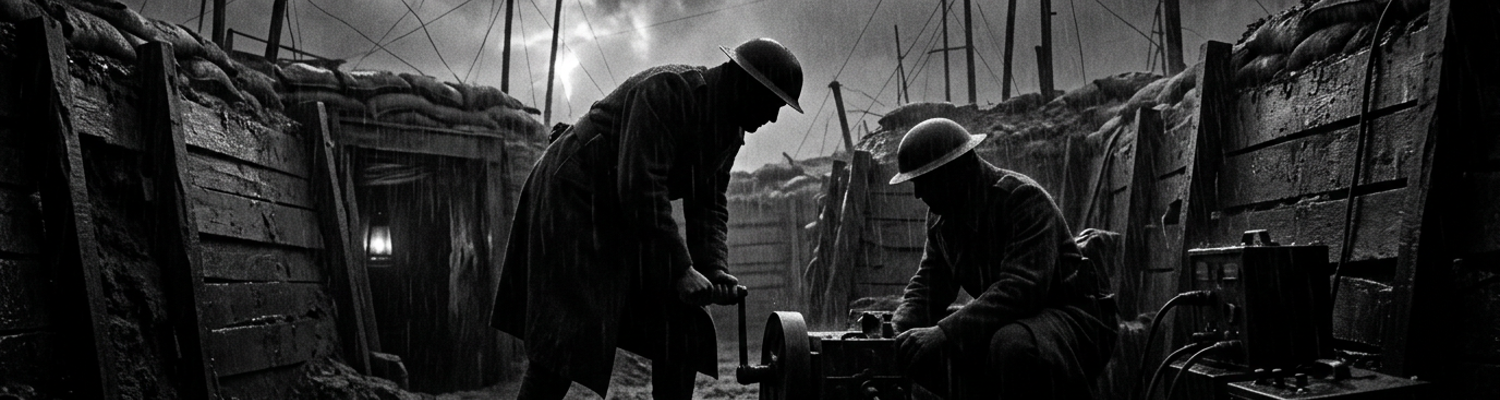
When examining the historical record, communications personnel from the 112th Cavalry Regimental Communications Platoon and attached 33rd Signal Construction Battalion elements dragged flooded transceivers into collapsed Japanese defensive revetments. These positions sat along the high-water line of House Fireman Beach. Shifting tidal mud seeped continuously into these shallow, waterlogged earthworks. Japanese Type A Daihatsu landing craft maneuvered five hundred yards off the western reef line. Japanese crews operated bow-mounted 13.2mm Type 93 heavy machine guns and rapid-firing 25mm autocannons. They sent flat-trajectory solid rounds snapping through the fringe of coconut palms directly into the sandbags. Incoming high-velocity rounds repeatedly clipped the revetment parapets. Salt mud and pulverized volcanic sand showered onto the open chassis of disassembled radios. Corporal technicians knelt in eight inches of stagnant brackish water. They stacked empty wooden ammunition crates to form an elevated bench above the rising tide. Staff officers demanded restoration of the regimental command link to Task Force 76 before noon. This compelled the signal team to establish an operational repair depot while fragments from barge gunfire shredded shelter halves rigged above the trench.
Shrapnel punctured two spare BC-654 housings before technicians could even pull the chassis bolts.
Archival evidence shows that moisture inside the transceivers had turned dry electrical insulation into conductive paths. This threatened total circuit destruction. Technicians systematically extracted the five-pin glass vacuum tubes and the rectangular metal crystal holders that governed primary tactical frequencies. Brine had penetrated the phenolic octal bases of 3Q5 power amplifier tubes. Salt coated the pins of 1N5 signal detector pentodes. This caused conductive shorts between high-voltage plate contacts and ground. Specialist fifth-class radio mechanics unbolted the inspection covers of FT-243 crystal holders. They exposed the hair-thin quartz wafers to open air. To purge trapped humidity without fracturing the temperature-sensitive quartz, the signalmen lit two-burner Coleman Model 520 squad stoves fueled by white gasoline. Radiomen balanced individual vacuum tubes on inverted mess kits set over the brass burner heads. They monitored the heat to prevent thermal shock from cracking the glass envelopes. They cooked quartz frequency plates on heated sheet metal strips for twelve minutes at a stretch. This drove off water vapor that dampened the physical oscillations of the crystal and silenced the carrier wave.
A single drop of sweat onto heated quartz shattered the crystal element.
A close review of operational logs indicates that mechanical corrosion posed an equally destructive threat to circuit integrity across the SCR-284 receiver assemblies. Airborne salt spray combined with tropical humidity had produced thick green copper carbonate across the variable tuning capacitors. This bridged the interleaved aluminum rotor and stator plates with conductive residue. Technicians dipped standard-issue synthetic-bristle GI toothbrushes into open cans of 80-octane vehicle gasoline. They scrubbed the closely spaced capacitor plates without bending their micro-calibrated tolerances. They worked the bristles between the fractional-millimeter plate gaps. This dissolved oily salt sludge and flushed out conductive sand grains that caused direct short-circuits during channel selection. Mechanics scrubbed corroded solder lugs, ceramic coil forms, and terminal strip jumpers until bare copper and tinned steel were exposed to fresh solder joints. Technicians then measured circuit continuity using salvaged Weston Model 663 volt-ohmmeters. They confirmed that plate-to-ground resistance exceeded five megohms before sliding the sub-chassis back into water-damaged outer cases.
Joint Assault Signal Party Technical Reconstitution
Archival evidence shows that elements of the 1st Joint Assault Signal Company detachment assigned to the Arawe landing zone dragged six smashed SCR-284 sets into a revetment fifty yards inland from House Fireman Beach. Shrapnel had shredded the stamped aluminum housings of three BC-654 transmitter-receivers. Ocean surf had corroded the internal modulation transformers and shorted the primary windings of the remaining units. Technicians used ground-down bayonets and screwdrivers filed flat against coral rock to strip intact intermediate-frequency coils out of flooded sub-assemblies. Signalmen desoldered undamaged ceramic wafer band-switches, dry 3Q5 power amplifier tubes, and unbroken filament rheostats from cracked chassis plates. They spliced scorched wiring harnesses with rubber-jacketed conductor wire pulled from drowned amphibious tractors idling at the surf line. Operating without factory replacement kits under sporadic Japanese sniper fire from the western bluffs, the signal party aligned salvaged gear assemblies. They tightened loose rotor plates on surviving variable tuning capacitors. Cannibalized parts from four ruined transceivers were bolted into two structurally sound aluminum cases. This produced working BC-654 sets.
Two functional transmitters emerged from the wreckage of six.
When examining the historical record, Japanese mortar bursts and coastal autocannon fire across the beach perimeter had snapped every five-section MS-54 mast and AN-130 whip antenna down to the base springs. Running the rebuilt BC-654 transmitters without an aerial of correct electrical length would burn out the delicate 211 power output tubes within seconds of keying the microphone. Technicians unspooled coils of standard W-110-B twisted-pair field wire. They sliced away the outer cotton braid and rubber insulation. They extracted the inner tinned-copper conductors. Signalmen weighted the wire ends with brass 75mm shell casings. They threw the lines thirty feet upward into the broken boughs of mangrove trees fronting the beach. To prevent the signal current from grounding out against rain-soaked foliage, the team improvised insulators using glass medical ampoules and dry phenolic scraps tied off with waxed linen cord. Radiomen extended sixty-five feet of bare wire horizontally toward the water. They anchored the lower ground lead directly to four-foot bronze stakes driven into the saturated tidal mud to form an artificial ground plane.
Copper wire strung through salt mangrove branches replaced the factory steel whips.
A close review of operational logs indicates that extreme tropical humidity and ninety-degree ambient heat caused destructive operational frequency drift inside the FT-243 crystal holders. Trapped moisture films altered the physical mass of the quartz wafers. This shifted the resonant oscillation by up to eight kilocycles and completely knocked the assault echelon off the Task Force 76 division net. Radiomen disassembled the rectangular phenolic crystal cases. They lifted out the wafer plates with brass tweezers. They cleaned grease and oxidation off the quartz surfaces using technical-grade alcohol. Technicians then applied graphite from standard issue pencils directly onto the crystal faces. This increased the physical thickness of the element to lower its operating frequency. If a crystal drifted too low, the signalmen stroked the quartz blank across fine volcanic pumice dust to shave off microscopic layers. Signal operators verified the frequency shifts by checking the signal against a battery-powered BC-221 frequency meter. They tuned until the receiver output stabilized at the exact 3885-kilocycle battalion command frequency. Mechanics resealed the crystal housings by brushing melted paraffin from K-ration boxes across the casing seams.
Paraffin wax kept the calibrated quartz dry inside the dripping trench.
Operational logs confirm that these reconstructed transceivers established direct contact with the destroyer USS Conyngham (DD-371) at 1315 hours. The naval gunfire liaison team transmitted target grid coordinates for Japanese gun pits concealed across the western base of the Arawe peninsula. Five-inch high-explosive salvos from offshore warships impacted the defensive redoubts twelve minutes later. This neutralized the 25mm autocannons that had pinned the cavalrymen since dawn.
Naval Gunfire Coordination Against Counterattacks
Archival evidence shows that by 1400 hours on December 15, patched-together BC-654 transmitters began pushing amplitude-modulated signals across the high-frequency band to offshore naval vessels. Operating on the assigned 3980-kilocycle emergency fire-control net, technicians clamped headphone receivers over their ears. This cut out the roar of tropical rain squalls and incoming Japanese mortar fire. Hand-cranked GN-45 generators groaned under physical effort. The dynamos sent 500 volts of plate supply directly through dried 3Q5 tubes into the jury-rigged copper wire aerials strung between the coconut palms. Naval radiomen stationed in the radio shacks of 7th Amphibious Force destroyers USS Shaw (DD-373), USS Drayton (DD-366), and USS Flusser (DD-368) intercepted the scratched voice transmissions coming off House Fireman Beach. Direct liaison between shore fire control parties and warship combat information centers was suddenly restored after nine hours of complete blackout. Combat intelligence officers on the destroyers plotted beachhead boundaries on grease-pencil plotting boards. They matched grid squares to forward cavalry lines anchored across the neck of the Arawe peninsula.
Static gave way to raw targeting coordinates.
A close review of operational logs indicates that forward observers exploited these patched links to walk naval artillery fire directly along the perimeter wire. Joint Assault Signal Party spotters dug their bellies into wet volcanic sand less than one hundred and fifty yards from incoming Japanese assault lines. Through field glasses, observers spotted enemy machine-gun teams deploying across the dense jungle fringe fronting the government track. Radiomen keyed their carbon microphones. They fed rapid target offsets, deflection corrections, and powder-charge requirements back to the gun bosses aboard the destroyers. Five-inch 38-caliber Mark 12 gun mounts on USS Shaw and USS Flusser rotated toward the tree line. They fired 54-pound high-explosive projectiles into low trajectories across the water. Spotters checked projectile impacts. They called in fifty-yard range drops that brought naval shell splinters showering down into their own shallow foxholes. Forward observers accepted the danger-close fragmentation hazards to suppress Japanese machine gunners attempting to enfilade the cavalry line.
Steel fragments sheared the upper palm canopy thirty yards ahead of the American foxholes.
When examining the historical record, this improvised signal net broke the organized counterattacks launched by the Imperial Japanese Army 229th Infantry Regiment. Major Masaru Komori had assembled two infantry companies armed with Type 99 rifles, Type 92 heavy machine guns, and knee mortars. He intended to drive the dismounted cavalrymen back into the sea before nightfall. Japanese troops charged out of the secondary growth east of the airfield strip. They rushed the narrow defensive line held by the 112th Cavalry. Rebuilt BC-654 transceivers allowed the shore liaison party to feed real-time coordinates directly into destroyer gun directors as the assault uncoiled. High-velocity five-inch broadsides exploded in continuous rolling barrages directly through the Japanese assembly areas. Blast pressure and shell splinters obliterated the advancing platoons. The explosions collapsed forward defensive ditches and cut down advancing Japanese squads before they closed within grenade range. Surviving elements of the 229th Infantry Regiment broke contact and fell back into the swampy depressions along the Pulie River trail. They left over one hundred dead across the shattered brush.
By nightfall, naval gunners had fired over six hundred rounds of five-inch ammunition into the perimeter tree line without hitting a single American weapon pit.