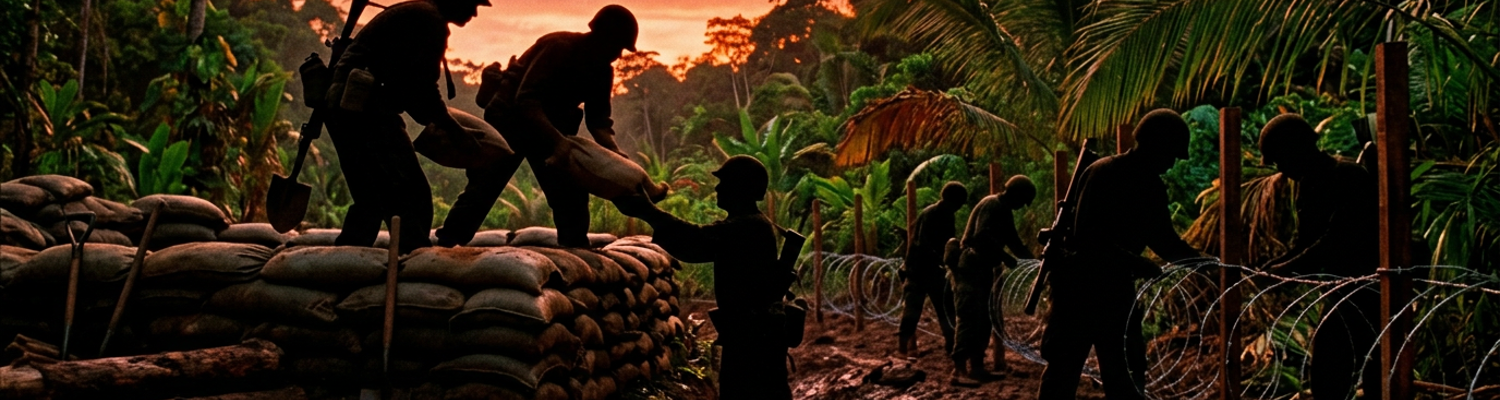

Quang Tri Headquarters and Keystone Eagle Drawdowns
Radio operators at Quang Tri Combat Base intercepted an urgent burst of distress signals filled with static from an isolated village compound near the buffer zone, triggering an immediate chain of command decisions inside the sweltering operations bunker. Suffocating humidity settled over the tactical operations center while monsoon rain churned the surrounding soil into knee-deep red clay that clogged the treads of tracked vehicles and weighted down the combat packs of arriving foot patrols. Headquarters for the 4th Combined Action Group coordinated eighteen Combined Action Platoons facing resource constraints that threatened daily survival along the Demilitarized Zone during July 1969. Staff officers gathered around acetate-covered map boards to pinpoint the reported enemy mortar positions, measuring shrinking defense lines where small Marine squads and local South Vietnamese Popular Forces lived together. Tactical controllers worked field telephones to assemble a reaction force and organize an emergency supply run of concertina wire, sandbags, and rifle ammunition for the besieged compound. Watch officers transmitted orders to the motor pool to prepare transport vehicles for an immediate run through the mud to reinforce the outer garrison before darkness fell.
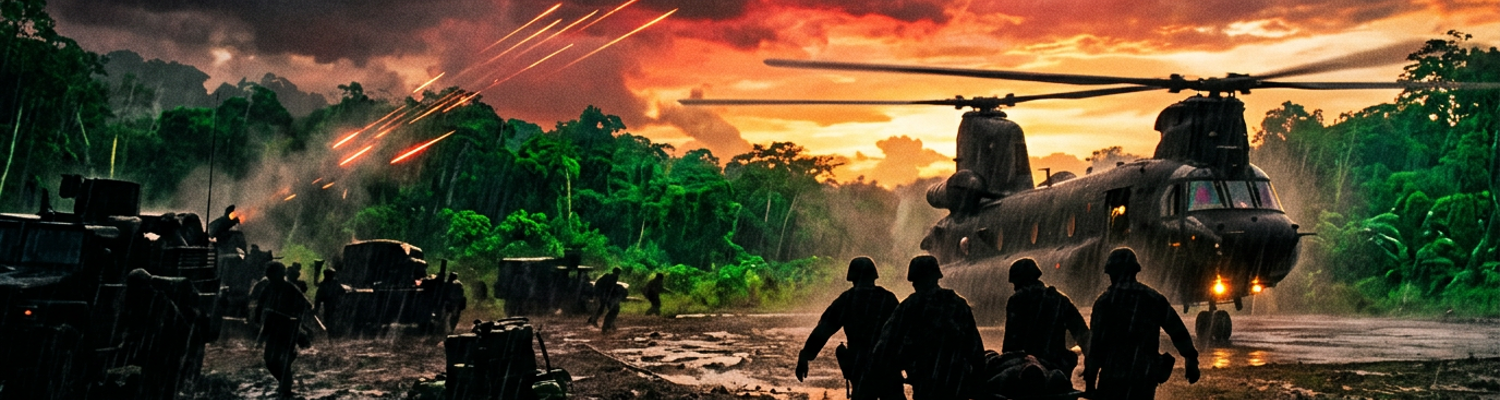
Truck drivers at the motor pool staging yard reported that no convoy vehicles or escort gunships were available to move toward the compound because Operation Keystone Eagle began withdrawing III Marine Amphibious Force personnel, severely reducing heavy logistical support and dedicated quick-reaction forces. Marine combat regiments and aviation squadrons packed their heavy gear for shipment back to offshore bases, stripping the 4th Combined Action Group of its regular coverage of aerial fire support and helicopter evacuation. Motor transport mechanics worked through the pouring rain to remove working drive shafts and fuel lines from broken six-by-six trucks, attempting to keep a dwindling reserve fleet of cargo haulers operational without factory replacement parts. Logistical records documented shortages in heavy engineering equipment, meaning bulldozers could no longer be dispatched to dig drainage ditches or build reinforced earth bunkers around exposed village garrisons. Artillery controllers at the base tactical center discovered that nearby fire support bases were shutting down their howitzer batteries to comply with scheduled troop departures, cutting off protective artillery coverage over the outlying hamlets. Operations planners informed the isolated outposts that ground convoys could not reach them, leaving all eighteen Combined Action Platoons to maintain their positions with whatever ammunition and engineering wire remained inside their perimeter trenches.
Ledger sheets spread across headquarters briefing tables showed that data-driven command assessments documented wide divergences between pacification progress metrics and the reality of remote compound vulnerability. Statistical evaluation printouts graded these farming communities as secure zones based on daytime commerce counts, school attendance figures, and the absence of daylight firefights. Enemy mortar crews exploited the lack of heavy defenses by firing fragmentation rounds into the compounds every evening, breaking through exposed living bunkers and proving that pacification index scores did not match the tactical reality along the river valleys. Frontline Marines and Popular Forces troops bridged this divide between paper metrics and physical survival by scavenging whatever scrap materials they could drag into their trenches, filling discarded wooden ration boxes and spent ammunition crates with wet red clay to build crude blast shields. Platoon leaders rationed mortar shells, patched punctured drainage pipes by hand, and strung rusty barbed wire along the outer dirt mounds to slow down enemy infiltrators in the rain. Headquarters dispatchers logged these improvised defensive measures into the daily record before transmitting orders for the remote platoons to conserve their remaining rifle ammunition and prepare for night ground assaults.
Platoon Dispersal Across Cam Lo and Trieu Phong
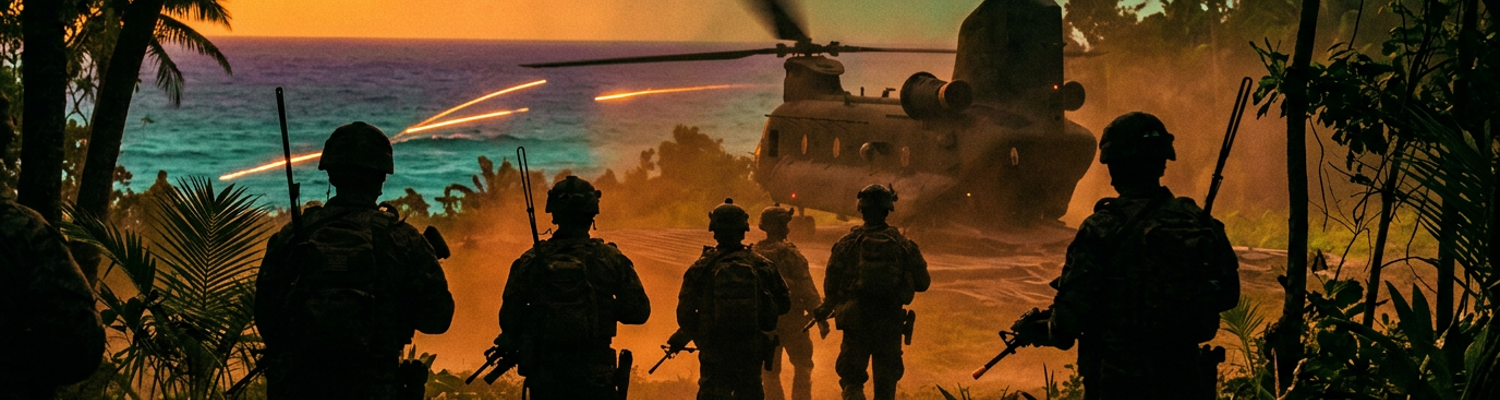
Radio receivers at outposts throughout Cam Lo, Mai Linh, and Trieu Phong districts buzzed with these incoming conservation directives while Combined Action Companies 4-1, 4-2, and 4-3 prepared their isolated positions along the Demilitarized Zone buffer. Marine rifle squads integrated directly with South Vietnamese Popular Forces to establish permanent twenty-four-hour security within contested rural hamlets, living in village compounds rather than returning to fortified central bases. Team members shared crowded earthen trenches, manned sandbagged fighting holes side by side, and split guard shifts across bamboo watchtowers overlooking rice paddies. Patrol leaders synchronized their night ambushes with village elders to intercept enemy movement along canal banks, ensuring that farming families could plant and harvest crops without paying extortion taxes to Viet Cong cadres. Compound perimeter sentries counted on this mutual vigilance every night, as the combined teams set up tripwires, placed claymore mines along natural avenue approaches, and checked their firing circuits before darkness fell.
Munitions stockpiles inside compound bunkers dwindled after every night firefight because the dispersed platoon compounds relied on unpaved secondary roads that were routinely mined or washed out, complicating ground resupply. Convoys attempting to haul sandbags, concertina wire, and ration cartons from Quang Tri Combat Base encountered muddy cratered bypasses where heavy six-by-six transport trucks sank to their axles in red clay. Viet Cong guerrillas took advantage of these terrain bottlenecks by planting unexploded artillery shells as improvised mines along the shoulders of Route 9 and smaller cart paths connecting Cam Lo to Trieu Phong. Marine combat engineers equipped with handheld metal detectors walked ahead of supply columns on foot, sweeping narrow dirt trails kilometer by kilometer while sniper fire forced them into roadside ditches. Explosive ordnance disposal teams repeatedly halted cargo movements to neutralize command-detonated explosives, stretching a ten-mile relief run into an all-day operation that often stalled before nightfall.
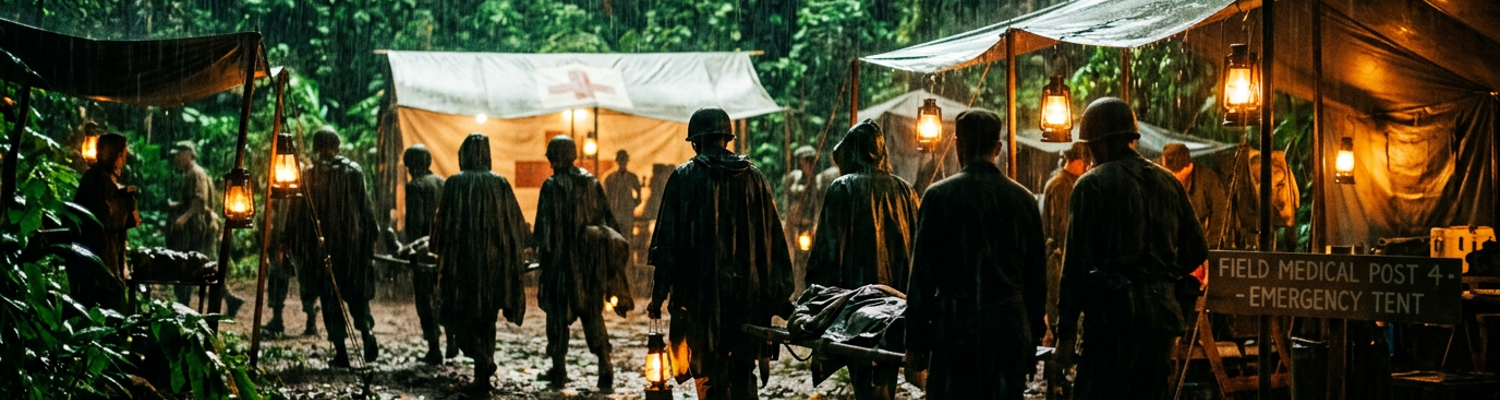
Trucks halted along flooded routes forced Marine squad leaders and Popular Forces troops to drag essential crates of small-arms ammunition and field dressings the remaining miles on foot. Local villagers assisted the troops with wooden handcarts and water buffalo to ferry drinking water, rice sacks, and dry radio batteries past collapsed culverts before enemy scouts discovered the stalled vehicles. Hospital corpsmen inside hamlet clinics treated skin infections, shrapnel wounds, and dysentery with dwindling medical packets, while riflemen cleaned rusted weapon actions with kerosene to keep automatic rifles firing reliably. Machine gun crews reinforced their fighting pits with packed clay, bamboo poles, and woven mats to shield open firing embrasures against incoming mortar fragments. Watch standers took up positions on the sandbagged parapets every two hours under driving monsoon rains, checking sectors of fire and aiming their weapons toward the surrounding tree lines to prevent night infiltration.
Magnesium flares ignited along the outer concertina wire when enemy reconnaissance teams probed the wet scrub, exposing infiltration squads near the edge of the rice paddies. Popular Forces riflemen opened controlled semi-automatic fire from their perimeter trenches, driving the intruders back toward the drainage ditches while Marine squad leaders coordinated defensive mortar counter-battery rounds. Mortar crews inside the compound dropped sixty-millimeter rounds down their tubes by hand, calculating elevation adjustments from memory to conserve their limited stock of high-explosive shells. Radio operators continuously tracked rounds expended on grease-pencil plotting boards, balancing ammunition reserves against the threat of renewed enemy probes across Cam Lo and Trieu Phong. Squad leaders posted fresh sentries in the saturated forward trenches at dawn, beginning another cycle of perimeter repair and physical weapons maintenance before the next monsoon squall struck.
Defensive Revetment Failures in Monsoon Red Clay
Shovels sliced into the sodden parapets as Marines and Popular Forces riflemen tried to rebuild the earthen walls that had washed away overnight. Intense summer humidity and monsoon rains liquefied the regional red clay soil, undermining the structural integrity of sandbag bunker revetments across the entire perimeter. Saturated burlap sacks rotted within days in the damp heat, tearing open under the lateral pressure of the shifting earth and spilling tons of sludge back into the fighting holes. Squads hauled replacement bags up the slick embankments on their knees, struggling for traction in the red clay while water pooled around their combat boots. Mud continued to slide down the interior trench faces, burying weapon firing steps and filling low-lying connecting ditches with thick red slurry that blocked platoon foot traffic. Runoff channels around the platoon perimeter quickly clogged with heavy silt, redirecting torrents of water straight into subterranean sleeping quarters and operational pits.
Infantrymen and combat engineers continuously cleared drainage trenches with entrenching tools and bare hands to prevent the catastrophic flooding and subsidence of underground command bunkers. Standing water inside the subterranean command spaces threatened to submerge radio generators, destroy grease-pencil tracking boards, and short out field telephone wire connections. Mud seeped steadily through unsealed bulkheads as working parties bailed the rising water out of bunker entryways using punctured ammunition cans and cut-open water containers. Marine technicians drove metal pickets deep into the floorboards to anchor shifting revetment walls, while Popular Forces soldiers dug auxiliary runoffs leading toward natural drainage swales outside the defensive wire. Platoon commanders watched subterranean walls bulge inward under the immense weight of the rain-soaked soil, noting where support columns were sinking into the subterranean mire. Structural subsidence placed intolerable vertical stress on existing bunker ceilings, bending native bamboo poles and cracking split-log roof beams under the growing weight of wet clay.
Marines faced a severe deficit of pre-cut dimensional lumber that forced outpost personnel to scavenge shipping pallets and dunnage to reinforce defensive overhead cover before the cracked roof beams gave way. Rear-echelon supply depots at Quang Tri Combat Base carried no stocks of two-by-four framing wood, heavy construction posts, or treated plywood, since logistical priorities favored crating military gear for departing units. Rifle squads searched supply drop zones and abandoned staging pads, tearing apart wooden cargo skids, heavy packing crates, and discarded dunnage timbers with crowbars and axes. Working parties dragged these splintered planks into the trenches, setting the rough pallet boards across buckling ceiling beams to form makeshift cribbing. Teams hammered additional dunnage braces under sagging load-bearing corners, wedging split oak pallets against earth walls to prevent sudden cave-ins during incoming mortar attacks. Platoon leaders supervised the placement of three fresh tiers of clay-filled sandbags on top of the scavenged wooden frameworks, securing the rebuilt overhead blast shields before the next mortar barrage fell.
Emergency Perimeter Repairs Under Mortar Harassment
Mortar rounds from North Vietnamese Army tubes slammed into the freshly reinforced blast shields at dusk, shaking the outpost with deafening concussions and scattering hot metal fragments across the trenches. Regular North Vietnamese Army mortar attacks fragmented defensive wire barriers and collapsed exterior fighting positions throughout the perimeter sector, destroying the barricades built earlier that afternoon. Shockwaves from the heavy projectiles caved in subterranean timber bulkheads, burying critical weapons pits under mounds of loose red clay and trapping defenders inside their fighting holes. Jagged steel shrapnel severed concentric belts of barbed wire into short coils, blowing wide gaps through the protective perimeter obstacles and creating open avenues for enemy infiltration. Squad leaders crawled through the smoke and falling dirt to pull injured personnel out of collapsed revetments, inspecting the edges of the compound to identify which fighting sectors had lost structural stability. Radio operators reported the widespread damage to company coordinators, requesting immediate artillery counter-battery fire while platoon commanders organized work parties to salvage the ruined barricades.
Marines from the Combined Action Platoons paired with Popular Forces militias to re-stake concertina wire and set defensive tripwire flares under nighttime fire before enemy ground troops could exploit the torn obstacle belts. Work details crept forward on their bellies through the muddy buffer zone beyond the collapsed berms, hauling wooden sledgehammers, spare rolls of barbed wire, and heavy steel pickets. Enemy snipers and mortar spotters concealed in the surrounding bamboo thickets fired sporadic rifle bursts and dropped single ranging shells toward the sounds of movement along the outer ditch. Popular Forces militia fighters held the springy coils of concertina wire firmly against the wet ground while Marine riflemen drove replacement stakes deep into the saturated clay to secure the perimeter line. Teams worked in coordinated pairs to string taut tripwires between low wooden pegs, attaching the fine metal strands directly to the spring-loaded firing pins of magnesium parachute flares. Tripwire mechanisms ensured that any North Vietnamese sapper crawling toward the newly patched breaches would instantly trip an aerial flare, illuminating the open paddies in bright white light.
Machine-gun parapets behind the newly wired breaches remained severely damaged from direct mortar impacts, leaving defensive automatic weapons without vital frontal cover. Depleted defensive stockpiles required soldiers to hand-shovel mud into burlap bags around the clock to restore breached machine-gun parapets before morning light brought renewed enemy observation. Logistical depots at Quang Tri sent no new burlap sacks for weeks, forcing troops to dig torn bags out of flooded trenches and patch the gaping holes with strips of canvas and communication wire. Exhausted defenders took turns driving short-handled entrenching tools into the thick red mud, scooping dense clay into the repaired sacks while kneeling in ankle-deep drainage water. Popular Forces soldiers and Marines hoisted each waterlogged fifty-pound sack onto their shoulders, carrying them along slick trench boards to rebuild the collapsed breastworks tier by tier. Gun crews packed wet clay into the gaps between bags to seal the firing embrasures, testing the traverse of their machine guns to confirm clear fields of fire across the outer wire.
Gunners loaded linked belts of ammunition into the rebuilt firing ports as forward sentries reported renewed enemy movement near the distant tree line. Platoon corpsmen treated blisters, chemical burns from flare phosphorus, and shrapnel gouges directly inside the fighting pits, bandaging hands so troops could continue gripping their rifles. Squad leaders distributed remaining rifle magazines and hand grenades along the newly stabilized firing steps, assigning local militia members and Marines to alternate firing positions to maintain continuous watch. Field telephone operators reconnected severed communication lines between the machine-gun bunkers and the command dugout, cranking the hand generators to test signal strength across each sector. Compound sentries rested their rifle barrels on the damp burlap sandbags and peered into the darkness, tracking the shadows along the wire as another intermittent shower of mortar shells rumbled across the valley.
PRC-25 Battery Deficits and Field Expedient Antennas
Mortar concussions from the surrounding explosions rattled the underground communications dugout where team operators tried to report the incoming fire to company coordinators. Handset receivers produced only faint crackles of white noise because the heavy metal transceiver boxes were running out of electrical current. Logistical spot reports from frontline companies registered a critical shortage of serviceable dry batteries for tactical radio transceivers. Monsoon humidity and relentless dampness corroded the multi-pin connectors inside the battery compartments, causing the heavy zinc-carbon dry cells to leak chemical paste and lose voltage on supply shelves before reaching outer compounds. Forward supply clerks reported zero fresh battery crates arriving on resupply trucks, leaving radio technicians with depleted power packs that dropped below operational voltage within two hours of steady listening. Transmitters rapidly lost amplification, stranding platoon operators on silent tactical frequencies while enemy mortar squads continued dropping rounds across the valley.
Commanders responded to this electronic failure by imposing emergency operating restrictions across every outpost in the sector. Stringent power conservation directives limited scheduled radio communications to brief tactical checks to preserve remaining battery reserves. Radio watchstanders kept their sets switched off during normal observation hours, powering up the units only for prearranged thirty-second window calls at the top of each hour. Operators replaced spoken voice transmissions with coded handset clicks to cut broadcast times down to fractions of a second, since keying the microphone transmitter drained battery voltage four times faster than passive receiving. Squad leaders relied on hand-cranked field telephones and physical runners to route routine tactical information inside the compounds, forbidding all non-essential radio traffic until direct enemy ground attacks were underway. Strict power limits kept the remaining dry cells alive, but the weakened radio sets lacked the output wattage to push standard frequency-modulated signals over the surrounding terrain.
Ridgelines around the outpost blocked the low-power line-of-sight transmissions, swallowing the signals before they could reach relay stations at Dong Ha or the division artillery fire direction center. Standard ten-foot whip antennas radiated power in all directions at once, wasting what little battery current remained on dead ground and wet jungle canopy. Radio operators assembled field-expedient directional antennas using telephone wire and bamboo masts to transmit past mountainous terrain barriers. Teams salvaged long spools of rubber-coated infantry telephone wire from damaged trenches, measuring out precise half-wavelength strands with combat knives. Soldiers stripped the plastic insulation from the copper strands, soldered the raw ends to coaxial cable connectors using heated wire tips, and fastened the lines into directional long-wire arrays. Communicators lashed these wire arrays to thirty-foot green bamboo poles chopped from the creek banks, pointing the angled wire tips directly toward the distant headquarters relay site.
Bamboo masts rose slowly through the darkness as four-man teams hauled the flexible poles upright against the interior bunker walls. Riggers drove wooden stakes into the muddy revetments and tied off nylon parachute cord to steady the tall poles against high wind gusts and falling mortar debris. Elevated directional arrays focused the radio transceiver remaining milliwatts into a narrow, concentrated beam of radio energy that skimmed cleanly over the northern ridgeline. Signal operators plugged the improvised transmission lines into their sets, turned the power switches to low wattage, and tapped their microphone keys twice. Headquarters watch officers at Quang Tri acknowledged the signal burst with clear voice confirmation, validating the makeshift link without burning through the outpost final battery reserves. Communicators immediately shut down the radio transceivers, logged the successful signal test on their grease-pencil clipboards, and resumed their visual vigil along the sandbag parapets.
Material Improvisation and Hamlet Defense Armament
Sentries peering past the sandbag parapets identified critical blind spots where standard machine gun tripods sat too high above the muddy trench line, exposing gunners to sniper fire. Factory-issued tripods elevated the weapon receiver over thirty inches above ground level, which forced Marine gunners to stand upright in the open mud to achieve adequate depression angles into nearby drainage ditches. Outposts fabricated improvised pintle mounts from discarded vehicle chassis steel to deploy machine guns along low-profile trench lines. Squad mechanics cut heavy structural channel iron from wrecked truck frames and salvage-yard jeep chassis using hand hacksaws, cold chisels, and cutting torches. Mechanics hammered these steel sections into heavy brackets, drilling pivot holes through the side plates to seat the mounting pins directly over reinforced foundation logs. Teams bolted these custom metal brackets directly into thick timber uprights set flush against the trench revetments, reducing the machine guns to low silhouettes that cleared the forward dirt berms by mere inches. Gunners tested the traverse and elevation of each newly mounted weapon across the rice paddies, locking the pivot bolts tight so the automatic fire would sweep flat across the primary approach avenues.
South Vietnamese Popular Forces riflemen standing beside the machine-gun pits faced their own mechanical crises with personal weapons that constantly jammed in the damp air. Popular Forces units experienced persistent delays in obtaining small-arms components, necessitating local cannibalization of damaged arms. Official requisition forms for replacement extractor springs, firing pins, magazine releases, and gas tubes remained trapped in rear-echelon clerical channels for months without deliveries arriving at the hamlet compounds. High atmospheric humidity and relentless grit eroded the internal tolerances of early model rifles, leaving entire militia squads with non-functional weapons during perimeter alerts. Militia fighters and Marine advisers spread torn rubber ponchos across the earthen floor of the armory dugout, disassembling cracked carbines, worn rifles, and battered automatic weapons into bare components. Technicians sorted the salvaged parts by wear, filing down burred metal edges by hand and reassembling functional actions by combining pieces from three or four damaged receivers into a single operating weapon. Armorers dry-cycled each rebuilt bolt assembly, test-fired the weapons into the dirt blast pit, and handed the restored rifles back to militia sentries before the evening guard change.
Militia sentries carried these restored rifles directly back to the perimeter revetments where defenders braced for renewed ground probes through the evening mist. Local weapon adaptations and improvised perimeter tripwires served as vital tactical stopgaps while regional supply depots cleared logistics backlogs. Saturated rear supply hubs at Da Nang and Quang Tri Combat Base directed their limited transport tonnage toward crating and staging equipment for departing Marine battalions, leaving remote hamlet platoons at the very bottom of the regional resupply priority list. Frontline defenders compensated for the resulting shortage of factory perimeter munitions by stretching salvaged communications wire and thin safety wire across natural canal approaches and concealed drainage ditches. Troops rigged these taut tripwires to mechanical trip flares, empty ration cans filled with gravel, and scavenged hand-grenade pins to provide immediate tactical warning against crawling sapper teams. Squad leaders inspected the field-expedient defenses sector by sector, verifying that every improvised tripwire connected cleanly to its release pin and that the chassis-mounted machine guns had clear firing lanes into the dark brush.