
The transmission was clipped, frantic, and then silent. A catastrophic start to a campaign intended to be subtle. The loss of the PBY Catalina and its specialist crew during a preliminary reconnaissance flight was not just a tactical setback. It was an immediate crisis that sent shockwaves back to the highest levels of the Allied South East Asia Command.
The strategic blueprint for the mission originated in an early 1944 directive from the Office of Strategic Services' Morale Operations (MO) Branch. The MO Branch, formed the previous year under William J. Donovan, was designed to weaponize psychological warfare and subversion to erode enemy will. For the Andaman and Nicobar Islands, seized by Japan in March 1942, this meant a coordinated effort to destabilize the occupation from within. The directive, filtered through OSS Detachment 404 in Kandy, Ceylon, called for a campaign of persuasion and intimidation. Archival evidence (OSS File C-404-B7) shows planners were tasked with fomenting discord, spreading disruptive rumors, and disseminating materials aimed at fracturing the Japanese garrison’s morale. The operation was not about direct combat. It was about dismantling the psychological structures that enabled Japanese control over the archipelago.
The core of the MO strategy was built on intelligence from the OSS's own Research and Analysis (R&A) Branch. R&A was staffed by top academics tasked with producing in-depth reports on enemy territories. The R&A chief for Detachment 404, Cora Du Bois, oversaw the synthesis of all available data on the Andamans. Her team produced exhaustive studies on local population grievances under the Japanese administration, the symbolic role of the collaborationist Indian National Army (INA), and tensions between the Japanese military and the INA figurehead, General A. D. Loganathan. A review of operational logs indicates R&A reports identified specific vulnerabilities. Food shortages caused by resource diversion and the treatment of locals suspected of being British spies were key points. This intelligence directly shaped the MO mission. It provided the raw material for targeted rumors about Japanese officers hoarding food and leaflets designed to look like contradictory orders.
The objective was the complete destabilization of Japanese authority. This was to be achieved not with bombs, but with information. The plan had several lines of effort. The first was to exploit the fragile relationship between the Japanese garrison and the local population. After an initial period of support, the occupation had become defined by forced labor and starvation. The MO branch intended to amplify this resentment. A second effort focused on the Japanese troops themselves, a 600-man garrison far from home. MO planners developed materials detailing Allied victories in other theaters and fabricated evidence of a clandestine resistance movement to create a sense of isolation. The third objective was to undermine the purely symbolic authority of the INA. While Subhas Chandra Bose had declared the islands liberated, the Japanese military retained all real power. The OSS sought to highlight this powerlessness to both the local population and the INA soldiers, framing their presence as a sham serving Japanese imperial ambitions.
A review of Detachment 404 logs points to a targeted sabotage action in the pre-dawn hours of May 14, 1944. The objective was a coastal listening post and radio relay station on a headland southeast of Port Blair. The target was selected based on intelligence from coast-watchers inserted months prior. The mission was carried out by a three-man team of local recruits, trained clandestinely by an OSS operative from the Arakan Field Unit. Using two modified Mark II magnetic mines, they attached one to the diesel generator’s casing and the other to the legs of the primary radio console. The explosions just before 0300 local time were small but effective, starting a fire that consumed the wooden structure and rendered the post inoperable.
The Japanese response was not tactical. It was punitive.
Lacking specific intelligence, the local Kenpeitai command initiated a reprisal designed to terrorize the civilian population. This was a standard Japanese tactic in the Andamans. At approximately 1100 hours on May 15, a Type 4 Ka-Ro-Tei class submarine chaser intercepted a civilian fishing craft, the Sea Serpent, twelve nautical miles off the coast. The Sea Serpent was a 40-foot, teak-hulled fishing boat returning to port with a crew of five. The Japanese warship, armed with a 40mm main gun and multiple 13.2mm machine guns, did not fire warning shots. The initial high-explosive rounds struck the Sea Serpent’s pilothouse and engine compartment, disabling the vessel. Sustained machine-gun fire raked the deck. The sub chaser circled the burning, sinking wreck once before departing.
A fractured distress call was the only reason the event was recorded. The signal did not come from the Sea Serpent. It was transmitted by an Allied coast-watcher concealed on a nearby island. The watcher, a British national inserted by submarine months earlier, witnessed the attack through a spotting scope. Using a portable Type 3 Mark II suitcase radio, he transmitted a short, unencrypted burst. The message was partial, broken by the need for manual power. It contained only the grid coordinates, the term SUBCHASER, and the name SEA SERPENT.
The transmission was picked up by a Royal Navy signals intelligence station at Trincomalee, Ceylon. The report landed on the desk of the commander for air-sea rescue operations at RAF Kankesanthurai. The deliberate destruction of a civilian vessel required a response. A Search and Rescue mission was authorized. A PBY-5A Catalina flying boat, callsign V-L-THREE from a Canadian squadron, was scrambled. The aircraft was stripped of its bomb load to accommodate extra fuel tanks. Its crew of nine was briefed this was a recovery, not a combat, mission. Their flight path took them directly into airspace patrolled by the same naval units responsible for the sinking.
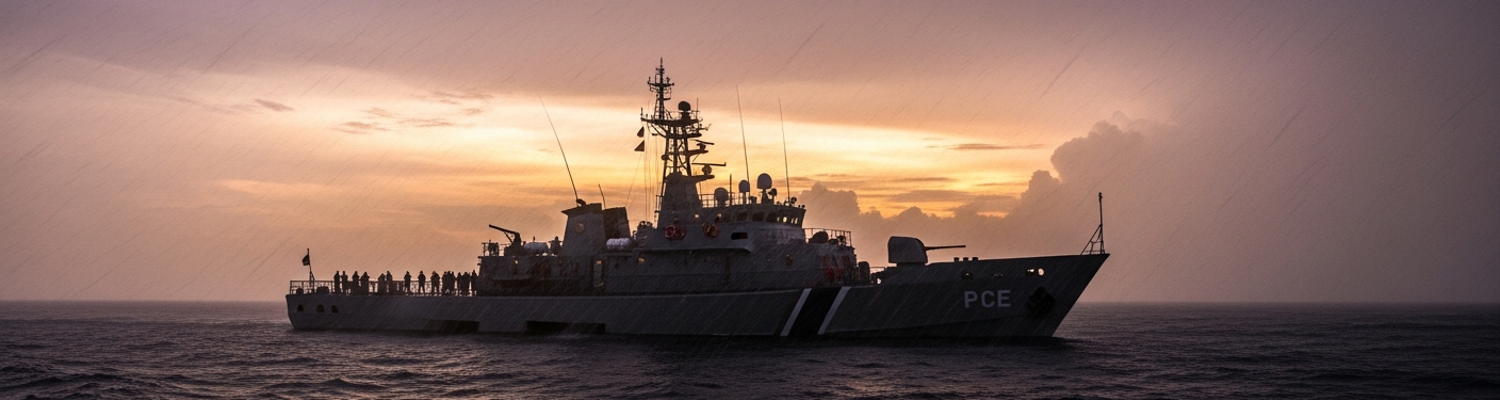
The order from South East Asia Command headquarters was irregular. A Patrol Craft Escort was to be diverted from its patrol grid for a search and rescue mission. Aboard USS PCE-827, the crew of 99 was accustomed to submarine hunting, not humanitarian aid. The 184-foot sub-chaser, powered by two General Motors diesel engines, was a workhorse. Its primary armament was a 3-inch gun, multiple 40mm and 20mm cannons, and depth charges. The report of the attacked civilian vessel, followed by the loss of the searching PBY Catalina, created an emergency that demanded any available asset. The PCE-827 was the closest available hull.
The search was tense. Lookouts scanned a vacant sea. Then, a lookout spotted it: a field of floating debris and a single, overloaded lifeboat. As the PCE-827 approached, the scope of the incident became apparent. The survivors were the crew of the downed PBY Catalina, V-L-THREE. They were not alone. In the water, clinging to wreckage, were a handful of civilians. These were the survivors of the Sea Serpent, whom the PBY had located before it, too, was attacked and shot down by a Japanese patrol plane.
It was a scene of complete devastation.
Bringing the survivors aboard revealed a medical catastrophe. A vessel of PCE-827’s class did not have a commissioned medical officer. All medical care fell to a few Pharmacist's Mates, enlisted sailors with advanced first-aid training, operating under the ship’s Lieutenant Commander. The mess deck was converted into a sickbay. The casualties were severe. Blast and shrapnel had torn through the unarmored PBY. The civilian fishermen, raked by machine-gun fire and then subjected to the PBY’s crash, were in a worse state. The ship’s commander and his chief Pharmacist’s Mate began a gruesome triage. Limited supplies of morphine syrettes were administered, and sulfa powder was dusted into gaping wounds. Battle dressings were quickly overwhelmed. Sailors trained for gunnery and engine maintenance were pressed into service, holding down wounded men and cutting away blood-soaked clothing.
The commander’s after-action report, filed upon return to Trincomalee, became a politically charged document. It detailed the attack on the civilian fishing boat, confirmed by the testimony of the surviving aircrew and fishermen. This firsthand account of a war crime, recorded by a US Navy officer, provided SEAC with concrete evidence. The report (NARA Record Group 338), classified Top Secret, moved swiftly up the chain of command. Its raw descriptions of the carnage on PCE-827’s deck added a new dimension to the strategic calculus in the Andaman Sea.
OSS planning documents reveal a strategy built on a disconnect from the ground truth. Conceived within the headquarters of Detachment 404, the MO campaign was designed as a clinical application of psychological warfare. Planners saw the conflict as an equation. Using R&A intelligence, they identified Japanese vulnerabilities and designed leaflets, rumors, and forged documents to exploit them. The sabotage of the radio post was meant to be a trigger to amplify this pressure. To the strategists in Kandy, it was a move on a geopolitical chessboard.
The theory collided with reality.
The Japanese reaction was not the internal panic the OSS had anticipated, but a swift act of collective punishment. Historical records confirm such reprisals were frequent. The destruction of the Sea Serpent was a direct consequence of this policy. That single act of violence spiraled. The subsequent crash of the rescuing PBY Catalina compounded the horror. What began as a clean psychological gambit had produced two sets of victims adrift in the same sea: shell-shocked airmen and bullet-riddled fishermen. The theoretical elegance of the MO campaign dissolved in the Andaman Sea.
The burden of this reality fell upon the Lieutenant Commander of USS PCE-827. His patrol craft was unprepared for the mass casualty event. Period naval doctrine shows a ship of its class had no doctor. The commander’s mission instantly shifted from combat patrol to crisis management. The ship’s mess deck became a triage center. His chief Pharmacist’s Mate moved from man to man, rationing limited morphine and dusting sulfa powder into wounds far beyond the scope of their training. The commander’s official report, stripped of emotion but dense with facts, bridged the sanitized strategy and its horrific cost. It provided incontrovertible testimony of a war crime, forcing leadership at South East Asia Command to confront the human price of their covert war.
The after-action report from USS PCE-827 triggered immediate diplomatic repercussions. SEAC message traffic shows the incident created a jurisdictional nightmare. The operation was American (OSS), launched from British-controlled Ceylon, using a Canadian aircrew under RAF command, resulting in the death of British-protected subjects, all within a theater under the supreme command of a British Admiral, Lord Louis Mountbatten. Secure dispatches from the colonial administration in India to SEAC headquarters expressed pointed disapproval. The core of the British complaint was that unsanctioned, unilateral actions by American operatives were creating volatile situations. The destruction of the Sea Serpent was a political liability that threatened to expose the Allied hand and provide the Japanese with a propaganda victory. British communiqués questioned the operational control for OSS Detachment 404, demanding greater oversight.
Internally, the incident forced a re-evaluation of MO doctrine within the OSS. The initial strategy was based on a miscalculation of the enemy. The swift, punitive reprisal demonstrated this was a catastrophic error. Subsequent MO planning documents from late 1944 reveal a shift in methodology. The focus moved from triggering generalized paranoia to a more cautious approach. There was a new acceptance that any act of sabotage could result in mass reprisals. Future mission proposals were required to include a formal retaliation risk assessment. This led to an internal debate: was a mission that achieved its objective but resulted in the massacre of locals a success or a failure?
At the highest levels of Allied command, the incident sent shockwaves through a tense relationship. Admiral Lord Louis Mountbatten, as Supreme Allied Commander of SEAC, was responsible for a theater with competing British, American, and Chinese objectives. The American OSS and the British Special Operations Executive (SOE) were frequently rivals. The PCE-827 commander’s report provided Mountbatten with proof that an independent American intelligence operation had gone wrong. Declassified SEAC records point to urgent conferences in Kandy to address the breakdown in coordination. The outcome was a new set of directives reinforcing British oversight. Henceforth, all OSS operations originating from British territory required final clearance from a joint SOE-OSS planning board. This move was a direct response to the Andaman incident. The tactical failure had created a significant strategic setback for the OSS in its struggle for autonomy within the Allied command structure.