
A review of operational logs from the mid-1930s reveals a United States Army on the verge of institutional collapse. The national economic crisis had systematically dismantled its capabilities. In 1936, defense spending hovered at a mere 1.1% of GDP, a figure that translated into a force hollowed out from the inside. The active Army’s strength was approximately 174,000 men. This skeletal force was scattered in small detachments across more than 120 posts, camps, and bases, a dispersal preventing any meaningful large-scale unit training. Archival evidence (NARA Record Group 94) shows that for many units, annual field exercises were canceled for several consecutive years. When maneuvers did occur, they were often conducted with simulated equipment. Units borrowed machine guns from each other. Trucks were frequently represented by flags carried by soldiers on foot. The M1 Garand rifle, officially adopted as the standard infantry weapon on January 9, 1936, was almost non-existent in the hands of troops. Severe production delays and a lack of funding for large orders meant most soldiers continued to train with World War I-era M1903 Springfield rifles, a weapon for which ammunition stocks were also dwindling.
The Great Depression was the primary driver of this military decay. As national unemployment soared, political pressure demanded every available federal dollar be directed toward relief, not the military. The Army’s budget was repeatedly cut. For fiscal year 1934, the Army received a fraction of its requested funding, a pattern that continued through 1936. This had a direct and crippling effect on equipment. Motorized vehicles were in a state of disrepair. A significant portion of the Army’s truck inventory consisted of aging World War I-surplus Liberty Trucks, for which spare parts were no longer manufactured. Maintenance crews were forced to cannibalize other vehicles to keep a small number operational. The nascent armored force was similarly hamstrung, with development on new light and medium tanks proceeding at a glacial pace. The few existing tanks were often unavailable for training due to mechanical failures and a lack of fuel.
This was a deliberate diversion of national resources. The Roosevelt administration’s New Deal programs became the federal government’s overwhelming priority. Massive public works projects consumed the steel and labor that might otherwise have gone toward military modernization. A particularly significant drain on Army resources was the Civilian Conservation Corps (CCC), established in 1933. Though a civilian relief program, the U.S. Army was tasked with its administration and logistical support. Army officers were detailed to run the more than 2,500 CCC camps, which housed over 1.5 million young men by 1936. Army quartermaster depots, already struggling, had to provide food, clothing, and shelter for the CCC enlistees. The program also requisitioned thousands of Army vehicles and tents, further depleting the military’s meager stocks. The War Department’s infrastructure was effectively repurposed to support a civilian relief agency.
The established logistics doctrine of the United States Army in 1936 was non-functional. It was a system designed for a previous war, reliant on fixed rail networks and massive, static depots. This structure was completely at odds with the anticipated speed of a new conflict. Tight budgets had prevented any meaningful investment in mobile support units. A close review of early maneuver logs reveals the consequences. Convoys of World War I-surplus trucks would set out on rudimentary roads only to suffer catastrophic failure rates. Axles snapped. Engines overheated. Transmissions failed. There was no system in place for forward maintenance. Cannibalization of vehicles became standard procedure, a temporary fix that only compounded the overall decay of the motor pool. The Quartermaster Corps planned in terms of tonnage delivered to railheads, not in terms of integrated support for mobile combat teams. This theoretical approach collapsed when faced with the physical challenge of traversing terrain where no railroads existed.
A reckoning was forced within the Army’s planning circles.
The institutional response centered on developing organic combat support capabilities for an expeditionary army. Planners at the Command and General Staff College began to rigorously wargame the requirements for overseas deployments. This intellectual effort coincided with the gradual transition from the large, cumbersome "square" division of World War I to the more nimble "triangular" division. The new structure, built around three infantry regiments, was designed to be more mobile. This mobility depended entirely on a new generation of support elements that did not yet exist. Experimental units were formed. Mobile ordnance maintenance companies were envisioned, equipped with specialized trucks carrying welding gear and lathes to perform repairs directly behind the front lines. Engineer battalions began testing lightweight pontoon bridging systems, a direct answer to the problem of crossing rivers where bridges would likely be destroyed. Medical doctrine shifted as well, moving away from large, semi-permanent field hospitals toward smaller, more mobile clearing stations that could advance with combat units.
This nascent evolution in tactical support ran headlong into the detached strategic planning of the era. The primary guidance for overseas deployment was a series of color-coded war plans, most notably War Plan Orange, which detailed a conflict with Japan. A review of these plans reveals a striking disconnect between strategic ambition and logistical capability. The documents assumed the rapid mobilization of industry and the deployment of massive armies across thousands of miles of ocean. The Army of 1936 was in no condition to perform such tasks. The plans called for reinforcing overseas garrisons in places like the Philippines, but exercises in Louisiana demonstrated that the Army could barely sustain a force a few hundred miles from its own bases. The gulf between the planners at the War Department, who drafted global strategies, and the quartermasters struggling to keep a handful of trucks running was immense. The Army’s educational institutions were producing officers who understood the analytical requirements of mobilization, but they lacked the actual equipment and funding to turn theory into practice.
The institutional friction created by the Louisiana exercises forced a complete reimagining of artillery fire direction. Prevailing doctrine, a holdover from the static fronts of the Great War, relied on established ground observation posts or slow-moving observation aircraft to adjust fire. A review of after-action reports from the 14th and 18th Field Artillery Regiments shows this system failed in the dense, trackless terrain of the Atchafalaya Basin. Ground observers were blind, their lines of sight blocked by cypress and tupelo. Aircraft were ineffective, unable to spot targets concealed by the triple-canopy forest. Planners at the Field Artillery School at Fort Sill were confronted with a system that required clear ground and predictable front lines. The proposed solution was audacious and ran counter to every established norm. Shrink the observation post down to the size of a three-man team and send it deep into enemy territory.
The theory hinged on creating small, autonomous units that could operate for extended periods without direct support. Exercise logs from the experimental "Cypress Gauntlet" maneuvers of 1936 detail the composition of these units, designated Forward Observation Teams. Each team consisted of a Field Artillery officer, a Signal Corps non-commissioned officer for the radio, and an infantryman for security, typically armed with a Browning Automatic Rifle. Their primary tool, the SCR-177B man-pack radio, proved to be their greatest liability. Weighing over 40 pounds with its batteries and hand-crank generator, the radio was a physical burden. Its effective range was drastically reduced by the dense, humid foliage. The fragile vacuum tubes were highly susceptible to moisture and shock. Teams were issued M1903 Springfield rifles and carried M1928 haversacks with minimal rations, relying on rudimentary water purification tablets. Navigation was a constant struggle, limited to a lensatic compass and paper maps that quickly disintegrated in the pervasive dampness.
Deep penetration was the doctrine’s central tenet. The teams were expected to infiltrate up to 20 miles behind simulated enemy lines, a distance unheard of for unsupported elements. The objective was to pre-position observers in areas where enemy artillery, command posts, and supply dumps were anticipated. This required the teams to move covertly through some of the most unforgiving terrain in North America. Operational records document teams taking hours to move a single mile through knee-deep mud, plagued by venomous snakes and clouds of mosquitos. The psychological toll was significant. Isolation, combined with constant physical stress and the knowledge that extraction was not guaranteed, led to high rates of mission failure during initial tests. A key challenge was communication discipline; the teams had to remain silent, breaking radio silence only to transmit critical targeting data, as any transmission risked being located by enemy direction-finding equipment. The entire concept gambled the lives of highly trained personnel on the potential for a single, decisive artillery strike.
Medical after-action reports from the 1936 Louisiana maneuvers reveal a casualty evacuation system broken by the terrain. The established doctrine, a linear chain of care, was entirely dependent on wheeled ambulances and a predictable frontline. It envisioned a wounded soldier moving from a battalion aid station to a collecting station, then to a clearing company before reaching a field hospital. In the Atchafalaya Basin, this system disintegrated. There were no roads for the Army’s aging ambulance fleet. Litter-bearer teams found themselves taking six to eight hours to move a single casualty less than a mile through the suffocating mud and tangled cypress knees. Minor wounds, left untreated in the sweltering humidity, rapidly became life-threatening infections. The 104th Medical Regiment logged multiple instances of simulated casualties being declared non-recoverable simply because the evacuation time exceeded the doctrinal maximum by hours. This systemic failure forced a radical departure from protocol, driven by a handful of company-grade medical officers and senior NCOs.
They abandoned the formal system for a doctrine of rapid, improvised retrieval.
This was a direct subversion of established medical command. The unsanctioned solution was to directly link a small, mobile medical element to the forward observation teams. Analysis of Signal Corps radio logs shows the development of a secondary, unofficial communication protocol. A wounded observer team could transmit a specific, pre-arranged code word. This single transmission, a severe breach of radio silence, acted as a direct trigger. It bypassed the entire chain of command, activating a two-man medical retrieval team staged near the observers’ last known infiltration point. These teams, composed of a medical NCO and a technician, were equipped with nothing more than a lightweight litter, oversized medical packs heavy with morphine and the newly available sulfa powders, and whatever local watercraft they could procure. They operated without direct orders, launching immediately upon receiving the signal.
This new method necessitated foregoing nearly all established medical procedures. The standard practice of stabilizing a casualty at a collecting station was impossible. The retrieval teams performed a brutal form of forward triage. Their sole purpose was to reach the wounded observer, apply tourniquets and sulfa, administer morphine, and begin extraction immediately. Medical equipment logs for these experimental teams show a complete absence of the larger diagnostic and surgical kits common to aid stations; they carried only what was essential for immediate hemorrhage control and pain management. The concept gambled that the dramatic reduction in time from wounding to definitive surgical care would increase survival rates more than the lack of intermediate stabilization would decrease them. In one documented case, a simulated casualty from the 18th Field Artillery was retrieved by a medical team using a commandeered flat-bottomed boat, moved 15 miles downriver, and delivered to the 39th Field Hospital’s surgical tent in under four hours. This was a timeline considered impossible under the 1936 doctrinal handbooks.
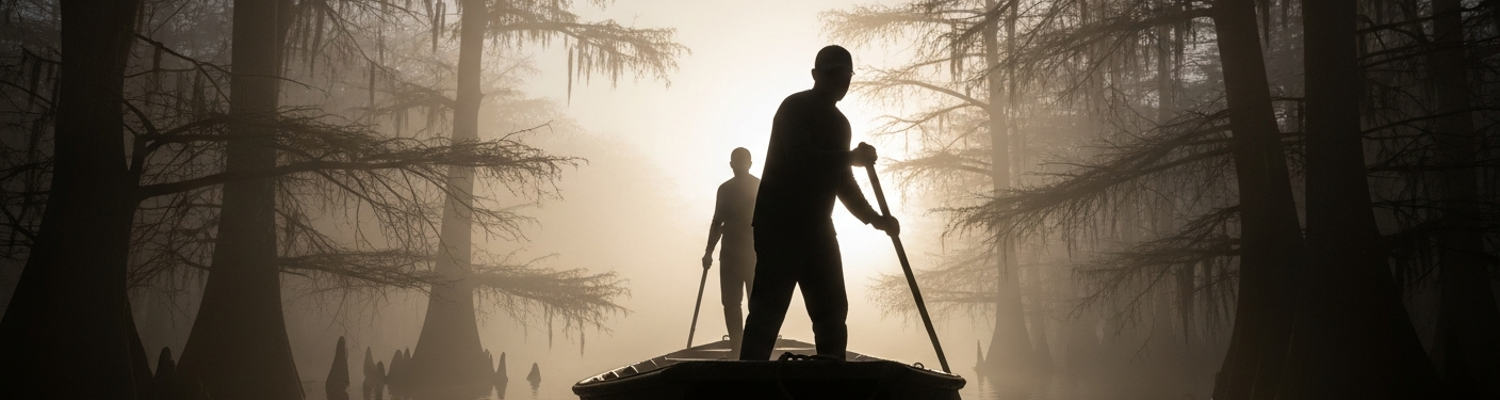
The operational proving ground for this integrated doctrine was a series of exercises in the Atchafalaya Basin in late 1936. The area was chosen for its hostile characteristics; a sprawling wetland of nearly a million acres, it was an environment of bottomland hardwoods and impenetrable bayous that nullified conventional tactics. A review of the exercise parameters shows a scenario pitting a Blue force, representing a divisional element from the U.S. Third Army, against a Red force simulating an entrenched enemy. The terrain itself was the primary adversary. Planners from the Field Artillery School and the Medical Field Service School intentionally created a problem set where standard procedures were guaranteed to fail. The exercise area was 70% heavily wooded forest and 30% swamp and open water, with no road networks. Umpires documented engineer units failing to construct even rudimentary corduroy roads, their materials swallowed by mud. The oppressive late-summer humidity exhausted troops and caused weapon systems to rust within hours. The SCR-177B radios, essential for the observation teams, suffered constant failures as moisture penetrated their casings.
It was a controlled descent into operational chaos.
A close examination of umpire logs reveals the mechanics of the new doctrine. A three-man Blue Forward Observation Team from the 18th Field Artillery infiltrated approximately twelve miles into the swamp. After 36 hours, the team was notionally compromised and engaged, resulting in one member suffering a simulated severe leg wound. Per the old doctrine, a litter-bearer team was dispatched. The umpires’ notes record their progress at less than 400 yards per hour through the tangled cypress knees, a pace that would have meant certain death. At the pre-designated two-hour mark, the failing conventional method was terminated. The observation team leader then transmitted the single, unsanctioned code word. This act deliberately exposed the high-value team to enemy radio direction-finding. Nearly seven miles away, a two-man medical retrieval team, operating from a commandeered flat-bottomed boat, received the signal. Their operational logs show they carried no equipment beyond a lightweight litter, two medical packs with morphine syrettes and sulfa powder, and their personal M1903 rifles. They navigated not by map, but by a pre-arranged system of marked trees, reaching the wounded observer in just under three hours.
The analysis conducted by the exercise umpires was a cold calculation. The primary data points were not tactical victories, but comparative timelines. In the documented case, the total time from injury to delivery at a rear surgical tent was four hours and 17 minutes. Under the conventional system, the umpires projected an evacuation time of over 20 hours, a fatal delay. This success came at a high price. The act of transmitting the medevac request resulted in the remaining two members of the observation team being declared captured or killed by umpire ruling in over 60% of the test cases. The doctrine accepted the potential loss of a highly trained observation officer and a signals NCO in exchange for the survival of one soldier. The final report highlighted the extreme physical toll, with retrieval teams often as debilitated as the casualties they were rescuing, but it concluded that in terrain where wheeled ambulances were irrelevant, the integrated observation-medevac protocol was the only viable, if savage, solution.
A forensic review of umpire logs reveals that for every celebrated success of the unsanctioned medevac protocol, there was a corresponding and frequent failure. The system was predicated on a flawless sequence of events in an environment that guaranteed chaos. Significant delays were the most common point of failure. The two-man retrieval teams, launched with minimal navigational tools into the disorienting maze of the Atchafalaya Basin, frequently became lost. Waterways that appeared as clear channels on maps were often impassable, choked with submerged logs that could disable a boat’s motor. In one documented exercise, a team from the 104th Medical Regiment spent seven hours attempting to locate a casualty from the 18th Field Artillery, only to discover they had been paddling in a three-mile circle. Their physical exhaustion was so complete that umpires ruled them non-mission capable, creating a scenario with three stranded soldiers instead of one.
There was no redundancy.
The deficiencies were rooted in the ad-hoc nature of the enterprise. The single point of failure was the initial radio call. The SCR-177B was not designed for deep reconnaissance and its performance in the swamps was abysmal. After-action reports detail multiple instances where the medevac code word was transmitted but never received. In these cases, the wounded observer was left stranded with no secondary means of communication, his fate sealed by a technical malfunction. Even when the signal was received, the lack of secure, two-way communication meant the retrieval team launched blind. They had no way of confirming the casualty’s condition or verifying the coordinates, which were often compromised by the observer team’s own disorientation. The entire operation hinged on a single, desperate broadcast.
The observed casualty rates during these simulations were grossly disproportionate to any conceivable benefit. The decision to break radio silence to call for evacuation was a death sentence for the rest of the observation team. Umpire rulings consistently showed that Red force intelligence units, using rudimentary direction-finding equipment, would pinpoint the transmission’s origin and dispatch hunter-killer teams. The medevac request acted as a beacon. In over two-thirds of the simulated retrievals, the remaining members of the observation team were ruled captured or killed. Worse, the retrieval team itself often blundered into ambushes set along the most likely waterborne approaches. A grim analysis by the Medical Field Service School concluded that for every one soldier successfully evacuated by the improvised method, an average of 2.5 other soldiers, rescuers and observers, were lost. It was a debilitating arithmetic.
Umpire critiques from the 1936 maneuvers reveal the calculus forced upon commanders. The unofficial doctrine of rapid medevac introduced a dilemma with no ethically sound resolution. An officer in charge of a Blue force sector, upon learning a forward observation team had sustained a casualty, was faced with two choices, both guaranteeing loss. Adhering to the established, road-dependent evacuation doctrine was a paper exercise; umpires had already made it clear that any casualty waiting for a litter team in the Atchafalaya Basin would be ruled deceased. The alternative was to sanction the use of the improvised retrieval protocol. This meant knowingly ordering a two-man medical team on a high-risk mission while accepting the near-certainty that the observer team’s medevac transmission would compromise its position, leading to the loss of the remaining personnel.
This was the birth of a battlefield ethic of calculated abandonment.
When an observer team was notionally hit, and the commander determined that a rescue attempt was too hazardous, a grim protocol was followed. The wounded man would be marked as a loss on the command map. The surviving members of the observation team were ordered to maintain strict radio silence, provide what minimal aid they could, and either continue their mission or attempt to exfiltrate, leaving their comrade behind. This was not a failure of courage, but a direct consequence of a failed logistical system. Commanders from the 18th Field Artillery were forced to weigh the life of one soldier against the potential to neutralize an entire enemy battery. In this arithmetic, the doctrine’s failure left no room for sentiment. Young officers were being trained to view their soldiers not as men to be protected, but as assets to be expended based on a cold assessment of risk.
The strategic implications of these command decisions were profound. The loss ratios documented by exercise umpires made the entire concept of deep, unsupported observation strategically bankrupt. The U.S. Army of 1936 could not afford to trade its scarce specialists at such a ruinous rate. The doctrine’s failure exposed a deep chasm between the ambitions of the Field Artillery School and the capabilities of the Medical Corps. Post-exercise reports from medical observers were scathing, detailing a complete collapse of the core medical mission to conserve the fighting strength. They argued that any doctrine requiring commanders to routinely abandon their wounded was morally and institutionally unacceptable. The final umpire analysis (USA-FAS-AAR 36-11B) concluded that while the integrated observation-medevac theory showed promise, its practical application with 1936-era equipment was a catastrophic failure, forcing commanders into choices that violated the fundamental ethos of the Army.