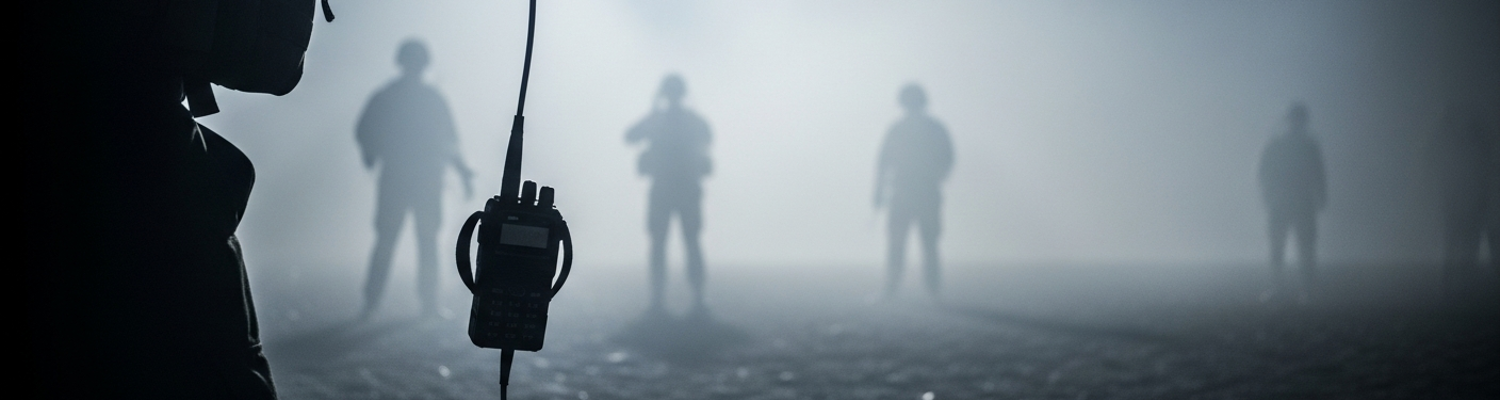

A close review of operational logs from the early 1990s finds a Marine Corps grappling with its identity. The collapse of the Soviet Union had erased the primary adversary that shaped doctrine and procurement for over forty years. Massive set-piece exercises like REFORGER, which annually rehearsed the reinforcement of Germany against a Warsaw Pact invasion, were terminated by 1993. This left the service facing deep budget cuts and a strategic mandate to redefine its purpose. The response was a pivot away from large-scale conventional warfare toward littoral, expeditionary operations. Doctrinal publications from the period, specifically the concept known as From the Sea and the emerging Operational Maneuver From the Sea (OMFTS), called for naval forces to project power from the ocean directly to inland objectives, bypassing the costly process of seizing a beachhead.
This was an entirely new way of fighting.
Exercises were designed to test this vision, stressing the capabilities of smaller, more agile Marine Air-Ground Task Forces (MAGTFs). Planners developed scenarios that validated the need for a sea-based force in a world without a peer naval competitor. The result was a focus on regional conflicts, coastal defenses, and asymmetric threats. Echo Reef 1993 was a direct product of this environment, conceived by the Marine Corps Warfighting Laboratory to explore the practical friction points of the OMFTS doctrine. It was designed to find the breaking points in a concept that looked clean on paper but had yet to be tested in a complex, punishing environment. The scenario was built around a simulated amphibious assault on Isla Perdida, a fictional volcanic island in the Northern Mariana Islands chain. The specific objective was the neutralization of a heavily fortified coastal defense strongpoint codenamed Echo Reef. Planners designated an opposing force (OPFOR) composed of a battalion-sized element of a fictional nation’s marine infantry, equipped with a plausible mix of export-grade Soviet hardware. The primary threat at Echo Reef was a battery of truck-mounted SS-N-2 Styx anti-ship missiles, concealed in hardened caves carved into the island’s volcanic rock. These were protected by overlapping fields of fire from ZU-23-2 anti-aircraft guns in sandbagged revetments and several platoons of infantry dug into trenches and bunkers. The approaches, both by sea and land, were seeded with simulated PMN-2 anti-personnel mines and offshore naval mines. The terrain itself was an adversary. The landing zones were narrow black sand beaches that quickly gave way to razor-sharp volcanic rock formations and dense, triple-canopy jungle that severely restricted movement and observation.
The entire operation was a test of night-fighting capabilities and a deliberate effort to strain command and control. The assault was scheduled to occur under the cover of darkness, forcing the landing force to rely on early-generation night vision and thermal imaging systems. A key piece of equipment under evaluation was the AN/PVS-7B night vision goggle, a bi-ocular device that provided a single image tube for both eyes. While functional, archival after-action reports noted that the PVS-7B offered no depth perception, making navigation over the treacherous volcanic terrain exceedingly difficult. The green-hued image was prone to blooming or washing out when exposed to flares or explosions, temporarily blinding the user. Compounding this sensory deprivation was the challenge of communication. The primary tactical radio was the SINCGARS (Single Channel Ground and Airborne Radio System), which operated in the VHF spectrum. While its frequency-hopping capabilities provided a high degree of security, VHF radio waves are strictly line-of-sight. The steep hills and dense, water-logged jungle canopy of Isla Perdida were found to absorb and block transmissions, creating intermittent communication blackouts between squads on the ground and, more critically, between the landing force and the command element aboard the USS Belleau Wood positioned 15 nautical miles offshore. This electronic isolation was the central problem of the exercise. Commanders were left staring at maps, functionally blind and deaf to the minute-by-minute struggles of their troops ashore.
Pre-exercise annexes for Echo Reef 1993 reveal an almost total dependency on the AN/TPS-71 radar system for air-space deconfliction and command overview. Detachments from Marine Air Control Squadron 2 (MACS-2) had deployed two of the containerized radar systems to a cleared hilltop on a neighboring island, approximately 30 kilometers northwest of Isla Perdida. The chosen site, codenamed Watchtower, was selected for its clear line-of-sight to the objective area and its elevation, which modeling suggested would provide uninterrupted coverage from sea level to 40,000 feet. The entire concept of air support, from SEAD (Suppression of Enemy Air Defenses) packages flown by EA-6B Prowlers to the on-call close air support from Marine A-6E Intruders, was built on the assumption that commanders aboard the USS Belleau Wood would have a clean, real-time radar picture of the airspace. This system was expected to track both friendly aircraft and any simulated OPFOR aerial threats, painting a comprehensive tactical display for the MAGTF commander. The operational plan contained no robust contingency for a complete loss of this radar feed. All fire support coordination, emergency medevac routing, and air-to-air threat warnings were channeled through the controllers interpreting the TPS-71’s data. The system’s physical components, including its primary power generators and data-link transmitters, were considered reliable assets, not single points of potential mission failure.
Planned communication protocols for forward observers and fire support teams were intricate and, on paper, redundant. A forward air controller (FAC) or naval gunfire spotter attached to the lead infantry elements was expected to maintain constant contact with the Supporting Arms Coordination Center (SACC) on the flagship. This link was to be established using SINCGARS radios operating on a predetermined, frequency-hopping net. Archival logs show the primary net was designated Strike, with an alternate net called Hammer available on a separate channel bank. In the event of VHF failure due to the anticipated terrain masking, the protocol dictated a switch to UHF frequencies using the bulkier AN/PRC-113 radios carried by the team leaders, intended for communication with airborne assets that could then act as relays. If all radio-based systems failed, the absolute last resort involved using pyrotechnic signals. A sequence of green star clusters to signify a request to lift or shift fires and red star clusters for an emergency extraction. This final contingency was viewed by planners as a procedural footnote, not a likely eventuality. The reliance on line-of-sight VHF communications, despite known issues in jungle environments, was accepted as a manageable risk. The entire elaborate dance of calling for naval gunfire from the destroyers offshore or 500-pound bombs from the Intruders circling overhead depended entirely on a single Marine with a radio handset being able to speak clearly to the command element.
Operational logs from the Marine Air Control Squadron 2 (MACS-2) detachment show that the primary AN/TPS-71 radar system at the Watchtower site achieved full operational status at 01:00 local time. For the next 73 minutes, the system performed within all expected parameters, its powerful transmissions cutting through the humid night air to provide a clear, stable air picture to the command element on the USS Belleau Wood. The radar, a containerized 3D air search system, was the single point of truth for the MAGTF commander’s view of the battlespace. At 02:13, just as the first Amphibious Assault Vehicles were crossing the line of departure to begin their run to the beach, the system failed. The initial report, logged by a technician over a secondary communications channel, was simple. The main tactical display aboard the flagship went blank, replaced by a NO DATA error message. On the hilltop at Watchtower, the event was far more dramatic.
The failure was not subtle. A loud, sharp crack echoed from the primary power container, a sound immediately recognizable to high-power systems technicians. It was followed by the distinct hum of the four-ton antenna array winding down and the instantaneous loss of all console displays. Within seconds, a thick, acrid smoke began pouring from the ventilation louvers of the power unit. A maintenance team, sprinting from the adjacent operations van, confirmed the system was completely inoperable. They were met with the overwhelming smell of burnt dielectric fluid and ozone, a tell-tale sign of massive electrical discharge. Any attempt at a rapid restart was impossible. The system’s own internal breakers had tripped, and a cursory inspection with thermal imagers showed extreme heat signatures originating from deep within the power conditioning module.
The air picture had vanished.
A detailed analysis by the MACS-2 technicians, conducted under emergency battle lanterns, quickly identified the point of origin. The failure was traced to the primary K-4 power capacitor bank. This assembly, a series of large, oil-filled canisters, is designed to store and discharge the electrical energy required to generate the radar’s pulse. Maintenance records (per USMC AAR E-93-04, dated 12 NOV 1993) show one of the primary busbar connections within the capacitor housing failed, likely due to micro-fractures induced by the vibrations of transport and setup. This created an electrical arc that flashed over, instantly short-circuiting the entire bank. The resulting power surge destroyed not only the capacitors themselves but also the adjacent rectifier units and control circuits, rendering the entire power module a piece of dead iron. A field repair was out of the question. The required components were specialized, heavy, and located in a depot hundreds of miles away. The AN/TPS-71, the electronic eyes of the entire amphibious force, was blind.
The terminal overload of the AN/TPS-71 radar was followed with startling speed by a complete shift in the weather. Meteorological forecasts for the exercise window had predicted clear skies, but after-action reports from the ships offshore note the unforecasted development of a dense bank of advection fog. It began forming just after 02:30 local time, as warmer, saturated air from the open ocean moved across a patch of colder sea surface temperature near the island. It coalesced from thin wisps into a solid wall of gray with a speed that defied meteorological predictions. Within twenty minutes, visibility for the command element aboard the USS Belleau Wood dropped to less than a quarter-mile, completely obscuring the coastline of Isla Perdida 15 nautical miles away.
This was more than an inconvenience. It was a tactical blindfold.
The fog effectively neutralized all optical and thermal imaging systems. The high moisture content of the air scattered the thermal radiation needed to create a clear image, rendering the advanced thermal sights on the flagship useless. On the ground, the situation was worse. The AN/PVS-7B night vision goggles of the assault force were severely degraded, the ambient starlight now blocked by the thick cloud layer. The humid air caused condensation on optical lenses, and the lack of visible reference points on the black sand beaches made navigation for the Amphibious Assault Vehicle crews a matter of pure guesswork based on compass headings. The fog was so thick it defeated the AN/PAQ-4 laser aiming modules, the infrared beam dissipating into a useless glow just a few feet from the rifle barrel.
Just as the physical environment became opaque, the electronic spectrum dissolved into chaos. Initial communications from the first wave of Marines ashore to the SACC on the Belleau Wood were intermittent but functional, a problem attributed to the expected line-of-sight limitations of the SINCGARS radios in the island’s jungle terrain. However, a review of the communications logs from MACS-2 shows that radio operators began reporting an unusually high level of static and signal distortion that did not match typical terrain-masking profiles. Transmissions were not simply blocked. They were being actively corrupted by a wash of background noise that made deciphering messages nearly impossible. Some technicians initially hypothesized that the island’s unique geology, rich in ferrous volcanic rock, was creating pockets of natural electromagnetic interference. This theory gained traction as the interference seemed to ebb and flow unpredictably, a phenomenon inconsistent with stationary terrain blockages.
Archival analysis of the exercise script and Red Team logs reveals a planned and coordinated electronic warfare attack. The Opposing Force, using a truck-mounted R-330P Piramida VHF jamming system concealed in a cave on the island’s northern ridge, initiated a sophisticated electronic attack at 02:55 local time. This was not a simple barrage jammer that would have been immediately obvious. Instead, the Red Team employed a more subtle follower or step-on jamming technique. The R-330P’s receiver would detect a transmission on the Marine’s primary Strike frequency net, and the system’s transmitter would then instantly blast that specific frequency with high-powered noise, cutting off the speaker mid-sentence. Since the SINCGARS system hops through frequencies over 100 times per second, the jamming was not constant, but it made any coherent, sustained voice communication impossible. A single word might get through before the rest of the sentence was buried in static. The effect was maddening for the command element, who were fed a stream of broken, unintelligible sentence fragments. When units attempted to switch to their alternate Hammer net, they found the R-330P was agile enough to jam that as well, confirming the OPFOR had successfully identified both primary and alternate frequencies. The combination of the radar failure, the blinding fog, and the targeted jamming had achieved the exercise’s central goal with terrifying efficiency. The MAGTF commander was completely isolated from the front line.
After-action reports from the USS Belleau Wood depict a command element descending into a state of profound sensory deprivation. The MAGTF commander and his staff were physically located within the ship’s Supporting Arms Coordination Center (SACC), a windowless, steel-walled compartment deep inside the vessel’s hull, 15 nautical miles from the hostile shore. This space was designed to be the operational brain, a hub where data from radar, naval gunfire spotters, and forward air controllers would be synthesized into a coherent picture of the battle. By 02:55, it had become a tomb of obsolete information. The primary tactical plot, a large map table where the progress of the landing force was meant to be tracked in real-time, was frozen. The last confirmed position of the lead assault wave was now over an hour old. The digital displays that should have shown a clear radar picture from the AN/TPS-71 were blank. The thermal imaging feeds that should have peered through the darkness were showing nothing but a uniform gray static, defeated by the unforecasted wall of fog.
The commander was blind.
The physical space of the SACC, intended to insulate the command staff from the chaos of battle to allow for clear-headed decisions, now served only to amplify their disconnection. Surrounded by cutting-edge technology that was now inert, the staff could only stare at maps that represented a past reality. The ship itself, a massive instrument of power projection, was rendered impotent. Its powerful sensors could not penetrate the atmospheric conditions, and its command facilities were starved of the data they were built to process. The psychological pressure on the commander was intense. He was separated from his forward-most troops by a seemingly impossible gulf of water, fog, and electromagnetic silence, yet he was still expected to command.
The electronic silence was the most unnerving element. Archival communications logs from the SACC document a complete and catastrophic loss of coherent radio contact with the landing force. The Opposing Force's R-330P Piramida jamming system was not employing a crude barrage of noise across the entire VHF spectrum. Instead, its operators used a follower jamming technique, stepping on specific SINCGARS frequency hops the instant a Marine tried to transmit. For the radio operators aboard the Belleau Wood, the effect was maddening. They would hear a single, sharp syllable from a forward observer, followed by an explosive burst of static that obliterated the rest of the transmission. The frequency-hopping capability of the SINCGARS radios, designed to defeat jamming, was rendered nearly useless. While the system hopped over 100 times per second, the jammer was agile enough to corrupt enough of the transmission to make any message unintelligible. An attempt to switch to the alternate Hammer frequency net proved futile, as the OPFOR jammer followed them immediately, confirming the Red Team had successfully identified both primary and alternate command nets. The next contingency, switching to the bulky AN/PRC-113 UHF radios to contact an airborne relay, failed completely. The same dense, high-moisture fog that blinded the thermal imagers also absorbed and scattered the line-of-sight UHF radio waves, preventing a solid link. The final, desperate protocol of using pyrotechnic flares was impossible. No one could see them through the fog.
This created the perfect conditions for the headquarters bubble to manifest, a dangerous cognitive state where decisions are made based on information that is dangerously out of sync with the ground truth. With no incoming intelligence, the commander and his staff were forced to rely on the last known positions of their units. The tactical map showed the lead elements of the battalion landing team pinned down near the waterline, facing heavy resistance. Based on this hour-old picture, the commander made a decision. He authorized a fire mission from the destroyer USS Hewitt, positioned in support. The mission was to saturate a grid square just inland from the beach, designated Target Area Viper, where OPFOR mortars were believed to be located.
The order was sent and confirmed by the Hewitt. The 5-inch guns were trained. What the commander in his isolated bunker could not know was that in the past hour, the forward platoon, cut off and acting on its own initiative, had broken through the initial line of defenses. It had advanced nearly 400 meters inland, fighting through trenches and seeking cover from the exact mortar fire the commander now sought to suppress. The platoon was, at that moment, moving directly into Target Area Viper.
The official press pool manifest for Echo Reef 1993 lists two civilian media personnel attached to the assault force: a veteran wire-service photographer with extensive experience in Central America and a young print journalist on his first major military assignment. Their stated mission was to document the seamless integration of sea-based power projection, a key tenet of the new From the Sea doctrine. They carried what was, for the time, standard professional equipment. The photographer used two ruggedized Nikon F4 film cameras, his vest heavy with spare lenses and dozens of rolls of high-speed film. The journalist relied on a microcassette recorder and waterproof notebooks. They were not formally embedded in the post-2003 sense of the term, but were attached directly to the command element of 1st Platoon, Bravo Company, Battalion Landing Team 1/4, placing them squarely within the first wave of the amphibious assault.
Their vantage point was the troop compartment of an AAV-7A1 Amphibious Assault Vehicle, designated Bravo-Two-One. Chronologies compiled from their later reporting describe the initial phase in claustrophobic detail. The air inside the 26-ton vehicle was thick with the smell of diesel exhaust and nervous sweat, the only illumination coming from the dim red glow of the interior lights and the green splash from the Marines' night vision displays. The vehicle, carrying nineteen combat-equipped Marines in addition to the correspondents and its own three-man crew, pitched violently in the open sea. The noise from the 400-horsepower engine was a constant, deafening roar that made conversation impossible, forcing reliance on hand signals. Looking through the small, periscopic vision blocks, their view was of nothing but black water and then, alarmingly, the thick, disorienting gray of the fog bank. The transition from the open sea to the opaque wall of moisture was total, reducing visibility to a few feet and transforming the assault from a coordinated maneuver into a blind charge.
The story they captured was not the one the Marine Corps intended to tell. Once the AAV’s ramp slammed down onto the black sand of Isla Perdida, the correspondents became direct witnesses to the cascading equipment and communication failures. The photographer’s first frames, later published, show Marines struggling to navigate the treacherous volcanic rock, their movements made clumsy and uncertain by the AN/PVS-7B’s lack of depth perception. The journalist’s audio recordings are dominated by the frantic, useless clicks of the platoon leader’s SINCGARS handset and the officer’s increasingly desperate shouts into the radio, met only by a wall of high-pitched static from the OPFOR’s jamming system. They documented the confusion as squad leaders, unable to see or speak to one another, reverted to shouting and arm signals, their commands swallowed by the fog and the surf.
They were there to document a new way of fighting. Instead, they recorded its breaking points.
Their notes detail the moment a fire team leader attempted to launch a red star cluster flare, the pre-planned signal for an emergency extraction, only to watch it soar 100 feet into the air and vanish completely into the low, dense cloud ceiling, its light entirely invisible to the ships offshore. The photographer captured a sequence of images showing a Marine squad leader, his radio clearly useless, using a simple lensatic compass and a paper map under the faint red light of a filtered flashlight, trying to orient his unit while completely cut off from higher command. The intended narrative of high-tech, over-the-horizon warfare dissolved on contact with the beach, replaced by a more primal story of infantrymen isolated and fighting with the tools immediately at hand.
Press clippings dated October 26, 1993, reveal the immediate fallout from the Echo Reef exercise. The story that reached the American public was not one of a successful doctrinal test, but of a high-tech force brought to its knees by fog and a single enemy jammer. The wire-service photographer’s images were particularly stark. One frame, distributed globally, depicted a Marine platoon leader, his SINCGARS handset hanging uselessly, trying to get a compass bearing from a paper map under a red-lensed flashlight. Another showed the disorienting, depthless green glow of the AN/PVS-7B night vision goggle, followed by a shot of a Marine stumbling on volcanic rock that was invisible through the device. The print journalist’s dispatches provided the damning context, describing in detail the maddening futility of trying to communicate through the follower-jammer, the failure of laser aimers in the fog, and the final, hopeless launch of a signal flare that was swallowed by the low cloud ceiling.
The narrative was one of systemic technological collapse. This public portrayal stood in sharp contrast to the polished messaging of the From the Sea and OMFTS doctrines, which were predicated on seamless, over-the-horizon command and control. The collected press reports informed a view of a Marine Corps whose advanced warfighting concepts were dangerously brittle, dependent on a fragile web of systems that could be broken with surprising ease. The story was not about the failure of Marines, but the failure of the assumptions they had been ordered to validate.
The direct result of the exercise’s operational failures and the subsequent press coverage was the immediate formation of a special after-action review board at Quantico. A deep analysis of its charter shows it was tasked with a complete technical and procedural dissection of the Echo Reef event. This effort was a direct precursor to the formal establishment of the Commandant's Warfighting Laboratory two years later, with Echo Reef serving as a primary case study. The board’s investigators focused forensically on the cascading points of failure. They analyzed the maintenance and transport logs for the MACS-2 detachment’s AN/TPS-71 radar, confirming the failure of the K-4 power capacitor bank was due to vibration-induced micro-fractures, a known but previously underestimated risk. They spent weeks analyzing the recorded radio traffic, identifying the precise signature of the Red Team’s R-330P Piramida jammer. It was confirmed that the Opposing Force used a sophisticated follower-jamming technique that the SINCGARS frequency-hopping algorithm, hopping at over 100 times per second, could not defeat.
The headquarters bubble was not a theory. It was a documented reality.
The review panel’s findings sent a shockwave through the Marine Corps Combat Development Command. The exercise had unintentionally proven that the Corps’ increasing dependence on centralized, technology-enabled command was a critical vulnerability. The findings directly challenged the top-down assumptions of OMFTS, which envisioned commanders maneuvering forces from a shipboard command post with perfect situational awareness. Echo Reef demonstrated that a thinking enemy and an unpredictable environment could sever that link completely, leaving commanders blind and subordinate units orphaned. This failure forced a significant doctrinal re-evaluation. The concepts of maneuver warfare and decentralized command, which had been championed in the late 1980s under General Alfred M. Gray in publications like FMFM-1 Warfighting, were given a new and urgent emphasis. The experience of the 1st Platoon leader, cut off and advancing on his own initiative, was held up as the model to be emulated, not an exception to be punished. The core implication was clear. The Corps had to pivot from training for ideal conditions to training for degraded ones. This led to concrete changes. A new mandate required future exercises to incorporate unscripted, force-on-force training against an enemy with robust electronic warfare capabilities. Scenarios were redesigned to deliberately create periods of denied communications and sensor degradation, forcing commanders at all levels to make decisions under extreme uncertainty. The philosophy of mission command, providing subordinate leaders with a clear commander’s intent and the freedom to execute it, was aggressively pushed down to the small-unit level.