
Allied Force Stealth Strategy and Mission Planning
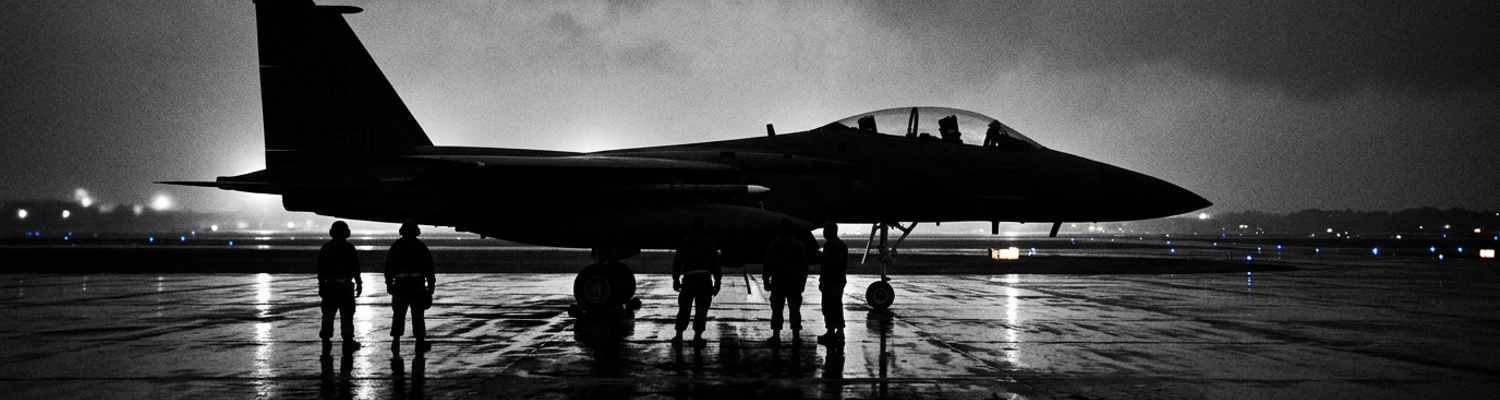
Mechanics wiped freezing rain from their bare hands and wrestled with stripped titanium fasteners across the tarmac of Aviano Air Base in northern Italy during late March 1999. Working through seventy-two straight hours of biting wind and sleep deprivation, ground crews faced severe supply shortages of specialized radar-absorbent coatings and replacement thermal tiles required to maintain the black jets. Maintenance personnel salvaged sealant from depleted supply kits while flight line armorers manually hauled two-thousand-pound laser-guided bombs across muddy ramps under dim lamps. Flight surgeons monitored rising levels of physical exhaustion among the pilots of the 49th Fighter Wing, who tried to rest in cold, overcrowded temporary tents between grueling twelve-hour mission cycles. Operations officers pushed these worn-out crews to launch high-tempo night sorties before intelligence specialists could distribute updated tactical maps of enemy surface-to-air missile batteries.
Batteries of Soviet-era antiaircraft weapons caused remarkably little worry among senior NATO commanders who believed their stealth fleet was practically untouchable. Pre-strike tactical assumptions among NATO leadership held that low-observable stealth platforms possessed total survivability against older Yugoslav air defense arrays like the SA-3 Goa and SA-6 Gainful systems. Air Force generals assumed that the faceted exterior surfaces and radar-absorbent materials of the F-117A Nighthawk would keep the strike aircraft completely undetected throughout the entire Balkan air campaign. This unquestioned confidence led military planners to deploy the 49th Fighter Wing from Aviano Air Base without dedicated standoff electronic jamming escort from specialized aircraft such as the Navy EA-6B Prowler. Air staff planners reasoned that pairing stealth bombers with conventional radar-jamming aircraft was entirely unnecessary and would only alert hostile ground observers to an incoming attack package.
Observers tracked these incoming strike packages with ease because Combined Air Operations Center Vicenza established repetitive ingress corridors over Yugoslav airspace. Flight planners funneled the stealth jets along the exact same geographic waypoints for three consecutive nights, fatally compromising operational security. Yugoslav radar units, commanded by Colonel Zoltan Dani of the 250th Air Defense Missile Brigade, quickly recognized these rigid flight schedules and mapped the exact entry gates used by the American aircraft. Colonel Dani relocated his mobile SA-3 missile batteries under cover of darkness, concealing launchers and surveillance vehicles beneath farm trees and village sheds along those predictable paths. Serbian missile crews then modified their older Soviet-designed P-18 acquisition radars to operate on the longest allowable wavelengths, searching the designated ingress corridor in brief seventeen-second transmissions to evade allied anti-radiation missiles.
Aircraft armed with anti-radiation missiles remained grounded on Italian taxiways on the stormy evening of March 27 due to severe localized squalls. Allied commanders refused to scrub the mission, relying on their firm belief in stealth technology to dispatch Vega 31, an F-117A piloted by Lieutenant Colonel Dale Zelko, into Yugoslav airspace entirely alone. Zelko flew his black jet straight down the established ingress corridor toward a fortified military bunker near Belgrade without any standoff electronic jamming aircraft in the sky to confuse enemy radars. Colonel Dani waited until the lone American jet reached the precalculated intercept sector near the village of Budanovci, then ordered his fire control crew to radiate the target. Launcher guide rails swung skyward, discharging two V-600 missiles into the cloud deck that struck the stealth jet and blew off its left wing.
Serbian Radar Adaptation and the Budanovci Engagement
Warheads from the two V-600 series missiles triggered their proximity fuzes alongside the airframe, crippling F-117A tail number 82-0806 near Budanovci. Violent rotational forces slammed Lieutenant Colonel Dale Zelko against the canopy glass as the shredded black bomber rolled upside down into the rainy darkness. Zelko strained against the crushing physical pressure to pull the ejection handles between his knees, rocketing his seat clear of the flaming wreckage seconds before the aircraft began its terminal plunge. Radar operators inside a camouflaged command van nearby cheered as the glowing target echo on their fire-control screen broke apart into falling debris.
Lieutenant Colonel Zoltan Dani silenced his celebrating crew inside the command vehicle, ordering an immediate shutdown of all electronics to protect the battery from allied retaliation. Dani commanded the 3rd Battalion of the 250th Air Defense Missile Brigade, a unit that survived the NATO air campaign through strict discipline and relentless mobility. Battalions in the brigade relied on the tactical deployment of the Soviet-designed S-125 Neva missile system, designated by NATO as the SA-3 Goa, hauling the bulky equipment over muddy backroads to reach concealed firing positions. Technicians moved the heavy four-rail launchers and support trucks dozens of times across the Vojvodina countryside, anchoring the weapons in farm pastures within hours to evade Western hunter-killer aircraft. Dispersed battery personnel used civilian landlines and motorcycle couriers instead of radio transmissions, keeping the entire missile battalion hidden from allied electronic surveillance.
Couriers and civilian spotters across the countryside telephoned the missile battalion as incoming strike packages crossed overhead, cueing the unit to activate its detection net without exposing its location. Technicians utilized long-wavelength P-18 radar emissions operating in the meter band, which interacted with the structural dimensions of the stealth jet rather than bouncing away from its angled surfaces. Dani restricted his radar crews to brief transmission intervals of no more than twenty seconds at a time, shutting down the transmitter before NATO anti-radar missiles could home in on the signal. The lone stealth bomber remained faint on the receiver scopes until the aircraft swung open its lower weapon bay doors to release its bombs. Radar antennas caught the dramatic radar cross-section spikes generated by the open bay cavity and exposed metal bomb racks, providing the battalion with an exact tracking lock at a distance of thirteen kilometers.
Operators held that sharp return signal just long enough to guide the climbing interceptors into the aircraft flight path before shutting down the radar array. Twisted pieces of black composite skin and metal wreckage slammed into an agricultural field near Budanovci, drawing local villagers who ran out into the night to inspect the burning crater. Serbian police forces cordoned off the perimeter to collect scattered fragments of secret radar-absorbent materials and classified avionics equipment. Dani ordered his battalion to pack up every cable, generator, and missile transporter within ninety minutes, moving the entire unit into deep forest cover before American strike packages could retaliate. Allied commanders in Italy monitored silent communications channels while search-and-rescue teams scrambled helicopters to locate Zelko before Serbian military patrols reached him in the mud.
Electronic Surveillance and Rivet Joint Signal Interception
Radar consoles inside the Combined Air Operations Center in Vicenza, Italy, flashed warning indicators when the data-link telemetry from Vega 31 abruptly blinked out. Air Force watch officers confirmed the immediate loss of target tracking across the main tactical display, realizing the stealth bomber had vanished directly over hostile Serbian territory. Operations personnel scrambled to interrogate secondary frequencies and backup transponder channels, but no response codes returned from the missing jet. Senior controllers grabbed red secure phones to alert allied air commanders that an undetectable aircraft had dropped out of the sky without sending an automated mechanical failure alert. Technicians rechecked satellite connections and ground receiver stations across the command floor to rule out a communication malfunction in Italy, leaving staff officers to confront the reality of a combat shootdown.
USAF RC-135V/W Rivet Joint electronic reconnaissance aircraft flying high-altitude orbits along the Balkan frontier intercepted the first transmission from the ground. Airborne electronic warfare specialists aboard the converted four-engine jet isolated faint electromagnetic pulses traveling through the rain over Vojvodina, filtering out Serbian jamming noise to isolate an ultra-high-frequency carrier wave. Antennas along the fuselage intercepted emergency distress squawks broadcast from Zelko's handheld PRC-112 survival radio. Crew members in the rear cabin verified the pilot's emergency authentication codes and pushed the precise transmission coordinates straight to the operations center in Italy. Rescue coordinators immediately translated the electronic homing squawks into a physical grid location, confirming that the pilot had survived his emergency egress and was alive on the ground.
Dale Zelko completed his parachute descent into the freezing rain, hitting the damp soil of a plowed winter wheat field near Budanovci. Zelko unfastened his harness, rolled up the white nylon canopy, and buried the cords and fabric beneath heavy clods of wet earth to prevent airborne detection. Survival training guided his fast movement across the open farmland toward low ground, leading him directly into a sunken agricultural drainage ditch overgrown with dead weeds. Serbian security police and armed village spotters arrived on nearby dirt roads in patrol cars and tractor wagons, sweeping spotlight beams across the muddy furrows just a few hundred feet away. Zelko crawled through stagnant water at the bottom of the ditch and pulled muddy brush over his flight suit, hiding his silhouette before search lights swept his direction.
Serbian security police fired assault rifles into roadside bushes and shouted orders into hand-held radios, organizing sweep lines along the irrigation canals to locate the downed American pilot. Zelko lay motionless in the mud, clutching his PRC-112 radio to his chest and shielding its small electronic screen with his gloved fingers to prevent any accidental light from reflecting through the grass. Patrol vehicles revved their engines along the parallel farm track, their headlights illuminating the misty rain and catching the upper stalks of the ditch weeds where he hid. Guard dogs barked from the nearby roadbed as Serbian officers combed the area, forcing Zelko to press his face into the freezing muck and remain totally still. Tactical survival now rested on allied rescue forces reading his intercepted coordinates in time, leaving Zelko to track every footstep in the darkness while waiting for friendly helicopters to arrive.
Combat Search and Rescue Task Force Deployment
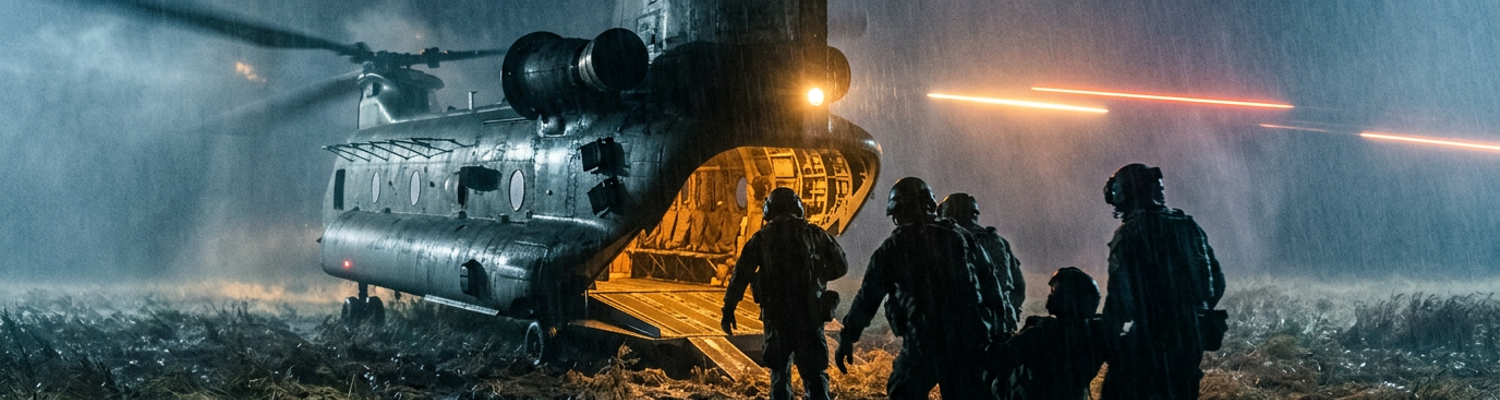
Air Force Special Operations Command flight crews sprinted through pouring rain across the flight line at Tuzla Air Base after rescue controllers decoded the emergency coordinates. Maintainers and flight mechanics detached external power cables from a pair of MH-53M Pave Low IV heavy-lift helicopters belonging to the 21st Special Operations Squadron, which sat fueled and armed for immediate extraction duty. Pilots in the cockpits rapidly spun up the six-bladed main rotors and checked their terrain-following radar displays, coordinating with an accompanying MH-60G Pave Hawk to form a three-ship recovery formation. Pararescue jumpers in the rear cabin racked their carbines, secured medical trauma bags to structural bulkheads, and mounted heavy machine guns in the open side doorways. Rotor wash churned standing water into blinding spray across the tarmac as the massive Pave Low helicopters lifted off and headed east toward the mountainous Yugoslav border.
OA-10A forward air controllers operating under the Sandy callsign orbited ahead of the rescue formation to oversee battlefield search patterns and clear a path across the frontier. Pilots flying the armored, twin-engine jets peered through night-vision goggles to survey the dark hills of northwestern Serbia, working through heavy radio static to re-establish direct contact with Zelko's beacon. Sandy flight leaders coordinated between electronic surveillance aircraft, inbound strike fighters, and the helicopter package to verify that no enemy ambushes waited near the downed aviator. Flight commanders divided the target area into distinct search quadrants on their cockpit paper charts, guiding wingmen through sweeping low-altitude turns to track Serbian vehicle convoys and spotlight sweeps along the roads. Radio operators on the Sandy team passed updated steering cues and threat warnings down to the inbound helicopters, directing them toward a narrow breach in the enemy radar network.
Helicopter pilots pushed their heavy airframes across the border, penetrating active Serbian integrated air defense sectors under driving rain and degraded visibility that severely reduced the effectiveness of night-vision devices. Pave Low navigators tracked electronic threat receivers as Serbian search radars swept the low clouds, forcing the aircrews to drop within fifty feet of the muddy ground to hide beneath the radar horizons of mobile missile batteries. Heavy rain lashed the cockpit canopies and obscured sudden terrain obstacles, forcing the pilots to weave manually around high-voltage power lines, church steeples, and forested ridges while water leaked through cockpit seals. Serbian anti-aircraft artillery batteries and infantry units spotted the low-flying rotorcraft in the dark, sending sporadic bursts of tracer fire and small-arms rounds arching blindly through the wet mist. Door gunners leaned into the gale from their open hatches, tracking muzzle flashes on the ridgelines while the pilots bypassed the enemy firing positions and surged into the agricultural lowlands of Vojvodina.
Pilots established low-level navigation lines across the flat farm fields of Vojvodina, following coordinates relayed by the Sandy controllers overhead. Sandy 11 established direct radio contact with Zelko over survival frequencies, directing the hidden pilot to ready his signaling device and prepare for an immediate pickup. Pararescue teams inside the helicopters chambered rounds into their weapons and prepared to leap into the darkness, scanning the nearby tree lines where Serbian searchlights flickered against the low clouds. Flight leads cross-checked their instruments against the coordinates provided by airborne controllers, committing the entire task force to an immediate descent onto the muddy ground.
Drainage Ditch Recovery and Extraction Operations
Helicopter pilots keyed their survival frequencies to broadcast encrypted tactical voice protocols, demanding immediate challenge and response countersigns to verify that the coordinates did not harbor a Serbian ambush. Dale Zelko raised the water-damaged PRC-112 radio to his mouth, speaking through chattering teeth into the damp microphone to recite his assigned authentication words and confirm his identity to the rescue controllers. Sandy controllers circling overhead matched his spoken countersigns against classified survival files and authorized the low-flying helicopters to close the final distance. Zelko pulled a handheld infrared signaling beacon from his survival vest, shielded the casing against his chest, and pointed the emitter upward through the tangled weeds of the ditch. Aircrews wearing night-vision goggles picked up the pulsating strobe cutting through the misty rain, converting the invisible infrared flashes into a steady green beacon on their helmet-mounted displays. Pave Hawk pilots adjusted their cyclic sticks toward the rhythmic flash, fixing the exact position of the ditch amidst the featureless agricultural fields.
Tires slammed into the saturated wheat field as the MH-60G flared above the ditch, kicking up clouds of muddy spray that masked the descent. Pararescue jumpers unhooked their safety harnesses and leaped into the knee-deep muck, fanning out with carbines raised to establish a hasty security perimeter around the idling airframe. Serbian military search parties and armed police units closed in from adjacent dirt roads, their vehicle headlights cutting through the foggy rain as they followed the thunder of the helicopter engines. Spotters in nearby farm lanes reported the low-altitude rotorcraft, deploying teams equipped with shoulder-fired Strela-2 portable missiles to set up surface-to-air ambushes along the hedgerows. Allied electronic warfare operators flashed warning tones over the radio net that enemy troops were converging within several hundred yards of the touchdown point. Door gunners leaned out of the open gun windows with their heavy machine guns, scanning the treeline for the telltale flash of shoulder-fired missile rocket motors.
Pararescuemen sprinted along the muddy ditch bank toward the infrared strobe, shouting Zelko's callsign through the deafening roar of the idling engines. Zelko lunged upward from the stagnant water, grabbing the outstretched gloved hands of the rescue team as they hauled him out of the ditch. Rescuers dragged the exhausted pilot across the wet wheat field, physically shielding him with their body armor while pushing him through the open cabin doorway of the Pave Hawk. Ground evasion ended right there on the sodden soil after approximately eight hours of dodging motorized search patrols, guard dogs, and armed civilian sweep lines. Crew chiefs dragged Zelko onto the cabin floor and hammered the pilot's seat with their fists, shouting that the package was secure and ordering an immediate emergency takeoff.
Turboshaft engines shrieked at full military power as the Pave Hawk tore its landing gear free from the suction of the mud. Door gunners laid down suppressing fire toward approaching headlights while the pilot banked hard into the mist, throwing out defensive flare bursts to decoy any launched Strela-2 infrared missiles. Lead navigators in the accompanying MH-53M Pave Lows initiated the immediate retrograde transit, guiding the three-ship formation west at treetop level toward the relative sanctuary of Bosnia. Helicopter pilots pushed their airframes to maximum airspeed beneath fifty feet of altitude, using dark river valleys and rolling hill contours to slip beneath the radar coverage of Serbian air defense batteries. Medical specialists in the rear cabin stripped away Zelko's soaked flight gear, wrapped his freezing body in thermal blankets, and treated him for hypothermia as the helicopters crossed the Drina River. Flight crews notified allied command posts across the Adriatic that Vega 31 was safe aboard the extraction package and descending toward the runway at Tuzla Air Base.
White House Crisis Response and Messaging Shifts
Sandy Berger received the flash cable confirming the extraction package had landed at Tuzla and immediately convened an emergency council with President Bill Clinton in the White House Situation Room. Military aides tracked the pilot's medical evacuation while Clinton and Berger faced the reality that the loss of an invincible stealth aircraft had shattered Washington assumptions about a risk-free air campaign. Defense officials clustered around the briefing consoles, wrestling with how to control the political fallout before foreign capitals interpreted the shootdown as proof of allied vulnerability. Berger directed staff to maintain absolute operational silence regarding the rescue mechanics until field commanders verified Zelko's physical condition and debriefed the helicopter crews. Clinton reviewed the initial damage assessments with his national security team, recognizing that the tactical loss would quickly spill into a global diplomatic problem.
Television screens inside the West Wing flickered with live satellite feeds from Belgrade, showing Yugoslav state television broadcasting triumphant footage of Serbian civilians dancing on the blackened wing of the F-117A. State media cameras zoomed in on the intact stencil markings, serial number 82-0806, and radar-absorbent skin panels, dismantling allied attempts to dismiss the crash as a mechanical mishap. Berger ordered an urgent revision of White House press guidance, instructing Pentagon spokesman Kenneth Bacon and allied briefers to acknowledge the lost jet while strictly refusing to confirm enemy missile capabilities or search methods. Speechwriters threw out pre-cleared talking points that had praised frictionless American air supremacy, substituting carefully vetted language that framed combat losses as an expected price of confronting Serbian forces. Diplomatic officers transmitted updated ministerial dispatches across secure lines to NATO headquarters in Brussels and allied defense ministries, urging foreign counterparts to project collective resolve and prevent Slobodan Milosevic from splitting the nineteen-nation alliance.
Legislators on Capitol Hill reacted to the broadcast wreckage with sharp bipartisan scrutiny, questioning the strategic direction of Operation Allied Force and warning that an ineffective bombing effort would trap the nation in an unplanned ground war. Berger coordinated with senior Pentagon officials to contain domestic political blowback before skeptical congressional leaders could draft restrictive legislative amendments against ground deployments. Clinton personally telephoned key committee chairmen, reiterating that the administration had no intention of introducing American ground combat forces into the Balkans. Press officers distributed background memos emphasizing that search and rescue teams had operated flawlessly, shifting public attention toward the survival of the pilot rather than the vulnerability of the stealth platform. White House briefers held back sensitive details about Serbian missile tactics, presenting the downing as an isolated incident that did not diminish allied air superiority.
President Bill Clinton approved this finalized crisis messaging strategy in the Situation Room and ordered defense chiefs to protect the air campaign from congressional intervention. Berger dispatched formal policy cables to the State Department and NATO ambassadors, instructing envoys to reassure allied capitals that Washington would absorb the material loss without wavering on the air war or demanding ground divisions. Congressional leaders accepted the administration assurances for the immediate news cycle, delaying premature floor resolutions while demanding regular classified briefings on pilot safety and combat search capabilities. Air Force commanders across the Atlantic received their new operational directives from the Joint Chiefs of Staff before sunrise, permanently ending unescorted night runs and ordering dedicated EA-6B Prowler radar-jamming aircraft to shield all future stealth strikes across Yugoslav airspace.
Stealth Material Exploitation and Counterintelligence Risks
Pentagon targeting officers evaluated precision standoff strikes against the Budanovci crater to vaporize the remaining airframe before sunrise, seeking to wipe out the secret hardware while friendly rescue helicopters were still flying home. Planners in the Combined Air Operations Center mapped out coordinates for Tomahawk cruise missiles and F-15E Strike Eagles loaded with two-thousand-pound laser-guided bombs. Joint Chiefs strategists confronted severe collateral risks during these emergency deliberations because hundreds of Serbian villagers, local police, and television journalists were already crowding around the burning wreckage. Dropping heavy ordnance onto an open agricultural field adjacent to residential homes risked killing dozens of civilians on camera, handing Belgrade an immediate propaganda victory. Strike planners also recognized that blast shockwaves might merely pulverize and scatter microscopic stealth fibers across the countryside rather than incinerate them. General Wesley Clark and allied defense leaders ultimately aborted the strike package, deciding that the certainty of civilian casualties outweighed the uncertain prospect of destroying fragments that Yugoslav soldiers had already begun dragging away.
Serbian army engineers loaded jagged sections of radar-absorbent composite skin, canopy framing, and shattered avionics boxes onto flatbed military trucks under heavy armed guard once the threat of allied bombing lifted. Recovery teams from the Yugoslav First Army worked alongside technical specialists from the Aeronautical Testing Center, methodically prying the intact left wing, control surfaces, and cockpit instrumentation out of the mud. Soldiers swept the agricultural fields with searchlights and rakes, confiscating black carbon-fiber fragments and thermal tiles from local farmers who had picked up souvenirs. Military convoys transported the largest pieces of the wreckage directly into Belgrade, securing the classified haul inside storage depots at the Belgrade Aviation Museum near Surcin Airport. Museum curators and military technicians sorted the components into secure hangars, setting aside the canopy glass, ejection seat mechanisms, and specialized exterior coatings for thorough structural evaluation while placing minor structural debris on public display to bolster domestic morale.
Trucks carrying foreign defense attaches and intelligence officers soon arrived at the military storage bays in Surcin to inspect the captured American hardware. Technicians inside the Belgrade Aviation Museum opened the hangars to Russian military intelligence specialists, who immediately began scraping samples of the radar-absorbent paint and measuring the edge alignments of the faceted airframe. Serbian handlers also allowed Chinese military observers to examine the internal radar systems, infrared optical sensors, and engine exhaust baffles. Yugoslav authorities traded physical chunks of the jet in exchange for electronic components, spare parts, and diplomatic backing, distributing fragments to foreign embassies that maintained active diplomatic compounds in Belgrade. Foreign aerospace teams packed these composite tiles and wiring harnesses into diplomatic pouches, airlifting the sensitive materials out of Yugoslavia before NATO could disrupt commercial air corridors to Moscow and Beijing.
Central Intelligence Agency analysts delivered urgent counterintelligence damage assessments to the Pentagon after reconnaissance satellites and human sources confirmed that Russian and Chinese experts had accessed the composite fragments. Electronic eavesdropping specialists intercepted cables detailing how Russian air defense bureaus planned to test the radar-absorbent material against varying microwave frequencies, aiming to refine their surface-to-air missile guidance algorithms and defeat stealth shaping. Pentagon technical experts warned the Joint Staff that Chinese aviation engineers were using recovered wing skin, radar-absorbent foam, and heat-resistant engine tiles to fast-track their own domestic stealth fighter programs. Counterintelligence officers concluded that foreign powers had gained a physical blueprint of American low-observable chemistry that would normally have taken decades and billions of dollars to unlock. Air Force acquisition chiefs responded by launching an immediate classified review across American aerospace factories, ordering contractors to alter next-generation radar coatings on the developmental F-22 Raptor to counter the specific vulnerabilities exposed at Budanovci.
Alliance Diplomacy and Doctrinal Air Combat Shifts
Blueprints for future stealth aircraft offered no immediate protection for the combat aircrews flying nightly sorties over Serbia. European defense ministers gathered with American commanders in heated ministerial debates inside NATO headquarters in Brussels to settle how the air campaign could continue. General Wesley Clark demanded an aggressive expansion of the allied target list to strike military command hubs, electrical power grids, and government ministries in downtown Belgrade. French President Jacques Chirac and Italian leaders resisted this push, warning that wider bombing risked severe civilian casualties and threatened to fracture the nineteen-nation alliance. European delegates also insisted on strict operational safeguards for their own national air detachments, demanding that United States Navy and Marine Corps EA-6B Prowler electronic warfare escorts accompany strike flights to blind Serbian radar systems. American representatives pushed back against blanket escort requirements that would strain their limited supply of electronic jamming aircraft, but allied ministers refused to approve expanded target folders until NATO leadership guaranteed dedicated radar-jamming protection for vulnerable strike packages.
General Michael Ryan and senior Pentagon commanders responded to the allied deadlock by formally eliminating unescorted, solo stealth penetrations from Air Force tactical doctrine. Air Force tacticians had maintained since the Persian Gulf War that black jets could penetrate heavily defended airspace in total isolation, relying solely on radar-absorbent materials and angular geometry to slip past enemy batteries. Lieutenant Colonel Dale Zelko losing his jet destroyed that institutional belief and exposed how vulnerable low-observable jets became when Serbian radar crews timed weapon bay door openings along predictable flight paths. Flight manuals and operational directives across the 49th Fighter Wing were immediately rewritten to prohibit any stealth pilot from crossing Yugoslav airspace without synchronized standoff jamming support. Air combat regulations permanently outlawed single-ship stealth penetrations, ordering that low-observable bombers must operate as integrated components of combined strike packages rather than independent strikers. This doctrinal reversal stripped the Nighthawk of its mythical solo invulnerability, reclassifying the aircraft as a specialized platform that required the same protective screen as standard fighter-bombers.
Lieutenant General Michael Short directed air planners in Vicenza to reallocate every available electronic warfare and defense suppression asset across southern Europe to guarantee continuous jamming for all subsequent strike packages. Strike planners pulled United States Navy EA-6B Prowlers and Air Force F-16CJ Wild Weasels from secondary combat air patrols, grouping them directly ahead of incoming strike formations to blind Serbian tracking radars. Flight leads synchronized mission clocks so that jamming pods began transmitting across Serbian frequencies minutes before any F-117A approached its target, while Wild Weasel pilots kept high-speed anti-radiation missiles primed on their wing pylons to destroy any active missile site. Maintenance crews at Aviano Air Base and Spangdahlem Air Base worked through round-the-clock rotations, loading radar-busting missiles and servicing jamming electronics on crowded flight ramps. Ground crews pushed these support aircraft into the air for every single offensive mission, guaranteeing that Serbian missile batteries could never radiate a target without facing immediate electronic interference and retaliatory missile strikes. Allied strike leads routed every subsequent F-117A through narrow jamming corridors carved out by Prowlers, dropping their laser-guided bombs onto Serbian targets before turning west under the continuous missile coverage of orbiting Wild Weasels.