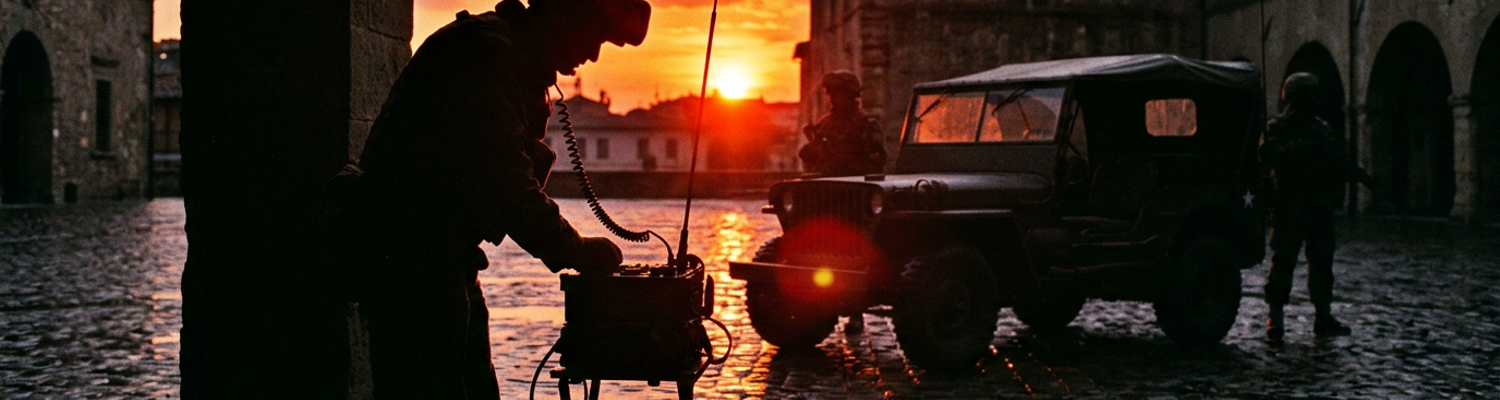

Signal Failures in Allied Occupied Vienna
Teletype keys clattered to a dead halt as the high-frequency telegraph circuits connecting the Vienna signal annex to the War Department in Washington failed completely in late 1945. Heavy rain beat against the basement windows while petrol fumes drifted into the workspace from an auxiliary generator running in the courtyard outside. Corporal James Miller adjusted the frequency dials on his radio receiver and listened for the distant carrier tone through his headphones, but only blank hiss filled the signal bands. Theater communications across the Atlantic were entirely severed, cutting the local Strategic Services Unit detachment off from the Pentagon and the European Theater command post in Frankfurt. Miller pressed the transmitter key repeatedly to test the antenna feed, yet the output meter needle remained resting at zero. He marked the circuit logbook as dead and stared down at the growing stack of unrouted traffic piling beside his elbow.
Cardboard folders covered the wooden desk beneath conflicting instructions from three separate Allied headquarters. Demobilization point scorecards demanded Miller's constant attention alongside radio logs, because the Army demobilization system required endless tallies of service credits, combat stars, and overseas months before any soldier could return home. Experienced radio operators were boarding transport ships for the United States every week, leaving the few remaining technicians in the occupied Austrian capital to handle triple their normal clerical workload. Revised signal instructions from Salzburg ordered operators to route all border surveillance traffic through Salzburg relay stations, while older written orders from Vienna headquarters insisted that all tactical dispatches stay on local lines. Miller tried to sort through the incoming courier reports and military government slips, but the shifting rules made it impossible to determine the legal priority of any single document. He picked up an urgent flash message regarding an unauthorized courier heading toward the Enns River, unable to verify who had authorization to read it.
Carbon paper copies warned that the traveler was already approaching an American checkpoint near the Soviet occupation boundary. Regulations clearly stated that frontline units could not detain travelers carrying official papers without direct authorization from the War Department or the theater commander. Radio failure meant that Miller could not request that authorization, and local civilian telephone lines remained severed across the ruined city. Demobilization had stripped the detachment of its staff officers, leaving only a junior lieutenant on duty who had to decide whether to let the suspect cross or violate theater protocol. The lieutenant read the urgent dispatch, checked the dead transmitter needles, and decided that letting the traveler escape into Soviet custody was an unacceptable intelligence risk. He shoved the demobilization point ledgers aside, buckled on his sidearm belt, and gathered three armed infantrymen from the annex guardroom.
Jeep tires threw up muddy gravel outside the signal annex as the lieutenant led the small team out of the courtyard on their unilateral interception mission. The patrol vehicle headed west along the bomb-damaged road toward the zonal border without written orders, travel permits, or headquarters clearance. Back in the annex, Miller reset the circuit breakers on the radio console and kept calling the Frankfurt relay station on secondary channels, but atmospheric interference blocked every transmission attempt. The operator had no way to call the lieutenant back, nor could he send word ahead to warn the Enns River checkpoint guards about the incoming American patrol. Miller placed the unrouted courier alert into a pending tray and listened to the engine noise fade toward the Soviet sector.
Executive Order 9621 and Strategic Services Restructuring
Miller reached for a thick organizational manual on the shelf to confirm whether their Vienna post even had the legal power to stop travelers at an international boundary. The paper trail inside the binder exposed the root of their administrative paralysis, charting how President Harry S. Truman signed Executive Order 9621 on September 20, 1945, abruptly abolishing the wartime Office of Strategic Services. That presidential directive eliminated the sprawling agency created by Major General William Donovan, scattering its research desks and operational assets across multiple government departments with just ten days of advance notice. Field stations from Berlin to Vienna suddenly lost their direct reporting channels to the Joint Chiefs of Staff, plunging frontline detachments into confusion while military government officers in Austria questioned the civilian agents' remaining authority. Miller flipped through the frayed mimeographed pages of the executive order, finding no clear rules for managing armed border emergencies during the chaotic transition. The document merely assigned the surviving espionage personnel to temporary custody under the military establishment, leaving local radio operators and field agents with contradictory marching orders.
Brigadier General John Magruder assumed command of these surviving espionage personnel when the War Department created the interim Strategic Services Unit to prevent America's foreign intelligence apparatus from dissolving entirely. Magruder secured the preservation of the Secret Intelligence and Counter-Intelligence branches inside this caretaker structure, sheltering experienced espionage networks and counter-espionage registries under the Office of the Assistant Secretary of War. War Department planners treated the arrangement as an austere liquidation bureau designed to catalog records, release nonessential specialists, and return surplus property to regular Army quartermasters. Magruder resisted the wholesale destruction of these overseas networks, instructing stations across occupied Austria to maintain their human sources against Soviet intelligence services despite shrinking budgets and lost personnel. His preservation effort kept trained field agents in Austrian safe houses, but it failed to provide the logistical staff, supply lines, or dedicated radio frequencies needed to coordinate tactical missions. Vienna operatives inherited secret agent files from the wartime counter-intelligence branch, yet they lacked the basic staff clearance to route urgent border alerts through regular Army telegraph lines.
Telegraph cables running through the Vienna signal annex remained tied directly to the United States Forces in Austria communications center, which refused to process messages from an unrecognized intelligence agency. Regular Army signal officers regarded the Strategic Services Unit as an irregular civilian appendage with uncertain security clearances and no formal standing in the theater table of organization. Every encrypted telegram concerning Austrian border crossings required manual endorsement from theater headquarters in Salzburg, creating bureaucratic delays that stretched across days while suspects moved in hours. Magruder could not resolve these signal bottlenecks from Washington because the interim unit held no statutory authority over theater signal corps battalions or frontline checkpoint commanders. Austrian station chiefs therefore instructed their field operatives to take independent tactical action whenever routine administrative channels stalled, encouraging junior officers to run counter-espionage operations on their own judgment. This institutional isolation turned routine border security into a series of improvisations, ensuring that minor field decisions carried the weight of international policy without anyone in Washington knowing they had occurred.
Miller adjusted his headphones at the silent radio console, staring at the empty wooden chair where the lieutenant had sat moments earlier before racing toward the Enns River. The young officer carried counter-intelligence dossiers preserved by Magruder's reorganization, but he possessed no written authorization from the War Department to detain persons along the demarcation line. Soviet guards patrolled the eastern bank of the river with submachine guns, operating under strict standing orders from Moscow to arrest any Allied personnel trespassing beyond their sector. American sentries at the western bridge abutment had received no radio notice of the incoming intelligence team because the Vienna teletypes sat dead beneath the rain. Miller clicked the transmitter toggle switch one more time and listened to the dead circuit hiss while the jeep sped into the contested border zone.
SIGABA Cryptographic Protocols and Station Bottlenecks
Miller pushed open the heavy steel door of the cryptographic vault, hoping that landline teletype circuits running westward toward Salzburg might still carry an urgent warning to the border. Army signal operators inside the windowless chamber worked under the harsh light of an unshaded bulb, frantically servicing an ECM Mark II SIGABA cipher machine that had overheated during the evening transmission cycle. Grease, graphite powder, and paper fragments coated the steel workbench where two technicians used small picks to dislodge shredded teleprinter ribbons from the drive gears. Cryptographic protocols established by the Signal Corps required absolute mechanical precision from the cipher unit, meaning that even a minor alignment error inside the rotor bank invalidated entire pages of enciphered text. Damp air filtering through the basement foundation had oxidized the machine's copper contact points, causing intermittent electrical shorts that garbled outbound characters and triggered automatic safety cutoffs. Sergeant Thomas Keller wiped sweat and machine lubricant from his forehead as he tested each rotor circuit with a battery-powered continuity meter, trying to revive the unit before the next scheduled transmission window.
Keller adjusted the brass contact pins on the fifth cipher rotor, struggling to meet the strict security procedures governing the SIGABA system. Every cipher cycle demanded an intricate configuration process, requiring operators to match five control rotors, five cipher rotors, and five index rotors against classified daily key lists before typing a single character. Army signal regulations prohibited operators from taking operational shortcuts or bypassing faulty stepping switches, forcing the technicians to complete a total mechanical reset whenever an internal timing cam slipped. Teleprinter tape reels spun erratically across the workbench as the motor drive surged against the unstable electrical current supplied by the courtyard generator. Replacement parts remained trapped in supply depots hundreds of miles away in Germany, leaving the Vienna detachment to clean worn stepping relays with solvent and salvage springs from discarded field radios. Keller locked the heavy aluminum cover back onto the cipher chassis, but the internal motor hummed unevenly as the stepping switches struggled to advance the paper tape.
Paper tapes filled with unrouted field reports overflowed the sorting baskets beside the cipher desk, creating a massive cryptographic backlog that paralyzed the annex. Administrative dispatches addressed to the War Department in Washington held absolute priority over field intelligence, monopolizing the operational SIGABA circuits for hours at a time. Theater directives forced signal operators to transmit voluminous demobilization ledgers, personnel scorecards, and property liquidation inventories before releasing machine time for local tactical warnings. Strategic Services Unit dispatches describing Soviet troop movements, safe house raids, and unauthorized border crossings accumulated in wire trays, marked with low precedence stamps that kept them waiting behind routine military government paperwork. Clerks had stacked dozens of encrypted yellow ribbons onto wooden shelves, where urgent operational intelligence sat unread while the teleprinter clattered through hundreds of yards of regular Army accounting tallies. Miller held out the handwritten alert regarding the runaway border patrol, but Keller pointed toward the teletype accumulator that was already filled with administrative dispatches until morning.
Salzburg relay stations offered no alternative route for the urgent alert, because technicians at the western communication center were battling their own mechanical failures and message backlogs. Operators at the Salzburg terminal managed critical traffic delays on their own ECM Mark II machines, struggling to maintain scorched electrical solenoids while administrative traffic filled their landline circuits. Cryptographic protocols prevented the Salzburg switchboard from accepting unencrypted telephone calls regarding intelligence matters, shutting down the last remaining channel between Vienna and the border posts. Army regulations required field detachments to route all border security alerts through this dual-station cipher bottleneck, ensuring that tactical emergencies remained subordinated to central theater administration. Miller dropped the unsent dispatch back into the pending tray and walked to the annex window, watching the rain beat against the courtyard cobblestones. Soviet sentries and American checkpoint guards along the Enns River remained completely unaware of the approaching intelligence patrol, while the critical warning sat trapped beneath a stack of demobilization rosters.
Danubian Economic Seizures in Series M1656
Folders containing field intelligence report batches A-67500 through A-69099 lay buried beneath those same administrative papers, preserving the raw operational evidence that explained why the lieutenant had raced toward the border. Strategic Services Unit personnel had compiled these documents into National Archives Microfilm Publication M1656, creating an exhaustive record of Soviet expansion in eastern Austria during the opening months of peace. Clerks in the Vienna station had filled these pages with systematic reporting on Soviet Red Army redeployments across Lower Austria, charting how infantry regiments and tank brigades shifted away from central garrisons toward the western boundary line. Field informants watched Soviet truck columns reinforce rural outposts and build armed roadblocks along every highway leading out of the capital. Secret agents noted that these sudden troop movements aimed to shield Soviet logistical corridors from Allied eyes while Russian work crews worked around the clock.
Freight cars loaded with crated machine tools rolled through those shielded corridors toward eastern railheads, fulfilling Moscow's aggressive program of Austrian factory dismantling. Batches in the M1656 microfilm recorded how Soviet recovery squads entered industrial districts in Floridsdorf and Wiener Neustadt to strip precision equipment from metalworking plants, aircraft repair shops, and electrical works. Red Army engineers unbolted heavy presses, lifted overhead gantry cranes, and severed copper electrical lines before loading the factory components onto waiting flatbed railcars. Informants inside the Austrian economic ministries smuggled production ledgers to American handlers, warning that the Soviets were removing essential equipment under the legal excuse of German external assets. Station agents warned in their dispatches that this systematic plant dismantling was gutting the postwar Austrian economy, leaving empty concrete foundations where major manufacturing hubs had stood only weeks earlier. Russian transport officers funneled the remaining bulk machinery southward and eastward toward the water terminals, where rail lines met the river docks.
Danube River shipping assets seized by Soviet occupation authorities served as the primary transport fleet for hauling this dismantled machinery out of the country. Operatives tracked how Soviet naval commandants confiscated hundreds of barges, tugboats, and tankers belonging to the First Danube Steam Navigation Company. Crews painted new Soviet registry numbers across Austrian hull plates and locked local harbor masters out of the freight wharves from Linz down to the Hungarian border. Intelligence files in the A-67500 through A-69099 series detailed how armed Soviet guards boarded passing rivercraft, forced civilian captains off their vessels, and diverted entire coal convoys into the eastern zone. American economic advisors viewed these Danubian shipping seizures as a direct violation of international agreements on free navigation, yet Washington diplomats lacked the frontline intelligence needed to challenge the Soviet command. Underground couriers attempted to bridge that information gap by smuggling vessel registration papers, cargo bills of lading, and seizure receipts across the zonal border into American hands.
Miller grabbed the carbon paper summary of the courier mission from the counter, recognizing that the intercepted traveler was carrying the newest proof of these illicit river seizures. The runaway lieutenant intended to seize those shipping manifests before the courier slipped past the Enns River bridge into the safety of the American zone. Army signal protocols still blocked Miller from sending a radio flash to the border checkpoint, leaving the young officer to confront armed guards without official clearance or tactical backup. Miller shoved the M1656 report folders back into their steel file drawer and slammed the drawer shut. He snatched his field jacket from the wall peg, took the spare ignition key from the dispatch desk, and ran out into the courtyard rain to start the station backup truck.
Field Isolation and Unsanctioned Tactical Deviations
Miller jammed the starter pedal down with his combat boot, coaxing the damp engine of the three-quarter-ton truck into a sputtering roar. Dashboard dials shuddered against the metal frame as he shifted into first gear and rolled out onto the wet cobblestones of the Vienna streets. Total communication blackouts continued to sever the local operational team from higher headquarters guidance in Frankfurt, leaving field personnel without formal mission authorizations or verified tactical instructions. Auxiliary radio receivers inside the vehicle picked up only static, proving that the signal collapse extended across every operational frequency in eastern Austria. The complete loss of telegraph and telephone lines meant that theater commanders had no knowledge of what the field team was doing, while the men in Vienna could not ask for orders or clarify border procedures. Miller accelerated through the bomb-damaged suburbs, tracking the wet tire ruts left by the patrol vehicle ahead of him.
Tires cut deep ruts through wet gravel along the westbound highway as the isolated surveillance detachment sped toward the demarcation line. The team had made an unauthorized tactical decision to intercept a moving courier target without theater clearance, violating standard military command structures to prevent valuable evidence from vanishing. Strict Allied occupation regulations required all operational units to obtain explicit written permits from the theater provost marshal before conducting armed interdictions inside the transit corridors. The detachment commander chose to disregard these administrative rules because waiting for communication channels to reopen would allow the courier carrying Danubian shipping papers to slip away. Driving without lights through the Soviet-controlled zone, the small group pushed their open jeep to its mechanical limits along the ruined asphalt. The officers checked their sidearms in the dark and prepared to ambush the approaching vehicle before it reached the river crossing.
Headlights pierced the darkness near the eastern approach to the Enns River, illuminating a black civilian sedan that matched the intelligence description of the target vehicle. The surveillance team swerved their jeep across both traffic lanes, forcing the civilian car to skid to an abrupt halt on the muddy shoulder just two hundred yards short of the border. Three American intelligence officers leapt into the roadway with drawn pistols, surrounding the stalled car before the driver could engage reverse gear. The team lacked theater clearance or coordination with the bridge garrison, making their armed roadside interception completely invisible to Allied military police logs. Detachment operatives yanked the car door open, pulled the courier onto the wet ground, and grabbed a heavy leather briefcase containing the contested shipping manifests. The courier struggled against his captors in the roadway, shouting warnings that echoed across the quiet water of the river.
Soviet guards stationed at the eastern bridgehead raised their submachine guns at the sound of the scuffle, immediately alerting their sector command post to the disturbance. Searchlight beams flicked on from wooden guard towers along the bank, catching the American intelligence team and their captive in bright glare. Sentries from the American sixty-fifth infantry division on the western side of the Enns heard the commotion, chambered rounds into their rifles, and pointed their weapons across the river toward the Soviet lines. Miller pulled the backup truck onto the road shoulder behind the idling jeep just as machine gun bolts clattered into battery on both banks of the demarcation line. The intelligence officers shoved the courier into the rear seat of their jeep and scrambled behind the steering wheel while rifle barrels tracked them from the perimeter towers. Neither national garrison understood who was conducting the roadside ambush, leaving twenty armed soldiers facing each other with cocked weapons over an unsanctioned border seizure.
The 1946 Enns River Checkpoint Confrontation
Soviet Red Army border sentries leveled their submachine guns directly at the American intelligence operatives, sprinting out from their sandbagged guardhouse toward the unmanifested Soviet courier vehicle that sat trapped against the river checkpoint. The American surveillance personnel held their ground with drawn sidearms, shielding the captured courier while American infantrymen on the western bridgehead raised their rifles to cover the detachment. This sudden interception of an unmanifested Soviet courier vehicle at the Enns River zonal boundary checkpoint in 1946 triggered an armed zone-boundary standoff pitting U.S. intelligence surveillance personnel against Soviet Red Army border sentries. Neither side possessed radio clearance, valid travel manifests, or central headquarters orders explaining why an intelligence team had seized a vehicle inside the shared transit corridor. Rain beat against the wooden bridge timbers while the two opposing lines of soldiers stood less than thirty yards apart, shouting competing commands across the boundary line. Miller stepped out from his truck cab into the glare of the searchlights, keeping his empty hands visible above his shoulders while the intelligence lieutenant kicked the seized courier briefcase deeper under the jeep seat.
Searchlights illuminated the wet road as Soviet officers marched forward to demand the immediate surrender of the courier vehicle and all seized cargo. The Russian captain pointed at the civilian sedan and stated that international transit accords protected official courier traffic from arbitrary search or seizure inside Allied transit corridors. The American intelligence lieutenant countered that the civilian sedan lacked official military travel permits, displayed no authorized bilateral convoy markings, and held no manifest entry in the border control register. American infantry sentries from the western bank moved across the bridge planks to form a defensive perimeter around the intelligence jeep, aiming their rifles straight at the Russian squad. Soviet machine gunners inside the eastern timber tower rotated their heavy Maxim gun toward the American soldiers, pulling the charging handle back with a loud metallic click that halted all spoken arguments. Both lines of soldiers stood motionless in the beam of the perimeter searchlights, keeping their trigger fingers rigid while the swollen river surged past the stone piers below.
Miller edged toward the American infantry sergeant stationed on the bridge ramp, warning him that the standoff would turn into an open firefight if the patrol remained exposed on Soviet territory. The sergeant recognized that an exchange of bullets over an unsanctioned roadside ambush would trigger a severe military crisis between the occupation powers. The infantry noncommissioned officer signaled his squad to hold their weapons at the ready while motioning for the intelligence jeep and the support truck to withdraw westward toward the American bank. Soviet sentries shouted angry warnings and brought their submachine guns to their shoulders, but their commanding captain held his right arm extended in the air, ordering his men to hold their fire rather than start a full shooting war over an unmanifested courier. The intelligence lieutenant shifted the jeep into reverse, backing the captured courier and the seized shipping dossiers across the white line painted on the bridge deck.
Tires churned through wet gravel as Miller rolled the backup truck backward across the demarcation line right behind the surveillance jeep. American infantrymen maintained their firing positions across the bridge until both vehicles cleared the boundary markers and rolled onto the western bank. Soviet border sentries slammed their heavy iron barrier gate shut and chained the crossing post against further transit from the American sector. The intelligence detachment pulled their vehicles behind the American checkpoint bunker, where officers transferred the soaked leather briefcase into a secure steel lockbox. Miller switched off his truck engine and listened to the rain hammer the cab roof, watching the Soviet tower searchlights sweep back and forth across the closed border crossing.
Quadripartite Liaison Negotiations and Border Incident Containment
Telephone bells inside the Allied Council headquarters building in Vienna clattered within an hour of the Enns River shutdown, alerting occupation commanders to the armed confrontation along the bridge. Soviet military authorities lodged an immediate protest with the American element, reporting that an armed American party had crossed the demarcation line, attacked an official courier car, and seized state documents. Representatives from the United States, Great Britain, France, and the Soviet Union convened an emergency diplomatic mediation session around the main conference table in Vienna to de-escalate the border confrontation before frontline troops opened fire. Soviet delegates insisted that the ambush was a deliberate violation of Allied transit pacts and threatened to close every inter-zonal checkpoint leading into Vienna unless the courier and his cargo were returned at once. American delegates had no clear facts from the broken signal network, so they stalled for time by insisting that bad weather and broken radios had caused a simple field misunderstanding rather than an intentional raid.
Diplomats from the four occupation powers argued through the early morning hours, exchanging tense notes and checking treaty clauses under the glare of electric chandeliers. American negotiators agreed to release the detained courier back to the eastern bank of the Enns River in exchange for a Soviet promise to withdraw their heavy machine guns from the bridge abutments. The diplomatic settlement required both sides to verify that all border detachments had operated strictly within standard patrol guidelines, creating an immediate crisis for the American intelligence headquarters. American commanders in Vienna realized that if quadripartite investigators discovered that the Strategic Services Unit had sent an armed team across the boundary without theater clearance or travel permits, the Soviet command would use the breach to shut down all western road traffic. Brigadier General John Magruder's remaining intelligence cadre in the capital scrambled to shield the field operatives from a formal military court of inquiry.
Army intelligence staff began administrative alterations of patrol sheets and transit paperwork inside the Vienna headquarters to obscure the unauthorized operational actions of the field team. Officers pulled original movement logs from the provost marshal dispatch boards and substituted freshly typed sheets showing that the lieutenant had departed on a routine highway maintenance survey rather than a targeted interception. Clerks used razor blades and ink erasers to scrape away the actual departure times from the motor pool ledger, backdating the route clearance slips so the trip appeared to have received advance approval from theater administrators. New paperwork described the armed encounter at the bridge as an accidental navigational error caused by heavy rain and fallen road signs. Staff sergeants stamped these modified trip tickets with counterfeit inspection marks, creating a clean bureaucratic trail that concealed the missing War Department authorizations.
Miller carried the forged route slips and altered vehicle manifests into the command file room as soon as he returned to the Vienna annex. The corporal slotted the falsified log sheets into the official records jacket beside the dead teletype logs, ensuring that visiting inspectors from the Allied Council would find matching paperwork for every vehicle that had approached the river. Soviet border guards reopened the iron gate at the Enns River crossing by sunrise, accepting their released courier while American sentries lowered their rifles and resumed standard guard shifts. Miller pushed the file drawer shut, turned the brass key in the lock, and walked back to his radio console to resume testing the dead telegraph circuits to Washington.
Liquidation of the SSU and Central Intelligence Transition
Telegraph circuits finally reconnected the Vienna annex to the War Department two days after the bridge standoff. Miller transmitted the backlog of encrypted border reports, sending the altered patrol logs and the translated Danubian shipping manifests through the revived SIGABA machines. Washington administrators read the delayed intelligence files and realized that the interim Strategic Services Unit could not continue operating under such severe logistical isolation. War Department officials recognized that frontline intelligence collection required dedicated communication networks and independent funding to prevent further unsanctioned border clashes. General John Magruder received orders to begin the final liquidation of the temporary intelligence unit, transferring its remaining overseas assets to a permanent civilian agency.
Magruder initiated the transfer process by boxing up the M1656 microfilm series and the surviving counter-intelligence dossiers. Clerks in the Vienna station packed their operational files into wooden shipping crates, preparing to hand their informant networks over to the newly established Central Intelligence Group. The transition directive stripped the Army of its temporary control over the espionage networks, placing the field detachments under direct presidential authority to eliminate the bureaucratic bottlenecks that had paralyzed Miller and the lieutenant. Supply officers arrived at the signal annex to inventory the cryptographic machines, radio transmitters, and patrol vehicles, officially closing the military ledgers on the interim operation. The Central Intelligence Group absorbed the experienced field agents and radio operators, providing them with the independent budget needed to secure their own dedicated telegraph lines.
Civilian technicians replaced the military signal corps personnel inside the basement vault, rewiring the communication consoles to bypass the regular Army switchboards in Salzburg. Miller watched the new operators test the upgraded high-frequency transmitters, noting that the dedicated circuits provided direct contact with Washington without requiring theater command approval. The former Army corporal packed his duffel bag and collected his demobilization discharge papers, leaving the intelligence network in the hands of the permanent civilian agency. The Central Intelligence Group later evolved into the Central Intelligence Agency, building its early European operations upon the surviving networks preserved during the chaotic postwar transition. Archive clerks locked the forged transit manifests and the translated shipping dossiers inside steel storage cabinets at the new headquarters.