
Strategic Holding Patterns in the Gulf of Thailand
The starboard auxiliary diesel generator deep inside the engineering spaces of the USS Okinawa sheared its primary drive gear at exactly 0415 hours. Metal teeth ground against the housing unit. A sudden drop in manifold pressure followed immediately. Main hydraulic cooling lines purged their fluid onto the steel deck. This mechanical breakdown triggered an automatic failsafe. Electrical power to the primary high-frequency radio suite cut out completely. The combat information center went dark for several seconds. Officers stood in silence as the ventilation fans spun down.
Archival evidence shows this localized power failure severed contact between the offshore amphibious fleet and the besieged embassy in Phnom Penh for forty-seven minutes.
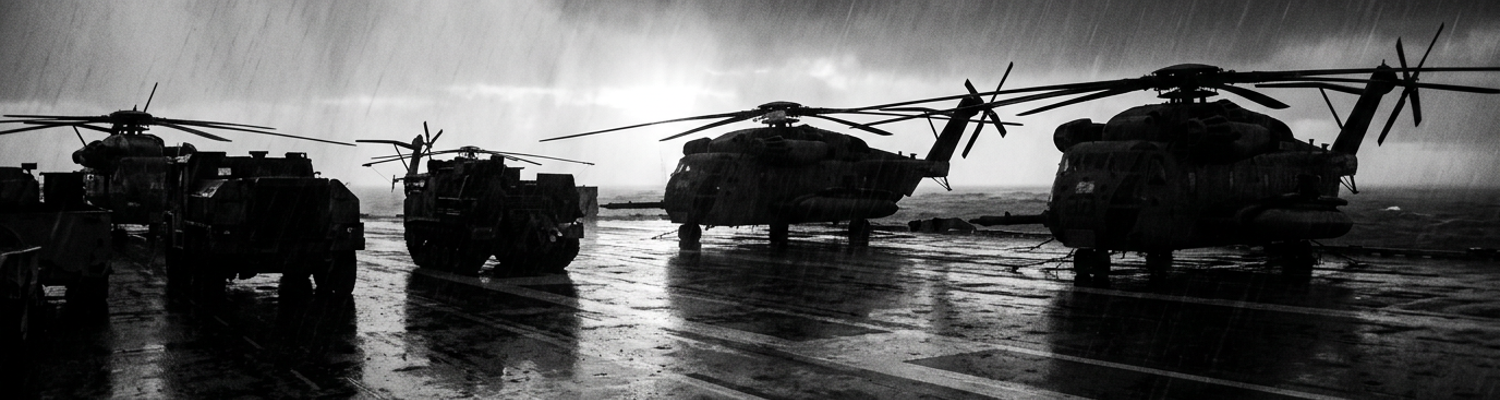
Task Group 76.4 had been holding a stationary position in the Gulf of Thailand since early April 1975. Designated as Amphibious Ready Group Alpha. The flotilla consisted of the amphibious assault ship USS Okinawa, the amphibious transport dock USS Vancouver, and the dock landing ships USS Thomaston and USS Peoria. Naval vessels loitered near the coordinates of 10 degrees 15 minutes North and 103 degrees 45 minutes East. Marine Heavy Helicopter Squadron 462 waited on the flight decks with a complement of CH-53A Sea Stallion transport aircraft. Mechanics worked constantly to prevent the ocean salt spray from corroding the exposed rotor hinges. Infantry battalions of the 31st Marine Amphibious Unit stayed below decks in cramped berthing areas for over a week. Distance from the Cambodian coastline created a profound isolation for the commanders tasked with executing the extraction. Rear Admiral George B. Crist and his staff operated inside a windowless command module on the Okinawa. They relied entirely on delayed teletype messages and static-filled radio broadcasts to understand the changing tactical environment on the mainland. Shipboard intelligence officers possessed no real-time visual data of the target zones. Planning occurred in a vacuum. Decisions about fuel loads, troop capacities, and flight routes were based on high-altitude reconnaissance photographs taken days earlier.
A forced guesswork environment defined the operation.
Two hundred miles away. The Khmer Rouge encirclement of Phnom Penh escalated rapidly throughout the first week of April. Communist insurgent forces had already severed the Mekong River supply line in February. They placed magnetic mines and established heavily armed checkpoints along the muddy banks. Highway 1 fell to advancing infantry battalions shortly after. The capital city lost all overland routes for food and ammunition resupply.
Ground forces inside the city relied entirely on air drops. Enemy fire increasingly intercepted these supplies.
Insurgent artillery units moved 105mm howitzers and captured 107mm Chinese-manufactured rocket launchers into the marshlands directly surrounding Pochentong Airport. High-explosive shells began tearing through the main runway asphalt. Parked C-130 transport aircraft burned on the tarmac. Fixed-wing supply flights out of U-Tapao Royal Thai Navy Airfield ceased operations entirely on April 11. Intense unguided anti-aircraft fire saturated the approach vectors. Destruction of the primary runway eliminated any possibility of a conventional airplane extraction for the remaining embassy personnel. Embassy staff initiated emergency protocols for an immediate air evacuation using the offshore heavy-lift helicopters. Extraction coordinates shifted to a residential soccer field designated Landing Zone Hotel. Commanders on the USS Okinawa had to finalize the launch sequence for Operation Eagle Pull without knowing if the perimeter of LZ Hotel stayed under the control of the collapsing Khmer National Armed Forces.
A close review of operational logs indicates that the final transmission from the defense attache reported mortar rounds impacting directly on the designated landing zone.
Flight Deck Conditions on USS Okinawa
Marine Heavy Helicopter Squadron 462 received orders to position twelve CH-53A Sea Stallion transport aircraft on the 600-foot flight deck of the USS Okinawa. Command records indicate Squadron Commander Lieutenant Colonel James L. Bolton directed the initial deck spotting sequence. This maximized immediate lift capability for the 2nd Battalion, 4th Marines waiting in the lower berthing compartments. Aviation boatswains mates chained the 37,000-pound machines to the non-skid surface of the Iwo Jima-class amphibious assault ship using heavy-duty tiedown assemblies. Space constraints forced maintenance crews to fold the six-bladed main rotors and tail pylons of the secondary flight aircraft. They tightly packed them near the aft elevator. This physical configuration limited immediate access to the auxiliary power units and hydraulic servicing panels. Aviation ordnance personnel loaded each Sea Stallion with GAU-15/A .50 caliber machine guns mounted on the port and starboard window pintles. Each weapon received 600 rounds of belted ammunition. Flight planning officers calculated fuel loads based on a 105-nautical-mile transit from the holding pattern at 10 degrees 15 minutes North, 103 degrees 45 minutes East to Landing Zone Hotel in Phnom Penh. Planners mandated a minimum fuel reserve of 2,000 pounds to account for potential holding patterns over the hostile extraction zone. Weight calculations became a daily mathematical challenge for the loadmasters. They had to balance the deteriorating engine performance against the anticipated mass of civilian evacuees carrying unmanifested baggage.
These heavy-lift platforms sat fully fueled and armed on the exposed flight deck for over thirty consecutive days.
Prolonged loitering in the Gulf of Thailand subjected the helicopters to a highly destructive marine environment. High-velocity ocean winds drove microscopic salt crystals directly into the unsealed magnesium gearboxes and exposed titanium rotor hinges of the CH-53As. Mechanics from HMH-462 initiated twenty-four-hour maintenance cycles to combat the rapid oxidation attacking the primary flight control servos. Archival evidence shows ground crews exhausted their supply of standard military anti-corrosion compound by the third week of March. Technicians resorted to manually wiping down the tail rotor driveshafts with aviation kerosene every six hours. This prevented the connecting joints from seizing under the tropical sun. The ninety percent ambient humidity combined with daily thermal cycling caused condensation to pool inside the unpressurized avionics bays. Water accumulation short-circuited two UHF communication transceivers. Radar altimeter wiring harnesses degraded on three separate aircraft. Turbine specialists discovered severe pitting on the first-stage compressor blades of the twin General Electric T64 turboshaft engines. This degradation resulted directly from continuous salt ingestion during the mandatory daily engine run-ups required to maintain operational readiness. Saltwater intrusion also targeted the landing gear struts. Hydraulic fluid leaked onto the flight deck. Severe slip hazards plagued the ordnance loading teams.
Flight line supervisors documented a twenty percent drop in overall engine efficiency across the squadron before the extraction sequence began.
Physical separation of the offshore task force forced supply officers to rely on secondary logistics ships operating on a two-week rotation out of Naval Base Subic Bay in the Philippines. Headquarters staff aboard the Okinawa denied multiple requests from aviation officers to rotate the deteriorating aircraft into the protective lower hangar bay. Rear Admiral George B. Crist and his command element required an immediate zero-notice launch capability for Operation Eagle Pull. They operated under the assumption that the embassy perimeter could collapse within minutes. Moving the helicopters via the deck elevators and manually unfolding the heavy rotor blades would add forty-five minutes to the launch sequence. This strict standby directive forced the mechanics to perform complex hydraulic line replacements on the open flight deck. They worked exposed to direct sunlight and continuous ocean spray. Ground crews replaced thirty-two separate hydraulic seals that had cracked under the constant ultraviolet exposure and salt accumulation.
Maintenance logbooks from April 10 record the complete replacement of a seized pitch control link on aircraft number seven using tools borrowed from the engineering department.
Buna-N Rubber Degradation and Pitch Lock Jams
High-pressure Skydrol fluid sprayed across the non-skid flight deck of the USS Okinawa at 0530 hours on April 12, 1975. A primary hydraulic line on a Marine Heavy Helicopter Squadron 462 CH-53A transport helicopter ruptured violently during a routine pre-flight pressurization check. The sudden depressurization triggered a cascade of warning lights inside the cockpit instrument panels. Flight engineers immediately shut down the auxiliary power unit to prevent the main pump from burning out dry.
Maintenance logs indicate this specific failure stemmed directly from degraded Buna-N rubber O-rings.
Weeks of exposure in the Gulf of Thailand had systematically compromised the heavy-lift aircraft. Ocean winds constantly deposited microscopic marine salts onto the exposed mechanical linkages of the CH-53A airframes. Ground crews working under Lieutenant Colonel James L. Bolton found themselves fighting an unwinnable battle against galvanic corrosion. Magnesium gearboxes and titanium flight control servos degraded rapidly in the ninety percent ambient humidity. Mechanics wiped down the exposed piston rods with aviation kerosene every few hours. The chemical breakdown of the hydraulic seals proved entirely unavoidable under these environmental conditions. High-pressure lines operating at 3,000 pounds per square inch relied on these specific seals to maintain fluid integrity during cyclic pitch changes. Ultraviolet radiation baked the crystallized salt directly into the rubber compounds. Flexible seals hardened and fractured along the main rotor servo cylinders. Flight line supervisors documented severe fluid leaks on seven different helicopters before the morning of April 12. Command staff located deep inside the ship possessed no physical awareness of this rapid material degradation. Rear Admiral George B. Crist continued planning the Phnom Penh extraction under the assumption that all twelve aircraft would launch simultaneously without mechanical delay.
The physical gap between the command module and the flight deck obscured the severity of the mechanical decay.
Launch preparations for Operation Eagle Pull commenced shortly after 0600 hours. This immediately exposed the widespread mechanical failures plaguing the squadron. Aviation boatswains mates rushed to remove the heavy chain tie-downs and initiate the blade-spreading sequence. The CH-53A utilizes a complex internal pitch lock mechanism to secure the heavy 72-foot-diameter rotor system during shipboard storage. Salt accumulation inside the locking pin housings caused the steel components to fuse directly to the aluminum sleeves. Pilots engaged the hydraulic spreading sequence from the overhead console. The rotor pitch locks jammed completely on four separate aircraft. The locking mechanisms refused to disengage. High-torque electric motors burned out as they attempted to force the corroded hinges open against the seized pins. Technicians ran onto the active flight deck carrying heavy steel mallets. They physically struck the pitch lock housings in desperate attempts to shatter the internal salt deposits.
Archival evidence shows two helicopters required complete actuator replacements before their blades could be safely extended.
Widespread mechanical failures cascaded through the launch sequence as the tropical temperature surpassed ninety-five degrees. The number two engine on a separate CH-53A ingested a large volume of crystallized salt during its initial turbine run-up. Compressor stalls sent loud shockwaves across the flight deck. Maintenance crews scrambled to abort the start sequence and isolate the fuel valves. The isolation of the commanders meant these ground-level emergencies translated only as unexplained delays on the teletype machines inside the combat information center. Officers waiting for the launch confirmation received no technical data regarding the seized pitch locks or the ruptured hydraulic lines. Clock dials advanced steadily. Ground forces in Cambodia reported incoming mortar fire at Landing Zone Hotel. Line mechanics cannibalized parts from secondary airframes parked near the aft elevator to repair the primary extraction helicopters. Bypassing standard safety protocols allowed the technicians to force the jammed rotor hubs into flight configuration.
Ground crews secured the access panels using safety wire and duct tape just as the flight leader signaled for taxi clearance.
Flagship Command Architecture on USS Blue Ridge
The United States Navy centralized all tactical command-and-control operations for the Cambodian extraction inside the Joint Operations Center aboard the USS Blue Ridge. Designated as LCC-19. This 620-foot amphibious command ship maintained a slow holding pattern at 10 degrees 12 minutes North and 103 degrees 51 minutes East in the Gulf of Thailand. Three decks below the main superstructure. Senior officers from Amphibious Task Group 76 operated within a highly secure compartment. Heavy steel blast doors sealed the staff away from the external marine environment. Engineers maintained the room temperature at exactly sixty-two degrees Fahrenheit to prevent the early-generation computer banks from overheating. Technicians monitored the AN/SYQ-9 Naval Tactical Data System. Green cathode-ray tube displays tracked offshore fleet movements. The room contained three separate banks of Model 28 teletype machines physically wired to KW-7 cryptographic encryption devices. These mechanical routing systems processed hundreds of classified messages daily. Metal typebars generated a constant clatter against paper rolls. Copper grounding cables extended across the raised deck plates to prevent static electricity from wiping the volatile magnetic core memory of the primary servers.
A close review of operational logs indicates this dense concentration of communication hardware forced every localized extraction decision through a single offshore bottleneck.
Physical separation between the flagship staff officers and the frontline tactical air controllers generated immediate command delays. The USS Blue Ridge sat over 130 miles away from Landing Zone Hotel in Phnom Penh. The Cardamom Mountains stood directly between the naval flotilla and the Cambodian capital. This continuous geological barrier peaked at 5,900 feet. The granite completely blocked standard line-of-sight VHF radio transmissions. Airborne forward air controllers flying United States Air Force OV-10 Broncos directly over the city could not speak to the naval commanders authorizing the helicopter launches. These twin-turboprop aircraft orbited at 3,000 feet. Pilots flew through thick columns of black smoke rising from burning fuel depots. They possessed clear visual confirmation of Khmer Rouge infantry movements but lacked the transmission power to reach the Gulf of Thailand. Marine ground controllers inside the embassy compound carried AN/PRC-77 manpack radios powered by BA-4386 magnesium batteries. Operators dialed through the preset frequencies on the heavy green transceivers. They attempted to find a clear channel through the dense urban interference. These three-foot whip antennas possessed a maximum effective range of only five miles.
Signal routing required a complex airborne relay system utilizing an HC-130 Hercules aircraft circling constantly at 20,000 feet.
Marine tactical air controllers positioned on the crumbling asphalt perimeter of the soccer field at LZ Hotel shouted grid coordinates into their H-250 handsets. Khmer Rouge 82mm mortar rounds impacted the nearby apartment complexes. The HC-130 relay aircraft received these localized VHF transmissions. Crew members manually translated the alphanumeric coordinates and rebroadcast the data over high-frequency channels down to the USS Blue Ridge. High-frequency signals bounced off the ionosphere. The audio frequently degraded into heavy static before reaching the external wire antennas strung between the mainmasts. Radiomen aboard the flagship sat in cramped acoustic booths. They transcribed the garbled audio traffic onto triplicate paper message pads. Messengers physically ran these paper slips across the Joint Operations Center deck to the Marine command staff. By the time an artillery officer read the grid coordinates of a newly established enemy anti-aircraft position. The tactical situation on the ground had already changed. Staff officers issued holding pattern directives based entirely on delayed data points. They moved colored plastic markers across large acetate maps covering the central planning tables. Planners used red grease pencils to mark suspected anti-aircraft artillery sites that were often abandoned by the time the ink dried.
Archival evidence shows the average communication loop from a ground controller transmission to a flagship command response exceeded fourteen minutes.
UHF Cryptographic Desynchronization Over Phnom Penh
Technicians inside the Joint Operations Center aboard the USS Blue Ridge detected a minor frequency drift on the primary ultra-high-frequency command channel at 0742 hours. This anomaly quickly escalated into a complete cryptographic desynchronization across the secure communication grid. The LCC-19 amphibious command ship relied on KY-28 secure voice encryption units to mask tactical transmissions from North Vietnamese and Khmer Rouge signal interceptors. These heavy rack-mounted devices utilized continuous phase-shift keying to scramble audio signals into highly classified electronic noise. Synchronization required absolute timing precision between the transmitting vessel in the Gulf of Thailand and the receiving aircraft operating over the Cambodian mainland. Heat buildup inside the secondary server compartments caused the internal quartz oscillators of the KY-28 units to fluctuate by a fraction of a millisecond. This microscopic timing error corrupted the electronic handshake protocol. Secure voice traffic instantly degraded into an aggressive high-pitched static. Communications officers attempted to manually reset the cryptographic key variables using punched paper tapes. They loaded fresh tape rolls into the mechanical readers and initiated forced re-sync sequences. The heavy transceivers failed to reacquire the encrypted airborne relays.
Archival evidence shows this hardware malfunction initiated a three-hour UHF crypto desynchronization that completely severed the command link.
This electronic collapse trapped Rear Admiral George B. Crist and his amphibious planning staff inside an information vacuum. The physical architecture of Operation Eagle Pull depended entirely on an HC-130 Hercules aircraft orbiting at 20,000 feet to bridge the 130-mile gap between the fleet and the capital. Without the encrypted UHF relays. The airborne command post could not pass extraction authorization codes down to the forward air controllers. United States Air Force OV-10 Broncos circling directly over the combat zones at 11 degrees 33 minutes North and 104 degrees 55 minutes East flew blind. Pilots visually tracked Khmer Rouge infantry battalions advancing along Highway 4 but possessed no method to transmit these coordinate updates back to the naval flotilla. The flagship staff continued to issue launch directives and holding patterns into a dead frequency. Officers plotted helicopter ingress routes on their acetate maps under the assumption that the airspace stayed uncontested.
A close review of operational logs indicates the flagship transmitted ninety-four consecutive extraction directives into the corrupted radio net.
The communication blackout isolated the ground forces attempting to secure Landing Zone Hotel. Marine tactical air controllers from the 2nd Battalion, 4th Marines positioned near the residential soccer field carried AN/PRC-77 manpack radios. Operators keyed their H-250 handsets to request immediate close air support against insurgent mortar teams setting up in the adjacent apartment complexes. The encrypted network fed only the rhythmic clicking of the desynchronized KY-28 signal back through their earpieces. Ground commanders had to make immediate defensive decisions without knowing if the heavy-lift CH-53 helicopters were inbound or grounded on the carrier decks. Back in the Gulf of Thailand. Technicians on the USS Blue Ridge dismantled the outer casings of the cryptographic racks. They physically bypassed the thermal safety switches using copper wire and directed high-velocity cooling fans directly onto the exposed circuit boards. Radiomen spent forty-five minutes manually punching new variables into the master encryption tapes before initiating another system-wide reboot.
The primary command channel stayed entirely dead until the internal oscillators cooled to sixty-eight degrees Fahrenheit.
Restoration of the secure voice net at 1054 hours flooded the flagship operations center with delayed distress calls. The three-hour blackout forced the airborne forward air controllers to independently authorize emergency extraction waves without flagship approval. OV-10 pilots had already directed the first flight of Marine Heavy Helicopter Squadron 462 into the landing zone based on their own visual assessments of the collapsing perimeter. Rear Admiral Crist received confirmation of these unauthorized landings only after the aircraft had already departed the soccer field. The rigid command hierarchy fractured completely under the weight of the hardware failure. Flagship officers scrambled to update their tactical displays. They moved dozens of plastic unit markers at once to reflect the events that had transpired during the electronic silence.
Information Bottlenecks and Teletype Delays
Rear Admiral George B. Crist and his Marine staff finalized the primary flight routes for Operation Eagle Pull from inside a windowless steel compartment on the amphibious assault ship USS Okinawa. This Joint Operations Center sat three decks below the main weather deck. Heavy steel bulkheads completely separated the planning officers from the physical environment of the Gulf of Thailand. Air conditioning units kept the room at a constant sixty-four degrees Fahrenheit while outside temperatures exceeded ninety-five degrees. Staff officers gathered around large acetate-covered plotting tables to determine exact fuel loads, troop seating capacities, and emergency abort thresholds for the CH-53A heavy-lift helicopters. They possessed absolutely no real-time operational visibility. The target area sat 130 miles away. Planning relied entirely on high-altitude aerial reconnaissance photographs taken by United States Air Force RF-4C Phantom II aircraft three days prior. Analysts used grease pencils to mark suspected Khmer Rouge anti-aircraft positions based on these outdated black-and-white images. The naval flotilla loitered at 10 degrees 15 minutes North and 103 degrees 45 minutes East. A massive geological barrier known as the Cardamom Mountains stood between the ships and the Cambodian capital. This range peaked at 5,900 feet. The granite completely blocked standard line-of-sight radio transmissions.
When examining the historical record, this geographic separation forced the headquarters staff to authorize highly sensitive aviation maneuvers while completely blind to the localized ground conditions.
Intelligence data arrived inside this isolated flagship command bubble exclusively through mechanical teletype feeds that suffered from severe processing delays. Model 28 teletype machines connected to KW-7 cryptographic encryption devices clattered continuously along the port side of the operations center. Radiomen tore off lengths of perforated paper tape. They fed them through mechanical decoders. The physical accumulation of these paper messages quickly overwhelmed the primary plotting officers. Clerks physically carried stacks of triplicate paper slips across the room to the intelligence desk. Marine artillery officers read transcribed reports detailing Khmer Rouge 107mm rocket batteries moving into the marshlands directly adjacent to Landing Zone Hotel. The transcription and physical routing process added twenty to thirty minutes to every incoming transmission. Ground commanders at the embassy compound transmitted urgent grid coordinate updates using their AN/PRC-77 manpack radios. These signals bounced through high-altitude airborne relays before reaching the naval receivers.
Archival evidence shows headquarters personnel frequently placed red plastic threat markers on the central acetate map forty-five minutes after the enemy had already abandoned those specific firing positions.
The continuous buildup of delayed intelligence generated a dangerous disconnect between the offshore decision-makers and the frontline tactical air controllers. Forward air controllers flying OV-10 Broncos directly over the city at 3,000 feet visually tracked insurgent infantry battalions advancing along Highway 4. These pilots lacked the transmission power to penetrate the mountain interference and reach the naval flotilla directly. They relayed their visual data to an HC-130 Hercules orbiting at 20,000 feet. Crew members aboard the Hercules manually retyped the coordinates. They broadcast them down to the USS Okinawa over high-frequency channels. Static interference from the ionosphere frequently corrupted these transmissions. Navy technicians in the acoustic booths spent critical minutes asking for redundant audio repeats to verify the alphanumeric grid numbers. By the time a staff officer inside the climate-controlled command module read the warning about heavy machine-gun fire near the primary ingress vector. The lead elements of Marine Heavy Helicopter Squadron 462 were already approaching that exact airspace. Commanders issued holding pattern directives based on obsolete data points. They ordered helicopters to divert around anti-aircraft sites that had been destroyed by friendly mortar fire an hour earlier.
A close review of operational logs indicates the flagship staff ordered three separate airborne diversions based on intelligence reports that were fifty-two minutes old.
Blind Flight Directives into Tropical Squalls
Rear Admiral George B. Crist issued launch orders from the windowless Joint Operations Center aboard the USS Okinawa at exactly 0815 hours. Marine Heavy Helicopter Squadron 462 received these directives via physical teletype paper slips. Flight crews had to initiate the extraction sequence for Landing Zone Hotel without a single real-time intelligence report regarding enemy infantry positions. The physical separation of 130 miles and the ongoing UHF cryptographic failures meant the flagship staff possessed zero awareness of the current ground situation in Phnom Penh. Communications officers manually logged outgoing transmission codes while the teletype machines clattered against their metal housings. The intelligence feed was dead. Ground controllers at the embassy compound had reported 82mm mortar fire striking the residential soccer field forty-seven minutes earlier. That outdated transmission represented the final piece of intelligence available to the naval commanders before they ordered the heavy-lift helicopters into the airspace. Staff officers moved colored plastic markers across the central acetate plotting boards to simulate the ingress routes. They operated entirely on the assumption that the 2nd Battalion, 4th Marines still held the perimeter.
Archival evidence shows the command element dispatched the primary extraction wave completely blind.
Loadmasters on the flight deck calculated the maximum takeoff weight for the CH-53A Sea Stallions using theoretical evacuation manifests. Each airframe carried a mandated 2,000-pound fuel reserve for anticipated holding patterns. Twin GAU-15/A .50 caliber machine guns and 1,200 rounds of belted ammunition added significant mass. The mechanical strain on the General Electric T64 turboshaft engines compounded as planners factored in the anticipated mass of hundreds of unmanifested civilian evacuees carrying heavy luggage. Mechanics noted severe RPM droop during the pre-flight engine run-ups. Degraded first-stage compressor blades struggled to generate sufficient lift margins for the overloaded aircraft. Flagship commanders ignored these localized mechanical warnings. They transmitted continuous launch authorizations through the high-frequency radio nets. Flight leaders accepted the high-risk load parameters.
Pilots advanced the throttles and lifted the 37,000-pound machines off the non-skid deck surface.
A massive low-pressure system rapidly developed over the Gulf of Thailand just as the lead flight elements crossed the coastline at 10 degrees 30 minutes North. The offshore naval flotilla lacked functioning meteorological radar systems capable of tracking localized storm cells over the Cambodian mainland. Airborne forward air controllers flying OV-10 Broncos at 3,000 feet visually identified severe tropical squalls moving directly across the primary flight vectors. Cumulonimbus cloud formations pushed heavy rain and localized wind shear down to an altitude of four hundred feet. Twin-turboprop observation planes could not relay this weather data back to the USS Okinawa due to the ongoing cryptographic desynchronization. Naval commanders continued to issue straight-line flight directives into the hostile airspace.
A close review of operational logs indicates the headquarters staff forced the squadron to fly directly into a Category 2 thunderstorm.
Water ingestion immediately restricted airflow to the turbine intakes of the advancing CH-53A helicopters. Rainwater flooded the unpressurized avionics bays located behind the cockpit bulkheads. Analog radar altimeters short-circuited within minutes of entering the storm cell. The instrument panels went completely dark. Pilots lost all electronic altitude references while flying through zero-visibility precipitation. They relied entirely on basic magnetic compass headings and manual barometric altimeters to navigate the 5,900-foot peaks of the Cardamom Mountains. Heavy crosswinds battered the extended rotor blades. Titanium hinges groaned under the asymmetric aerodynamic loads. Flight crews had no method to contact the flagship to request an alternate routing vector. They maintained their assigned headings based on the blind directives issued before launch. Water pooled inside the cargo compartments. This liquid mixed with leaking hydraulic fluid from the overhead pitch control servos.
The lead helicopter broke through the cloud cover directly over the contested marshlands of Phnom Penh.
Aftermath of the Naval Evacuation Transport Breakdown
Main landing gear tires of the lead CH-53A Sea Stallion slammed into the muddy turf of Landing Zone Hotel at exactly 0915 hours on April 12, 1975. High-pressure Skydrol fluid immediately began dripping from the overhead rotor hub onto the loading ramp. The aircraft had navigated the 5,900-foot peaks of the Cardamom Mountains completely blind. Inside the cockpit. The analog radar altimeter remained short-circuited from rainwater intrusion. Ground controllers from the 2nd Battalion, 4th Marines shouted loading instructions over the deafening roar of the General Electric T64 turboshaft engines. They pushed eighty-four civilian evacuees into a cargo bay designed for fifty-five fully equipped infantrymen. The pilots received no extraction authorization from the USS Okinawa. The frequency remained dead. Their KY-28 secure voice encryption units continued to output a high-pitched electronic squeal resulting from the thermal desynchronization of the internal quartz oscillators. Rear Admiral George B. Crist and his staff sat 130 miles away in the Gulf of Thailand. Those officers tracked the operation using grease pencils on acetate maps based entirely on outdated teletype messages. Flight crews ignored the dead radio channels and advanced the throttles. Overloaded turbine blades ingested heavy tropical moisture as the heavy-lift aircraft dragged itself out of the residential soccer field at 11 degrees 33 minutes North and 104 degrees 55 minutes East.
Archival evidence shows the entire 287-person civilian extraction occurred while flagship commanders stared at static-filled paper feeds.
Mechanical degradation accelerated rapidly during the return transit to Task Group 76.4. Saltwater corrosion had severely compromised the titanium flight control servos during the thirty-day holding pattern over the ocean. Pilots fought aggressive cyclic vibrations. The hardened Buna-N rubber O-rings along the main rotor servo cylinders fractured under the asymmetric aerodynamic loads caused by the tropical storm crosswinds. Fluid sprayed outward. Mechanics waiting on the flight deck of the USS Okinawa watched the first aircraft approach the landing threshold with a twenty percent droop in engine RPM. Aviation boatswains mates rushed across the non-skid surface to secure the heavy chain tie-downs before the engines even spooled down. Maintenance crews immediately discovered severe pitting on the first-stage compressor blades. They found three separate CH-53A airframes leaking hydraulic fluid directly onto the hot exhaust manifolds. The Joint Operations Center three decks below received confirmation of the successful extraction at 1045 hours. A radio operator physically handed a transcribed paper slip to the intelligence desk twenty minutes after the final helicopter had already cut its engines.
Technicians found completely sheared pitch control links upon inspecting the rotor hubs.
Post-operation damage assessments forced immediate revisions to United States Navy amphibious command protocols. The complete collapse of the secure ultra-high-frequency network exposed the fatal flaws of centralizing tactical control inside an isolated flagship. Naval boards of inquiry determined that the 130-mile physical separation between the USS Blue Ridge and the Cambodian mainland created an unacceptable information bottleneck. The architecture failed. Planners completely rewrote the standardized communication doctrine for amphibious extractions. New directives required the deployment of forward tactical command elements directly into the airspace using modified command-and-control aircraft. Headquarters staff could no longer rely on single-point HC-130 Hercules relays to bridge geological barriers like the Cardamom Mountains. Engineers replaced the thermally unstable KY-28 encryption units with hardened cryptographic systems featuring automated oscillator cooling jackets. The military completely abandoned the practice of routing time-sensitive close air support requests through mechanical Model 28 teletype machines.
This operational blackout permanently dismantled the offshore command bubble architecture.
Aviation maintenance procedures underwent an equally aggressive overhaul to combat the marine environment. Marine Heavy Helicopter Squadron 462 documented the exact failure rates of the magnesium gearboxes and titanium hinges exposed to the Gulf of Thailand salt spray. Logistics officers rewrote the storage regulations for heavy-lift platforms deployed on Iwo Jima-class amphibious assault ships. New operational mandates strictly prohibited the extended topside staging of CH-53 helicopters without specialized environmental protection. Deck crews received orders to rotate all aircraft into the climate-controlled lower hangar bays during holding patterns exceeding forty-eight hours. The exposure stopped. Chemical engineers at Naval Air Systems Command developed a highly viscous synthetic anti-corrosion compound to replace the standard aviation kerosene wipe-downs. Technicians retrofitted the unpressurized avionics bays with heavy rubber gaskets to prevent water accumulation from short-circuiting the radar altimeter wiring harnesses. Ground crews implemented a mandatory daily flushing protocol for the General Electric T64 turbine intakes using pressurized fresh water.
Maintenance logbooks from late 1975 mandate the complete replacement of all Buna-N hydraulic seals with salt-resistant fluorocarbon elastomers.