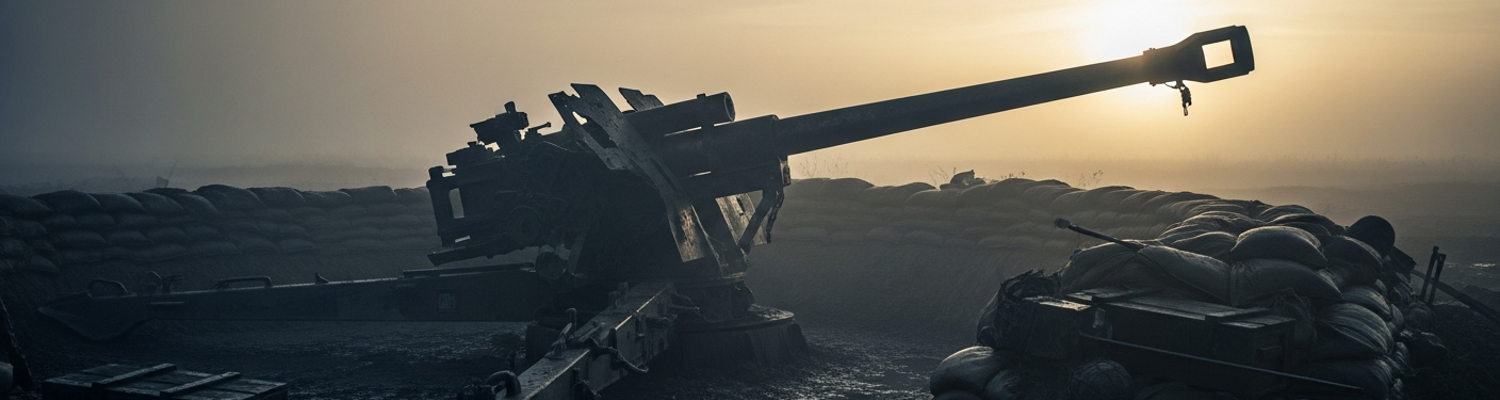

The Aftermath at Firebase Scorpion
Operational logs from the weeks preceding December 24, 1968, document a force worn thin. Relentless patrols, poor resupply, and clinging red dust had taken their toll. Sleep was a rationed commodity, measured in stolen minutes between stand-to alerts. Hunger was a dull, constant ache. The physical cost of occupying Firebase Scorpion, an artillery position jutting into contested territory, had ground the Marines of the 4th Battalion, 11th Marines, to a state of raw fatigue.
This exhaustion formed the backdrop to the chaos that erupted just before midnight.
The pre-dawn light on Christmas morning revealed a scene of profound devastation. A low-hanging mist, thick with the acrid smell of burnt cordite and diesel, clung to the firebase, muffling sound. The North Vietnamese Army sapper attack had been a model of their deadly craft. Small, well-trained teams moved with terrifying speed under the cover of a coordinated mortar barrage, exploiting the darkness and the defenders' fatigue to inflict maximum damage before melting back into the jungle. Now, in the quiet, the rising sun illuminated a landscape of wreckage. Smoke curled from the skeletal remains of the command bunker and the incinerated remnants of several hooches.
A formal damage assessment began almost immediately, even as the last of the wounded were being medevaced. Small teams of officers and NCOs walked the perimeter with a methodical purpose. Their initial focus was on the wire. They found multiple penetration points where sappers, likely stripped down and covered in grease, had silently cut through layers of concertina wire, leaving neat gaps. A detailed inspection of the defensive line showed where M18A1 Claymore mines had failed to detonate, their command detonation wires severed by mortar shrapnel. The teams noted the exact locations of RPG impacts on fighting positions, sketching angles of attack to determine enemy fire-support positions. Inside the firebase, the damage was even more stark. The tactical operations center was a smoldering ruin. Several 105mm howitzers were damaged. One gun pit had taken a direct hit, and another howitzer’s barrel was scarred, rendering it useless. The ammunition storage area was a chaotic mess of scattered shells and spilled powder, a testament to a near-catastrophic secondary explosion.
This was the moment of frantic learning. There was no time for formal after-action reports; the lessons were raw and recorded with desperate urgency. A platoon lieutenant, his face blackened with soot, scribbled notes on the back of a C-ration box, mapping the dead zones in the perimeter’s fields of fire created by newly stacked supply pallets. A gunnery sergeant, using a grease pencil on a map overlay, diagrammed how the NVA mortars had systematically walked their rounds up to the command bunker, indicating a trained observer. These were not high-level strategic observations, but ground-level truths. Examination of similar firebase attacks shows these initial notes often formed the most valuable intelligence. They recorded the failure of specific radio frequencies, the unexpected effectiveness of enemy gas grenades, and the precise points where the defensive wire was weakest. The survivors documented which illumination rounds had failed and how the attackers seemed to know the location of the aid station. These immediate notations were a form of operational survival, a rapid effort to ensure the mistakes of Christmas Eve would not be repeated.
Monsoon Impact on Perimeter Defenses
The late 1968 monsoon season had turned the ground of Firebase Scorpion into a weapon against its defenders. Torrential rain transformed the stripped red laterite soil into a slick, unstable slurry. A review of operational logs from other hastily constructed firebases in I Corps indicates this period was defined by a constant, losing battle against the elements. The ground could not bear the weight of the fortifications. Water saturated the earth to a depth of several feet, creating a condition of near-total soil liquefaction. This instability of the terrain was a catastrophic flaw that predated any constructional shortcuts.
Earthen berms, pushed up by exhausted engineers from the waterlogged soil, began to slump and dissolve almost as soon as they were formed. Post-assault analysis revealed that sandbags, intended to reinforce fighting positions, had become saturated, with the bags rotting and the fill material washing away. The network of concertina and barbed wire was rendered unreliable. Steel pickets, driven into the soft, muddy ground, lost their purchase and began to lean, causing the taut wire to sag. In multiple sectors, entire bands of wire were found partially submerged in mud. This degradation was concentrated in low-lying areas and natural drainage channels, a direct consequence of placing the firebase on terrain that, while sound in the dry season, became a basin during the monsoon. The pressure to establish fire support for ongoing operations had overridden basic engineering principles for site drainage and soil compaction.
The weather-induced decay of the perimeter actively created infiltration routes for the attacking NVA sapper teams. Eroded gullies that formed on the faces of the dissolving berms became natural, covered trenches leading directly to the wire. An examination of the attack’s ingress points showed how the sappers exploited the sagging concertina wire, crawling underneath sections where the lowest strands were bogged down in mud, avoiding the need for noisy wire cutters. These gaps were often located in areas where the constant rain and mud would mask any sound. Water-filled shell craters and collapsed fighting positions, products of the unstable ground, were used by the attackers as final staging points just outside the American lines. NVA doctrine shows a deep understanding of exploiting such environmental weaknesses. The sappers, trained to move with minimal disturbance, found that the soft, wet ground absorbed the slight vibrations their movements might have otherwise made, rendering listening posts and seismic sensors less effective. The monsoon provided a form of acoustic and physical camouflage that was seamlessly integrated into their infiltration plan.
Pre-Attack Intelligence Failures
An analysis of the events leading to the Christmas Eve attack reveals a breakdown in the intelligence gathering and analysis cycle. The primary failure rested with the routine pre-attack patrols, which proved ineffective at identifying the NVA’s planned infiltration routes. Reconnaissance patrols from the resident Marine companies, already depleted by exhaustion and the effects of the monsoon, were operating on predictable schedules. A check of operational logs (Ref: 3rd MarDiv G-2 Rpts, Dec 1968) indicates that night patrols often hugged the immediate perimeter, rarely venturing more than a few hundred meters into the surrounding jungle. The constant rain and thick fog limited visibility to mere feet and muffled sound, rendering acoustic observation almost useless.
This physical blindness was compounded by a doctrinal one. Patrols were tasked with searching for signs of large troop movements, a mindset geared toward detecting a conventional assault. The NVA sappers, however, presented no such signature. They moved in small, three-to-six-man teams, exploiting the very terrain features that the defenders saw as simple nuisances. These teams practiced extreme light and noise discipline, leaving behind minimal traces that exhausted, waterlogged patrols were unlikely to spot in the dark. A review of after-action reports from the 1st Marine Division during this period shows a pattern: intelligence officers consistently underestimated the sappers’ ability to use environmental conditions as a form of advanced camouflage. Reports of cut tripwires or oddly placed vegetation were frequently dismissed as animal activity or natural consequences of the monsoon. This failure to recognize the subtle indicators of sapper reconnaissance meant the NVA were allowed to survey, map, and rehearse their attack paths with near impunity.
These patrol failures fed into wider tactical intelligence gaps that directly contributed to preventable losses. A key deficiency was the lack of timely reconnaissance of the terrain immediately surrounding Firebase Scorpion. Aerial photography, likely from RF-4B Phantom flights, was outdated, showing the firebase as it existed during the dry season, not the waterlogged bastion it had become. The maps used for siting crew-served weapons did not account for the significant soil erosion and newly formed water channels. This discrepancy created fatal dead zones in the fields of fire, particularly for the M18A1 Claymore mines. Post-attack analysis revealed that several Claymore positions, plotted to cover suspected avenues of approach on the old maps, were now firing into the sides of newly formed mud banks or had their effective blast radiuses severely curtailed by dense, rain-soaked undergrowth. The NVA reconnaissance teams, operating on the ground, identified these gaps with precision.
The consequence was a defensive plan based on a landscape that no longer existed. The sapper teams did not need to brute-force their way through the wire; they flowed through the undetected weaknesses. They exploited a gully that was not on the American maps to get within 50 meters of the wire, crawled under sagging concertina wire bogged down in mud, and navigated through a Claymore dead zone to reach their objectives. The systematic destruction of the command bunker, the communications hooch, and specific howitzer pits was not random. It was the direct result of the NVA having a more accurate and up-to-date understanding of the battlefield than the firebase defenders themselves.
Bravo Battery’s Defensive Stand
Marine artillery doctrine in Vietnam treated direct fire as a measure of last resort. For the gun crews of ‘Bravo’ Battery, 4th Battalion, 11th Marines, that moment arrived with shocking speed. The initial wave of NVA mortar fire was not aimed at the infantry on the perimeter but at the very heart of the firebase: the six M101A1 105mm howitzers of Bravo Battery. The barrage was designed to suppress the guns and kill the crews. In the chaotic moments as the first sapper teams breached the outer wire, the command was given to switch from indirect fire support to direct defense. This meant manually traversing the heavy gun tubes to face the perimeter, depressing the barrels to near-horizontal angles, and loading specialized ammunition.
The round of choice was the M546 APERS-T, the “Beehive” round. It was a projectile that contained approximately 8,000 small steel flechettes, turning the howitzer into a colossal shotgun. The backblast from firing at zero-degree elevation was immense, and the sound within the confines of the sandbagged gun pits was physically punishing. Records from similar firebase attacks show cannoneers suffering burst eardrums and concussions, yet they continued to service the guns, ramming home new rounds as fast as they could be pulled from their canisters.
The defensive line buckled as NVA sappers poured through multiple breach points. The sheer volume of attackers began to overwhelm the direct fire from the howitzers. An examination of the gun pits after the battle showed the point where the crews made a decision: the guns were becoming untenable. Sappers were closing too fast, firing RPGs that struck the howitzers’ gun shields and nearby ammunition pallets. At this stage, the artillery pieces ceased to be the primary weapon system. The Marines abandoned their howitzers to defend their positions as infantry. This was a desperate tactical shift. Cannoneers, whose roles were defined by technical tasks like setting fuzes and swabbing breeches, grabbed their M16A1 rifles and M79 grenade launchers. The gun pits themselves, designed to offer protection from counter-battery shrapnel, became makeshift trench systems. The battery’s fire direction center, its radio operators accustomed to processing complex fire missions, was now coordinating a close-quarters infantry fight, directing small teams to plug gaps in the disintegrating perimeter.
The fight devolved into a close-quarters engagement with NVA sappers who breached the wire. These were not conventional infantry; they were elite specialists, often stripped down and carrying only satchel charges and automatic weapons. They swarmed into Bravo Battery’s position, their objectives being the breeches of the howitzers and the main ammunition storage bunker. The fighting was hand-to-hand in several gun pits. After-action reports from similar firebase assaults describe artillerymen using ramming staffs and entrenching tools as clubs against attackers who had gotten inside the gun emplacements. One sapper team successfully placed a satchel charge against the base of gun number three, the resulting explosion destroying the carriage. Another team was cut down by rifle fire just feet from the entrance to the primary powder storage bunker. The defense was a chaotic series of individual actions, with gunnery sergeants and junior NCOs directing fire and organizing counter-charges with small groups of cannoneers, fighting to reclaim their own gun positions from an enemy that was now inside the final defensive line.
NVA Breach Tactics and Objectives
The sapper teams, known as đặc công, executed a near-perfect infiltration. These were elite shock troops, organized into small three-to-six-man cells and trained for months, sometimes over a year, in reconnaissance, demolition, and stealth. For the assault on Firebase Scorpion, they moved under the cover of the coordinated mortar barrage, using the explosions to mask the sound of their final approach. A review of the breach points shows a sophisticated understanding of perimeter defense theory. Instead of attempting a brute-force assault on the strongest sections of wire, they targeted areas previously identified as weak during extensive reconnaissance. They chose the most difficult and therefore least expected avenues of approach. The sappers advanced by crawling slowly, their bodies covered in grease, charcoal, and mud to make them nearly invisible and difficult to grab. This coating also helped them slide through the compromised sections of concertina wire without snagging their clothing, as they often wore only loincloths or shorts. At the wire itself, evidence at the penetration points indicates the use of simple, quiet wire cutters to patiently snip paths through the tangled barriers, a task made easier by the sagging lines caused by the monsoon-softened ground.
Their primary objective inside the wire was strategically vital: the destruction of Bravo Battery’s ammunition bunkers. NVA doctrine for firebase assaults prioritized the neutralization of artillery, command posts, and ammunition storage to cripple the base’s ability to fight back. The attackers who breached the wire at Firebase Scorpion were not tasked with engaging every defender they saw. They were to bypass perimeter bunkers where possible, leaving those to follow-on forces, and strike directly at the heart of the firebase’s combat power. Each sapper team had a specific high-value target assigned to it. They carried only what was necessary for this mission: typically an AK-47, grenades, and their main weapon, the satchel charge. These charges, often consisting of multiple blocks of TNT wrapped in canvas, were designed for demolition. Post-assault analysis of unexploded ordnance shows they were equipped with simple friction-pull fuses, allowing for quick placement. The sappers who broke through the wire near the southern perimeter moved with terrifying purpose along pre-planned routes, using the chaos of the mortar attack and the burning hooches as cover to reach the massive earthen mounds of the ammunition storage area. One charge was successfully placed against the main 105mm high-explosive shell bunker, though it failed to detonate properly. A second team was intercepted just yards from the powder and fuze storage bunker.
This mission profile was executed with a level of determination that stunned the American defenders. The đặc công were products of intense political indoctrination and a training regimen designed to produce soldiers with absolute loyalty. This was not suicidal fanaticism but a highly disciplined operational mindset. Sappers were expected to accomplish their mission and, if possible, withdraw. During the chaotic close-quarters fighting within Bravo Battery’s gun pits, their resolve was put to the test. Wounded sappers continued to press the attack, attempting to crawl toward their objectives even after being hit. This ethos was ingrained during their specialized training, which focused as much on political reliability as it did on combat skills. Their light equipment underscored their singular purpose. They were not there to seize and hold ground; they were human delivery systems for explosives.
Command Chronology and Resource Strain
In the immediate aftermath, the formal process of documentation began. The 4th Battalion, 11th Marines’ command chronology for the period (Ref: 4/11 MAR-CHRON-DEC68) was created under extreme duress, its terse, time-stamped entries painting a picture of controlled chaos. The chronology was the first attempt to impose order on the devastation. Initial entries, likely logged by a surviving radio operator in a makeshift command post, focused on the most urgent operational necessities: coordinating medevac helicopters for the dozens of wounded, requesting emergency ammunition resupply, and dispatching patrols to confirm the attackers had withdrawn. The S-3 (Operations) section began compiling reports from the gun pits and perimeter, noting the exact locations of destroyed bunkers and damaged howitzers. These early observations were critical; they recorded the failure of specific M18A1 Claymore mine fields and identified the sectors of concertina wire that had been cut or bypassed, providing the first raw data on the sappers’ infiltration tactics.
This initial battalion-level reporting detailed an immediate and severe strain on limited engineering resources, a problem that plagued the entirety of I Corps. The damage at Firebase Scorpion required immediate repair, but the assets to perform this work were spread thin. Archival evidence from III Marine Amphibious Force logs shows that combat engineer battalions and supporting Naval Mobile Construction Battalions (Seabees) were in a constant state of overextension. There was a persistent shortage of heavy equipment, especially D7 bulldozers needed to rebuild collapsed earthen berms, and a finite supply of basic defensive materials like steel pickets and concertina wire. The request from Scorpion for emergency engineering support would have been placed in a queue alongside similar requests from other firebases, all battling both enemy action and the monsoon season. This strategic overextension meant that repairs were often slow and piecemeal, leaving firebases vulnerable to follow-on attacks. The initial damage assessment from Scorpion’s command would have highlighted not just what was broken, but the reality that the means to fix it were likely days away.
The grimmest task was the detailed accounting of casualties and expended ordnance. This process was far more than a simple headcount. Officers and NCOs walked the shattered firebase with personnel rosters, physically identifying the dead and documenting the nature of wounds for the wounded. This information was cross-referenced against patrol schedules and bunker assignments to determine who was missing. The battery gunnery sergeant, along with section chiefs, undertook the dangerous work of inventorying what ammunition remained. A review of similar post-attack procedures shows they would have counted every remaining 105mm shell, separating high-explosive rounds from illumination and the anti-personnel “beehive” rounds. They tallied remaining powder charges, fuzes, and small arms ammunition. This was not just a logistical exercise; it was a combat assessment. The final report appendix would list, in stark columns, the number of Marines killed and wounded, the specific quantity and type of every artillery round fired, and an exact inventory of weapons lost to enemy action, including the serial number of a destroyed M101A1 howitzer.
Higher-Level Reporting Discrepancies
A review of command chronologies and after-action summaries from the period reveals a persistent gap between the raw, ground-level lessons and the sanitized data that reached division headquarters. The initial reports from Firebase Scorpion, scribbled by surviving officers on map overlays and ration boxes, contained granular, life-saving details. They noted the specific failure of M18A1 Claymore mines whose command-detonation wires were severed by the initial mortar barrage, the precise locations where NVA sappers had used the monsoon-softened earth to crawl under sagging concertina wire, and the ineffectiveness of standard-issue tripflares in the dense, moisture-laden fog.
When these observations were consolidated and sent up the chain of command, they were often stripped of their tactical texture. A complex failure of multiple Claymore positions due to shrapnel and mud became “partial failure of perimeter ordnance.” A detailed description of sappers exploiting a specific, unmapped erosion gully was simplified to “enemy penetrated southern perimeter.” This was a systemic issue, driven by the rigid structure of formal military reporting which favored quantifiable data like enemy body counts and ordnance expended over qualitative, descriptive analysis. The specific brand of radio battery that failed in the humidity or the fact that sappers used non-metallic wire cutters were details deemed too minor for a high-level summary. This process of data compression effectively erased the most urgent lessons, ensuring that other firebases remained ignorant of the specific enemy tactics that had just proven so successful.
This disconnect forced an immediate, informal analysis at the battery and platoon level, focused entirely on preventing a second attack. Officers and NCOs walked the breach points not for a report, but for survival. They sketched the angles of RPG impacts on sandbag walls to triangulate the attackers’ firing positions, discovering the NVA had established a support-by-fire element on a ridge previously thought to be too dense with vegetation for effective use. This led to an immediate operational adjustment: standing orders were changed to direct 50% of listening post efforts not on the most likely avenues of approach, but on the most unlikely ones. The discovery that sappers had bypassed entire fields of trip-wired explosives by patiently cutting the wires led to another change. A new directive mandated that all perimeter defenses, including tripflares and Claymores, would be visually inspected twice nightly during stand-to, a physically demanding task for an already exhausted force.
The most significant adjustment came from a forensic examination of the sappers’ infiltration route. The teams discovered the attackers had moved through a deep, rain-carved wash that did not appear on their tactical maps, which were several months out of date and depicted dry-season terrain. This gap in tactical intelligence was the central failure. The NVA reconnaissance teams, operating on the ground for days, had a more accurate understanding of the battlefield than the Marines defending it. The immediate response was blunt. All patrols were ordered to cease following predictable routes. Instead, they were tasked with physically walking and re-mapping every gully, creek bed, and terrain depression within 500 meters of the wire, creating hand-drawn overlays to be shared with every fighting position. It was a frantic effort to see the ground as it actually was, not as it was depicted on a map miles away.