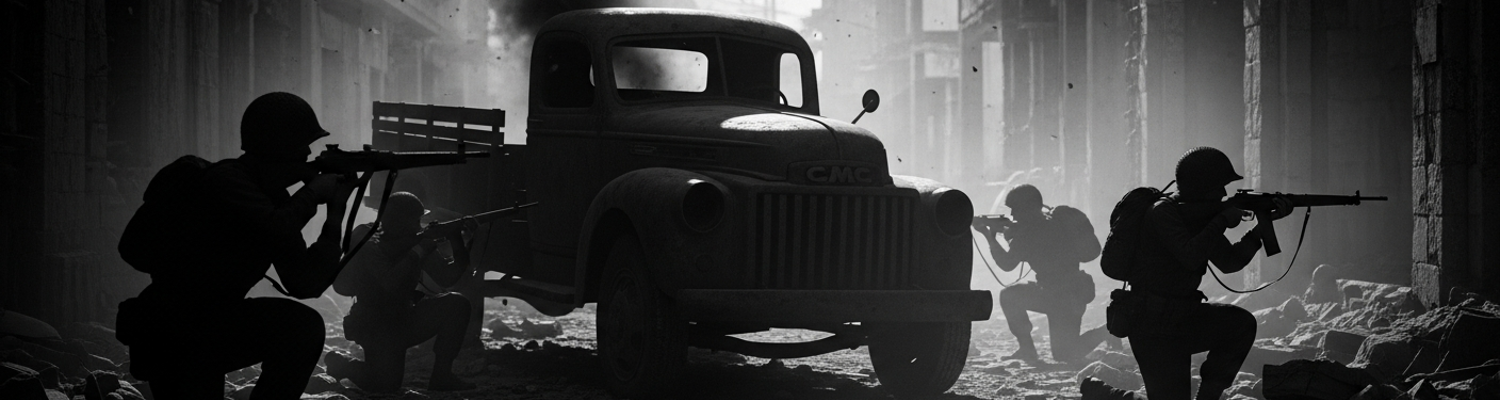

A close review of operational logs shows the Ohio National Guard’s 37th Infantry Division entering the northern outskirts of Manila on February 4, 1945. These soldiers were veterans of jungle campaigns on Bougainville. They were unprepared for what came next.
Their initial objectives were securing the Old Bilibid Prison, where over a thousand civilian internees and prisoners of war were held, and pushing south toward the Pasig River. The division, comprising the 129th, 148th, and 145th Infantry Regiments, operated under XIV Corps command. Their task was to clear the city’s northern sector. They were not facing an army preparing for a tactical withdrawal. General Tomoyuki Yamashita, overall commander of Japanese forces in the Philippines, had ordered Manila abandoned to spare the city. Rear Admiral Sanji Iwabuchi, leading the 16,000-strong Manila Naval Defense Force, defied this order. His forces, augmented by army personnel, were dug in with a mandate to fight to the last man.
The 37th Division’s advance on February 5th became a methodical push against an opponent who had turned the city itself into a weapon. Their first major river crossing occurred on February 7th. Elements of the 148th Regiment crossed the Pasig to clear the Paco and Pandacan districts, initiating a new, more grinding phase of the battle.
The fight for Manila became a month-long siege because of the defensive doctrine employed by Iwabuchi’s men. The city was not occupied; it was engineered for defense in depth. This was not a fluid battle of maneuver but a slow, agonizing process of attrition. Archival evidence reveals the Japanese systematically converted Manila’s large, earthquake-resistant government buildings into concrete fortresses. Structures like the Legislative Building, the Finance Building, and the Agricultural Building became formidable strongpoints. Japanese engineers and sailors cut firing ports in walls, established interlocking fields of machine-gun fire, and connected buildings through tunnels and trenches. Major thoroughfares were blocked with barricades, and the streets were seeded with mines, including buried anti-ship mines. This strategy forced American units to bypass open streets and advance building by building. The battle for single objectives could last for days; the fight for the power plant on Provisor Island took the 129th Regiment from February 9th to the 11th, while the New Police Station held out for eight days against sustained assault.
This block-by-block, room-by-room fighting produced casualty rates that were shocking to units accustomed to jungle warfare. The month-long battle resulted in 1,010 American soldiers killed and 5,565 wounded. For the Japanese, the losses were near total, with 16,665 dead counted in the Intramuros district alone. The intimate nature of the combat was extreme. Infantrymen had to clear each structure from the top down, as Japanese defenders would cut holes in floors to drop grenades on troops clearing lower levels. Soldiers from the 37th Division found themselves using flamethrowers, bazookas, and demolition charges inside buildings to eliminate defenders who would not surrender. At the University of the Philippines, when conventional assaults failed to dislodge defenders from subterranean passages, soldiers poured a mixture of oil and gasoline into the openings and ignited it. Initial restrictions on artillery, meant to preserve the city, were quickly lifted as infantry casualties mounted. The decision was made that buildings holding up the advance would be pounded by direct-fire artillery, turning much of southern Manila into rubble and contributing to the estimated 100,000 civilian deaths.
Operational logs from the 37th Infantry Division’s push into southern Manila show the Paco district immediately became a grinder for both men and machines. After the 148th Infantry Regiment crossed the Pasig River in plywood assault boats on February 7th, they entered a landscape engineered for failure. The primary supply routes, narrow streets to begin with, were rendered nearly impassable. Pre-battle artillery from both sides had collapsed buildings, showering the roads with tons of shattered concrete, twisted rebar, and splintered wood. This debris was then bulldozed by Japanese defenders into formidable barricades, often integrated with overturned civilian automobiles and heavy streetcars. Wheeled vehicles, particularly the Dodge WC-54 ambulances essential for casualty evacuation, found their paths completely blocked. A single disabled truck or jeep could create a bottleneck stretching back several blocks, paralyzing the movement of follow-on forces, ammunition, water, and medical assets. The advance on February 9th slowed to a crawl. Some units gained only 300 yards the entire day as they navigated this deliberate chaos. This was a core component of the Japanese defensive plan, channeling American armor and supply columns into predictable, pre-sighted killing zones.
The streets were not just blocked. They were targeted.
Archival evidence (NARA Record Group 338, 37th ID) shows that the Japanese Manila Naval Defense Force had converted the district into a matrix of interlocking strongpoints. The Paco Railroad Station, a sturdy, European-designed structure of concrete and steel, became the lynchpin of this defense. An estimated 300 Japanese troops defended it. They had established machine gun nests around its entire perimeter, with each nest supported by rifle pits. Inside, sandbagged forts mounting 20mm cannons covered the corners, while a 37mm gun was housed in a large concrete pillbox. This single building became a fortress that dominated the open ground around it, pinning down Company B of the 148th Infantry for an extended period. Similar defensive preparations were made at other key structures like the Paco School and Concordia College. These positions did not operate in isolation. They were carefully sited to provide mutual support, creating overlapping fields of fire that turned streets into corridors of death. Any convoy attempting to force its way through the physical blockades was immediately subjected to a torrent of fire from multiple directions.
The combination of blocked routes and lethal strongpoints created a perfect storm for the medical chain of command. The standard American doctrine of rapid casualty evacuation from the front lines completely broke down. Battalion aid stations, which were supposed to be positioned a safe distance behind the fighting, were instead forced to set up in the rubble of destroyed buildings, sometimes just yards from active combat. The flow of casualties was relentless, yet the ability to replenish basic medical supplies vanished. Reports from the period indicate severe shortages of blood plasma, morphine syrettes, sulfa powder, and even simple sterile bandages. Medics and surgeons at the aid stations were overwhelmed, forced to perform triage under fire and make impossible decisions about who would receive the limited available morphine. Wounded men who could have been saved by prompt evacuation to a field hospital bled to death in makeshift collection points because the medical jeeps and ambulances could not reach them. This strangulation of the supply chain turned survivable wounds into fatal ones and placed a severe strain on the morale of the frontline infantry.
The standard-issue Dodge WC-54 ambulances and unmodified Willys MB jeeps of the 37th Infantry Division’s medical detachments were effectively nullified by the tactical conditions in the Paco district. These thin-skinned vehicles, designed for rapid evacuation behind established lines, offered negligible protection against the interlocking fields of fire established by the Manila Naval Defense Force. A review of operational logs shows that any attempt to drive these vehicles down the rubble-choked streets resulted in them being immediately targeted and disabled. The Japanese defenders, armed with Arisaka rifles and Type 92 heavy machine guns, had turned the district into a shooting gallery where every intersection was pre-sighted. The medical support chain was severed. Wounded men were piling up in the cellars of shattered buildings, and the battalion aid stations were running out of plasma and morphine.
Working in frantic, impromptu workshops just blocks from the fighting, men of the 117th Engineer Combat Battalion began a program of radical and unauthorized vehicle modification. Their primary subjects were the ubiquitous jeep and the workhorse GMC CCKW 2.5-ton truck. The goal was not to create an infantry fighting vehicle, but a battlefield taxi that could survive a 300-yard dash through a sniper’s crosshairs. Using cutting torches and welders powered by portable generators, the engineers began to bolt and weld slabs of scavenged steel to the vehicle chassis. Archival photographs show a chaotic yet purposeful application of armor. Steel plates, some reportedly cut from the boilers of the captured Provisor Island power plant, were fitted around the driver’s compartment and the open rear of the jeeps. Sandbags, while of dubious value against direct hits from heavy weapons, were piled thickly on the floorboards of both trucks and jeeps as a measure to provide some protection against the blast effects of the numerous mines and booby traps littering the streets. The most common modification involved building a crude steel box around the rear of a jeep, designed to shield two litters and the attending medic from the hail of 7.7mm rounds.
They were brutalist, heavy, and born of pure necessity. The 117th Engineers, a unit decorated for its role in the Pacific, effectively created a new class of vehicle overnight. They were designated as makeshift medical evacuation vehicles. The engineers worked with the medics, designing racks that could hold two or four litters within the newly armored truck beds. Access panels were cut to allow medics to tend to the wounded while the vehicle was in motion. The primary focus was on protecting the casualties and driver from small arms fire and shrapnel. What emerged were hybrid machines: part jeep, part armored car, all improvisation.
The immediate effect was a renewed ability to retrieve casualties from the front. This protection came at a significant mechanical cost. A standard Willys MB jeep weighed just over 2,400 pounds; the ad-hoc armor and sandbags added an estimated 800 to 1,200 pounds of dead weight. Maintenance logs from the period record a sharp increase in catastrophic failures of vehicle components not designed for such loads. Leaf spring suspensions flattened and snapped. Engines, forced to move double their intended load over pulverized concrete, constantly overheated. Clutches burned out and transmissions failed under the strain. The modified vehicles were slow, unwieldy, and consumed fuel at an alarming rate, but they moved. For the infantrymen of the 148th and 129th Regiments, the sight of one of these ugly, lumbering creations grinding its way toward their position meant that getting wounded was no longer an automatic death sentence. The engineers had traded vehicle longevity for human lives.
By February 12th, 1945, the tactical situation in southern Manila had reached a crisis point. The 37th Infantry Division’s push south of the Pasig River had devolved into a street-by-street fight against the fortified positions of the Manila Naval Defense Force. The 148th and 129th Infantry Regiments were bleeding heavily for every block they gained in the Paco and Ermita districts. The fight for objectives like the Paco Railroad Station had demonstrated the Japanese strategy of turning large concrete buildings into fortresses that had to be reduced with direct-fire artillery and costly infantry assaults. The date itself was significant. It marked the culmination of nearly a week of grinding combat south of the river, a period during which the standard medical evacuation chain had completely disintegrated. The number of wounded overwhelmed the forward aid stations, which were themselves under fire and running out of everything. It was on this day that the 1st Cavalry Division, fighting to the south, finally reached Manila Bay, completing the encirclement of the city's Japanese garrison. This tactical achievement, however, did nothing to alleviate the immediate crisis facing the infantry of the 37th Division.
The purpose of the improvised convoy was to address the critical failure of the medical supply chain. The vehicles tasked for the mission were a direct result of the frantic work done by the 117th Engineer Combat Battalion: a handful of their newly armored GMC trucks and Willys jeeps. Their objective was simple: carry a cargo of the most urgently needed medical supplies from a rear supply dump to the front. After-action reports detail the specific shortages driving the mission: whole blood and plasma, morphine syrettes, sulfa powder, and sterile bandages. These were the essential components required to keep men from dying of survivable wounds in the rubble of makeshift aid stations. The convoy was an admission that standard, thin-skinned ambulances could no longer function in this environment. It was a calculated risk.
The target was a forward casualty collection point established in the ruins of a building near the massive Philippine General Hospital (PGH) complex on Taft Avenue. The PGH, along with the adjacent University of the Philippines, had been converted by Japanese naval troops into a major strongpoint. The sprawling, reinforced concrete hospital was an imposing fortress dominating the landscape, and its capture was a key objective for the 148th Infantry Regiment. The advance had stalled under intense machine-gun and mortar fire emanating from the hospital and its surrounding buildings. It would take another five days of brutal fighting, from February 12th to February 17th, for elements of the 148th to finally secure the hospital after a vicious, room-by-room struggle. The convoy’s route would force it down streets like Taft Avenue, which were pre-sighted by Japanese defenders and littered with barricades. Successfully reaching the casualty collection point meant not just delivering the supplies, but doing so under the direct observation and fire of the very strongpoint that was generating the casualties in the first place.
The improvised medical convoy of the 37th Infantry Division pressed down the ruins of Taft Avenue on February 12th. Its objective was the casualty collection point near the Philippine General Hospital. The convoy, composed of several up-armored GMC trucks and jeeps from the 117th Engineer Combat Battalion, was a slow-moving, ugly necessity. The vehicles were burdened with welded steel plates scavenged from city ruins and their floorboards were heavy with sandbags. This ad-hoc armor made the trucks and jeeps sluggish and mechanically unreliable. The route was a pre-sighted channel of destruction. To the front, the PGH and the nearby University of the Philippines campus bristled with machine-gun nests and mortar positions. The buildings flanking Taft Avenue provided Japanese riflemen with ideal second- and third-story firing points. The advance of the 148th Infantry had been stalled here by this defense-in-depth, generating the very casualties the convoy was intended to save. For the convoy’s drivers, every foot forward brought them deeper into a tactical box from which there was no easy exit.
It started with a high-velocity crack.
A Japanese 37mm anti-tank gun, expertly concealed in the ground floor of a partially destroyed commercial building, fired a single shot. The target was the lead GMC 2.5-ton truck, the vehicle carrying the bulk of the whole blood and plasma. The shell struck the engine compartment, instantly disabling the vehicle and turning it into a 13,000-pound roadblock. Before the crews in the following vehicles could process the situation, the secondary phase of the ambush erupted. From the upper floors of the PGH and adjacent structures, multiple Type 92 heavy machine guns opened up, their 7.7mm rounds stitching lines across the thin armor of the American vehicles. The fire was not speculative; it was a coordinated crossfire, designed to pin the convoy in place and annihilate it. Bullets slammed into the steel plates with deafening reports, while rifle fire from closer positions targeted drivers and any exposed crew. The driver of the second vehicle, a modified jeep, was killed instantly. Within two minutes, the convoy was static, trapped between the disabled lead truck and the debris behind it, taking effective fire from at least three directions.
The convoy commander, a sergeant from the 117th Engineers, recognized the tactical reality in under a minute. Forward movement was impossible. Retreat was impossible. Staying put meant certain death. The convoy’s cargo of plasma, morphine, and bandages was intended for the aid station several hundred yards ahead, but new, critically wounded casualties were now inside the vehicles themselves, bleeding on the very supplies meant to save others. Standard procedure was rendered meaningless. The mission objective had been superseded by the immediate crisis. A choice was made to triage the mission itself. Instead of pushing forward, the sergeant ordered the surviving men to use the disabled trucks as cover. He instructed the medics to break open the supply crates on the spot. The back of a sandbagged GMC truck, still under a hail of machine-gun fire, became a makeshift operating table. Medics, ignoring the incoming rounds, began administering plasma and applying battle dressings to their own wounded comrades, turning the kill zone into an impromptu aid station. This decision to abandon the original objective and use its resources to stabilize the immediate casualties represented the ultimate expression of battlefield pragmatism.
U.S. Army doctrine from the Second World War reveals a structured, linear system for casualty care known as the chain of evacuation. This process was designed for conventional battlefields, where a clear front line separated combatants. It began with a frontline medic providing immediate first aid, followed by movement to a battalion aid station for stabilization with morphine and plasma. From there, casualties would be transported to a collecting station, then a clearing station, and eventually to large field or evacuation hospitals miles behind the lines for surgery. This entire system depended on the ability of unarmored ambulances, primarily Dodge WC-54s and jeeps, to travel predictable and relatively secure routes. In Manila, this doctrine completely collapsed. The Japanese strategy of turning the city into a series of interlocking, fortified strongpoints with no defined front line transformed potential evacuation routes into pre-sighted kill zones. The rubble-choked streets and relentless sniper, machine-gun, and mortar fire made it impossible for standard ambulances to operate. Aid stations, which should have been safe havens, were instead set up in the basements of buildings still under active assault.
The five-minute pivot during the February 12th convoy ambush was the direct, unplanned consequence of this doctrinal failure. The decision by the convoy’s NCO to halt and treat casualties in the middle of the kill zone was a complete inversion of established procedure. Standard operating doctrine dictated that the primary mission, delivering supplies to the forward aid station, was paramount. The convoy’s own casualties were to be stabilized only if possible. But with that chain broken, the NCO made a pragmatic choice. An analysis of the action shows that by ordering the medics to break open the supply crates, the convoy itself became the highest echelon of care available at that specific time and place. Plasma and bandages intended for unknown casualties hundreds of yards away were instead used to save the men bleeding out inside the trucks. This act transformed the convoy from a simple logistics mission into a self-contained, mobile, and highly situational trauma unit, a concept entirely alien to the rigid, linear thinking of 1940s military medicine.
The long-term implications of the medical realities in Manila were significant, forcing a fundamental rethink of combat casualty care in urban environments. The ad-hoc armored ambulances created by the 117th Engineers were a clear signal that casualty evacuation vehicles required built-in protection. This lesson echoed through subsequent conflicts, leading to the development and formal adoption of armored medical evacuation vehicles, such as the M113 Armored Personnel Carrier variants used extensively in Vietnam. The experience of medics forced to treat overwhelming casualties with limited supplies and no hope of timely evacuation highlighted the need for what would later be formalized as prolonged field care. The five-minute pivot, where medics stabilized their own in the kill zone, was an early, desperate example of this principle: extending the golden hour when evacuation is impossible. The lessons learned in the rubble of buildings like the Philippine General Hospital directly influenced the creation of more resilient and decentralized medical support systems for the urban battlefields of the future.