
Amphibious Objectives and Harbor Infrastructure
War Department Field Manual 31-5 guaranteed standard-issue SCR-284 radio sets would maintain clear voice contact over a twenty-mile range during amphibious assaults. The damp Algerian coast rapidly reduced that transmission radius to less than four hundred yards.
Archival evidence shows this single equipment discrepancy initiated a near-total collapse of command and control.
Planning documents for Operation Torch dictated a massive coordinated assault on North Africa in November 1942. Major General Lloyd Fredendall commanded the Center Task Force from his flagship. His orders prioritized outflanking the heavily defended city of Oran by striking twenty-four miles to the east. Securing the naval port of Arzew was the absolute prerequisite for this maneuver. Located at coordinates 35 degrees 51 minutes North and 0 degrees 19 minutes West, the harbor featured a 1000-yard concrete breakwater and deep-water berths capable of accommodating large Allied transport vessels. Planners needed these specific quays captured entirely intact. Unloading M3 Lee medium tanks required stable docking facilities rather than contested soft-sand beaches. Heavy artillery pieces and thousands of tons of motorized supply vehicles demanded deep-draft access. A close review of operational logs indicates intelligence officers had identified multiple Vichy French coastal defense batteries surrounding the town. Fort de la Pointe sat directly on the harbor entrance armed with 75mm artillery. Looming on the high ground to the northwest was Batterie du Nord.
It pointed massive 105mm coastal guns directly out to sea.
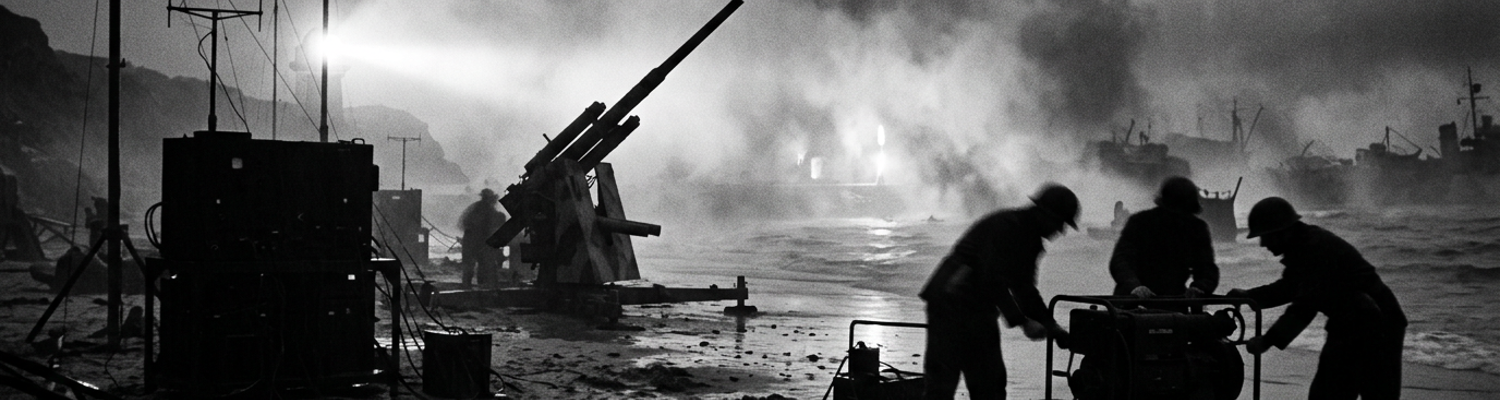
Neutralizing these concrete emplacements required precise naval gunfire directed from the ground. The 36th Engineer Combat Regiment landed at night to establish shore battery support control. Elements of the regiment boarded flat-bottomed Landing Craft Vehicle Personnel at 2300 hours on November 7. Navigating toward the designated landing zones marked as Beach Z, the coxswains steered just south of the main breakwater. Engineers carried the 130-pound SCR-284 radio units broken down into three separate canvas loads. One soldier hauled the receiver and transmitter chassis. Another carried the heavy GN-45 hand-cranked generator. A third managed the twenty-foot sectional antennas and heavy rubberized cables. Spare vacuum tubes filled the remaining pouch space. Rough sea states battered the small boats. Waves continuously crested over the steel ramps of the landing craft.
Freezing saltwater flooded the troop compartments.
The first wave of engineers hit the beach at exactly 0100 hours on November 8. Upon reaching the sand, the engineers moved rapidly to set up their communications posts just inland from the coastal road. Their primary objective was establishing a direct frequency link with the command ship HMS Largs and the supporting cruisers offshore. Working in pitch black conditions, the men unpacked the radio components. Metal chassis housings of the SCR-284 transmitters had absorbed significant amounts of seawater during the shore transit. Operators connected the hand-cranked generators and applied power. Moisture caused immediate electrical arcing across the unsealed terminal boards. Inconsistent voltage spikes pulsed from the GN-45 generators. These power surges immediately blew out the fragile glass vacuum tubes inside the transmitter units. Operators attempted to swap in their spare tubes using only red-lens flashlights. Submerged during the chaotic offloading process, the replacement components were already compromised. Saltwater intrusion inside the canvas supply bags ruined the delicate filament seals at the base of each tube. Engineers connected the cables and cranked the generators a second time.
Radio dials illuminated briefly.
Internal wiring shorted out with a loud pop. Shore party personnel lost all frequency contact with the naval fleet stationed three miles offshore. Heavy cruisers USS Augusta and HMS Jamaica sat in the darkness awaiting targeting coordinates. High above the harbor, the 105mm guns of Batterie du Nord began tracking the silhouette of the Allied troop transports.
Salt Corrosion Vulnerabilities of SCR-284 Radios
Archival evidence shows shore party signal teams relied heavily on portable SCR-284 radio sets during the Arzew landing operations. Developed by the Crosley Corporation in Ohio, this amplitude-modulated transceiver operated on a frequency range of 3800 to 5800 kilocycles. The system utilized a continuous-wave telegraphy mode alongside standard voice transmission. Army planners designated the SCR-284 as the primary communications link between ground elements of the 1st Infantry Division and the offshore naval bombardment groups. A complete operational setup weighed over 130 pounds. Signal corps personnel divided this heavy burden into three distinct canvas loads for the amphibious assault to ensure mobility across the soft sand. Operators carried the main BC-654 transmitter-receiver chassis strapped to wooden packboards. Assistants hauled the heavy GN-45 hand-cranked generator. Others carried the BA-43 dry cell batteries and the required sectional antennas.
The equipment was engineered for dry inland European battlefields rather than the soaked environment of a hostile beachhead.
When examining the historical record of the Center Task Force, operational logs indicate the SCR-284 was the only system authorized to coordinate immediate naval artillery fire. Signalmen of the 36th Engineer Combat Regiment hitting Beach Z dragged these canvas bags through waist-deep surf under the cover of darkness. Freezing water penetrated the poorly sealed cotton seams of the carrying cases before the troops even reached the dry sand. Operators frantically assembled the units near the concrete seawall just south of the main Arzew breakwater. They connected the thick rubberized power cables to the PE-104 vibrator power supplies. They extended the twenty-foot whip antennas into the night sky. Maritime moisture and salt air rapidly corroded the sensitive tuning components of the field sets.
A close review of maintenance reports reveals the exact mechanical breakdown sequence within the BC-654 chassis. Mediterranean saltwater contains highly conductive sodium chloride ions. These chemical compounds act as aggressive electrolytes when exposed to differing metal alloys. Microscopic droplets of this corrosive spray permeated the unsealed tuning dials on the front panel of the radio. Windblown moisture settled directly onto the variable tuning capacitors inside the metal housing. These capacitors relied on a series of closely spaced aluminum plates to lock onto specific transmission frequencies. Accumulating salt residue formed immediate conductive bridges across the microscopic air gaps between these metal plates.
Electrical current bypassed the intended circuits entirely.
Signal operators turned the main tuning knobs to reach the designated naval support frequency of 4300 kilocycles. Physical resistance inside the dials increased as the salt buildup caused severe galvanic corrosion on the silver-plated rotary switch contacts within minutes of exposure to the sea air. Turning the dial manually scraped away the degraded silver plating. Bare copper underneath oxidized almost instantly in the damp coastal conditions. Operators cranked the GN-45 generators to transmit targeting coordinates for the Vichy French coastal batteries located at Fort de la Pointe. Internal electrical shorts caused by the salt bridges absorbed the generated transmission power. Radio frequency energy dissipated as raw heat inside the chassis instead of radiating out through the antenna network. The transmission range dropped from twenty miles to absolute zero. Technicians attempted to dry the variable capacitors by wiping them with standard-issue cotton field towels.
This physical action simply smeared the highly conductive salt paste deeper into the delicate tuning coils of the master oscillator circuit.
Resulting short circuits permanently locked the radio receivers on static noise. Signal teams sat stranded on the Algerian shoreline with completely useless equipment. The heavy cruisers USS Augusta and HMS Jamaica waited for coordinates three miles offshore. High above the harbor, enemy searchlights began sweeping across the water to locate the source of the landing craft engine noise.
Atmospheric Interference and Signal Attenuation
Archival evidence shows an unusual meteorological phenomenon trapped the Algerian coastline during the early morning hours of November 8. Cold surface waters of the Mediterranean Sea rapidly cooled the immediate layer of air sitting directly above the waves. A high-pressure system simultaneously pushed warm Saharan air over the top of this cold layer. This sharp thermal stratification created a dense localized marine boundary layer extending from the primary landing zones at Beach Z out past the three-mile limit. Signal officers of the Center Task Force had tuned their surviving SCR-284 transceivers to the assigned naval support frequency of 4300 kilocycles. At this specific frequency band, amplitude-modulated radio waves rely entirely on stable ground-wave propagation to travel horizontally over the curvature of the earth. Ground waves travel by interacting with the conductive surface of the saltwater. The severe temperature inversion disrupted the refractive index of the coastal atmosphere. This caused heavy atmospheric interference.
Generating only 20 watts of transmission power, the hand-cranked GN-45 units lacked the sheer wattage to penetrate the dense humid air mass.
Instead of traveling parallel to the water surface toward the command ship HMS Largs, the electromagnetic emissions refracted violently upward into the troposphere. Electromagnetic emissions bounced off the thermal ceiling and scattered entirely. A close review of operational logs indicates the immediate tactical paralysis this caused on the ground. Naval gunfire spotters attached to the 36th Engineer Combat Regiment crouched behind a concrete seawall directly south of the main Arzew breakwater. They unrolled their map grids under heavy canvas ponchos to block the sea spray. Their specific mission required maintaining continuous voice contact with the heavy cruisers USS Augusta and HMS Jamaica anchored off the coast. Without real-time corrections relayed from the beachhead, offshore gunnery officers lacked the necessary data to calculate accurate firing solutions in the pitch black conditions. The engineers depressed the push-to-talk switches on their T-17 carbon microphones. They called in map grid coordinates for the Vichy French 75mm guns at Fort de la Pointe.
These enemy guns had just begun firing star shells over the harbor entrance.
Heavy atmospheric interference severely attenuated the amplitude-modulated voice signals. This stripped away the lower audio frequencies. Background noise from the crashing surf bled into the microphones and merged with the atmospheric distortion. Only heavily fractured robotic syllables reached the radio rooms of the offshore fleet. Radiomen aboard the British and American cruisers logged every incoming transmission as completely unintelligible. Ground operators quickly identified the voice mode failure and attempted a rapid technical workaround. They flipped the mode selector switches on the BC-654 chassis from Voice to CW to transmit Continuous Wave telegraphy. This mode was designed to cut through interference by using an unmodulated carrier wave. Using J-37 telegraph keys strapped to their thighs, the spotters began tapping out Morse code coordinates targeting the heavy 105mm coastal guns at Batterie du Nord.
The atmospheric interference generated a high volume of broadband radio noise across the entire 3800 to 5800 kilocycle spectrum.
This continuous static electrical discharge sounded like crushing gravel inside the Bakelite headsets. It drowned out the faint 25-watt hand-keyed Morse signals. Shore battery directors on the beach lost all reliable contact with the fleet. This stripped them of the ability to confirm target identification or issue immediate check-fire commands. Naval gunnery crews could not visually distinguish the 1st Infantry Division troops advancing up the coastal road from the Vichy French defensive emplacements without illumination flares. Firing blind risked dropping high-explosive 8-inch shells directly onto friendly infantry units. The shore directors sat in the dark. They were unable to adjust the fall of shot or verify enemy movements. Gunnery officers locked the main batteries and halted all fire missions.
Unauthorized Mechanical Frequency Adjustments
Archival evidence shows a specialized signal team attached to the 36th Engineer Combat Regiment broke standard communication protocols at exactly 0215 hours on November 8. Crouched in wet sand behind a three-foot concrete seawall just south of the main Arzew breakwater, the operators faced a completely jammed receiver. Their assigned SCR-284 transceiver output nothing but continuous broadband static on the mandated 4300 kilocycle frequency. The dense atmospheric boundary layer over the Mediterranean Sea trapped a high volume of electrical interference directly on this assigned combat net. The primary operator made an unauthorized mechanical adjustment. He grabbed the main variable tuning knob on the front panel of the metal BC-654 chassis.
He turned the dial away from the designated naval support channel.
This uncoordinated mechanical adjustment bypassed the strict operational framework established for the amphibious assault. The technician manually forced the variable capacitor into a higher frequency range to escape the atmospheric interference. Salt buildup on the internal silver-plated rotary switches scraped heavily as he twisted the Bakelite knob. He swept the receiver past 4500 kilocycles. Pushing it through 4800 kilocycles, the operator specifically searched for any clear channel free of the crushing static generated by the localized thermal inversion layer. At exactly 5115 kilocycles, the harsh gravel sound inside his earpieces ceased. The technician locked the master oscillator circuit into this new unapproved position. Strapping the J-37 telegraph key to his right thigh, he pressed the contacts together. He sent Morse code targeting data for the Vichy French 75mm artillery positions currently firing star shells from Fort de la Pointe.
This unilateral frequency shift instantly severed the entire fire support network.
A close review of operational logs indicates the immediate blackout experienced by the offshore fleet. Radiomen aboard the heavy cruiser USS Augusta and the command ship HMS Largs sat in their armored communication compartments with their receivers physically locked to 4300 kilocycles. Naval command protocols required fleet operators to monitor only their pre-briefed frequency bands to prevent cross-channel contamination during large-scale ship-to-shore bombardments. They possessed no orders to scan the broader electromagnetic spectrum for lost ground units. Operators stared at silent equipment. When the engineering team on Beach Z shifted their transmission output to 5115 kilocycles, their signal simply vanished from the naval receivers. Offshore radiomen heard only the continuous hiss of the marine boundary layer. Army fire directors attached to the 1st Infantry Division command staff aboard the transport vessels simultaneously lost all telemetry from the beachhead. These directors relied on the incoming SCR-284 transmissions to plot enemy artillery locations on large paper maps laid out across the ship plotting tables. The uncoordinated adjustment bypassed the entire command network architecture designed to link the naval spotters with these Army directors.
Ground spotters broadcasted precise artillery coordinates into dead air.
The physical disconnect paralyzed the Center Task Force command structure. Offshore gunnery officers required precise real-time fall-of-shot corrections relayed from the beach to calculate accurate firing solutions in the pitch-black conditions. They lacked visual confirmation of the target zones. Without this direct frequency link, commanders refused to initiate fire missions against the massive 105mm coastal guns at Batterie du Nord. Firing 8-inch high-explosive shells blindly into the darkness risked destroying the 1st Infantry Division troops currently advancing up the coastal road near coordinates 35 degrees 51 minutes North. Back on the wet sand, the isolated signal team cranked the 130-pound GN-45 generator. They transmitted updated map grid locations for twenty-three consecutive minutes. Receiving zero confirmation signals through their earpieces, the men kept transmitting into the blind. The Allied fleet sat anchored three miles out in the Mediterranean Sea with their main batteries locked and silent. Vichy French searchlights swept across the water and illuminated the stalled amphibious transport craft.
Target Misidentification and Accidental Bombardment
A close review of operational logs indicates complete tactical blindness plagued the naval gunfire spotters attached to the 36th Engineer Combat Regiment at 0245 hours. Crouched behind the concrete seawall south of the Arzew breakwater, these men possessed no functioning radio link to the offshore fleet. The unauthorized frequency shift to 5115 kilocycles had entirely severed their communication network. A thick marine boundary layer trapped heavy silica dust directly over the harbor. Visibility dropped to less than two hundred yards.
Spotters peered through their M1932 binocular scopes into the pitch-black fog.
Archival evidence shows the engineers detected distinct silhouettes moving slowly across the harbor entrance. Three low-profile vessels with long sweeping hull lines drifted outward from the inner commercial quays. Spotters instantly categorized these shapes as Vichy French Chasseur-class patrol boats. Intelligence briefings aboard the command ship HMS Largs had explicitly warned the assault teams about these fast coastal interceptors. The threat data indicated these military craft carried heavy dual-mounted 13.2mm Hotchkiss machine guns and stern-dropped depth charges capable of destroying the vulnerable Allied landing craft. The physical profiles seen through the distorted optical glass matched the identification charts perfectly. The target vessels were actually French-Algerian fishing luggers. Local fishermen operated these carvel-planked wooden boats daily to harvest sardines along the Oran coastline. The civilian crews had cast off from the deep-water berths to escape the escalating noise of the amphibious landing craft engines. Heavy fishing nets draped over the gaff-rigged booms mimicked the silhouette of naval gun tubs in the darkness.
Cut off from target data and unable to request secondary confirmation from naval intelligence, the isolated battery spotters treated the civilian vessels as hostile military craft.
When examining the historical record of the 1st Infantry Division, field reports detail the improvised fire mission that followed. The engineering team lacked the SCR-284 radio required to contact the heavy cruisers. They instead unspooled heavy W-110-B field wire across the wet sand to a newly established local command post. Artillerymen of the 33rd Field Artillery Battalion had just dragged four M2A1 105mm howitzers onto Beach Z. The spotters cranked their EE-8 field telephones and transmitted direct firing coordinates to this shore-based artillery unit. Battalion commanders calculated the firing solution based entirely on the flawed visual identification of the wooden fishing luggers. Fire direction centers plotted the deflection angles on their M1 plotting boards using only flashlight illumination. Gun crews loaded high-explosive M1 shell casings fitted with M48 point-detonating fuses into the steel breeches of the howitzers. Cannoneers slammed the breechblocks shut and adjusted the quadrant elevation dials.
Lanyards snapped backward at exactly 0302 hours.
An unexpected harbor bombardment erupted across the bay. Four 105mm artillery shells cleared the concrete seawall and traveled roughly eight hundred yards over the water. The projectiles struck the lead fishing lugger directly amidships. Thirty-three pounds of TNT detonated inside the wooden hull. The explosion destroyed the civilian vessel and sent a massive column of boiling water into the night sky. Shrapnel tore through the heavy canvas rigging of the two trailing luggers. Secondary concussions collapsed their masts directly onto the wooden decks. Flashes from the exploding howitzer shells intensely illuminated the entire Arzew harbor basin.
Vichy French gunners stationed at Fort de la Pointe suddenly possessed a perfectly lit view of the Allied beachhead.
The mistaken identity of the civilian vessels triggered a direct counter-barrage. French 75mm artillery crews depressed their gun barrels and sighted in on the muzzle flashes of the 33rd Field Artillery Battalion. Armor-piercing tracer rounds streaked across the water toward Beach Z. The localized thermal inversion layer amplified the concussive shockwaves of the incoming fire. Shells impacted the soft sand directly adjacent to the stalled landing craft. Engineers dove into the freezing saltwater to escape the shrapnel clouds. The offshore fleet remained completely unaware of the escalating ground combat.
Logistical Disruption of Invasion Support Operations
A close review of damage assessment reports indicates the accidental barrage from the 33rd Field Artillery Battalion extended far beyond the civilian carvel-planked wooden fishing luggers. Errant 105mm M1 high-explosive shells overshot the harbor basin. Thirty-three-pound TNT payloads slammed directly into the primary 1000-yard concrete breakwater and the adjacent deep-water commercial berths. Nighttime visibility stood at near zero due to the localized marine boundary layer. Gun crews calculating deflection angles on their M1 plotting boards using only red-lens flashlights failed to account for the exact elevation of the commercial quays. Armor-piercing fragmentation tore through the structural steel reinforcing rods of the main docking bollards. Shockwaves from the point-detonating M48 fuses collapsed a sixty-foot section of the primary offloading pier. Shrapnel shredded the hydraulic lines of two stationary electric gantry cranes positioned specifically to hoist heavy motorized vehicles from the holds of Allied transport ships. The explosion of the lead fishing vessel hurled burning oak planks and heavy canvas rigging across the harbor surface. This flaming debris drifted into the structural pilings of the secondary wooden docks. It ignited stored barrels of marine diesel fuel.
Thick black smoke joined the suspended silica dust in the atmospheric thermal inversion layer.
Archival evidence shows this infrastructure destruction immediately halted the entire Center Task Force supply schedule. Major General Lloyd Fredendall required these specific deep-draft docking facilities intact to unload his mechanized units. Soft-sand beaches could not support the weight of M3 Lee medium tanks belonging to Combat Command B of the 1st Armored Division. Planners had scheduled the first wave of these thirty-ton armored vehicles to roll directly onto the concrete quays at 0600 hours on November 8. Transport ships carrying these tanks sat anchored three miles offshore alongside cargo trucks loaded with 105mm artillery ammunition. Without functioning SCR-284 radios to relay precise damage reports, ground commanders relied on physical runners navigating the coastal road under sporadic Vichy French 75mm fire. Couriers reached the 1st Infantry Division command post at 0515 hours with handwritten notes detailing the collapsed pier and burning gantry cranes. Naval captains aboard the transport vessels received visual semaphore signals ordering a complete halt to all heavy equipment offloading procedures.
The mechanized advance toward the heavily defended city of Oran stopped entirely.
When examining the historical record of the 36th Engineer Combat Regiment, operational logs detail the frantic repair efforts required to restore harbor functionality. Signal operators abandoned their ruined BC-654 radio chassis on the wet sand. They joined the heavy construction platoons marching toward the burning commercial berths. Engineers utilized portable pneumatic drills powered by Le Roi gasoline compressors to break apart the shattered concrete slabs of the collapsed pier section. Troops hauled heavy timber pilings by hand to construct temporary shoring under the damaged docking bollards. Repair crews lacked heavy lifting equipment because the electric gantry cranes sat paralyzed by shredded hydraulic lines. Soldiers attached block-and-tackle systems to the surviving crane booms to manually hoist quick-setting concrete bags and steel plating. This manual reconstruction process consumed forty-eight hours of continuous labor under intermittent sniper fire from the surrounding high ground.
Invasion logistics and heavy supply offloading operations at Arzew officially resumed at 0730 hours on November 10.
During this two-day operational pause, the Allied fleet sat trapped in a vulnerable holding pattern in the Mediterranean Sea. Thousands of tons of motorized supply vehicles sat lashed to the steel decks of the transport ships. Quartermasters rationed food and fresh water for the infantry units already on the beachhead. Their designated supply dumps floated offshore. The 1st Infantry Division infantrymen advanced along the twenty-four-mile route toward Oran carrying only the ammunition they had brought ashore in their canvas webbing. Artillery crews of the 33rd Field Artillery Battalion rationed their limited 105mm shells. They fired only at confirmed Vichy French muzzle flashes to conserve their stockpiles. The delayed arrival of the M3 Lee medium tanks forced the infantry to assault fortified concrete roadblocks using only man-portable bazookas and Bangalore torpedoes. Cargo ship winches finally began lowering the first thirty-ton tank onto the repaired concrete quay on the third morning of the invasion.