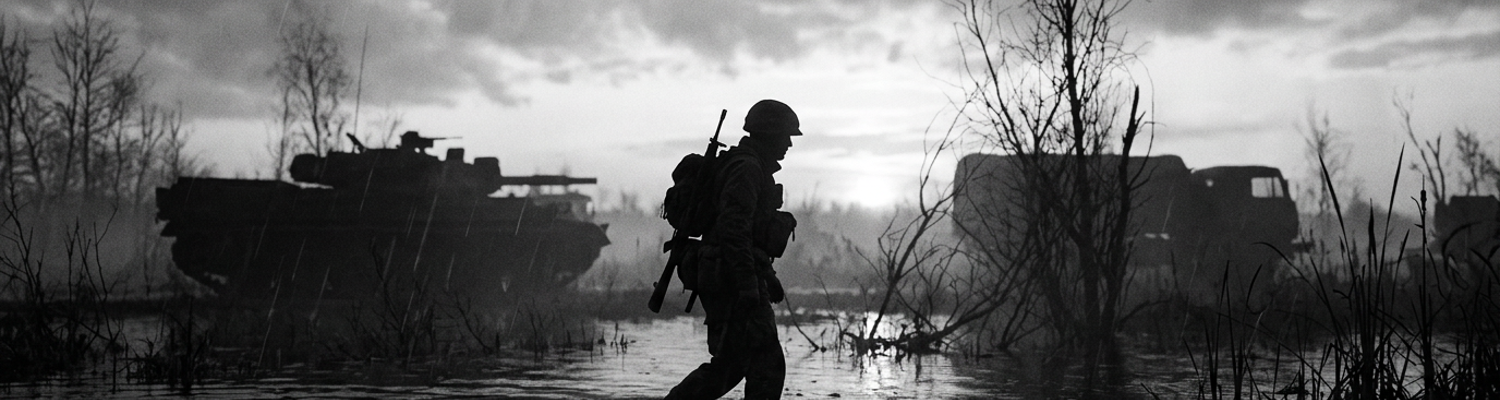

Monsoon Rains and the Kokuba Basin Inundation
By late May 1945, riflemen of the Tenth Army operated under acute caloric deficits and near-total sleep deprivation. Archival evidence shows infantrymen in the 77th and 96th Infantry Divisions functioned on forty-eight-hour waking rotations while clearing the Shuri perimeter. These frontline elements subsisted entirely on cold field rations. Lighting chemical heat tabs drew immediate mortar fire from elevated Japanese positions. Combat loads consistently exceeded fifty pounds per man (Standard Issue Table of Organization and Equipment 7-17). Wet wool socks rotted inside roughout leather service boots. This caused severe friction injuries and skin sloughing that made movement down the coral ridges physically agonizing. Chronic gastrointestinal infections spread rapidly through untreated water sources. This dehydrated men who were already marching twelve miles a day under active Japanese artillery registration. The physical reserve of these forward elements was completely exhausted before they ever reached the low ground flanking the Kokuba River.
Men collapsed while marching and slept in shell craters under direct fire.
When examining the historical record of Tenth Army weather detachments, a severe meteorological shift occurred on May 21, 1945. A low-pressure front collided with the seasonal East China Sea monsoon. This weather event deposited over eight inches of water across southern Okinawa within forty-eight hours. Artillery observation posts on the ridges overlooking Shuri recorded rainfall intensities exceeding two inches an hour during the peak squalls. Gun pits filled to the trunnions of 105mm and 155mm howitzers. Artillery crews shoveled out mud with bare hands to keep recoil mechanisms from jamming into the earth. Operational logs from the XXIV Corps command post indicate visual observation ground to an immediate halt. Cloud cover settled below three hundred feet. This grounded all tactical air support from Marine Aircraft Group 31. The downpour did not pause to allow natural drainage. Water fell continuously across saturated ridgelines. The runoff swept decaying corpses and discarded field equipment down into the natural drainage bowls of the southern island.
Every natural drainage ditch in the Shuri sector overflowed by dusk on May 22.
The deluge completely paralyzed Tenth Army motorized transport. The Kokuba River basin converted into an impassable expanse of limestone slurry and submerged agricultural paddies. Field reports from the 711th Tank Battalion document the mechanical failure of the soil. Coralline limestone subsoil pulverized under heavy track movement. This mixed with organic topsoil to create a thick gray paste with zero load-bearing capability. Standard GMC CCKW two-and-a-half-ton cargo trucks sank past their wheel hubs within minutes of leaving paved coastal tracks. Drivers burned out their clutches and stripped drive-shaft universal joints attempting to reverse out of the bogs. Caterpillar D7 bulldozers deployed to scrape bypasses high-centered on the limestone bedrock. Their steel tracks packed with sticky sludge that sheared track-tensioner bolts under the extreme torque. Across the Kokuba basin itself, existing drainage dikes crumbled. This converted hundreds of terraced rice fields into unbroken sheets of waist-deep water. The floodwaters concealed deep tank traps and pre-sighted Japanese 47mm anti-tank kill zones. M4 Sherman tanks bellied out in the mud. Their lower hulls rested flat against the earth while their churning tracks free-spun without traction.
Wheeled vehicle movement ceased across the entire corps front.
Supply lines shifted entirely onto foot parties and tracked M29C Weasels. The Weasels burned through steering bands after only eight miles of travel in the abrasive grit. Wounded men suffered catastrophic delays in medical triage. Six-man litter teams took four hours to carry a single casualty two miles through the Kokuba mud flats. Ammunition supply points along Highway 5 rationed small-arms rounds and 60mm mortar charges. Frontline companies relied heavily on bayonets and scrounged Japanese ordnance. On May 25, the 7th Infantry Division reported that rations could only be delivered by air-drop. Forty percent of these cargo containers sank into the Kokuba marshes and disappeared beneath four feet of gray water.
Equipment Failures in Saturated Patrol Environments
Water destroyed standard infantry firepower long before enemy gunners opened fire.
Archival evidence shows that by May 26, XXIV Corps intelligence required precise coordinate data to locate reverse-slope firing positions. These positions anchored General Mitsuru Ushijima and his secondary defense lines along the Kokuba River. Officers in the 17th Infantry Regiment of the 7th Infantry Division selected five-man dismounted scout teams for deep night reconnaissance. These men stripped their web gear down to basic bandoliers and combat knives. They left behind steel helmets that produced telltale scraping sounds against limestone outcroppings. Entering the inundated valley between Yonabaru and the Kokuba headwaters at 2300 hours, scouts pushed through chest-deep slurry. Drainage ditches had dissolved into open bogs. Every foot of forward movement required dragging limbs through viscous clay mixed with decaying matter and agricultural fertilizer. Patrols advanced at a rate of less than one hundred yards an hour. They felt underwater with their boots to locate submerged barbed wire and wooden box mines. Working within twenty yards of Japanese forward listening posts, scouts plotted the coordinates of concealed Type 98 20mm autocannon bunkers and pillbox embrasures cut into the limestone bluffs.
Every weapon carried into the basin filled with liquid sludge.
A close review of operational logs indicates that immersion in the coralline silt rendered the standard infantry rifle almost completely inoperable. The M1 Garand relied on an exposed receiver bridge and a rotating bolt assembly. This design possessed zero tolerance for abrasive sediment. When scouts waded into the muck, suspended limestone particulates slipped past the follower assembly and into the bolt raceways. This locked the operating rod cam recess solid. Riflemen attempting to chamber rounds found the bolt lugs unable to rotate into battery. The hammer dropped harmlessly against an unlocked firing pin. The heavier Browning Automatic Rifle failed at a similar rate. The BAR gas cylinder sat slung low beneath the barrel. It sucked in slurry whenever a gunner went prone in the marsh. Grit worked past the gas cylinder tube into the gas piston and slide assembly. The return spring could not overcome the resulting friction. BAR gunners repeatedly kicked their charging handles with boot heels to break free locked bolts. This action frequently sheared the cocking handle pin and turned a twenty-pound automatic weapon into an awkward club.
Voice communication collapsed at the forward edge of the swamp.
When examining the historical record of the 184th Infantry Regiment, signal detachments suffered catastrophic technical breakdowns. They attempted to keep SCR-300 back-pack radio sets functional across the Kokuba flood plain. The BC-1000 receiver-transmitter unit possessed rubberized gaskets around the battery box. Continuous immersion past chest height forced water past the housing seals. Acidic brackish swamp water flooded the internal dry-battery compartments. This attacked the multi-pin connector sockets of the BA-70 battery. Galvanic corrosion began within minutes. It coated the brass prongs in heavy green oxidation that broke circuit connectivity. Electrolytic shorts burned through the miniature vacuum tube filaments. Radio operators lost carrier frequencies without warning. The rubber diaphragms inside the TS-15 handset microphones soaked through. This distorted human speech into unintelligible clicks. Forward observers pinned against paddy dikes could not transmit firing solutions back to 105mm artillery battalions. Forward platoons crawled back through the mud on their bellies to deliver handwritten sketches.
Artillery Harassment in Waterlogged Fighting Positions
Men drowned in their own foxholes before enemy shrapnel could reach them.
Archival evidence shows that by May 27, forward observation details from the 57th Field Artillery Battalion were completely cut off. Infantry scouts of the 32nd Infantry Regiment shared this isolation along the northern approaches to the Kokuba River. Sustained rainfall coupled with nearby heavy shell impacts pulverized the surrounding clay. The walls of their sandbagged revetments collapsed inward under hundreds of pounds of saturated topsoil. Scouts wedged their bodies into narrow limestone crevices to keep their heads above the foul rising water. They monitored the approaches to Shuri from these submerged positions. Skin on their lower legs sloughed away inside waterlogged combat boots. This exposed raw nerve endings to run-off contaminated by chemical fertilizers and unburied human remains. Continuous subterranean drainage filled the fighting pits to chest height. The men used empty ration tins to bail out gray muck. They worked only in darkness to avoid sniper fire from the opposing ridgeline. Visual reconnaissance continued through battery-powered BC-611 handie-talkies whenever atmospheric conditions allowed. Observers recorded Japanese pillbox locations while shivering uncontrollably in the standing cold.
Sleep deprivation drove men into severe auditory hallucinations.
Across the river, gunners of the Imperial Japanese Army 1st Medium Artillery Regiment maintained continuous interdiction patterns. These patterns were designed to seal the basin. The Japanese batteries operated Type 89 150mm guns and Type 96 150mm howitzers from deep limestone cave embrasures cut into the Shuri-Mawashi escarpment. They placed observed salvos directly along the only passable dikes. High-explosive shells struck the marsh at irregular intervals of three to five minutes. The gunners used delayed-action fuzes that burrowed two yards into the peat before detonation. The resulting subterranean concussions ruptured the eardrums of observers pinned in adjacent holes. The blasts cast blankets of mud across their observation slits. XXIV Corps dispatched tracked M29C Weasels from the 7th Reconnaissance Troop to pull the trapped observers out. The Japanese 150mm batteries systematically pulverized the access lanes. High-velocity fragment patterns shredded the light sheet-metal hulls of the unarmored cargo carriers. Explosions tore track bands off drive sprockets and killed recovery drivers before they could reach the forward perimeter.
Command decisions prioritized target intelligence over immediate tactical rescue.
A close review of operational logs indicates that division headquarters repeatedly denied permission for withdrawal attempts across the flooded rice flats. Regimental commanders ordered the trapped scouts to hold their positions. They demanded continuous coordinate plots on Japanese counter-battery positions. The observers reported severe physical exhaustion and systemic trench foot over the surviving radio nets. Trapped riflemen took turns holding sleeping comrades by their field jackets. This prevented exhausted men from slipping beneath the surface of the inundated trenches. In multiple fighting holes, soldiers shared their cramped space with decomposing corpses. They were unable to heave the dead over the parapet without exposing themselves to high-angle 150mm airbursts. Men choked down cold rations while listening to the mechanical clanking of Japanese artillery breech blocks echo across the Kokuba marsh.
By the morning of May 29, the Japanese 1st Medium Artillery Regiment had expended over nine hundred 150mm rounds across a four-hundred-yard sector of the Kokuba crossing. Every litter squad dispatched from the 32nd Infantry aid station was turned back by heavy fragmentation. The shrapnel severed communication wire and shattered wooden stretchers. Surviving observers inside revetment pocket 7882-O documented thirty-four separate heavy-caliber impacts within twenty paces of their pit. Their final field telephone line went dead at 1140 hours.
Physiological Attrition and Severe Immersion Foot
Human skin liquefied after seventy-two continuous hours in the Okinawan paddies.
Archival evidence shows that forward scouts from the 7th Reconnaissance Troop operated along the northern bank of the Kokuba River under extreme physical duress. These men spent up to four days continuously submerged in waste-laden runoff without removing their M-1943 combat boots. Southern Okinawa agricultural flats were heavily fertilized with human excrement and nightsoil. This saturated the standing water with virulent strains of Clostridium and fecal streptococci. Cold water trapped inside the roughout leather boots dropped foot temperatures below fifty degrees Fahrenheit for extended periods. Severe peripheral vasoconstriction starved the capillary beds in the extremities of oxygenated blood. Feet swelled to twice their normal dimensions. The flesh turned a mottled waxy white before shifting into dark cyanosis. Patrol members finally cut their saturated laces with trench knives upon returning to the perimeter. The entire epidermal layer frequently peeled away with the wool sock fibers. This exposed raw weeping dermis and tendon sheaths to the contaminated mud. Regimental aid stations under the 17th Infantry recorded that over forty percent of forward scouts suffered third-degree immersion foot by May 30. Sensory nerve damage rendered them incapable of supporting their own body weight or sensing puncture wounds from submerged bamboo spikes.
Men crawled back to the perimeter on hands and knees because walking was physically impossible.
A close review of operational logs indicates that frontline reconnaissance detachments burned approximately five thousand calories a day. They dragged themselves through knee-deep coralline clay under heavy combat loads. They received less than twelve hundred calories in consumable rations during this same period. Frontline quartermasters could not transport hot chow forward across the washed-out tracks. Scout detachments subsisted entirely on cold water-soaked K-ration biscuits and tinned pork luncheon meat. Lighting small squad stoves or matches was punishable by field demotion. Any flicker brought instant Japanese 50mm knee-mortar rounds from the opposite bluff. Core body temperatures plummeted in the continuous downpour without hot food. This triggered uncontrolled shivering that depleted skeletal muscle glycogen within thirty-six hours. Dry bivouacs simply did not exist anywhere across the Kokuba lowlands. Forward patrols slept upright in waist-deep water. They tied their pistol belts to mangrove stumps or drove bayonets into limestone fissures to anchor their bodies. This prevented them from slipping under and drowning during involuntary bouts of microsleep. Frontline officers noted that men in this state of acute physical depletion experienced severe tremors. They could no longer seat eight-round clips into their Garand rifles.
Chronic caloric starvation rapidly destroyed the central nervous system.
When examining the historical record of the 96th Infantry Division reconnaissance elements, Tenth Army medical officers documented a direct correlation between caloric exhaustion and acute combat neurosis. By June 1, scout platoons that had maintained ten days of continuous perimeter screening reported massive physical degradation. Body-weight losses averaged eighteen pounds per man. Basal metabolic exhaustion induced severe circulatory hypotension. Forward scouts presented with resting pulses below forty-five beats per minute. Their blood pressures dropped too low to maintain consciousness when rising quickly from a prone position. Infantry scouts sat motionless in sixty-degree slurry in the mud trenches outside Kochinda. They ignored artillery detonations landing fifty yards away because their motor pathways failed to execute basic survival reflexes. Medical clearing companies established near Highway 5 received dozens of soldiers exhibiting no physical fragmentation wounds. These men presented with complete catatonia, hypothermia, and irreversible muscular atrophy.
Psychological Erosion and Combat Neurosis at Kokuba
Archival evidence shows that the concussive stress of Japanese artillery broke the nervous systems of Tenth Army scouts before enemy rifle fire ever reached them. Gunners from the Imperial Japanese Army 42nd Field Artillery Regiment and 1st Medium Artillery Regiment dropped continuous barrages onto the northern marsh approaches. They utilized 150mm high-explosive and 120mm dual-purpose rounds. Percussive blast overpressures repeatedly slammed through the waterlogged soil. The kinetic force compressed human chest cavities and ruptured inner ear membranes. Scouts from the 7th Reconnaissance Troop spent forty-eight consecutive hours pinned in stagnant water. They absorbed ground-conducted kinetic vibrations that rattled brain tissue against cranial bone. Torrential runoff constantly unearthed decaying corpses from the earlier battles for Chocolate Drop and Conical Hill. Dismembered limbs and putrefied torsos floated directly into the American fighting positions. Maggot-covered remains wedged against squad revetments. This filled observation slits with the stench of human decomposition. Frontline observers could not escape the visual horror without drawing sniper fire. They began shaking uncontrollably, vomiting into their clothing, and experiencing acute dissociative episodes.
Scouts sat neck-deep in mud alongside putrefying enemy dead while absorbing relentless concussive shockwaves.
A close review of operational logs indicates that the physical combination of sensory trauma and complete sleep deprivation caused immediate breakdowns in basic motor function. Soldiers who had spent six days without rest displayed extreme involuntary tremors. Facial tics and sudden bouts of hysterical blindness became common occurrences. Field surgeons stationed at the 7th Infantry Division clearing station near Yonabaru classified dozens of forward scouts under the diagnostic umbrella of acute combat neurosis. North of the river, men stopped diving for cover when incoming Japanese 81mm mortar rounds whistled overhead. They sat completely paralyzed in open view. Some soldiers broke into uncontrollable weeping. Others stared blankly ahead, entirely unresponsive to direct verbal commands. Forward medical personnel administered heavy doses of sodium amytal to force temporary sleep in rear-echelon tents. Patients awoke hours later with violent panic reactions. They thrashed at the sound of any sudden metallic clatter.
Psychiatric collapse rapidly stripped Tenth Army reconnaissance platoons of experienced frontline leaders.
When examining the historical record of Tenth Army personnel rolls, widespread psychiatric casualties severely depleted forward reconnaissance rosters. This occurred just prior to the eventual Japanese withdrawal from the Shuri defense line. Platoon leaders in the 7th Reconnaissance Troop and 96th Infantry Division scout detachments faced crippling manpower deficits by late May. Japanese General Mitsuru Ushijima organized the southern withdrawal of the 32nd Army toward the Mabuni heights between May 26 and May 31. American scouting detachments lacked the functional personnel required to track this night movement through the Kokuba corridor. XXIV Corps medical directorates set up specialized exhaustion centers near Chinen. Recovery rates among forward observers remained below twenty percent. Green replacements ferried in from the Hagushi beaches collapsed within twenty-four hours under the constant artillery barrages. Company officers watched daily casualty reports shift heavily toward neuropsychiatric cases. Frontline units operated without the experienced scouts needed to confirm whether Japanese cave networks had been vacated.
By June 1, the 7th Reconnaissance Troop recorded twenty-two psychiatric evacuations within forty-eight hours. Forward outposts along Highway 13 operated with skeletal squads incapable of offensive action.