
Axis Encirclement and Legation Bern Intelligence Channels
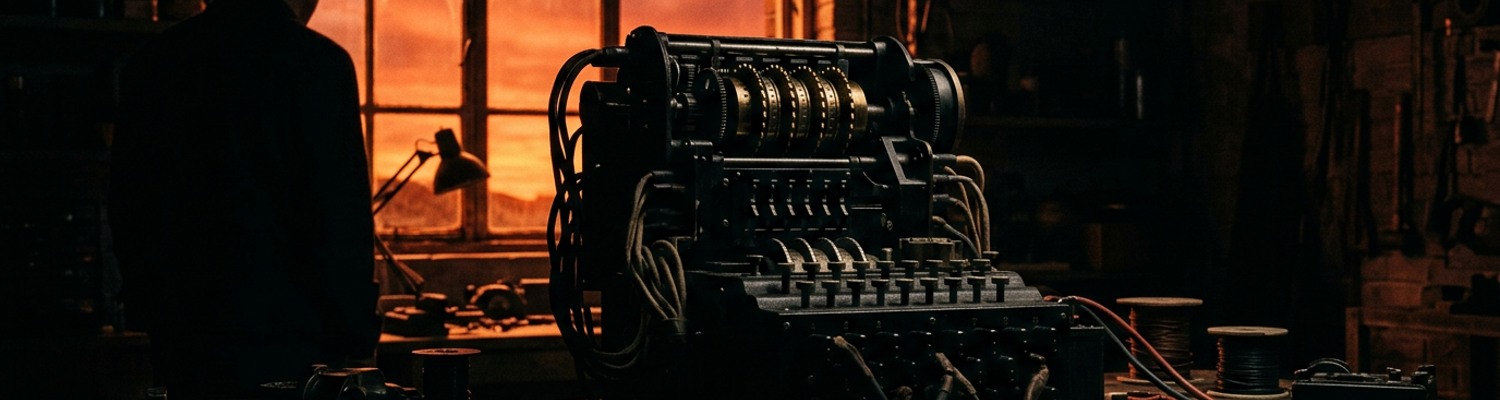
Army Signal Corps manuals promised that electromechanical cipher machines would operate in clean headquarters offices connected to reliable commercial telegraph networks, but reality in Switzerland shattered those expectations. Civilian cryptanalysts in Washington workshops had struggled with slipping drive gears, short-circuited stepping switches, and fragile rotor wiring before issuing the device for diplomatic service. German troops occupied southern France in November 1942, closing the last open border corridor and leaving the American Legation in Bern completely surrounded by Axis-controlled territory. Swiss frontier guards sealed alpine rail lines against foreign courier traffic, cutting the legation off from official mail pouches and naval supply routes. American staff members moved their mechanical cipher apparatus into a dark basement vault beneath the legation on the Alpenstrasse to protect the brass stepping wheels and internal electrical rotors from damp winter drafts.
Colonel Barnwell R. Legge inspected the machine's brass stepping wheels each morning to ensure the apparatus could process incoming intelligence reports without jamming in the cold cellar. US Minister Leland Harrison and Military Attache Colonel Barnwell R. Legge maintained covert intelligence networks and diplomatic communication channels directly feeding the War Department Military Intelligence Division. Informants crossed mountain tracks under cover of darkness to deliver typed dossiers, map overlays, and intercepted German correspondence directly to Harrison's staff. Bern electric utilities often suffered sudden voltage dips that threatened to throw the machine's rotating code wheels out of phase mid-sentence. Legation technicians wired bank after bank of lead-acid automobile batteries into the machine's power assembly to stabilize the current and keep the drive motor spinning at a steady rate.
Technicians monitored the hum of this drive motor during grueling ten-hour enciphering runs, watching for signs of mechanical wear on the primary cipher rotors. Rotor contact pins flattened against the bakelite discs after repeated operations, causing intermittent electrical shorts that garbled outbound messages. Local Swiss watchmakers secretly fabricated miniature springs and polished brass replacement pins, allowing legation code clerks to rebuild damaged rotor assemblies on a basement workbench. Colonel Legge relied entirely on this modified mechanical cipher unit when explosive new dispatches arrived regarding mass graves discovered in the Katyn forest in eastern Europe. Swiss forensic doctors and visiting observers had returned from the excavation sites with autopsies, ammunition casings, and witness statements that demanded immediate delivery to military leadership in Washington via the cipher machine.
Clerks stacked the Katyn forensic statements next to this cipher machine keyboard and typed the raw text into the apparatus letter by letter. Brass rotors turned and clicked inside the casing with every key strike, converting descriptions of execution wounds and uniform cloth into scrambled strings of encrypted characters. Radio transmitters on legation grounds flashed the coded Katyn files through shortwave antennas, bypassing the ring of German monitoring stations stationed along the Swiss frontier. Continuous heavy usage ground down the machine's internal escapements, showing legation staff that mechanical rotor systems were rapidly nearing the end of their operational lifespan under wartime intelligence loads. Colonel Legge locked the overheated machine back inside the safe, logged the final transmission timestamp in the station register, and handed the Katyn clearance slip to Minister Harrison.
German Announcements and the International Medical Commission
Leland Harrison studied the transmission slip while German radio broadcasts triggered a sudden crisis that threatened to overwhelm the legation cryptographic staff. Radio Berlin announced in April 1943 the discovery of mass graves containing thousands of executed Polish military officers in Katyn Forest near Smolensk. German radio broadcasters stated that Soviet secret police units had systematically shot the Polish prisoners in the back of the neck during the spring of 1940 and buried them in deep sandy trenches. Swiss monitoring posts intercepted the German transmission transcripts within minutes and forwarded the raw bulletins across Bern directly to Harrison's desk. Legation staff understood that this sensational announcement would generate an enormous volume of urgent intelligence traffic, requiring their basement cipher machine to run at peak capacity for days to process the incoming German forensic data.
German authorities generated this forensic data by assembling the International Medical Commission of twelve prominent forensic pathologists from neutral and occupied countries, including Dr. Francois Naville of the University of Geneva, to evaluate the physical evidence in the field. Doctors traveled under German military escort across occupied Poland directly to the excavated pits outside Smolensk, where stacked corpses lay preserved in cold clay and peat. Pathologists cut through stiff winter uniforms, extracted deformed lead bullets from skull cavities, and examined personal letters showing that victim correspondence ended abruptly in the spring of 1940. Naville conducted multiple post-mortem examinations under portable field lamps, recording precise entry wounds and the exact mummification of human remains. German officials pressed the visiting specialists to sign a collective protocol confirming Soviet culpability before flying the medical delegates back to their home nations.
Francois Naville carried his handwritten field notes, autopsy records, and forensic observations back to Geneva, where American intelligence contacts immediately arranged to review his private documentation. Colonel Legge hauled the heavy cipher apparatus back onto the basement workbench as soon as Naville's technical findings reached the legation on the Alpenstrasse. Technicians checked the unit's bakelite rotor wheels and lubricated the brass stepping ratchets with light machine oil to prevent mechanical bind-ups during the upcoming enciphering run. Clerks converted pages of anatomical autopsy data into standard five-letter code groups, forcing the machine's drive shaft to rotate through hundreds of stepping cycles every hour. Automobile batteries supplying the unit hissed softly on the damp stone floor, their lead plates straining under the steady current draw required by the electric stepping solenoids. Heated electrical coils filled the vault with the smell of warm varnish as the machine translated descriptions of shattered skulls and decomposed uniform cloth into encrypted character streams.
Rotor contact pins inside the central cipher cylinder began to chatter under the sustained friction of continuous high-speed typing. Swiss replacement springs flexed inside the rotor carriage, barely maintaining enough tension to advance the code wheels through the final pages of the Swiss pathologist's anatomical report. Legation operators paused every twenty minutes to cool the drive casing with damp cloths, keeping the sensitive stepping switch from locking up mid-sentence. Colonel Legge reviewed the encrypted tape outputs as they rolled off the mechanical punch head and carried the yellow paper strips straight to the shortwave radio transmitters. Signal operators tapped the completed cipher groups over diplomatic frequencies toward War Department receivers in Washington, delivering the neutral forensic evidence across German-controlled skies.
Clandestine Debriefings of Pathologist Francois Naville
Washington military intelligence officers received these incoming forensic transmissions and wired back urgent instructions for Legation Bern to verify the evidence through direct, unmonitored medical interviews. United States Consul Paul C. Squire arranged confidential meetings in Geneva with Dr. Francois Naville in May 1943 immediately after Naville returned from the Katyn autopsy sites. Dr. Naville provided Legation officials with uncensored forensic observations free from the influence of German propaganda handlers, welcoming Squire into private rooms far removed from Axis surveillance. Naville produced personal diaries, anatomical sketches, and field memoranda that documented his direct post-mortem examinations on the Polish officer corpses. Squire took exhaustive shorthand notes as the Swiss pathologist walked through each clinical finding, establishing a factual record completely detached from the official German press releases by relying entirely on Naville and his anatomical notes.
Naville presented these detailed anatomical notes showing that the victims had died years before the German army captured the Smolensk district in July 1941. Naville explained that the bodies in the mass graves wore heavy winter overcoats, knitted cardigans, and fur-lined mittens, clothing entirely inconsistent with a summer execution. Swiss examinations of conifer saplings planted atop the burial mounds revealed three distinct annual growth rings, confirming that the soil had been backfilled over the trenches in the spring of 1940. Diaries, personal letters, and newspaper clippings pulled directly from the uniform pockets ended without exception in April 1940, pointing unmistakably to Soviet culpability. Squire compiled these forensic observations into a comprehensive seventy-page dispatch, secured the typed pages inside an oilcloth satchel, and sent a trusted diplomatic courier aboard the evening passenger train to Bern.
Colonel Barnwell Legge met the evening courier at the legation gate and carried Squire's satchel down into the basement cipher vault. Code clerks cleared the wooden workbench and switched on the electromechanical cipher apparatus, listening as the electric drive motor sputtered against the damp cellar air. Technicians had modified the machine with Swiss-crafted brass ratchets and tempered balance springs, but the added hardware struggled to handle the sudden volume of Squire's massive report. Clerks pecked at the keyboard for hours, translating Naville's descriptions of cranial gunshot wounds and bullet exit trajectories into endless strings of five-letter groups. Drive gears slipped inside the casing as the unit overheated, causing the stepping switches to lag behind the operator's keystrokes. Automobile batteries hooked in series across the flagstone floor bubbled with caustic fumes as they supplied heavy direct current to prevent the machine's solenoids from freezing mid-cipher.
Copper solenoids clattered inside the bronze housing as the machine entered its sixth continuous hour of encipherment, scattering sparks across the central rotor carriage. Rotating commutators accumulated a gritty layer of carbon soot under the intense friction, which threatened to garble the outgoing Katyn dispatch unless operators intervened. Technicians cut the battery power every half hour to swab the bakelite rotor discs with pure rubbing alcohol and adjust bent contact pins with needle-nose pliers. Mechanical fatigue inside the drive train revealed that these bulky, motor-driven cipher boxes were reaching the absolute end of their operational usefulness under modern intelligence loads. Operators threaded the final yards of yellow punched paper tape through the output head as the last paragraph of Naville's testimony clicked through the mechanism. Signal clerks bundled the perforated paper rolls into canvas pouches and carried them directly to the legation radio operators for shortwave transmission to Washington.
Forensic Ballistics and Cold Weather Pathological Evidence
Radio operators fed the punched paper tape into high-frequency transmitters to broadcast the initial dispatches across Europe, but down in the basement vault, the electromechanical cipher machine faced another mounting stack of detailed anatomical files. Colonel Legge brought in the next thick sheaf of technical autopsy sheets describing the ballistic trauma and cranial damage found across the Katyn execution trenches. Dr. Naville's clinical testimony confirmed uniform executions carried out by close-range occipital gunfire into the base of the skull using 7.65mm Geco pistol rounds. The cipher machine typed out descriptions of identical entry wounds drilled cleanly through the lower rear cranium, where executioners had pressed pistol barrels directly against the nape of each prisoner's neck to produce instantaneous death. Copper rotor brushes sparked and smoked under the sustained electrical load of enciphering hundreds of German-manufactured cartridge headstamps and precise bullet trajectory angles. Operators blew carbon dust off the rotor faces every few minutes to keep the stepping solenoids from slipping teeth and misaligning the complex five-letter output groups.
Carbon residue threatened to freeze the rotor mechanism completely as the encipherment shifted to the pathological findings gathered from the victim clothing and decomposed flesh. Autopsies revealed victims dressed in heavy winter overcoats and wool garments without insect larval development, establishing that deaths occurred during freezing late-winter temperatures. Clerks tapped the keys rhythmically to avoid jamming the fragile Swiss-made ratchet gears while recording how the cold climate had preserved human tissues and halted natural biological decay. The electromechanical machine converted Naville's accounts of unhatched fly cycles, mummified skin tissue, and intact wool fibers into steady electrical pulses that advanced the scrambled wheels step by step. Damp cellar air continued to corrode the internal bronze contacts, forcing legation technicians to drip light mineral oil directly into the gear train between incoming report paragraphs. Heat radiating from the solenoid bank warped the thin aluminum cover plate and burned the operator fingertips, demonstrating that this delicate laboratory cipher design was never built to withstand sustained tactical field operations.
Aluminum casing plates rattled against the wooden workbench as the electric motor vibrated violently through the final pages of the Swiss forensic documentation. Swiss-made brass replacement ratchets and modified balance springs barely held the internal rotor drive together as the machine punched out the final cipher groups detailing the mass burial layers and soil stratification. Legation cryptographers rotated fresh automobile batteries into the power circuit to prevent the falling direct current voltage from corrupting the encoded ballistic measurements and cranial measurements. Internal stepping switches groaned under the high friction, warning the cipher team that the overworked mechanical components were on the verge of catastrophic structural failure. The cipher mechanism finally slowed with a heavy metallic click as the last encoded line of Dr. Naville's medical report dropped onto the table. Colonel Legge grabbed the fresh rolls of encrypted paper tape, bypassed the smoldering cipher unit, and marched up the cellar stairs toward the transmission room.
Botanical Growth Rings and Interrupted Victim Timelines
Radio operators fed the punched paper tape into high-frequency transmitters on the top floor while courier clerks carried a fresh stack of Swiss botanical affidavits down into the cellar. The electromechanical cipher machine sat resting on the workbench with its aluminum cowl removed, releasing waves of trapped heat from its bronze rotor carriage into the cold vault air. Technicians used hand blowers to clear away the fine copper dust that had shaved off the commutators during the previous ballistic transmission before locking the power cables back onto the battery terminals. Clerks began typing the botanical field reports describing how forensic specialists examined five-year-old pine saplings transplanted over the Katyn burial pits to disguise the mass graves. Brass stepping wheels clicked and advanced inside the chassis as the machine translated descriptions of cross-sectioned tree trunks whose wood showed three distinct annual growth rings, scientifically dating the burials to the spring of 1940. Every keystroke forced the modified Swiss ratchet assembly to shove the heavy rotor cylinders forward, straining the delicate gear teeth against the relentless friction of the encipherment process.
Clerks dripped mineral oil directly into the spinning gear teeth to stop the rotor assembly from binding as the text shifted from forest botany to the paper records recovered from the corpses. Typists hammered the keyboard to encode thousands of diary entries, transit receipts, and letters found unread inside the officers overcoats. The electromechanical cipher machine chattered steadily as it scrambled evidence showing that personal letters, Soviet camp publications, and pocket diaries recovered from officer remains halted abruptly in April and early May 1940, over a year prior to the German offensive of July 1941. Electric current surged through the wiring harness every time the machine processed names of Soviet prison camps and dates stamped on confiscated newspapers, producing sharp ozone smells that filled the cellar. Solenoid armatures rattled against their rubber stops, slipping out of alignment whenever the operator typed faster than forty words per minute, forcing cryptographers to tap the keys with careful, deliberate strikes to generate the final yards of paper tape.
Copper commutators inside the central rotor drum warped from excessive heat as the punch head spat out these final yards of paper tape, exposing the design flaws that had plagued the machine since its initial development in Washington workshops. Civilian cryptanalysts in prewar laboratories had built the device for brief administrative cables rather than massive evidentiary dossiers, leaving the brass bearings and stepping switches vulnerable to rapid breakdown under sustained loads. Legation mechanics had already retrofitted the chassis with Swiss watchmaker screws and tempered steel balance springs, but these field modifications could only postpone the physical breakdown of the aging mechanism. Continuous friction continued to chew through the drive gears, proving to the Bern intelligence staff that mechanical rotor machines were entering their final obsolescence as modern war demanded high-speed electronic systems. Technicians cut the battery circuit to silence the shuddering motor, packed the encoded botanical and diary tapes into canvas pouches, and carried the complete Katyn intelligence portfolio straight to the rooftop radio room.
Assembly and Transmission of Military Attache Despatches
Transmitters in the rooftop radio room hummed as operators fed the perforated paper strips through the sending heads, transmitting encrypted cable summaries of the Katyn findings directly to military intelligence officers in Washington. Colonel Barnwell R. Legge codified Naville's signed medical depositions, affidavits, and photographic exhibits into formal military attache intelligence reports downstairs in his Alpenstrasse office. Legge organized the dense anatomical files into standard War Department formats, pairing the Swiss doctor's clinical descriptions of skull trauma with Naville's handwritten notes from the mass graves. Clerks mounted the glossy black-and-white photographic plates onto heavy manila folios, numbering each print to correlate with specific paragraphs detailing 7.65mm bullet entry angles, winter uniform garments, and buried pine root rings. Legge attached Squire's debriefing memorandums and Naville's signed personal declarations to the dossier, establishing an unbroken chain of forensic evidence gathered entirely outside Axis propaganda influence. Typewritten carbon duplicates accumulated across the attache desk as staff members verified that every paragraph of the official intelligence report aligned precisely with the radio cipher summaries currently beaming across the Atlantic as encoded text.
Couriers packed the finished multi-page intelligence files into heavy canvas sacks because shortwave radio transmitters could only send this encoded text rather than original physical exhibits. The Legation routed these classified physical dossiers through diplomatic courier pouches across Axis-controlled transit corridors while transmitting encrypted cable summaries to military intelligence desks in Washington. Staff clerks sealed the paper files, photographic negatives, and autographed medical certificates inside waterproof canvas sacks, securing the neck of each pouch with heavy lead tags and stamped American wax impressions. Couriers carried these official packages past Swiss border posts and onto international passenger trains that ran directly through occupied France and fascist Spain. German military police and Axis customs officials maintained checkpoints along these transit corridors, watching courier movements but remaining legally barred by international diplomatic protocols from breaking the American seals. Couriers guarded the pouches day and night in their sleeping compartments until reaching the naval docks and airstrips of neutral Lisbon, where military transport planes loaded the physical dossiers for final delivery to intelligence desks in the Pentagon.
Technicians returned to the dark Alpenstrasse cellar vault to dismantle the electromechanical cipher machine that had transmitted the preliminary Katyn summaries toward Washington. Trapped heat still radiated from the heavy bronze chassis, filling the vault with the smell of scorched wire insulation, battery acid, and carbon soot as mechanics unscrewed the aluminum casing to inspect the gear train. Continuous typing had flattened the contact points on the central rotors and stripped teeth from the brass stepping wheels. Washington research workshops had originally constructed this electromechanical system for routine peacetime cables, leaving its delicate bronze shafts and mechanical escapements completely unsuited for encoding massive forensic case files under wartime intelligence loads. Legation repairmen used miniature files and Swiss watchmaker balance springs to realign the warped commutators, but these makeshift field modifications could not halt the mechanical obsolescence of motor-driven cipher apparatus. Technicians locked the repaired mechanism back inside its fireproof safe, logged the maintenance work in the station register, and locked the vault door for the night.
War Department Classification and Postwar Archival Obsolescence
Pentagon communications officers received the encrypted shortwave signals that the legation machine had generated before being locked into its Alpenstrasse safe. War Department analysts paired these incoming radio texts with the bulky courier folios that Paul C. Squire and Colonel Barnwell R. Legge had assembled from Dr. Francois Naville's forensic debriefings. The resulting intelligence dossier provided clear anatomical and botanical evidence proving that the Katyn massacres took place in the spring of 1940 when the territory was under Soviet control. War Department and State Department officials classified Legge's and Squire's Katyn forensic dispatches to prevent diplomatic friction with the Soviet Union during the war. Senior officials recognized that circulating proof of Soviet war crimes would jeopardize joint military strategy against Nazi Germany and disrupt the supply convoys moving through Arctic sea lanes. Bureau clerks stamped top secret across the clinical reports, stripped Naville's anatomical diagrams from interagency distribution lists, and locked the entire Swiss dossier inside guarded War Department safes.
Safes in Washington held the paper files in total secrecy while the battered electromechanical cipher machine in Bern finished its wartime operational service. Prewar research and development had saddled the apparatus with slipping drive gears and fragile rotor contact pins, forcing legation staff to keep the unit running through emergency improvisations like custom Swiss watch springs and alcohol-swabbed commutators. These improvised mechanical fixes could not overcome the fundamental limitations of motor-driven rotor boxes under the crushing data loads of modern global intelligence. Army Signal Corps laboratories in Washington rapidly turned away from mechanical commutators in the immediate postwar years, developing all-electronic cryptographic systems powered by vacuum tubes and early magnetic memory cores. Legation personnel eventually unscrewed the worn chassis from the Alpenstrasse workbench, crated up the scorched bronze housing, and shipped the obsolete machine into military storage warehouses where surplus wartime gear was abandoned to collect dust.
Dust gathered over the decommissioned cipher gears while the paper reports that they had enciphered sat undisturbed in classified military archives for nearly a decade. Army intelligence custodians kept Legge's signed evaluations and Naville's autopsy notes buried beneath deep security classifications through the end of the Second World War and into the opening years of the Cold War. The dispatches remained suppressed in classified military archives until subpoenaed and published during the 1951 to 1952 Madden Committee congressional hearings. Lawmakers formed the House Select Committee to Conduct an Investigation of the Facts, Evidence, and Circumstances of the Katyn Forest Massacre, chaired by Indiana Representative Ray Madden, to establish a formal public record of the executions. Committee investigators used broad congressional subpoena powers to demand all suppressed Katyn intelligence records from the archivists at the Department of the Army, the Pentagon intelligence division, and the State Department.
Archivists complied with the legislative orders by unlocking classified vaults and delivering Legge's original Bern dispatches directly to committee hearing rooms on Capitol Hill. Committee members laid the yellowed carbon copies, courier folios, and decoded radio transcripts onto witness tables alongside the photographs of cranial bullet holes and winter military overcoats. Former intelligence officers and diplomatic personnel testified under oath to verify the authenticity of the forensic measurements that had been transmitted from Switzerland in 1943. Hearing clerks entered the complete text of Legge's and Squire's reports into the published congressional proceedings, exposing the anatomical findings, botanical sapling studies, and personal diary timelines to international public scrutiny. Committee printers bound the declassified Swiss dispatches into the multi-volume official record of the hearings, delivering the physical evidence into public libraries across the United States.