
Operation Constant Guard III and Base Reactivation
Airman First Class Robert Miller scraped a rusted trenching spade against a choked iron culvert grate twelve yards off the asphalt overrun at Takhli. Rotting tamarind leaves and thick laterite mud spilled out over his combat boots under the midday sun. Archival evidence shows that on May 5, 1972, Pacific Air Forces ordered the immediate reopening of Takhli Royal Thai Air Force Base. The installation sat at coordinates 15 degrees 16 minutes North and 100 degrees 17 minutes East. It had remained dormant under Thai caretaker status since late 1970. Ground equipment, electrical wiring, and operational plumbing were gone. Military assistance planners originally expected a deliberate six-week refurbishment cycle to prepare the facility for combat staging. Seventh Air Force commanders issued a hard 72-hour emergency reactivation mandate to establish base operations for Operation Linebacker strike packages. Personnel dispatched from the 554th Civil Engineering Squadron arrived to find high jungle scrub engulfing the tarmac. Disabled back-up generators and dry fuel distribution pipelines littered the perimeter.
Seventy-two hours was all Seventh Air Force gave them.
A close review of operational logs indicates the North Vietnamese Army cross-border Easter Offensive forced this abrupt timeline. Hanoi struck across the Demilitarized Zone with Soviet-supplied T-54 tanks and heavy artillery. South Vietnamese defensive lines broke. Washington assembled an immediate tactical counterstroke. Linebacker required sustained radar-suppression escorts deep inside Route Package 6. Existing regional hubs like Korat and Ubon were already choked with flight lines at maximum density. Pacific Air Forces leaders selected Takhli because its geographic location provided the straightest flight corridor into the Red River Valley. Tactical Air Command directed the 49th Tactical Fighter Wing to deploy from Holloman Air Force Base in New Mexico. Four full fighter squadrons moved across the Pacific Ocean under the codename Constant Guard III. Ground crews landed on a base without functional mess halls or clean drinking water. Flight mechanics slept directly on concrete pads beside unfinished revetments. High-voltage power lines were spliced by hand in open trenches.
Work crews had to stabilize the airfield drainage network before heavy iron could stage safely on the apron. Monsoon rains quickly turned unmaintained tropical airbases into swampy catchment basins. Civil engineers and augmentee security police dug by hand into the collapsed drainage saps flanking the main 9,800-foot runway. Tropical vegetation and decomposed sandbags choked the deep earthen ditches. Thousands of gallons of stagnant runoff were trapped beneath structural subgrades. Water seeped upward through cracked asphalt joints. This threatened to wash out taxiways beneath seventy-ton fuel tankers and loaded ordnance trailers. Enlisted teams used short entrenching shovels and bare hands to extract root masses and rotten timbers from subterranean concrete culverts. Excavators were unavailable. Men dragged heavy debris baskets out of waterlogged trenches while venomous snakes emerged from the stagnant pools. Silt buildup cut the trench depths in half. Personnel re-carved raw lateral bypass ditches in rain-saturated red clay before incoming landing gear sheared on weakened shoulders.
The concrete was decaying before the first jet arrived.
When examining the historical record, flight operations began while the runway environment was still hazardous. On May 11, the first formations of F-105G Wild Weasels from the 17th Wild Weasel Squadron entered the landing pattern. Modified F-4C airframes outfitted with Wild Weasel electronics followed. Both airframes carried dense radar-detection arrays and heavy AGM-45 Shrike anti-radiation missiles that demanded stable ground handling. Pilots touched down on uncleaned tarmac slick with moss and pitted with jagged foreign-object debris. The base lacked operational sweeping trucks. Line mechanics walked the runway shoulder to shoulder. They filled canvas buckets with loose pebbles, broken glass, and abandoned brass casing fragments. Aircraft arresting cables were locked in manual rigging. Underground hydraulic retraction winches were flooded with silt. Jet engines ingested loose stones. Mechanics hand-filed compressor blade nicks between sorties. Heavily loaded F-105G fighters weighed over fifty thousand pounds at maximum gross weight. Main landing gear tires blew out when rubber met deteriorated runway expansion joints filled with loose gravel.
Revetment Reconstruction and Monsoonal Runoff Challenges
Archival evidence shows enlisted airmen from the 554th Civil Engineering Squadron were assigned to rebuild sixty-eight standardized corrugated steel blast revetments along the central flight loop. Tropical downpours dumped five inches of water across the airfield in six-hour windows. The interiors of the U-shaped aircraft bins turned into knee-deep sloughs. The structures were built from curved twelve-gauge galvanized steel panels bolted into double-walled bins. They had degraded during eighteen months of desertion without grease or protective paint. Rust ate through connecting flanges and structural shear pins. Thousands of tons of compacted river gravel fill spilled out across aircraft parking spots. Enlisted crews worked twelve-hour shifts in driving rain. They used sledgehammers and crowbars to bend warped interlocking corrugated plates back into alignment. Oxidized metal shards cut through standard leather work gloves. Deep lacerations became contaminated with wet laterite soil and stagnant water. Heavy diesel cranes could not operate on the saturated ground without sinking past their axles. Squads of eight men muscled replacement quarter-ton steel sheets into place against forty-knot wind gusts while monsoon rain stripped away footing.
The steel walls gave way under their own saturated deadweight.
A close review of operational logs indicates supply channels from regional depots at Korat and Sattahip failed to deliver designated structural construction items to Takhli through mid-May 1972. Civil engineering work orders called for two-part elastomeric polysulfide joint sealants to seal horizontal panel seams against driving rain. Logistics flights delivered only standard domestic roofing tar. The tar stripped away within hours under heavy rainfall. Unsealed revetment joints leaked continuously. This eroded the sand and laterite ballast that absorbed bomb fragments from potential 122mm rocket strikes. The base quartermaster faced an absolute absence of pressure-treated creosote timbers required for structural revetment retaining headers and aircraft wheel stops. Airmen improvised by dragging untreated local teak and green jungle pine logs from cleared brush lines. They cut them with hand saws and wedged them into blast-wall retaining channels. Unseasoned wood warped within forty-eight hours under the combined heat and moisture. Retaining fasteners split open. Heavy gravel dropped directly onto the taxi paths of arriving F-105G jets.
Raw timber rotted where high-grade treated fir should have held.
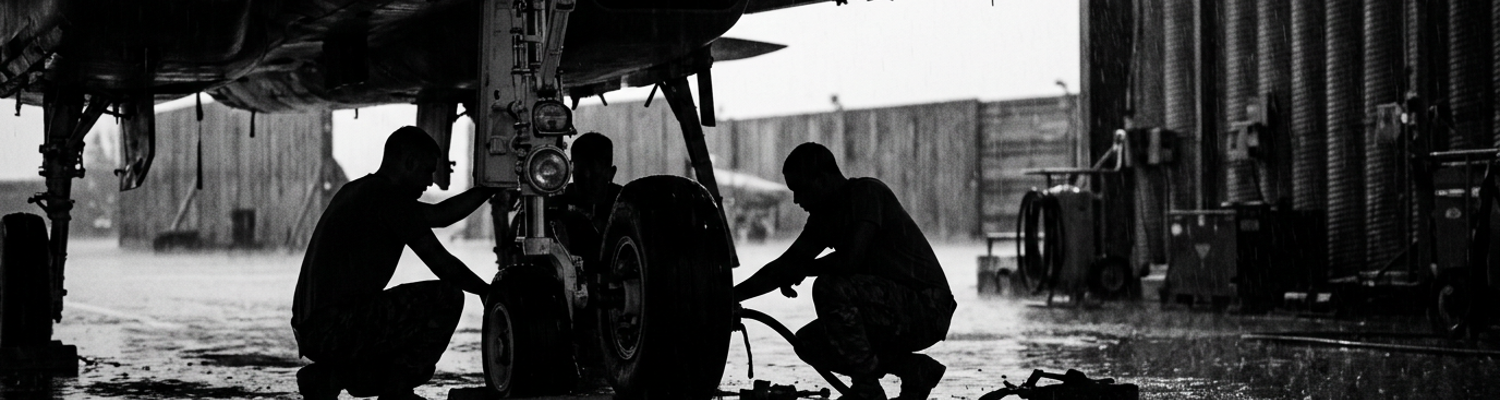
When examining the historical record, the physical environment inside the fighter stalls presented acute physical hazards to maintenance specialists and civil engineers. Gravity drainage channels flanking the aircraft cells were obstructed by sediment and collapsed sandbags. High volumes of surface runoff mixed with unburned JP-4 aviation fuel flushed from open vent lines and damaged engine manifolds. Over one thousand gallons of fuel drained into the revetment floors during daily quick-turn engine tests and defueling procedures. This aviation kerosene formed a dense emulsion with monsoon mud. It pooled eighteen inches deep in unpaved work depressions. Personnel from the 17th Wild Weasel Squadron waded through this slurry to service landing gear assemblies. They connected external fuel tanks and loaded heavy AGM-45 Shrike missiles onto rusted wing pylons. The hydrocarbon mixture dissolved the glue of standard combat boots within thirty-six hours. The soles stripped away from leather uppers. Contact with the fuel-soaked soil caused chemical dermatitis and open skin ulcerations across the lower extremities of the mechanics. Volatile hydrocarbon vapors collected beneath the high steel revetment walls. Flash fires ignited whenever ordnance crews accidentally grounded loose external battery cables against wet asphalt.
Medical stations treated twenty-four chemical burns in the revetments before drainage trenches reached the main retention pond.
Protective Fortifications for Dispersed Aircraft
Archival evidence shows civil engineering teams placed prefabricated splinter-proof personnel shelters directly against the outer berms of individual dispersal revetments. Maintenance crews sprinting across exposed concrete during incoming rocket alerts had less than thirty seconds to clear the pad before munitions detonated. The 554th Civil Engineering Squadron assembled these emergency bunkers using six-foot-diameter corrugated galvanized steel culvert sections laid horizontally in shallow trenches. The flanks were backfilled with compacted laterite gravel. Enlisted troops stacked three layers of rot-resistant burlap and polypropylene sandbags across the exposed tunnel entrances. They pinned the seams with barbed wire to suppress concussive blast overpressures. Ten to twelve flight-line mechanics squeezed together in complete darkness inside these narrow metal tubes. They sat on damp wooden dunnage while primary fragments from Soviet-manufactured 122mm rockets struck the revetment walls outside. The interior air reached 115 degrees Fahrenheit within five minutes of hatch closure. The air was contaminated by lingering JP-4 fumes and battery off-gassing drawn in from the revetment apron. Silt repeatedly clogged the drainage grates at the bunker entry sills. Airmen bailed out stagnant water with their steel M1 helmets to keep the structural floor timbers from floating loose.
No shelter stood more than forty feet from a running jet.
A close review of operational logs indicates ground marshals had to maneuver forty-nine-thousand-pound F-105G Thunderchiefs and forty-eight-thousand-pound F-4C Phantoms into revetment bays offering minimal physical clearance. Standard corrugated steel blast bins measured fifty-two feet across. The swept wings of an F-105G spanned thirty-four feet eleven inches. The F-4C spanned thirty-eight feet five inches. Ground handlers guided each taxied aircraft forward with wooden wheel chocks in hand. They inched main landing gear struts toward designated red-painted alignment marks on the tarmac. Mechanics monitored wingtip clearance with handheld wooden gauges. They worked with fewer than eight feet of total separation from the corrugated steel walls on either side. An engine thrust surge on the fuel-slick concrete shoved high-pressure wing fuel tanks straight into structural steel framing. This sheared metal and triggered uncontrolled fuel spills. Engine exhaust tails cleared the rear revetment ballast by ten feet. Thousands of pounds of jet blast concentrated against degraded gravel retaining walls. Jet wash routinely scoured twenty-pound chunks of laterite ballast out of broken panel seams. Debris hurled back into the aircraft stalls and shattered hydraulic lines mounted along the main gear wells.
Margin for error on the dispersal pad was twenty-four inches.
When examining the historical record, weapons technicians faced high detonation hazards while running simultaneous rearming cycles during sixty-minute combat turnarounds. Aircraft returned from Route Package 6 with active electronic countermeasure pods, empty rocket rails, and hung ordnance that had failed to separate over targets in North Vietnam. Load crews from the 388th Munitions Maintenance Squadron trundled heavy trailers carrying 1,000-pound AGM-78 Standard ARM missiles straight into the narrow stall openings. Ground teams erected movable sandbag barrier screens and portable quarter-inch steel blast shields between loaded ordnance dollies and hot aircraft engine bays. These blast barriers prevented shrapnel from punctured fuel tanks from causing sympathetic chain detonations across adjacent weapon piles. Ordnance crews attached grounding cables with heavy copper alligator clips to designated aircraft grounding plugs. This neutralized electrical static charges that could otherwise ignite rocket motor squibs on the weapon pylons. Arming crews mounted heavy missiles beneath the wings. Crew chiefs used pressurized water hoses to spray down main wheel hubs that exceeded 400 degrees Fahrenheit after high-speed landing rollouts. This stopped overheated magnesium brakes from bursting tires and spraying hot rim fragments directly into exposed warhead casings. Ground crews carried twenty-pound fire bottles with unpinned safety handles throughout every turn.
Emergency Mobilization of Specialized Microwave Technicians
Archival evidence shows that by mid-May 1972, high-frequency receiver modules and traveling wave tubes inside the AN/APR-35 and AN/ALR-31 radar homing systems were burning out. The failure rate was three times the anticipated peacetime attrition level. The 17th Wild Weasel Squadron had eighteen modified F-105G airframes sitting on the Takhli ramps. Over half suffered from blind receiver channels across the critical S-band and C-band frequencies used by North Vietnamese Fan Song fire-control radars. Air Force supply chains had no pipeline of active-duty enlisted specialists trained to repair the delicate internal cavity resonators and solid-state strip-line mixers mounted inside the aircraft noses. Military personnel managers activated emergency recruitment protocols through the 1962 National Register of Scientific and Technical Personnel roster. This Cold War database contained career files, security clearances, and specialty codes for thousands of private-sector physicists and microwave engineers across the United States. Systems Command staff scoured these rolls to identify engineers who had designed the original receiver circuitry for project Wild Weasel III. Military recruiters contacted civilian researchers at home within seventy-two hours of identification. They secured leaves of absence from commercial industrial plants and issued priority travel orders directing them to Southeast Asia.
The Pentagon pulled civilian microwave specialists straight out of domestic research laboratories.
A close review of operational logs indicates civilian technical representatives were dropped directly into the maintenance flow alongside nineteen-year-old enlisted airmen of the 388th Avionics Maintenance Squadron. Tech reps from Airborne Instruments Laboratory and Applied Technology Incorporated walked into Takhli wearing civilian cotton khakis. They changed into standard olive-drab jungle fatigues without rank insignia. These corporate engineers slept on folding cots in the un-airconditioned field tents beside the revetment rows. They shared mess rations and water trailers with the enlisted line mechanics. Flight line commanders waived standard military protocol. They granted civilian contractors direct access to classified cryptographic keyways and electronic countermeasure test harnesses inside the F-105G cockpits. Enlisted radar repairmen learned on-the-spot tube alignment and micro-soldering methods from the very engineers who held the manufacturing patents on the subassemblies. Maintenance teams worked twelve-hour night shifts under portable halogen floodlights. They stripped down the AN/ALQ-105 jamming blisters that ran flush along the Thunderchief fuselages. Contractor personnel exposed themselves to the same physical hazards as the uniformed crews. They inhaled aerosolized trichloroethylene solvent fumes and brushed against ungrounded high-voltage chassis connections while guiding young airmen through the diagnostic testing of radio frequency pre-amplifiers.
Civilian field engineers drew standard fatigue trousers over private-sector work shirts.
When examining the historical record, flight schedules left zero room to pull malfunctioning avionics suites from the airframes and haul them to clean-room calibration vans. Maintenance officers instituted revetment-side dispatch protocols. They sent hybrid contractor-enlisted troubleshooters directly to the aircraft parking stalls the moment a fighter dropped its tailhook. Tropical humidity above ninety percent caused dense condensation to collect inside coaxial feedlines and antenna horn fairings. This shorted out delicate crystal video detector diodes whenever an aircraft descended from thirty thousand feet into the humid lowlands around Nakhon Sawan. Technicians hauled ninety-pound portable sweep generators and microwave power meters through the flooded mud aprons. They climbed external access ladders to balance local oscillator frequencies inside the tight confines of the forward radar bays. They worked within five feet of forty-pound weapon pylons hung with live AGM-45 Shrike missiles. Civilian specialists used portable heat guns to dry out moisture-laden wave guides. Enlisted troops spliced replacement silver-plated copper cabling directly into the receiver harnesses. Ground tests were conducted while aircraft engines idled at sixty percent thrust to supply continuous 400-hertz electrical power. Technicians faced intense structural vibrations, hundred-knot turbine slipstreams, and searing 140-degree engine bay surfaces.
Testing a single S-band mixer diode on the revetment apron took twenty minutes of direct exposure to toxic hydraulic mist.
Forward Maintenance of Sensitive Wild Weasel Avionics
Archival evidence shows the AN/APR-35 radar homing and warning receivers deployed on the F-105G Thunderchiefs suffered severe thermal destruction on the Takhli flight line. Internal compartment temperatures inside the unventilated forward fuselage nose bays exceeded 135 degrees Fahrenheit under the midday sun. Heat buildup cooked the solid-state local oscillators. It destroyed the delicate traveling-wave tube assemblies required to identify North Vietnamese Fan Song acquisition signals. Ground technicians from the 388th Avionics Maintenance Squadron pulled scorched receiver chassis drawers directly from unshaded airframes parked on the boiling asphalt. Solder joints cracked across internal circuit boards when thermal shock ripped apart delicate subminiature connections. Enlisted airmen handled the hot aluminum chassis plates with canvas welding gloves to avoid skin blisters. They aimed portable ground-cooling blowers into open fuselage access ports that only circulated hundred-degree ambient air.
Bare metal enclosures trapped radiant heat faster than line blowers could dissipate it.
A close review of operational logs indicates the B-70 radar tracking circuits inside the receiver chain failed under extreme tropical humidity. Neoprene environmental seals on avionics access doors degraded within days. Airborne water vapor entered high-impedance circuitry. Moisture pooled across delicate printed circuit boards. This triggered continuous electrical short circuits and corroded gold-plated terminal contacts. Line mechanics set up field workbenches beneath canvas fly-tents pitched directly against the mud revetment berms. They stripped tracking boards down to individual components. Technicians cut away fungus-infested insulation. They soldered replacement ceramic disk capacitors by hand and washed scorched copper traces with technical-grade isopropyl alcohol. Water intrusion shifted circuit resistance values. Airmen brushed fresh liquid polyurethane sealant over repair joints before placing boards under heat lamps to cure.
Tropical air turned delicate radar tracking paths into corroded conduits of stray current.
When examining the historical record, environmental degradation inside the corrugated steel revetments repeatedly wrecked precision receiver calibration. Curved zinc-coated steel blast walls bounced radio-frequency emissions back into the open aircraft stalls. Portable signal generators attempting to emit precise S-band and C-band alignment patterns produced severe multipath interference against the corrugated walls. Azimuth indicators inside the rear cockpit displays drifted up to eighteen degrees off true bore-sight alignment. Stagnant pools of unburned JP-4 fuel and flood runoff on the revetment floors altered ground impedance. This confused external test sets and skewed signal strength measurements. Ground specialists attempted to shield test antennas using portable plywood screens lined with radar-absorbent rubber sheets. Monsoon rains delaminated the rubber backing within forty-eight hours. This corrupted the radio-frequency null points during pre-flight alignment checks.
Maintenance control responded to persistent calibration drift by restricting all primary avionics alignment procedures to the hours between 0100 and 0430. Night shifts offered cooler air and reduced atmospheric humidity. Ground crews held receiver frequency tolerances within operational limits. Line specialists rigged cold-pack wraps around external power transformers. This suppressed voltage fluctuations during continuous sixty-minute system burn-ins. Testing concluded only after an enlisted technician knelt in the gear well with an oscilloscope. He verified radar pulses against a handheld test probe while exhaust from an adjacent diesel generator blew straight across the tarmac.
Manual Munitions Logistics and Environmental Ground Hazards
Archival evidence shows specialized MJ-1 weapons loaders were in severe shortage across the Takhli apron throughout May 1972. Priority for the few functioning lift trucks went directly to loading AGM-45 Shrike and AGM-78 Standard ARM anti-radiation missiles onto inboard pylons. Line mechanics from the 388th Tactical Fighter Wing were forced to manhandle delicate AN/ALQ-87 and AN/ALQ-101 electronic countermeasure pods by hand. These pods weighed over four hundred pounds. They contained brittle traveling-wave tubes, quartz delay lines, and pressurized nitrogen cooling reservoirs. Ground crews constructed makeshift wooden levering bars from discarded shipping crates. They slid them under the aluminum pod bodies. Teams of six enlisted men lifted the cylindrical jammers shoulder-high while kneeling in loose mud to align the mounting lugs with station wing racks. Dropping a pod even two inches against the pylon sway braces bent delicate waveguide pins. It cracked internal radio frequency amplification tubes. This rendered the multi-thousand-dollar electronic jamming suites completely blind before takeoff.
Six airmen carried four hundred pounds of precision microwave electronics on their bare shoulders.
A close review of operational logs indicates base commanders mandated non-stop twenty-four-hour sandbagging details to fortify exposed revetment perimeter walls against fragmentation. Ambient airfield temperatures consistently hovered above 102 degrees Fahrenheit with relative humidity near eighty-five percent. The heat index drove past 125 degrees. The 554th Civil Engineering Squadron exhausted mechanized front-end bucket loaders. Airmen from every maintenance squadron shoveled rain-soaked red laterite mud into coarse burlap sacks by hand. Saturated laterite soil weighed nearly fifty pounds per bag. Burlap fabric rotted within seventy-two hours of ground contact. Work crews stacked fresh layers continuously over collapsing berms. Personnel operated in uninterrupted eight-hour shifts under searing daytime skies and generator-powered floodlights at night. Salt depletion and dehydration caused severe muscle cramping and nausea. Core body temperatures exceeded 104 degrees. Up to twelve airmen per shift were incapacitated with heat exhaustion before medical corpsmen could establish salt-tablet distribution points along the blast walls.
Burlap sacks rotted in three days.
When examining the historical record, flight-line mechanics suffered chronic physical ailments caused by constant immersion in volatile chemicals and uncontained airfield effluent. Gravity runoff ditches around the dispersal revetments contained an undiluted mixture of spilled JP-4 aviation kerosene, MIL-H-5606 petroleum-based hydraulic fluid, trichloroethylene degreaser, and waste flushed from flooded pit latrines. Ground crews servicing landing gear struts knelt directly in this eighteen-inch chemical mire without rubberized protective waders or vapor-rated respirators. Hydrocarbons stripped natural lipids from skin tissue within two hours of exposure. This induced severe contact dermatitis, blistering chemical burns, and deep secondary bacterial infections known across the base as revetment rot. Inhaling concentrated aromatic solvent vapors trapped inside the three-sided steel revetment cells caused persistent chemical pneumonitis. Weapons loaders experienced severe bronchial coughing and sudden bouts of peripheral nerve dizziness.
Flight-line dispensary records logged seventy-eight cases of acute chemical skin burns during the second week of line operations.