
Early US Army Counter-Sniper Doctrine
Pre-war US Army doctrine was a creature of the open range. It was a promise of marksmanship forged in competition, where any infantryman could become proficient through dedicated training. The curriculum, heavily influenced by the tradition of national marksmanship matches, centered on slow, aimed fire at known distances. Soldiers practiced from standing, kneeling, and prone positions, targeting large, clearly visible silhouettes up to 500 yards away. This was preparation for a war of movement across open fields.
It was not preparation for the Siegfried Line.
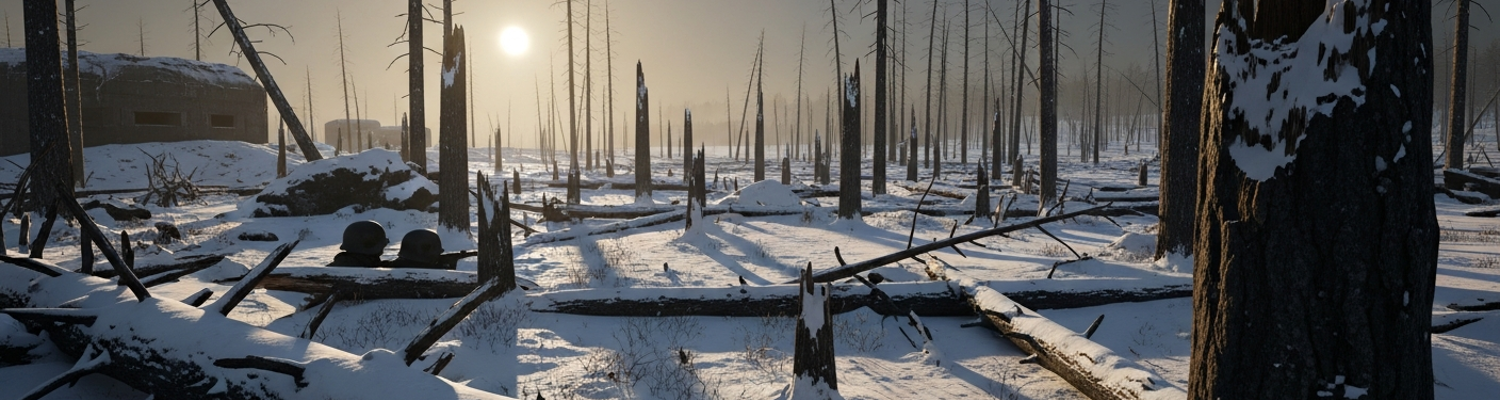
The autumn of 1944 presented American troops with a static, fortified battlefield. It was a landscape defined by interlocking fields of machine-gun fire from concrete pillboxes and the constant, unnerving threat of a single, unseen shot. A close review of operational logs from units entering the Hürtgen Forest and the approaches to Aachen (Record Group 407, National Archives) reveals an almost total lack of readiness for this environment. The US Army operated no formal sniper school during the Second World War. Any specialized training was an ad-hoc affair conducted in combat zones, a reactive measure to escalating casualties. The existing marksmanship program taught none of the skills required to fight a hidden enemy in a fortified position. Camouflage, stalking, terrain analysis, and the rapid identification of fleeting targets were absent from the training manuals.
Archival evidence shows American training instead emphasized rate of fire with the semi-automatic M1 Garand. The rifle was a masterpiece of engineering designed for volume, not surgical precision. There was no institutional knowledge for fighting in a landscape of dense woods and concrete bunkers where the enemy was invisible. This doctrinal void meant infantry companies were fed into the line without the specialized skills to counter an enemy who had spent years perfecting defensive warfare.
This training deficiency was compounded by a severe, systemic lack of specialized equipment. The United States entered the war without a dedicated sniper rifle in its inventory. The weapon eventually standardized in January 1943, the M1903A4 Springfield, was a stopgap measure. It was a modified version of the older M1903 bolt-action rifle, chosen because the top-loading en-bloc clip of the M1 Garand made fitting a scope difficult. The selected optic, a commercial Weaver 330C scope designated the M73B1, offered only a meager 2.5x magnification and was not designed for the rigors of military service. These rifles were not specially accurized with improved triggers or bedding. They were standard production rifles pulled from the line and fitted with a scope. Distribution was sparse. While over 28,000 were produced, they were not available in sufficient numbers for widespread issue. Many units entered the fight for the Siegfried Line with no specialized marksman rifles at all. Even binoculars were in short supply, denying infantrymen the basic ability to scan opposing ridgelines for enemy observers. The Army did not even commission optometrists as officers, a decision reflecting a systemic disregard for optical specialists within the military structure.
German sniper doctrine, heavily influenced by the fighting on the Eastern Front, was defensive and highly effective. German snipers were frequently veterans selected for their proven marksmanship and then sent to formal, multi-week training courses. There they mastered camouflage, fieldcraft, and range estimation. They were taught to operate as hunters, using patience and deception, firing a single shot before relocating. Their primary role was to eliminate key personnel. Officers, NCOs, and radio operators were priority targets, a method to destabilize the American command structure and sow psychological chaos. Intelligence reports from the US First and Ninth Armies show a command structure slow to grasp the scale of the problem. Initial casualties were often attributed to sporadic machine-gun fire or mortars. It took weeks of consistent losses among leaders for a clear pattern to emerge. American forces were being systematically targeted by highly trained marksmen occupying expertly prepared positions within the Westwall’s defenses. The tactical problem was not a few skilled individuals; it was an integrated part of the German defensive scheme, one the US Army had neither trained for nor equipped itself to fight.
Siegfried Line Sniper Engagements
The push toward the German frontier in late 1944 devolved into a meatgrinder. Against the deep, layered defenses of the Siegfried Line, American infantry divisions bled heavily. A close review of operational logs from the U.S. First Army in the sectors around Aachen and the Hürtgen Forest shows a disproportionate casualty rate among leaders. The 22nd Infantry Regiment, for example, saw the attrition among its rifle company leaders exceed 300 percent. In three days of fighting, it lost all three of its battalion commanders. These were not random losses. They were the methodical work of trained German marksmen. Total American casualties in the Hürtgen campaign alone would climb to 33,000. For every two yards the 22nd Infantry advanced, one soldier fell. The concrete pillboxes and dense woods provided German snipers with a near-perfect hunting ground, allowing them to slow the American advance, inflict maximum casualties, and disappear.
Facing a threat for which they had no formal doctrine, American units developed their own counter-sniper measures through bloody trial and error. Squads learned to stop reacting in predictable ways. Instead of a panicked rush for cover after a shot, which only presented more targets, veterans taught replacements to freeze and scan. Unofficial hunter-killer teams formed within rifle companies, often composed of just two men. One soldier would deliberately expose himself, sometimes by raising a helmet on a rifle, to draw fire. The other, positioned with binoculars or a precious scoped rifle, would search for the muzzle flash or a puff of smoke.
Other units turned to overwhelming firepower.
M8 Greyhound armored cars and M10 tank destroyers were brought up to blast suspected sniper hides in tree lines or church steeples with 37mm or 3-inch high-explosive shells. In some sectors, infantrymen learned to call in mortar fire not on specific targets, but on entire patches of woods suspected of concealing a shooter. These ad-hoc tactics were born of desperation and were often costly, but they represented a tactical evolution forced upon the American GI by the unseen enemy in the forest.
The psychological toll was unique. The constant threat of a single, invisible shot from an unknown location induced a specific form of combat stress. This was not the thunder of an artillery barrage, but a quiet, personal lethality that could arrive at any moment. This unseen pressure could paralyze entire platoons, making soldiers unwilling to cross a clearing or enter a village. Unit cohesion frayed as men became isolated by fear. The Army itself recognized that a soldier’s breaking point under such conditions could be reached in as little as 60 days. This pervasive dread had a direct impact on combat effectiveness. Advances stalled, patrols failed to gather intelligence, and supply lines were disrupted by the work of one or two skilled marksmen. The very landscape became an enemy. Every window, hedgerow, and dark patch of forest concealed a potential point of death. This state of constant, high-alert vigilance exhausted soldiers mentally and physically, contributing heavily to the 9,000 non-combat casualties from combat fatigue, pneumonia, and trench foot suffered during the Hürtgen campaign.
Equipment Delays and Desperate Tactics
The American response to the sniper threat was crippled from the start by a slow-moving, unresponsive bureaucracy. The U.S. Army Ordnance Department, focused on the mass production of standard-issue weapons like the M1 Garand, was ill-equipped to rapidly procure or develop specialized counter-sniper tools. Requests from the field for accurized rifles and high-powered optics were lost in a procurement system that had failed to anticipate the realities of fighting in fortified, static positions. The standardized sniper rifle, the M1903A4, was a stopgap based on an older design. The optic chosen, a commercial Weaver 330C designated the M73B1, was a sporting scope with only 2.5x magnification, not built for military use. These scopes were prone to fogging in humid conditions, lost their zero if bumped, and had adjustment screws that were easily damaged. There was no large-scale program to produce truly specialized equipment. Even basic items like high-power binoculars for spotting were in chronically short supply at the company level. This institutional inertia meant that by the time American divisions reached the Siegfried Line, they lacked the fundamental tools to effectively locate and engage an enemy who was systematically dismantling their command structure one rifle shot at a time.
This equipment deficiency translated directly into prolonged, bloody engagements. In the dense Hürtgen Forest, a single German sniper could pin down an entire platoon for hours. For units like the 28th Infantry Division, fighting around Schmidt and Vossenack in November 1944, the battlefield was a series of deadly puzzles with no easy solution. Lacking adequate spotting scopes, a squad under fire had no effective means to locate the sniper’s hide. The only M1903A4 rifle in the company might be with a different platoon miles away, or the soldier carrying it may have had no specialized training in its use. The grim alternative was to call for overwhelming firepower. Field reports detail infantry units resorting to firing hundreds of rounds of machine-gun ammunition or calling in 60mm mortar barrages on entire patches of woods just to suppress a single shooter. In the urban fighting for Aachen, M10 tank destroyers were used to level structures to eliminate a single threat. These tactics were hugely inefficient, wasted precious ammunition, and frequently exposed radiomen and other key personnel to even greater risk as they coordinated the fire support. Each engagement became a slow, grinding affair of attrition, bleeding American units of men, materiel, and morale.
The tactical impotence bred by equipment shortages and the constant psychological pressure fostered a brutal, unofficial policy among frontline troops. Archival evidence contains no formal orders from high command regarding captured snipers. Instead, a consensus emerged at the platoon and squad level.
Snipers were not to be taken alive.
They were seen as assassins who operated outside the perceived rules of conventional combat by targeting leaders and medics. Veteran accounts and field reports allude to a grim, unwritten protocol where captured snipers were reported as shot while attempting to escape or simply disappeared after being taken into custody. This retaliatory violence was a direct consequence of the frustration and helplessness felt by soldiers who lacked the proper tools to fight back effectively. Unable to win the duel on tactical terms with superior marksmanship or optics, the American infantryman’s only recourse was often a final, absolute act of battlefield retribution.
Tactical Escalation’s Strategic Impact
A review of operational logs from the First US Army in the autumn of 1944 reveals a consistent and strategically costly pattern. A single German sniper, operating from a concealed position in the Hürtgen Forest, could force a disproportionate American response that bled resources intended for offensive operations. The tactical problem of one rifleman was answered with a strategic expenditure of heavy assets. Infantry companies, pinned by an unseen shooter and lacking their own specialized optics or rifles, had no choice but to call for support far exceeding the threat. M10 tank destroyers, designed for ambushing panzer columns, were pulled from their primary anti-armor role to blast individual buildings or tree lines with their 3-inch high-explosive shells. Entire batteries of 81mm mortars would be tasked to saturate a small patch of woods suspected of hiding a marksman. This diversion was not a planned use of combined arms. It was a reactive, inefficient, and expensive tactic born of necessity. It pulled key assets away from the main effort of breaking the Siegfried Line’s concrete fortifications and blunted the spearhead of the American advance.
This was not sustainable.
The persistent sniper threat fundamentally altered the operational tempo of the entire campaign. The advance to the German border had already stretched Allied logistics to the breaking point. The systematic targeting of key personnel along these fragile supply lines created a cascading series of delays. A single sniper overlooking a critical road junction could interdict traffic for hours, stopping the flow of ammunition, fuel, and medical supplies to forward units. Jeep drivers, combat engineers repairing roads, and runners carrying messages became priority targets. The effect was a slow strangulation of frontline units. Company and battalion-level attacks, scheduled to begin at a specific hour, were frequently postponed because essential supplies had been held up or because the unit’s command structure had been disrupted by the loss of an officer or NCO just prior to jumping off. These localized delays, accumulating across the entire front, wrecked division and corps-level operational timelines. The broad-front strategy depended on continuous, simultaneous pressure, but the German sniper campaign introduced a friction that slowed movement to a crawl, turning what was intended to be a rapid push to the Roer River into a static battle of attrition.
German commanders systematically exploited the doctrinal and equipment weaknesses they observed in the American forces. Having honed their defensive sniper tactics on the Eastern Front, they recognized the American Army’s lack of institutional preparation. German doctrine, formalized in training schools, instructed snipers to function as hunters whose primary purpose was to destabilize the enemy by eliminating key personnel. They were not deployed randomly. They were carefully integrated into the defensive scheme of the Westwall, placed in positions that offered clear fields of fire into likely American command posts, observation points, and supply routes. These marksmen were taught to identify the subtle visual cues of leadership: an officer pointing, a radioman with his distinctive antenna, a sergeant directing a machine-gun crew. Their patient, single-shot-and-relocate tactic was a direct counter to the American emphasis on volume of fire and was designed to sow maximum chaos with minimum risk, turning the American command-and-control advantage into a vulnerability.
Post-War Accountability and Military Justice
The end of hostilities did not end the questions raised by the fighting along the Westwall. A review of post-war military legal proceedings shows a concerted effort to formally address violations of the laws of war, establishing a top-down framework of accountability. High-profile American military tribunals held at Dachau prosecuted German officers for a range of offenses. The trial of United States of America v. Kurt Andrae, Richard-Heinrich Buehring, et al., for instance, saw defendants charged with a violation of the laws and usages of war for atrocities committed at the Nordhausen concentration camp complex. While these major trials focused on systematic crimes, such as the Malmedy Massacre trial which prosecuted Joachim Peiper and members of the 1st SS Panzer Division, they created a legal atmosphere where the conduct of all soldiers came under scrutiny. The principle of command responsibility, firmly established in cases against figures like SS-General Sepp Dietrich, meant that officers could be held accountable for the actions of their troops. This formal legal reckoning stood in sharp contrast to the unwritten, bottom-up policies that had been practiced by American infantry against German snipers.
Within military legal circles, this created a complex debate. There was no formal sanction for the summary execution of captured snipers, an act that was, by the letter of the 1929 Geneva Convention, illegal. Yet, archival records and veteran testimony make it clear the practice was widespread. Military courts had to grapple with the defense of extreme duress. Arguments were made that the German sniper was not a conventional soldier but an assassin who deliberately targeted leaders and medics to sow terror. The defense posited that the intense psychological pressure and the inability to effectively counter the sniper threat with available equipment created conditions where soldiers felt retaliation was their only recourse. Prosecutors, however, were bound to uphold the law of armed conflict. That law made no distinction for a sniper’s effectiveness or their perceived fairness as a combatant; a uniformed soldier of a signatory nation was entitled to protection as a prisoner of war.
The experiences along the Siegfried Line directly informed a generation of military planners and lawyers. A review of the development of U.S. military doctrine in the decades following the war shows a clear trend towards providing soldiers with better options than illegal reprisals. This led to the formalization of Rules of Engagement (ROE), a concept that became far more detailed and widely disseminated during the Cold War. While the first comprehensive peacetime ROE for all U.S. forces were issued by the Joint Chiefs of Staff in 1986, the groundwork was laid by analyzing the failures of World War II. The unwritten rules of the Westwall demonstrated a critical doctrinal void. If soldiers lacked the training and equipment for effective counter-sniper tactics, they would invent their own, often brutal, solutions. Post-war reforms emphasized dedicated counter-sniper training, the development and issuance of superior optics and accurized rifles (like the M21 and M24 Sniper Weapon Systems), and clear directives on the use of proportional force. The goal was to give a squad leader pinned down by a sniper a set of effective, legal responses so that a policy born of desperation would never again become the default tactical choice.