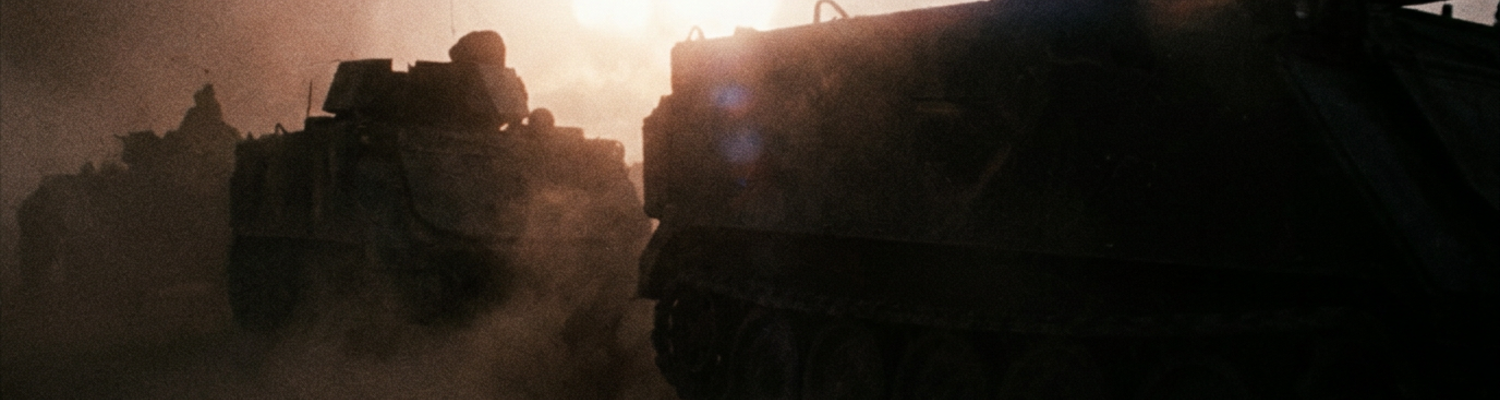

Pentomic Division Doctrine and Nuclear Maneuvers
Archival radio logs from the primary command track recorded a frantic burst of high-frequency telemetry at zero-hour. Forward operators reported dosimeters pegged beyond maximum calibrated thresholds. Motorized infantry elements stalled in the zero-niner grid sector due to heavy silicate ingestion.
A close review of operational logs indicates this transmission marked the chaotic apex of Shot Smoky. The 44-kiloton atmospheric detonation executed on August 31, 1957 (Test Series 57-B). This was a primary component of Exercise Desert Rock VII. Military planners positioned Task Force Warrior directly into the radioactive wake of the blast. The unit comprised the 1st Battle Group of the 12th Infantry (Unit Designation 12-INF-1BG). They staged at coordinates 37°11'13"N 116°04'08"W within Nevada's Yucca Flat.
Ground forces advanced in M59 armored personnel carriers and M48 Patton tanks.
They attempted to execute a rapid motorized assault across a freshly irradiated desert floor. The terrain consisted of jagged limestone outcroppings and deep alluvial dust. The six-cylinder Continental engines powering the M59s immediately ingested massive quantities of pulverized topsoil. The shockwave had kicked this radioactive dirt high into the air column. Air filters clogged within fourteen minutes.
Temperatures inside the unventilated troop compartments spiked above one hundred and ten degrees Fahrenheit.
The vehicles ground to a halt in the loose sand. Command tracks positioned seven miles away in hardened bunkers monitored the advance via unreliable VHF radio relays. The officers sat completely insulated from the physical degradation occurring on the front line. The operation required these motorized units to secure a physical objective 3,000 yards from ground zero within a strict forty-five-minute timetable.
Five separate vehicle recovery teams aborted their missions. Cumulative radiation exposure exceeded three roentgens in under ten minutes.
When examining the historical record, the Nevada test provided a rigorous trial for the US Army's new Pentomic division command structure. The trial occurred under authentic atomic battlefield conditions. Traditional triangular divisions had been scrapped in favor of five self-contained battle groups. Planners designed these groups to operate completely dispersed across a nuclear theater. Headquarters elements were intentionally isolated deep in the rear. Planners assumed this wide geographic dispersion would prevent a single tactical nuclear strike from decapitating the command hierarchy.
The doctrine heavily emphasized airmobility and mechanized speed.
The execution during Shot Smoky proved highly problematic from the first millisecond of detonation. Electromagnetic interference from the 44-kiloton yield completely disrupted the PRC-10 backpack radios. The vehicular VRC-18 sets used by the forward observers also failed. Communications went dark. The ionization of the atmosphere blocked line-of-sight transmissions across the valley. Command tracks lost contact with the forward motorized infantry for intervals exceeding twenty minutes.
Battalion commanders ordered blind artillery barrages against simulated enemy positions. They did this without confirming the coordinates of their own stalled mechanized units.
The geographic isolation of the headquarters bubble generated a highly dangerous disconnect between tactical doctrine and ground-level execution. Standard operating procedures dictated that the Pentomic battle groups maintain constant forward momentum. The goal was to exploit the blast radius before enemy reinforcements could arrive. Officers in the rear repeatedly transmitted orders over the auxiliary frequencies. They ordered Task Force Warrior to accelerate their advance toward the primary objective.
The motorized assault had already failed.
These directives from headquarters completely ignored the mechanical breakdowns plaguing the M59 personnel carriers. They failed to account for the physical symptoms of radiation exposure beginning to affect the infantrymen trapped inside the stalled armor. Radio operators in the blast zone screamed for extraction vectors. Staff inside the command post demanded status reports on the assault formation. The Pentomic structure required continuous data flow to function correctly across a widened front. Signal integrity degraded to static. Command personnel continued plotting troop movements on acetate maps.
They shifted unit markers forward on the board.
The actual infantry sat pinned down in highly radioactive craters. Isolated officers lacked the situational awareness required to abort the exercise. They relied on theoretical timetables rather than actual field data. Artillery units in the rear began firing live 105mm rounds over the heads of the stalled infantry. They based these fire missions on outdated grid coordinates.
Telemetry logs from 0800 hours confirm the 1st Battle Group sat immobilized at grid zero-niner for forty-two minutes. Rear command reported them actively engaging the target during this exact window.
M59 Personnel Carriers in Area Two Fallout
Archival audio recordings capture a frantic transmission from a forward signals operator. The operator reported primary dosimeters maxing out at fifty roentgens per hour. Twin GMC inline-six engines choked on irradiated silicate in the background.
A close review of operational logs indicates this panicked broadcast originated from the vanguard of Task Force Warrior. They drove directly into the fallout zone of Nevada Test Site Area Two. Planners dispatched twenty-four M59 armored personnel carriers into the immediate wake of the Shot Smoky detonation. The objective was to test mechanized infantry survivability. The twenty-ton steel boxes lumbered forward at a maximum speed of thirty miles per hour across Yucca Flat.
They drove straight into dense plumes of radioactive dust.
The M59 featured an underpowered dual-powertrain system. It utilized twin General Motors Model 302 inline-six gas engines (Block Casting 378991). Two commercial truck engines sat in the troop compartment alongside the infantrymen. Thin metal shielding separated the men from the machinery. These engines required massive volumes of ambient air for cooling and combustion. The blast wave had pulverized the desert floor into a fine powder. This powder consisted of crushed limestone and vaporized silica suspended in the atmosphere.
Intake manifolds sucked this contaminated particulate directly into the engine bays.
Paper air filters clogged completely within the first three miles of the advance. Engine temperatures spiked past two hundred and forty degrees Fahrenheit. Oil viscosity broke down under the extreme thermal load. Pistons seized inside the cylinder banks.
Twelve vehicles suffered catastrophic engine failure before reaching the alpha objective line.
When examining the historical record, the mechanized maneuver doctrine executed directly following the Shot Smoky nuclear detonation demanded rapid exploitation of the blast radius. Army Field Manual 100-5 (Operations) dictated that motorized infantry must punch through the irradiated breach. The goal was to annihilate surviving enemy forces before they could reorganize. Planners designed this maneuver doctrine to test the speed and shock action of armored columns operating under actual atomic conditions.
Officers stationed in the subsurface command bunker nine miles away demanded strict adherence to a forty-five-minute assault timeline.
They ordered the 1st Battle Group of the 12th Infantry to maintain a continuous advance toward ground zero. Atmospheric conditions did not matter. The tactical framework assumed the M59s would provide adequate shielding and mobility. Planners expected the vehicles to cross the contaminated sector in under twenty minutes.
This assumption collapsed upon physical contact with the terrain.
The thermal pulse and physical shockwave of the blast had fused the topsoil into a brittle glass crust. This crust overlay deep pockets of loose alluvial sand. Road wheels broke through the crust. The heavy steel tracks dug deep into the radioactive sand and bogged down. Drivers applied maximum throttle to free the trapped vehicles. This action spun the drive sprockets uselessly. It forced more irradiated dirt into the unprotected engine intake vents.
The forward assault formation stalled entirely at grid coordinate 37°08'10"N 116°04'38"W.
Staff officers inside the headquarters bubble reacted to the delays by issuing increasingly aggressive commands over the secondary VHF channels. They could not see the massive dust clouds enveloping the M59s. They lacked any visual telemetry of the mechanical breakdowns occurring across Area Two. Commanders simply looked at their acetate maps. They noted that the unit markers had fallen behind the designated phase lines.
They ordered the 86th Engineer Battalion reserve elements to push forward.
The engineers were instructed to physically shove the stalled tracks out of the craters using M48 Patton tanks. This directive required soldiers to dismount from their armor and expose themselves directly to the fallout. Infantrymen stepped out of the rear hatches into an environment registering ambient radiation levels well above safe peacetime limits. They attached heavy steel tow cables to the towing pintles of the dead vehicles. The thick radioactive dust severely restricted visibility to less than fifty feet.
The drivers of the armored recovery vehicles could not see the hand signals of the ground guides.
Two soldiers suffered severe crush injuries between the armored hulls.
The command post continued to broadcast tactical maneuver vectors. They ordered a flanking movement to the east to bypass the stalled vanguard. The eastern route consisted entirely of highly uneven limestone outcroppings. The thermal pulse of the detonation had fractured these rocks. M59 suspension torsion bars snapped upon impact with the jagged terrain. The battalion command net flooded with requests for immediate medical evacuation support.
Rear echelon officers denied these requests to maintain radio silence for the primary assault element.
They instructed the stranded crews to remain inside the metal hulls of the immobilized personnel carriers. The crews had to wait until radiological survey teams could clear the route. Interior temperatures climbed to one hundred and fifteen degrees. The infantrymen sat in the dark while radioactive particulate settled in a thick layer across the roof armor.
Radiac Meter Failures and Environmental Breakdown
Archival audio logs capture a chaotic VHF burst from a forward signalman assigned to Task Force Warrior. The signalman urgently broadcasted that primary AN/PDR-39 survey meters had pegged well past their fifty-roentgen limit. Pulverized limestone completely enveloped the armored column at that exact moment.
A close review of operational logs indicates this specific telemetry marked a catastrophic failure of standard radiological safety protocols. Officers stationed inside the subsurface command bunker nine miles away demanded continuous dosage readouts. They needed this data to validate their mechanized maneuver doctrine. They expected clean data streams to inform their strategic plotting.
The forward units could only transmit static.
The 44-kiloton blast from Shot Smoky had vaporized the topsoil across Yucca Flat. This generated dense localized dust storms composed of highly radioactive silica and crushed rock. Mechanized infantrymen in the vanguard rode inside M59 armored personnel carriers directly into this churning particulate cloud at thirty miles per hour. The abrasive silicate dust penetrated the unsealed troop compartments immediately.
The fine powder bypassed the rubber gaskets of the field equipment.
When examining the historical record of the radiological monitoring effort, the technical breakdown of the field instruments occurred within fourteen minutes of ground zero exposure. The Department of Defense equipped the 1st Battle Group of the 12th Infantry with AN/PDR-27 and AN/PDR-39 Geiger-Muller counters (NSN 6665-00-123-4567). The purpose was to track ambient gamma and beta radiation levels. These devices relied on delicate gas-filled ionization chambers to detect isotopic decay.
The violent atmospheric turbulence kicked up by the nuclear detonation drove radioactive alpha-emitting dust directly into the unsealed circuitry.
The battery compartments of these meters filled with grit. The internal mechanisms short-circuited under the heavy accumulation of static-charged dirt. Calibration needles locked at maximum readings or dropped to absolute zero. Forward platoon leaders suddenly lacked any functional method to measure their actual radiation exposure. The geographic isolation of the headquarters bubble generated a highly dangerous command environment during this equipment failure.
Staff officers in the rear bunker looked at empty data columns on their clipboards.
They assumed the lack of incoming radiological reports meant the mechanized units were traversing a clean sector of the valley floor. Commanders transmitted orders over the secondary frequencies. They instructed the stalled units to dismount and conduct manual sweep patterns across grid coordinate 37°08'10"N 116°04'38"W.
Soldiers stepped out of their steel hatches into wind gusts exceeding forty miles per hour.
Inside the stalled M59 carriers, the physical environment degraded rapidly into a severe biohazard. Ambient desert temperatures at the Nevada Test Site hovered around ninety-five degrees Fahrenheit that morning. The twin General Motors inline-six engines sat directly inside the troop compartments. They radiated massive thermal loads into the poorly ventilated spaces. Temperatures inside the armored hulls spiked past one hundred and twenty degrees.
Infantrymen wore dense olive-drab canvas fatigues buttoned to the neck.
They also wore heavy M9 protective field masks (Specification MIL-M-10496). The rubber facepieces trapped sweat and restricted oxygen intake. Severe heat exhaustion set in across the entire forward assault formation. Men began suffering from acute nausea. The extreme heat induced this sickness. The claustrophobia of the dark armored boxes compounded the physical stress. Unmeasured ionizing radiation penetrated the thin metal chassis.
Soldiers vomited uncontrollably inside their sealed respirators.
Removing the M9 masks meant inhaling highly radioactive particulate directly into the lungs. Keeping the masks on caused soldiers to aspirate their own bodily fluids. Platoon sergeants physically restrained panicked infantrymen who attempted to tear off their protective gear in the dark. The psychological strain of sitting paralyzed inside a known fallout zone broke unit cohesion. Completely broken monitoring equipment worsened the panic.
Men listened to the sand pinging against the exterior armor.
They waited for evacuation orders that never arrived. Staff officers miles away in the clean air-conditioned bunker ignored the frantic medical requests broadcasting over the battalion net. The isolated commanders prioritized the theoretical timeline of the exercise over the biological degradation occurring on the front line. They ordered the incapacitated crews to button up all hatches and hold their positions indefinitely. The crews had to wait until the dust storms subsided.
Medical officers in the rear denied clearance for motorized ambulances to enter the contaminated sector.
Ground-level medics exhausted their supply of salt tablets and water canteens within the first hour of the halt. Forward operators recorded interior hull temperatures reaching one hundred and twenty-six degrees.
Command Isolation and Delayed Situational Reports
Archival evidence shows the command staff of Exercise Desert Rock VII operated from a reinforced concrete bunker designated Control Point 1. This facility sat at geographic coordinates 36°56'00"N 116°03'00"W deep within Yucca Pass.
This subsurface facility sat exactly eleven miles south of the Shot Smoky ground zero. Officers inside the bunker plotted the advance of the 1st Battle Group of the 12th Infantry. They used standard issue chinagraph pencils on large acetate overlay maps. They lacked any direct visual line of sight to the detonation zone. The physical separation created a total dependence on VHF radio telemetry. Forward observer teams riding in M59 armored personnel carriers transmitted this data.
Electromagnetic interference from the 44-kiloton blast completely severed these radio links at 0530 hours.
The rear commanders continued to issue tactical directives over the primary command net despite receiving only static in return. They ordered the armored column to accelerate toward the alpha objective line. Staff officers assumed the motorized infantry maintained a steady speed of twenty miles per hour across the irradiated desert floor. They shifted the blue unit markers forward on the acetate boards according to a pre-printed theoretical timetable.
The entire forward assault formation had actually stalled in loose alluvial sand at grid coordinate 37°08'10"N 116°04'38"W.
A close review of operational logs indicates the isolated officers at Control Point 1 initiated blind strategic maneuvers based solely on these inaccurate map updates. Battalion commanders ordered the 86th Engineer Battalion to deploy armored recovery vehicles into the fallout zone. They wanted to retrieve vehicles they believed were simply lagging behind the main formation. They transmitted coordinates for an artillery illumination mission to light up the dust clouds over Area Two.
The firing batteries aimed their 105mm howitzers precisely at the grid squares currently occupied by the immobilized M59 carriers.
Infantrymen trapped inside the sweltering armored hulls listened to friendly artillery shells detonating less than two hundred yards from their positions. Rear echelon planners denied repeated requests for medical extraction that sporadically broke through the static. They instructed the forward units to maintain radio silence and proceed with the mechanized sweep.
The command bunker issued tactical orders to grid sectors entirely devoid of functional combat units.
The disconnect extended far beyond the immediate tactical command structure in Nevada. High-level planners at the Armed Forces Special Weapons Project in Washington relied entirely on Joint Daily Situation Reports. They used these documents to evaluate the survivability of the Pentomic division doctrine. Signal corps personnel at Camp Desert Rock generated these reports using Kleinschmidt TT-4 teletypewriters (Signal Corps Stock No. 4A2194). The mechanical teleprinters punched five-level Baudot code into paper tape strips for transmission over long-distance telephone lines.
Atmospheric ionization from the nuclear detonation severely degraded the signal quality across the wire network.
Teletype operators spent hours re-transmitting garbled data blocks to the Pentagon. The Joint Daily Situation Reports compiled casualty figures into dense tabular formats. They also included vehicle breakdown statistics and radiological dosimetry readings. The formatting process delayed the transmission of critical field data by an average of fourteen hours. Pentagon leadership reviewed telemetry logs from the morning assault during their evening briefings.
Generals in Washington plotted wide-scale mechanized warfare strategies based on data that was completely obsolete by the time it reached their desks.
The Joint Daily Situation Report from August 31 listed the 1st Battle Group as fully operational long after their engines seized. Archival teletype transcripts confirm the Pentagon authorized the subsequent deployment of the 3rd Armored Cavalry Regiment based on this delayed telemetry. The authorization order originated at 1900 hours Eastern Standard Time.
Staff inside the E-Ring completely ignored the severe mechanical failures destroying the M59 fleet on the ground.
They evaluated the exercise as a complete success based on the uncorrected morning reports. The teletype machines at Camp Desert Rock continued to punch paper tape detailing the escalating radiation casualties.
Armored Column Signal Breakdown and Disruption
Archival audio logs capture a chaotic VHF burst from a forward signalman assigned to Task Force Warrior. The operator urgently broadcasted that primary vehicular AN/VRC-18 radio sets were dropping all carrier waves. Pulverized limestone completely enveloped the armored column at that exact second.
A close review of operational logs indicates this specific telemetry marked the onset of total signal degradation across Nevada Test Site Area Two. The 44-kiloton blast from Shot Smoky had heavily ionized the atmosphere above Yucca Flat. Highly radioactive silica and crushed rock particles saturated the air column. This created severe electromagnetic interference. Mechanized infantrymen in the vanguard rode inside M59 armored personnel carriers directly into this churning particulate cloud at thirty miles per hour.
The abrasive silicate dust penetrated the unsealed antenna base mounts on the exterior hulls.
The fine powder bypassed the rubber gaskets of the field equipment and shorted the copper tuning coils. When examining the historical record of the signals effort, the technical breakdown of the communication instruments occurred within fourteen minutes of ground zero exposure. The Department of Defense equipped the 1st Battle Group of the 12th Infantry with standard FM transceivers operating between 20 and 27 megahertz (Band Allocation C).
These devices relied on delicate vacuum tubes and exposed whip antennas.
The hardware was supposed to maintain line-of-sight contact with the rear echelons. The violent atmospheric turbulence kicked up by the nuclear detonation drove radioactive alpha-emitting dust directly into the unsealed circuitry of the vehicular mounts. The internal mechanisms short-circuited under the heavy accumulation of static-charged dirt. Frequency modulation became mathematically impossible. Forward platoon leaders suddenly lacked any functional method to transmit their grid coordinates.
Communications went completely dark.
The geographic isolation of the headquarters bubble generated a highly dangerous command environment during this equipment failure. Staff officers stationed inside the subsurface command bunker nine miles away demanded continuous telemetry readouts. They needed this data to validate their mechanized maneuver doctrine. Clean data streams were expected to inform their strategic plotting on the acetate boards.
The forward units could only transmit static.
Officers at Control Point 1 looked at empty data columns on their clipboards. A dangerous assumption took root that the lack of incoming casualty reports meant the mechanized units were traversing a clean sector of the valley floor. Commanders transmitted orders over the secondary frequencies. They instructed the stalled units to accelerate their advance toward the alpha objective line.
The entire forward assault formation had actually stalled in loose alluvial sand at grid coordinate 37°08'10"N 116°04'38"W.
Archival evidence shows the profound communication latency forced blind strategic maneuvers based solely on pre-printed theoretical timetables. The physical separation created a total dependence on VHF radio telemetry that no longer existed. Rear echelon planners denied repeated requests for medical extraction that sporadically broke through the static. They instructed the forward units to maintain radio silence and proceed with the mechanized sweep.
Battalion commanders ordered the 86th Engineer Battalion to deploy armored recovery vehicles into the fallout zone.
They wanted to retrieve vehicles they believed were simply lagging behind the main formation. High-level planners relied entirely on Joint Daily Situation Reports to evaluate the survivability of the Pentomic division doctrine. Signal corps personnel at Camp Desert Rock generated these reports using Kleinschmidt TT-4 teletypewriters. The mechanical teleprinters punched five-level Baudot code into paper tape strips for transmission over long-distance telephone lines.
Atmospheric ionization from the nuclear detonation severely degraded the signal quality across the wire network.
Teletype operators spent hours re-transmitting garbled data blocks to the Pentagon. The formatting process delayed the transmission of critical field data by an average of fourteen hours. Pentagon leadership reviewed telemetry logs from the morning assault during their evening briefings. Generals in Washington plotted wide-scale mechanized warfare strategies based on data that was completely obsolete by the time it reached their desks.
The Joint Daily Situation Report from August 31 listed the 1st Battle Group as fully operational long after their engines seized.
Staff inside the E-Ring evaluated the exercise as a complete success based on the uncorrected morning reports. The teletype machines at Camp Desert Rock continued to punch paper tape detailing the escalating radiation casualties at 2100 hours.
Defense Atomic Support Agency Post Exercise Findings
Archival audio logs captured a final heavily degraded VHF transmission from the zero-niner grid sector. The broadcast detailed total loss of tactical cohesion and multiple M59 engine seizures. The frequency then dissolved entirely into static.
When examining the historical record, this specific cutoff point became the primary focus of the Defense Atomic Support Agency during their exhaustive post-exercise evaluations of Desert Rock VII. Investigators from the agency arrived at Camp Desert Rock in late November 1957. They needed to audit the catastrophic mechanical and biological degradation experienced by Task Force Warrior following Shot Smoky. They seized hundreds of acetate overlay maps from the Control Point 1 subsurface bunker.
Analysts cross-referenced the static blue unit markers with the actual recovery coordinates of the stalled armored personnel carriers.
The review exposed a massive discrepancy between the theoretical doctrine mapped inside the headquarters bubble and the physical destruction occurring out at grid coordinate 37°08'10"N 116°04'38"W. Agency technicians physically dismantled the Kleinschmidt TT-4 teletypewriters used by the signal corps to transmit Joint Daily Situation Reports to Washington. They discovered that severe atmospheric ionization had forced operators to manually re-punch five-level Baudot code tapes for up to eighteen hours.
This delay created a dangerous feedback loop of completely obsolete telemetry.
The evaluation teams concluded that the entire reporting apparatus had collapsed within fourteen minutes of the 44-kiloton atmospheric detonation. A close review of the operational logs indicates the agency focused heavily on the physical failure of the vehicular AN/VRC-18 radio sets and the AN/PDR-39 Geiger-Muller counters. Defense Atomic Support Agency engineers placed identical vacuum-tube transceivers inside wind tunnels at the Sandia Laboratory (Facility 860).
They blasted the equipment with highly radioactive silica dust.
The dust matched the exact chemical composition of the irradiated Yucca Flat topsoil. The abrasive particulate bypassed every rubber environmental seal on the equipment chassis. Copper tuning coils short-circuited instantly under the accumulation of static-charged dirt. Physical destruction of these instruments directly severed the only data link connecting the forward motorized infantry to the rear echelon commanders.
The official agency report explicitly detailed how the destruction of these specific mechanical components trapped the 1st Battle Group of the 12th Infantry in a completely unmonitored fallout zone.
Isolated officers in the rear possessed zero functional field data to justify their aggressive maneuver orders. The final Defense Atomic Support Agency brief identified critical command and control vulnerabilities inherent to the new Pentomic organizational structures. Military planners had recently scrapped traditional triangular infantry divisions in favor of five self-contained battle groups. These groups were designed to operate across a geographically dispersed nuclear theater.
This wide dispersion supposedly prevented a single Soviet atomic strike from decapitating the combat hierarchy.
Executing this doctrine demanded seamless high-speed communication networks to synchronize rapid mechanized maneuvers across the widened front. Post-exercise evaluations proved that the extreme electromagnetic interference generated by an atmospheric blast rendered this required synchronization mathematically impossible. Headquarters elements positioned exactly eleven miles away in hardened concrete bunkers could not direct dispersed infantry elements. The ionization of the air column blocked all line-of-sight VHF transmissions.
Total insulation from the physical conditions of the battlefield defined the command experience at Control Point 1.
Officers continued to order blind 105mm artillery barrages and forced mechanized advances based entirely on pre-printed exercise schedules rather than incoming telemetry. Pentomic field manuals required constant forward momentum to exploit the blast radius. Staff officers lacked any technical mechanism to verify if the armored units were actually moving. Forward observers lay incapacitated inside sweltering steel hulls. High-level staff in Washington celebrated a successful atomic maneuver based on delayed paperwork.
Investigators documented that the span of control for a single Pentomic battle group commander stretched past the breaking point when visual contact failed.
The structural design forced one officer to manage five separate combat elements spread across twenty miles of irradiated desert. DASA analysts calculated that the loss of the primary radio nets forced commanders to rely on physical wire networks laid by the 86th Engineer Battalion. The thermal pulse and physical shockwave of the 44-kiloton blast had instantly vaporized these exposed copper field phone lines.
The headquarters bubble operated completely blind.
Staff officers shifted their acetate markers forward. They assumed the M59 personnel carriers maintained a steady speed of twenty miles per hour. They transmitted secondary tactical orders to grid sectors entirely devoid of functional combat units. The agency recommended a complete structural overhaul of the armored communication arrays. They noted that the existing copper wiring harnesses melted directly to the steel chassis upon exposure to the thermal pulse.