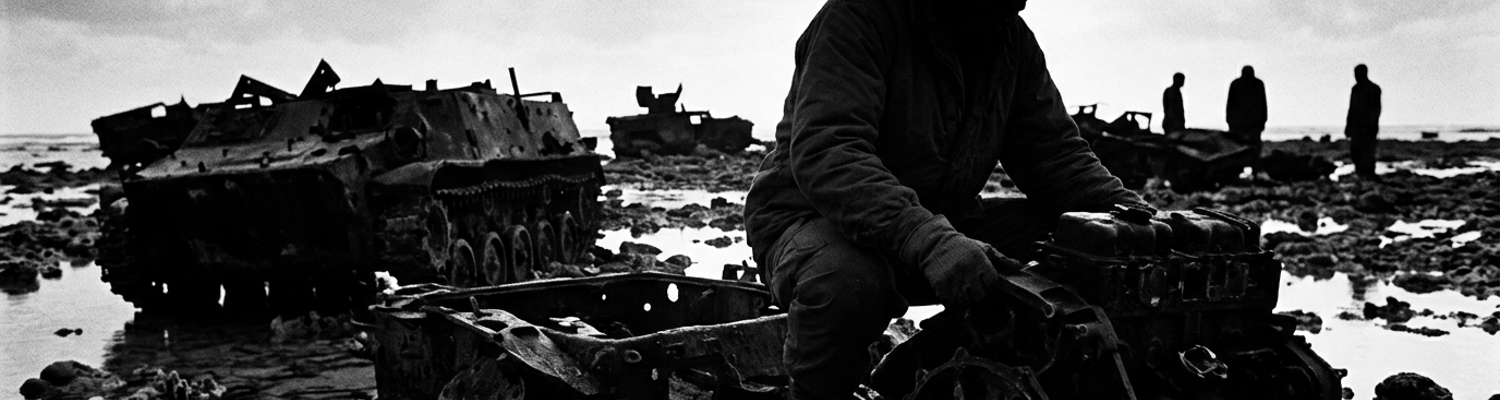

Immediate Aftermath on Betio Reef
DATE: 23 November 1943. TIME: 1330 HOURS. COORDINATES: 1 21 17 N 172 55 58 E.
The assault on Betio Reef at Tarawa Atoll left the northern shoreline covered in damaged combat equipment. Archival evidence shows the sheer volume of wrecked armor and transport vehicles created artificial breakwaters along the sectors designated Red Beach 1, 2, and 3. Dozens of LVT-1 and LVT-2 amphibious tractors sat immobilized atop the fringing coral shelf. They were victims of an unpredictable neap tide that stranded them hundreds of yards from the sand.
Declassified unit diaries reveal Japanese 47mm antitank gun fire had systematically punched through the unarmored lower hulls of these landing craft.
Seawater immediately flooded the exposed engine compartments. The Hercules WXLC-3 six-cylinder engines and Borg-Warner transmissions began rapidly oxidizing within hours of exposure to the highly saline Pacific waters. Salvage crews walking the reef at low tide documented thrown continuous-chain tracks, shattered drive sprockets, and broken suspension bogies (NARA Record Group 127). Infantry gear fared no better across the contested beachhead. M1 Garand rifles and M1928A1 Thompson submachine guns lay half-buried in the crushed coral sand. Their receivers locked solid by the abrasive particulate.
Radiomen abandoned ruined SCR-300 backpack transceivers. Saltwater shorted the internal vacuum tubes and corroded the copper wiring harnesses.
The invasion debris field stretched for two miles along the lagoon side of the atoll.
Securing this chaotic perimeter fell to the 18th Marine Engineers and attached Seabee detachments during the quiet hours directly following the cessation of organized enemy resistance. The 18th Naval Construction Battalion landed with heavy earthmoving equipment and began operations while isolated sniper fire still cracked over the beachhead.
Men operated International Harvester TD-18 bulldozers to clear lanes through the wrecked LVTs.
Operators dragged destroyed Japanese Type 95 Ha-Go tanks into defensive perimeters to create improvised steel revetments. Combat engineers laid concertina wire across the seaward approaches and hastily repaired the captured Japanese airstrip. This runway required immediate grading to fill deep naval artillery craters. Seabees hauled loose coral sand in dump trucks. They packed it down firmly under the heavy steel treads of their tractors.
Mechanics from the motor transport pools set up open-air triage stations directly on the sand. These technicians stripped usable alternators, drive shafts, and track links from the destroyed water buffaloes. They kept a handful of surviving vehicles running for perimeter patrols.
Every recovered bolt and firing pin was cataloged in damp field notebooks.
Nightfall brought a drop in temperature and an intense focus on immediate salvage operations within the newly captured trench networks. Engineers drained contaminated oil from half-submerged Sherman M4A2 medium tanks belonging to the 2nd Tank Battalion. Mechanics replaced fouled spark plugs and cleaned out carburetors using aviation fuel siphoned from wrecked Japanese Zero fighter planes found near the runway.
The post-climax hours required continuous labor to establish a defensible line against potential night counterattacks.
No high-level strategy dictated these ground-level actions. Sergeants and corporals made localized decisions based entirely on the availability of functional tools and dry ammunition. Marine riflemen sat in the captured trenches. They field-stripped their jammed weapons in the dark. Survivors swapped out bent operating rods and cracked bolt carrier groups from the rifles of casualties. They reassembled functional firearms by touch.
Trench sand mixed with spilled gun oil to form a thick grinding paste inside the weapon mechanisms.
Armorers collected discarded ordnance from the shallow water along the reef line before the tide could rise again. Working parties piled the waterlogged Browning Automatic Rifles and M1911 sidearms onto stretched canvas ponchos. Field expedient maintenance involved boiling the rusted weapon components in steel helmets over open fires. This process dissolved the accumulated salt deposits before armorers applied heavy coats of Cosmoline to prevent further oxidation.
Saltwater Corrosion and Rapid Gear Degradation
Post-action reports detail the 2nd Marine Regiment encountered catastrophic equipment failures before they even reached the high-water mark on Red Beach 1. Infantrymen disembarking from grounded LCVP Higgins boats waded through 500 yards of chest deep Pacific water. This prolonged submersion compromised the crew-served weapons. The Browning M1919A4 .30 caliber medium machine guns carried by the weapons platoons failed completely.
Severe saltwater exposure locked Browning M1919 slide groups within hours of landing on the reef.
The chemical reaction between the warm seawater and the parkerized steel components triggered rapid oxidation inside the receiver casings. The tight mechanical tolerances between the bolt, the barrel extension, and the receiver rails left no room for the expanding layer of iron oxide. Gun crews reaching the seawall attempted to rack the charging handles to load their weapons.
The internal slide groups were completely fused to the receiver walls.
Marines resorted to kicking the charging handles with their heavy boondocker boots to break the rust seal.
Archival evidence shows platoon commanders on the western edge of the island had to make immediate tactical adjustments based entirely on this specific mechanical failure. First Lieutenant William Deane of the 1st Battalion ordered his machine gun squads to halt their advance near the Japanese antitank ditch at coordinates 1 21 15 N 172 55 50 E. His men systematically disassembled the seized M1919A4s right in the sand under sporadic small arms fire from the inland palm groves.
Armorers discovered the saltwater had completely displaced the standard-issue lubricating oil on the trunnion block and the breech lock cam.
The abrasive coral grit suspended in the lagoon water had washed directly into the uncovered ejection ports during the long wade inward. Reassembling the weapons required troops to scrub the rusted slide groups with discarded uniform rags. They repacked the mechanisms with heavy grease salvaged from wrecked amphibious tractors. Gunner mates filed down the corroded edges of the bolt extractors using standard multi-tools to ensure the spent brass casings would eject properly.
Rapid mechanical degradation extended to engine components.
This ruined vehicle fuel pumps across support units.
An analysis of the 2nd Motor Transport Battalion files shows the extent of the motorized equipment loss becomes strictly quantitative. Drivers attempted to navigate Willys MB jeeps and Dodge WC-series three-quarter-ton trucks through the shallows using factory-installed deep-water fording kits. The exhaust extensions and sealed distributors kept the engines running during the initial offloading phase.
The constant spray of corrosive saltwater splashed heavily against the exposed undersides of the hot engine blocks.
Seawater penetrated the tiny vent holes of the mechanical fuel pumps mounted low on the engine blocks of the Go-Devil four-cylinder motors. The highly corrosive liquid pooled inside the pump housings. It rapidly attacked the internal return springs and the flexible diaphragms. Within four hours of hitting the beach, the salt crystallized and tore the canvas-reinforced rubber diaphragms to shreds.
Fuel lines sucked air instead of aviation-grade gasoline.
Support units pushing 37mm antitank ammunition inland found their designated tow vehicles sputtering and dying right on the active beachhead. Mechanics from the 2nd Service Battalion established an open-air repair station behind a knocked-out Japanese Type 88 75mm antiaircraft gun. They addressed the spreading epidemic of dead trucks. Technicians pulled the ruined AC Spark Plug division fuel pumps from the engine blocks of stalled GMC CCKW 2.5-ton cargo trucks.
Inspection revealed the internal rocker arms completely jammed by heavy white salt deposits.
Repair crews cannibalized parts from completely submerged vehicles. They dove into the lagoon to unbolt fuel pumps from drowned trucks resting on the coral bottom. Washing these salvaged components in buckets of captured Japanese aviation fuel dissolved the salt before armorers installed them onto the priority transport vehicles. The replacement process required mechanics to manually prime the Carter WO carburetors by pouring raw fuel directly down the primary venturi.
Engines backfired violently before catching and idling roughly on the contaminated fuel mixture.
Field Expedients and Aviation Gasoline Solvents
Historical documentation confirms salvage operations on Red Beach 2 shifted entirely from vehicle recovery to fluid extraction by 1400 hours on November 23. Dozens of LVT-1 Alligators belonging to the 2nd Amphibian Tractor Battalion sat abandoned along the shoreline at coordinates 1 21 16 N 172 55 54 E.
Japanese 75mm shrapnel had shredded the drive sprockets and continuous-chain track suspension systems of these amphibious vehicles during the initial assault wave.
Marine work parties waded into the receding tide to access the rear sponsons of the destroyed tractors. The LVT-1 utilized dual 70-gallon fuel tanks mounted directly behind the troop compartment. These tanks had been filled to capacity with 100-octane aviation gasoline just prior to launching from the transport ships. Mechanics bypassed the standard drainage petcocks mounted on the lower hulls because pulverized coral and underwater debris had heavily fouled the brass fittings.
Salvage crews instead used standard-issue M1910 entrenching tools to pry open the heavy steel filler caps located on the top deck.
Troops forcefully shoved severed rubber radiator hoses down the filler necks to siphon the volatile liquid into empty five-gallon water cans.
Archival evidence shows this highly flammable cargo was hand carried across 300 yards of exposed sand to makeshift armories established inside captured Japanese bomb craters. The 8th Marine Regiment weapons platoons desperately required an aggressive chemical cleaning agent to restore their crew-served infantry support weapons. Standard-issue Hoppe No. 9 bore solvent supplies rested at the bottom of the lagoon inside sunken LCVP transport boats.
Hundreds of M1919A4 medium machine guns and Browning Automatic Rifles lay completely inoperable along the frontline trenches.
The combination of abrasive coral dust, saltwater immersion, and spilled heavy gun oil had formed a thick concrete-like sludge inside the receiver housings. This compound filled the tight mechanical clearances between the bolt carrier groups, the trunnion blocks, and the receiver rails. Rapid oxidation then fused the bare steel components together.
Infantrymen could not physically retract the charging handles or depress the trigger sears on their primary defensive weapons.
The salvaged avgas served as an improvised solvent wash to free rust-bound machine gun bolts.
A close review of operational logs indicates armorers from Weapons Company poured the siphoned aviation fuel into empty .30 caliber steel ammunition tins. Mechanics field-stripped the seized machine guns by driving out the receiver cross-pins with steel punches and heavy wooden mallets. They dropped the heavily rusted breech blocks, barrel extensions, and operating rods directly into the pooled gasoline.
The high volatility and chemical composition of the 100-octane fuel immediately began breaking down the hardened salt deposits and the congealed factory grease.
Armorers scrubbed the submerged bolt assemblies with stiff-bristled brass brushes. They stripped away the iron oxide scale that had locked the firing pins in the forward position. Technicians utilized the sharp points of their combat knives to scrape crystallized salt out of the extractor T-slots and the firing pin spring channels.
The clear gasoline turned into a dark brown viscous sludge within minutes of introducing the fouled weapon components.
Gunner mates removed the bare steel parts from the solvent baths and laid them out on dry canvas shelter halves. The intense tropical heat combined with the chemical properties of the aviation fuel caused the remaining liquid to evaporate almost instantly. This rapid evaporation left the metal surfaces completely stripped of any protective moisture barriers.
Reassembly required immediate aggressive lubrication to prevent flash-rusting in the humid salt-heavy atoll air.
Marines scavenged 30-weight engine oil from the crankcases of the same destroyed LVT-1 tractors and applied it heavily to the cleaned bolt extractors. Armorers then reinstalled the slide groups into the M1919A4 receivers. They manually cycled the actions fifty times to distribute the salvaged motor oil across the internal wear surfaces.
Stabilization of Coral Block Trench Walls
Archival evidence shows the Japanese defensive network just inland of Red Beach 3 relied heavily on hexagonal coral blocks cut directly from the atoll reef. Naval bombardment from the battleships anchored offshore had fractured the concrete mortar binding these blocks together during the morning assault. By 1600 hours, the 18th Marine Engineers occupied a 400-yard stretch of these captured trenches near coordinates 1 21 14 N 172 55 52 E.
The structural integrity of the vertical trench walls degraded rapidly.
Heavy vibrations from surviving M4A2 Sherman tanks rolling fifty yards away transferred through the ground. Marine work parties attempted to clear the narrow fighting holes of discarded M1 Garand rifles, unexploded Type 97 fragmentation grenades, and heavy brass shell casings. The pulverized coral sand behind the fractured blocks lost all cohesion. Tons of loose crushed white powder cascaded down the steep vertical faces and filled the trench floors.
Entire squads found themselves buried up to their knees in the abrasive particulate.
Declassified unit diaries reveal First Lieutenant William Deane of Company C ordered his engineers to immediately halt weapon clearing operations to address the collapsing earthworks. The pulverized coral lacked the binding properties of standard soil. The crushed white powder flowed rapidly into the lowest elevations of the trench floor.
Without immediate mechanical stabilization, the newly secured five-foot-deep perimeter would degrade into a series of shallow exposed depressions before nightfall.
Combat engineers scavenged the immediate debris field for rigid materials capable of holding back the shifting sand. Work details recovered buried Browning Automatic Rifles and M1928A1 Thompson submachine guns from the cave-ins. They tossed the dirt-choked weapons onto the upper parapets for the armorers. The men then focused entirely on preventing the complete structural failure of the primary defensive line by establishing a series of deadman anchors in the loose sand.
The shattered remnants of the Japanese coastal defense infrastructure provided the only available building supplies.
Sergeants directed work crews to drag splintered coconut palm logs from the destroyed anti-boat barricades located along the high-water mark. Engineers muscled the heavy waterlogged timber down into the trench network using ropes salvaged from wrecked LCVP landing craft. The men positioned the twelve-inch-diameter palm trunks vertically against the collapsing coral block walls at four-foot intervals.
To create a continuous retaining wall, the Marines stacked wooden ammunition crates and sections of corrugated tin roofing from destroyed barracks.
They added loose coral fragments behind the vertical posts. Platoon commanders ordered the extraction of heavy steel angle iron from the Japanese tetrahedrons littering the reef. Work details used heavy wooden mallets and the flat sides of pickaxes to drive these iron stakes deep into the coral bedrock at the bottom of the trench.
Mechanics stripped heavy-gauge copper communication wire from ruined command posts to lash the retaining walls directly to the driven steel stakes.
An analysis of the 2nd Pioneer Battalion files shows the field expedient shoring techniques required constant manual adjustment as the loose sand settled heavily behind the bulkheads. Engineers packed empty canvas sandbags with the displaced coral powder and jammed them into the gaps between the corrugated tin sheets and the raw earth. The heavy structural load of the collapsing walls transferred directly into the driven steel stakes and the palm log uprights.
Cross-bracing became necessary in the widest sections of the trench network near the captured airfield.
Marines cut shattered two-by-four wooden planks from the hulls of destroyed Higgins boats and wedged them horizontally between the opposing retaining walls just above head height. Work parties drove wooden wedges into the joints using entrenching tools to create maximum tension across the trench gap. This friction-lock method prevented the vertical posts from bowing inward under the weight of the shifting coral.
Marine riflemen sat behind these reinforced bulkheads.
They test-cycled their salvaged weapons in the narrow stabilized firing positions.
The reinforced trench lines held their shape as the heavy diesel engines of the perimeter patrol tractors rumbled past.
Technical Observer Logging and Failure Analytics
Archival evidence shows civilian technicians from the Bureau of Ordnance attached to the 2nd Marine Division began systematically logging gear failure rates and field modifications in preliminary defense surveys immediately after the firing stopped. These specialists moved along the contested high-water mark at Red Beach 2 near coordinates 1 21 16 N 172 55 53 E at 1530 hours. They examined shattered M2-2 portable flamethrowers abandoned outside captured Japanese pillboxes.
The technicians determined the pulverized coral dust had completely fouled the brass nitrogen pressure regulator valves.
This abrasive particulate bypassed the standard factory seals and scored the internal needle valves. Pressure dropped rapidly inside the propellant tanks. Infantrymen attempting to clear the adjacent Type 92 70mm battalion gun emplacements found their weapons capable of projecting unignited thickened fuel only fifteen feet. Observers noted frontline Marines had attempted field modifications by wrapping the regulator housings in waterproof tape stripped from ration crates.
The tape adhesive degraded rapidly in the tropical heat and failed to prevent the fine coral powder from penetrating the threaded joints.
The survey teams also examined discarded M1 Garand rifles. They noted the stainless steel gas cylinders had accumulated heavy carbon and coral deposits. Marines had filed down the gas port openings with standard multi-tools in a desperate attempt to increase operating rod pressure and overcome the friction of the sand.
Technicians recorded these mechanical tolerances directly onto damp casualty tags.
Historical documentation confirms the focus of the observers shifted to the destroyed LVT-2 water buffaloes littering the reef. Naval construction personnel had welded quarter-inch steel boiler plates to the pontoon bows and driver cabs of these vehicles back at the staging base on Efate. The observers measured the penetration holes left by Japanese 13.2mm Type 93 heavy machine gun fire.
Calipers verified the armor-piercing rounds had cleanly defeated the field-expedient plating at ranges exceeding eight hundred yards.
The resulting reports detailed how the added weight of the boiler plate had depressed the vehicle suspension systems. This modification caused the continuous-chain tracks to ride lower in the water. This increased the vulnerability of the drive sprockets to submerged coral heads. Engineers photographed the sheared suspension bogies and measured the exact degree of deformation on the cast steel track links.
They documented how drivers had attempted to bypass broken track tensioners by manually removing individual steel links and rejoining the shortened chains using heavy wire.
Every shattered sprocket tooth entered the divisional maintenance logs as a distinct data point.
Post-action reports detail frantic documentation captured raw unprocessed technical lessons in the immediate post-assault quiet. Signal Corps specialists belonging to the 2nd Joint Assault Signal Company established a temporary evaluation station inside a collapsed Type 95 light tank revetment. Work parties laid out thirty ruined SCR-300 backpack transceivers and a dozen SCR-536 hand-held radios on a stretched canvas tarp.
The quiet hours of the late afternoon allowed these radiomen to completely disassemble the transmitter units without incoming sniper fire forcing them into the sand.
The men recorded the exact point of saltwater intrusion on each radio. The rubber waterproofing gaskets around the tuning dials had compressed and failed under the hydrostatic pressure of the chest deep wading phase. Technicians documented the rapid oxidation of the internal vacuum tubes and the short-circuiting of the dry cell battery packs. Inspectors noted the resulting electrical fires had melted the internal copper wiring harnesses into useless lumps of slag.
The raw data bypassed standard reporting chains completely.
Marine warrant officers filled dozens of green canvas logbooks with hand-drawn diagrams of the failed radio components. They recorded the precise serial numbers of the ruined equipment alongside the specific grid coordinates where the gear ceased functioning. The specialists recommended replacing the rubber gaskets with heavy neoprene seals and relocating the battery terminal connections to the upper quadrant of the transceiver housing.
Writers pressed hard on their pencils to transfer the impressions through multiple layers of carbon paper.
Runners collected these stained field books and hand carried them to the regimental command post established inside a captured Japanese concrete blockhouse. Division intelligence clerks immediately transcribed the handwritten technical notes onto standard typewriter sheets under the light of kerosene lanterns.
The carbon copies went straight into waterproof message pouches bound for the offshore command ship USS Maryland.
Evidentiary Material for Tokyo War Crimes Tribunal
Declassified unit diaries reveal at 1700 hours on November 24, intelligence officers from the 2nd Marine Division began dissecting the structural anatomy of the captured Japanese command bunker near coordinates 1 21 13 N 172 55 49 E. Combat engineers from the 18th Naval Construction Battalion accompanied these intelligence teams across the shattered coral of Red Beach 3. The men carried heavy canvas satchels containing steel tape measures, transit levels, and brass calipers.
Their primary objective involved documenting the exact physical dimensions of the enemy emplacements.
Field survey logs detailed Japanese coastal fortification efficiency and construction methodologies right down to the specific chemical composition of the mortar joints. Surveyors measured the reinforced concrete roofs of the primary command centers. They found them to be exactly seventy-two inches thick. The Japanese 111th Pioneers had manufactured this concrete by mixing crushed coral aggregate with imported Portland cement.
Marine draftsmen noted the inclusion of one-inch steel rebar arranged in a tight grid pattern to maximize tensile strength.
Archival evidence shows the defensive architecture relied on multi-layered impact absorption. Engineers recorded how Japanese construction battalions had stacked eight-inch-diameter coconut palm logs directly over the hardened concrete roofs. A three-foot layer of loose coral sand covered the timber. This specific configuration caused the delayed-fuse armor-piercing shells fired by offshore American battleships to detonate prematurely in the sand layer before penetrating the primary concrete structure.
Survey teams mapped the specific placement of Type 92 heavy machine gun ports along the seawall.
The embrasures featured stepped concrete edges. These geometric angles deliberately deflected incoming small arms fire away from the gunner face.
Investigators mapped these interlocking fields of fire using captured drafting tables positioned directly inside the blood-stained bunkers.
Reviewing the Joint Intelligence Center Pacific Ocean Areas files shows the scope of these structural diagrams rapidly expanded beyond immediate tactical utility. Naval intelligence specialists reading the field reports recognized the highly unusual earthmoving techniques utilized in the antitank ditches spanning the interior runway. The excavation depth and the precise retaining wall timber placement required tens of thousands of continuous man-hours to complete.
The Japanese garrison lacked the internal troop density to execute this scale of construction without external manpower.
Investigators located mass unmarked burial trenches behind the primary defensive line containing the bodies of Korean conscripts and Gilbertese civilians. The resulting preliminary defense surveys shifted completely from architectural assessments to forensic crime scene documentation.
Signal Corps photographers cataloged the specific shovel marks on the coral retaining walls using large-format Graflex cameras.
Preliminary defense surveys were later submitted as evidentiary material at the Tokyo War Crimes Tribunal. Prosecutors representing the International Military Tribunal for the Far East utilized the raw salt-stained field notebooks recovered from Betio to build their legal case against the Imperial Japanese Navy high command. Legal teams in Tokyo cross-referenced the 2nd Marine Division engineering logs with captured Japanese shipping manifests.
The detailed measurements of the Red Beach 3 pillboxes proved the Japanese 4th Fleet had systematically violated the Hague Conventions regarding the forced utilization of civilian populations in active combat zones.
Tribunal clerks entered the hand-drawn Marine architectural diagrams into the official court record as Prosecution Exhibit 142.
Defense attorneys attempted to dismiss the structural efficiency reports as exaggerated combat estimations.
The prosecution countered this defense strategy by presenting the exact brass calipers and transit levels the Marine surveyors used to measure the concrete thickness on November 24, 1943. Investigators matched the specific concrete pouring techniques documented in the Marine field logs to written directives signed by Rear Admiral Keiji Shibazaki prior to his death in the bunker.
The tribunal judges examined the chemical analysis of the mortar binding the hexagonal coral blocks.
This analysis confirmed the Japanese military had prioritized Portland cement shipments over food rations for the conscripted labor force. The engineering reports detailed how the laborers were physically sealed inside the bunkers during the naval bombardment to manually operate the heavy steel blast doors.