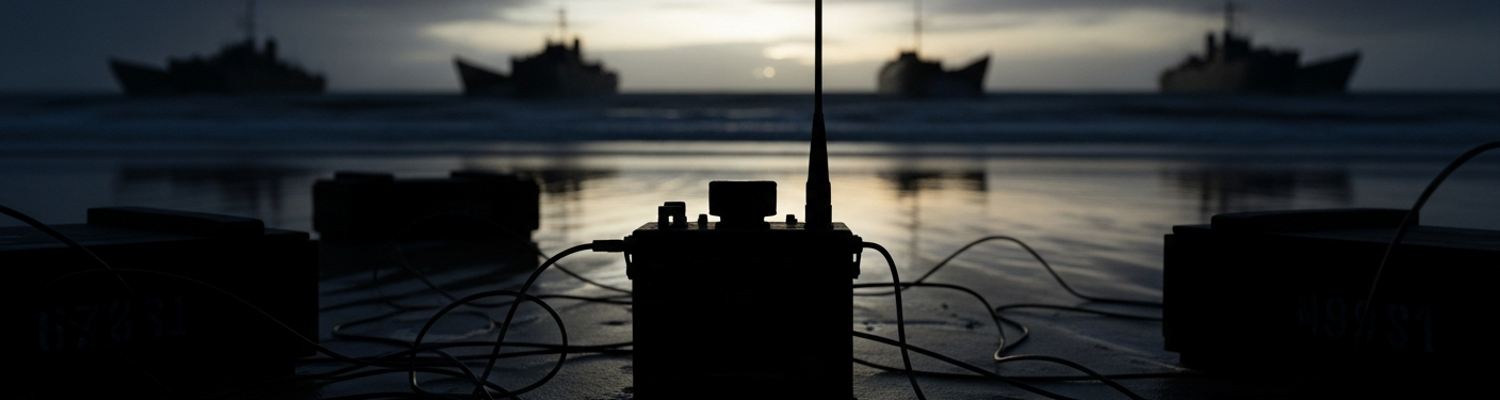

A close review of operational logs from U.S. Navy Fleet Landing Exercises of the 1930s reveals a consistent and dangerous weakness. Communications. During FLEX 4 in 1938, as the 1st Marine Brigade attempted mock assaults on the beaches of Puerto Rico, commanders were repeatedly stymied by an inability to coordinate movements between ship, shore, and landing parties. Existing long-range High Frequency (HF) radios were physically massive, required large antennas, and their signals were easily intercepted due to skywave propagation. For the new doctrine of amphibious assault being forged by the Marine Corps, this was an unacceptable tactical failure. The problem demanded a technological solution that did not yet exist.
The U.S. Naval Research Laboratory (NRL), established in 1923, was tasked with inventing a way out of this communications dilemma. The resulting project, which would ultimately produce the TBY, was conceived as a portable, Very High Frequency (VHF) transceiver. This choice of frequency band was deliberate. VHF signals, specified for the TBY as 28 to 80 Megacycles, travel in a straight line, a characteristic known as line-of-sight propagation. This physical limitation was weaponized into a tactical advantage. A VHF transmission from a beachhead to a destroyer a few miles offshore was practically undetectable by an enemy ship over the horizon. Archival evidence (NRL Report RA-3A) shows the primary challenge was miniaturization and power. To create a pack-type unit, engineers had to develop stable vacuum tubes, including specialized acorn tubes, that could operate reliably at these higher frequencies while withstanding the shock of combat. Just as difficult was the power source. Contracts from 1940 show the system was designed around a combination battery pack and a hand-cranked generator, a compromise between portability and the high power drain of 1930s-era vacuum tube technology. The entire apparatus was engineered to be a self-contained system that one man could, in theory, carry and operate.
The intended role for this new device was simple and narrowly defined. Planners envisioned the TBY as a tool for basic ship-to-shore and intra-beach communication. It was built to solve the specific problems observed in the Fleet Landing Exercises. It would allow a naval gunfire spotter on the beach to direct a destroyer’s fire, enable a beachmaster to control the flow of landing craft, or let a company commander coordinate with an adjacent unit. Its effective transmit range with its half-watt output was estimated to be only a few thousand yards, adequate for connecting an assault wave to its immediate offshore support but useless for anything deeper. The design reflected this limited scope. It was splash-proof but not truly waterproofed. The complete system, with the transceiver, battery, and canvas backpack, was a heavy, cumbersome load meant to be set up in a relatively fixed position upon reaching the shore. It was a logistical tool for the initial phase of an assault, not a frontline combat radio for infantry maneuvering through jungle terrain.
The TBY transceiver, a product of late 1930s engineering, entered the Pacific theater as a piece of equipment theoretically capable of solving short-range communication problems. Its initial deployments, most notably during the landings at Tarawa, revealed a cascading series of design flaws. The unit intended to be a lifeline was often rendered inert by the very conditions of its use. Its sheet metal case was not waterproof, with numerous holes for controls and a battery compartment that was not sealed from the main electronics. After-action reports from the 2nd Marine Division are filled with accounts of TBY sets becoming useless after being soaked in seawater during the wade to the beach. The inherent instability of its high-VHF circuits made tuning difficult, and the sets would frequently drift off-frequency, demanding significant operator skill to maintain a connection.
A debilitating weakness centered on the TBY’s power source. The unit required four separate voltages to operate its eight vacuum tubes: +150, +3, +1.5, and -7.5 VDC. This complex requirement was met by a heavy dry-cell battery pack, the BA-41, that offered a notoriously short operational life. Reports consistently highlighted weak batteries as a constant problem, with many arriving in theater already beyond their shelf life. A Marine signalman burdened with the 33.7-pound load could expect only a few hours of intermittent use before the power failed. The field solution was a hand-cranked generator, the GN-45. This alternative presented its own severe tactical disadvantages. Operating the crank was a physically exhausting, two-man job that produced a loud, whining noise, instantly compromising the operator’s position. For a forward observer attempting to discreetly call in fire coordinates, using the hand-crank was often a death sentence. This power deficiency forced an impossible choice upon the operator: communicate and risk immediate detection, or maintain silence and allow communications to break down.
The Pacific environment itself proved to be a relentless adversary. The technology predated the military’s widespread adoption of Moisture Fungus Proofing (MFP) techniques, leaving the electronics dangerously exposed. The extreme humidity of islands like Guadalcanal and Bougainville was ruinous. Moisture would quickly saturate the canvas backpack and penetrate the unsealed case, causing condensation directly on the circuit boards and high-voltage vacuum tubes. This led to short circuits, corrosion on metal connectors, and the gradual breakdown of insulating materials. The warm, damp conditions were a perfect breeding ground for aggressive tropical fungi. A review of maintenance logs indicates that signalmen would open their sets for repair only to find a green film of mold growing across tuning capacitors and resistors, altering their electrical properties and rendering the radio untunable. The combination of salt spray and constant humidity created a highly conductive and corrosive electrolyte that destroyed the TBY from the inside out.
Beyond its environmental vulnerabilities, the physical configuration of the TBY was poorly suited for the terrain of jungle warfare. Its primary antenna was a long, multi-section whip that was easily snagged and broken by dense foliage. For a radio that depended entirely on line-of-sight propagation, a damaged antenna meant the complete loss of signal. While designed as a pack radio, its weight and bulk made it a punishing load during combat maneuvers through mud or up steep coral ridges like those on Peleliu. Its intended role was for relatively static communication posts, yet it was forced into service with highly mobile infantry units. A Marine attempting to climb a steep, vine-choked ravine while carrying the TBY was not only slowed significantly but also dangerously unbalanced, making him an easy target. The geography of the islands, with their deep valleys and sharp ridges, frequently broke the required line-of-sight, rendering the half-watt signal useless even over short distances.
The operational record of the TBY is a study in forced battlefield innovation. Confronted with hardware unsuited for amphibious assault, Navy and Marine Corps communicators were compelled to become field engineers. The most immediate flaw was the unit’s vulnerability to water. After-action reports from Tarawa are a litany of failures. To counteract this, signalmen in units like the V Amphibious Corps Signal Battalion developed unauthorized but essential pre-invasion modification routines. A review of anecdotal accounts reveals that men would meticulously seal the transceiver’s sheet metal seams using Pliobond, a rubber-based adhesive, or whatever else they could acquire. They packed control shaft openings with grease and attempted to fashion crude gaskets for the battery box from salvaged rubber, sometimes cut from gas masks or ponchos. This was not a factory-authorized upgrade. It was a life-or-death procedure performed by enlisted men.
Powering the TBY in the field presented a tactical dilemma. The dry-cell battery packs were heavy, had a short operational life, and often arrived with their charge already degraded. The alternative, the hand-cranked GN-45 generator, was a beacon for Japanese mortars. This forced communicators to devise new power sources. Once a beachhead was secure enough to land vehicles, signalmen began cannibalizing jeep electrical systems. They fabricated jury-rigged power cables that could connect the TBY’s complex four-voltage input requirements to the 6-volt system of a jeep battery. This modification transformed the TBY from a failed portable radio into a semi-permanent fixture at a command post, a role for which it was never designed but proved more suitable.
The jungle environment relentlessly attacked the TBY’s pre-MFP electronics. Extreme humidity saturated internal components, leading to short circuits. A review of maintenance logs shows a green film of mold would grow directly on tuning capacitors and resistors, altering their electrical properties. Signalmen fought back with improvised preventative maintenance, opening the cases to dry in the sun and cleaning delicate parts with captured Japanese solvents or allotments of alcohol before coating them with any available varnish. A similar battle was fought over the antenna. The standard multi-section whip was brittle and easily snapped. In response, operators abandoned it entirely. They began constructing field-expedient quarter-wave ground-plane or dipole antennas from salvaged copper wire. These were often strung between trees, hoisting the radiating element higher to gain a better line-of-sight over the canopy and ridges that defined island battlefields like Peleliu. Calculating the correct wire length for a specific frequency, using the formula 234 divided by the frequency in megahertz for each quarter-wave leg, became a necessary skill for the Marine radioman.
The TBY was never intended to be a flexible piece of equipment. Archival evidence of its conception shows it was engineered to solve a very specific problem. Yet, the pressures of the Pacific War forced the unit into roles its creators at the NRL had never envisioned. The radio was not designed for these new tasks. The very characteristics that made it a flawed infantry pack radio were re-purposed by operators into tactical advantages within new communication doctrines created on the battlefield.
This was most apparent in the control of landing craft during the initial hours of an assault. The original doctrine called for Beachmaster parties to use TBYs to direct traffic at the water’s edge. Operational records from Iwo Jima show this role expanded dramatically out of necessity. As waves of Landing Craft, Vehicle, Personnel (LCVPs) approached the beaches, they often faced Japanese defenses that had survived the pre-invasion bombardment. A review of after-action reports reveals that TBYs, operated by forward observers or even Underwater Demolition Team personnel, became the primary tool for redirecting entire flotillas in real time. An operator, taking cover in a shell crater and using a jeep battery for power, could receive targeting adjustments from a spotter on a ridge and relay them directly to the command ship, which in turn would broadcast new coordinates to the incoming wave. This ad-hoc network allowed assault planners to divert hundreds of men and their vehicles away from a prepared kill zone on Yellow Beach 1 moments before landing. The TBY’s half-watt, line-of-sight signal was perfectly suited for this over-water communication, creating a low-probability-of-intercept link.
Once ashore, the TBY found a second, unanticipated life as the backbone of emergency logistical networks. The initial dumps of ammunition, water, and medical supplies on an active beachhead were magnets for enemy artillery. The formal process for requesting resupply was slow and ill-suited to the fluid reality of the fight. A TBY network, often powered by cannibalized jeep electrical systems, provided a solution. A battalion aid station suddenly inundated with casualties and running out of blood plasma could use its TBY to transmit an urgent request directly to the beachmaster’s command post, bypassing the normal chain of command. An infantry company pinned down and running low on machine gun ammunition could make a direct plea to the ammo dump. Marine signal unit logs show these localized, low-power VHF nets were highly effective. The line-of-sight limitation became a security feature, preventing distant enemy listening posts from intercepting the calls for supplies. An operator at the supply depot could receive the coordinates of the unit in need, confirm its status, and dispatch a jeep or carrying party with the required materiel.
A review of operational logs from Peleliu reveals the TBY’s direct effect on personnel survival. The radio became the principal instrument for directing medical evacuations under active fire. At casualty collection points established just behind the shattered treeline of White and Orange beaches, battalion aid stations were rapidly overwhelmed. A TBY operator, often set up in the same shell crater as the surgeon and powered by a scavenged jeep battery, became the only reliable link to the Beachmaster party controlling traffic at the reef’s edge. This network completely bypassed the slower, multi-echelon formal request system. A surgeon running low on plasma could have his TBY operator transmit an urgent request directly to the logistical command post. More significantly, this link was used to call for dedicated amphibious craft for casualty evacuation. An operator could transmit the coordinates of the aid station and the number of stretcher cases, allowing a specific LCVP to be dispatched from the transport area, navigate through the chaos of incoming supply waves, and land at a designated point for the sole purpose of evacuating the wounded. The TBY’s low-power, line-of-sight VHF signal was a tactical advantage in this role, nearly impossible for Japanese stations over the horizon to intercept.
The end of the Second World War marked the immediate beginning of the TBY’s obsolescence. Its late-1930s design, centered on Amplitude Modulation (AM) and unstable, manually tuned vacuum tubes, was decisively outclassed by a new generation of radio technology. The primary agent of this change was the widespread adoption of Frequency Modulation (FM). Where the TBY’s AM signal was highly susceptible to ignition noise from vehicle engines and atmospheric static, FM offered vastly superior audio clarity. This technological shift was embodied by radios like the AN/PRC-6, which saw service in the Korean War. The AN/PRC-6 operated using wide-band FM, providing clear voice communication that was simply unattainable with the TBY. These new radios were also crystal-controlled, eliminating the TBY’s notorious frequency drift that demanded constant adjustment.
A close review of post-war equipment design specifications shows that the TBY’s extensive operational failures became a direct blueprint for what to avoid. Its litany of shortcomings gave military engineers a precise list of problems to solve. The lesson of ruggedization was paramount. Later designs, such as the AN/PRC-series, abandoned the TBY’s folded sheet-metal case in favor of cast aluminum housings sealed with rubber gaskets, a direct response to after-action reports from Tarawa. The widespread adoption of Moisture Fungus Proofing (MFP) techniques was another direct legacy. This involved applying a protective conformal coating of varnish to internal circuit boards, preventing the exact kind of moisture buildup and fungal growth that had plagued the TBY. Control shafts were sealed with O-rings, and battery compartments were isolated from the main electronics.
Perhaps the most influential lesson derived from the TBY’s service record was the need for a practical and self-contained power source. The TBY’s reliance on short-lived batteries or the tactically suicidal GN-45 hand-crank generator was an operational disaster. Post-war designs incorporated far more efficient and simplified power systems. The AN/PRC-6, while still using vacuum tubes, was powered by a single disposable battery pack that provided up to 30 hours of intermittent use, a significant improvement. This eliminated the need for a noisy, two-man generator and its complex four-voltage output. The failures of the heavy TBY reinforced the concept that a radio needed to be truly man-portable for every platoon leader, not just a specialized tool for a signals detachment. The requirement for radios to be fully waterproof, not merely splash-proof, became a standard design specification for amphibious operations. The hard-won experience of Marine communicators modifying their TBYs with grease and salvaged rubber was institutionalized into the factory designs of the transceivers that replaced it. The AN/PRC-6 weighed only 7.5 pounds with its battery, a fraction of the TBY's 33.7-pound system weight.