
Aquidneck Island Strategic Context
The arrival of Vice-Admiral Charles Hector, comte d'Estaing's fleet in Narragansett Bay on July 29, 1778, changed the operational calculus. Sixteen French warships presented a sudden opportunity to isolate and destroy a key British garrison. Major General John Sullivan commanded the American forces, a contingent of approximately 10,000 Continental soldiers and militia. The plan, coordinated with d'Estaing and his 4,000 French infantry, called for a combined land and sea assault to trap the British on Aquidneck Island. Sullivan's army would cross from Tiverton to the island's eastern shore. The French would land on the west from a staging area on Conanicut Island. This pincer was designed to overwhelm the British forces fortified in Newport at the island's southern tip.
The prize was significant. Capturing Newport would eliminate a major Royal Navy base that had harassed New England shipping since 1776. It would also deliver a spectacular inaugural victory for the new Franco-American alliance, a result that could potentially shorten the war. A close review of operational logs (NARA Record Group 93) indicates deep-seated friction between the allied commands from the start. Sullivan and d'Estaing harbored reservations about one another. Disagreements over timing and precedence began almost immediately. The entire operation was a fragile construction, dependent on perfect coordination and good weather.
The island was a fortress.
Major General Sir Robert Pigot, a veteran of Bunker Hill, commanded the British garrison. His force consisted of roughly 6,700 British regulars, Hessian mercenaries, and Loyalist troops. Since occupying Aquidneck Island in December 1776, the British had spent nearly two years methodically transforming Newport into a hardened defensive zone. When d'Estaing's powerful fleet appeared, outmatching the small Royal Navy squadron on station, Pigot made a series of cold, pragmatic decisions. Between July 30 and August 8, he ordered the scuttling and burning of eleven British warships in the harbor. This prevented their capture and obstructed French naval movements. He withdrew all outlying detachments from Conanicut Island and the northern redoubts, including the high ground at Butts Hill, consolidating his forces around Newport. Archival evidence shows that Pigot’s engineers had leveled orchards and demolished homes to create clear fields of fire. They constructed a formidable network of abatis, obstacles of felled trees with sharpened branches facing the enemy, around the city’s perimeter. Newport became a kill zone, forcing any attacker into a direct siege against prepared positions.
The plan collapsed with the wind. On August 9, as American forces began crossing to Aquidneck to occupy the abandoned Butts Hill, a lookout spotted a British relief fleet under Admiral Lord Richard Howe. The situation changed completely. D'Estaing, his fleet superior but now facing a direct challenge, halted the landing of his own troops. He sortied to engage Howe at sea. Before a naval battle could occur, a massive nor'easter struck on August 11. The hurricane-force winds and violent seas battered both fleets for two days, scattering them and inflicting severe damage. The French flagship, the 80-gun Languedoc, was dismasted. The French fleet limped back to Newport on August 20 to deliver unwelcome news to General Sullivan. Citing extensive damage and the need for shipyard repairs, d'Estaing announced his unilateral decision to sail for Boston. The departure of the French on August 21 was a terminal blow. It removed the naval blockade, exposed the American land forces, and triggered a mass desertion of New England militia who saw the siege as hopeless without French support. Sullivan's position became instantly untenable. The failed siege devolved into a scramble to evacuate his remaining army from the island.
American Light Infantry Withdrawal
A council of war confirmed General John Sullivan’s assessment. With the French fleet gone and militia desertions reducing his army to just over 5,000 men, the position was indefensible. The order to withdraw from the siege lines around Newport was given on the evening of August 28, 1778. This was not a panicked flight. It was a calculated retrograde action. The first phase involved a silent, overnight march northwards, pulling back from the forward trenches to consolidate forces around the fortified high ground at Butts Hill. A review of Sullivan's orders shows he tasked detachments with repairing these northern works even before the main retreat began, preparing a final defensive line to cover his escape. All heavy equipment and cannons that could be spared were sent ahead to the mainland. The army moved with discipline, reaching the northern defenses by early morning on August 29th, having successfully disengaged from the main British force.
The retreat was a gamble on time.
At dawn, British pickets discovered the abandoned American siege works. Major General Sir Robert Pigot ordered an immediate pursuit. He divided his force into two columns. One, under Major General Francis Smith, advanced up the East Main Road. The other, commanded by Hessian General Friedrich Wilhelm von Lossberg, moved up the West Main Road. The British objective was to catch and destroy Sullivan's army before it could cross back to the mainland. The American rearguard, a collection of light infantry units under Colonel John Laurens, was tasked with delaying this advance. A running series of sharp, violent skirmishes erupted as Laurens' men engaged the pursuing British and Hessians. The fighting centered on two key terrain features south of the main American line. Quaker Hill and Turkey Hill.
Smith's column assaulted American forces under Brigadier General John Glover. Glover's men used a series of stone walls on Quaker Hill to mount a stubborn defense. Simultaneously, Lossberg’s Hessians, including highly effective Chasseur rifle units, pushed Laurens' troops back to Turkey Hill. These tactical delays were costly but bought the necessary hours for Sullivan’s main body to organize for the final crossing.
The fighting on August 29th was intense. British and Hessian troops launched multiple assaults against the American lines. On the American right flank, defended by troops under General Nathanael Greene, the 1st Rhode Island Regiment, a unit composed largely of Black and Native American soldiers, repulsed three separate Hessian charges. The engagement became a fierce artillery duel that lasted for hours. British warships in the Narragansett Bay added their cannon fire against Greene’s positions until driven off by concentrated American battery fire from the shore. Though the British and Hessians secured Quaker and Turkey Hills, they could not break the main American defensive line anchored at Butts Hill. The battle ended as a tactical draw but a strategic win for the Americans. They had held off the pursuit long enough to prepare their escape.
The final act was a complex riverine crossing under pressure. The only escape route was Howland's Ferry, a narrow passage on the Sakonnet River separating the island from Tiverton. Awaiting them was a flotilla of flat-bottomed boats, many hastily constructed. The operation was managed by Colonel John Glover and his regiment of Marblehead mariners, the same unit that had evacuated the army from Long Island in 1776. Beginning on the evening of August 30th, Glover’s men began ferrying the army across the water. The task was to move thousands of soldiers, their remaining equipment, and baggage in darkness while the rearguard, now commanded by the Marquis de Lafayette, kept the British at bay. The evacuation continued through the night and was completed by the morning of August 31, a logistical success accomplished with minimal losses. Sullivan had extricated his army just one day before a British fleet carrying 4,000 reinforcements arrived.
Seconnet River Evacuation Mandate
Operational logs from the evening of August 29, 1778, reveal a command decision made from necessity. General John Sullivan’s army had repulsed British and Hessian assaults and consolidated on the high ground at Butts Hill, a formidable defensive position at the northern tip of Aquidneck Island. A council of war convened. The debate was not whether to leave, but how and when. Sullivan presented a controversial rationale. Instead of holding the fortified ground and forcing the British into a costly siege, a move that might buy time for a more conventional withdrawal, he mandated an immediate, all-or-nothing amphibious evacuation that very night.
This defied the instincts of some officers who saw Butts Hill as a bastion of strength. The controversy lay in the risk. The only escape route was across the narrow Seconnet River at Howland's Ferry, a waterway patrolled by the Royal Navy. The operation would depend entirely on a limited flotilla of 85 flat-bottomed boats to ferry over 5,000 men with their remaining cannon and supplies in complete darkness. A single detection by a British patrol vessel or a sudden shift in weather could lead to the army’s annihilation, trapped between a superior enemy force and the water. Sullivan argued that remaining on the island was a slow, unwinnable fight. The evacuation, however perilous, offered a chance for complete extraction. His mandate was a gamble, wagering the army's entire existence on speed, secrecy, and the skill of his boatmen.
Not a retreat. An escape.
The plan was a direct rejection of established 18th-century military doctrine. Standard procedure for a retrograde movement dictated a controlled, fighting withdrawal, using terrain and a dedicated rearguard to methodically slow a pursuing enemy while the main body of the army retired in good order. Such an operation was designed to preserve the army as a fighting force, even if it meant sacrificing men and material. Sullivan’s order mirrored the unconventional operation that had saved the Continental Army two years prior at Long Island. He committed everything to a waterborne extraction managed by Colonel John Glover and his regiment of Marblehead mariners. This was an improvised solution not found in European military texts. The orthodox alternative would have been to make a final stand at Butts Hill, a move certain to result in the army's eventual capture and the loss of all its equipment. Sullivan’s decision acknowledged that a conventional fight was unwinnable. His mandate for a mass amphibious lift was a doctrinal heresy, prioritizing the complete preservation of his force over the accepted methods of retreat.
The entire operation depended on the discipline of a specially selected mobile detachment. To create the illusion that the American army was digging in for the night to renew the fight on August 30th, a dedicated rearguard was tasked with maintaining a convincing deception. This force, commanded by the recently returned Marquis de Lafayette, was composed of the army’s most reliable light infantry and veteran Continental troops. Their orders were precise. Keep the campfires burning. Maintain the regular sentry posts. Make conspicuous movements to suggest a large, active force was still present in the fortifications. They were the screen, the element tasked with buying the hours needed for Glover’s men to ferry the main army across the Seconnet River. This detachment was mobile by necessity, equipped to fight a delaying action and then fall back quickly to the embarkation point. Their commitment was absolute. Had General Pigot seen through the ruse and ordered a night assault, Lafayette’s command would have been the anvil upon which the rest of Sullivan’s army was smashed. They were the last men scheduled to leave the island, a position of extreme peril.
Battlefield Casualty Management
The fighting on August 29, 1778, left Sullivan’s army with 137 wounded men. They represented a severe logistical challenge to the evacuation. The wounds inflicted were a direct product of 18th-century weaponry. A large-caliber, low-velocity musket ball from a British Brown Bess did not pierce cleanly. It smashed its way through the body, shattering bone and pulverizing soft tissue. Unlike modern, high-velocity rounds, these heavy lead projectiles often tumbled upon impact, creating massive internal damage and large, ragged exit wounds. Bayonet wounds, particularly from the triangular blades common at the time, were designed to create gashes that were nearly impossible for a field surgeon to suture. The most horrific injuries came from artillery. Canister and grapeshot acted like giant shotgun shells, spraying dozens of smaller iron balls across a wide area and inflicting multiple, devastating wounds. The fighting on Quaker and Turkey Hills produced this full spectrum of trauma. Hessian troops were noted for using bayonets on wounded Americans as they fell back.
An improvised system of medical triage was put into effect behind the American main line at Butts Hill. No formal doctrine for this existed. It was a harsh prioritization dictated by necessity. Regimental surgeons and their mates, working at crude aid stations just behind the fighting, made rapid, life-or-death decisions. Archival evidence shows that a field hospital of sorts was established in the barracks of the Butts Hill fort, which had been designated as a collection point for invalids even before the main battle began. The primary goal was not complex surgery but stabilization for transport. Surgeons focused on controlling bleeding with compresses, crudely probing for and removing musket balls from flesh wounds, and performing amputations when a limb was hopelessly shattered by shot.
The calculus of survival was unforgiving.
Men deemed mortally wounded were likely given a measure of comfort but were left behind in favor of those who had a chance of survival and could be moved. The lightly wounded, who could still walk, were directed toward the evacuation point. Surgeons spent their limited time on the gravely injured who might withstand the journey to the mainland. General Sullivan’s orders from August 30 specified that the wounded should not want for comfort, and a party of 100 men was detailed to collect the dead from the field.
Every wagon became an ambulance. The transport of over 100 casualties from the Butts Hill defensive line to the embarkation point at Howland's Ferry was an undertaking executed in darkness and under extreme pressure. There was no dedicated ambulance corps. The task fell to able-bodied soldiers pulling their comrades from the fight. A close review of the army’s withdrawal order shows that all available carts and farm wagons, previously used for supplies and ammunition, were commandeered to move the non-ambulatory wounded. These rough, unsprung vehicles would have caused excruciating pain as they bounced over the rutted roads leading to the ferry landing. Where wagons were unavailable, soldiers fashioned litters from muskets and blankets or carried their comrades on their backs. The process was managed as part of the orderly retreat, with the wounded moved along with the cannons and baggage. The final leg of the journey was placing these men onto the flat-bottomed boats for the night crossing of the Seconnet River. Sullivan’s specific orders on August 31, issued from Tiverton after the escape, mandated that all sick and wounded were to be moved onward to the hospital at Providence as soon as it could be done without further endangering them.
Under Fire Improvised Transport
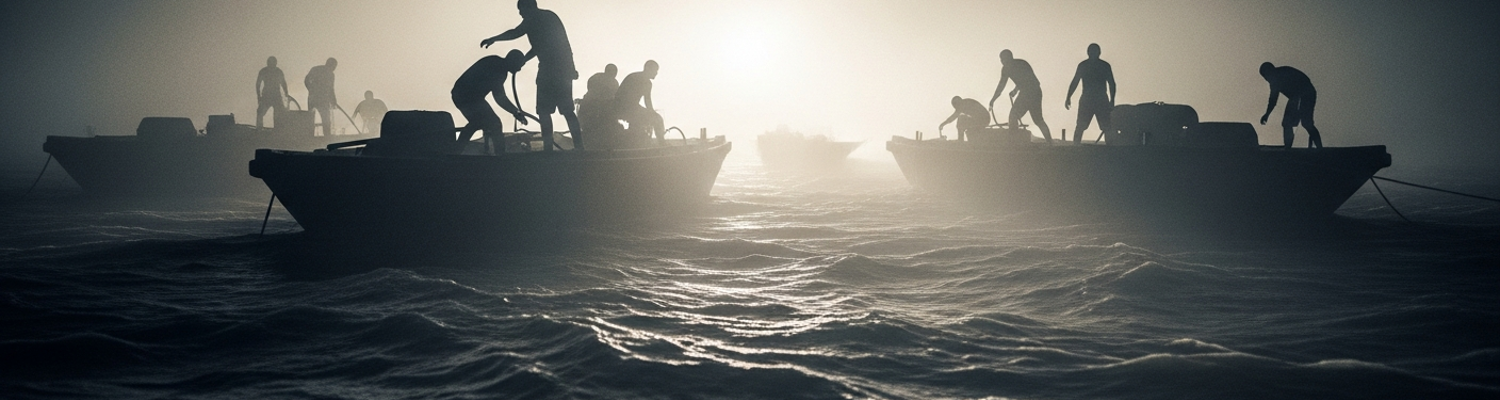
The American evacuation from Aquidneck Island hinged on a flotilla of just 85 flat-bottomed boats. These were not purpose-built military assault craft. They were a motley collection of bateaux and scows, many of them hastily constructed after the British had previously located and destroyed the Americans' initial boat-building efforts in the Fall River area. Silas Talbot was tasked with overseeing the emergency construction of this new fleet, an enterprise that involved commandeering every available carpenter in the army and stripping the surrounding countryside of any usable planks and boards. The result was a collection of shallow-draft, clumsy vessels, each capable of carrying a few dozen men or a single piece of light artillery. They were unsuited for rough water and required experienced boatmen to manage, especially in the swift currents of the Seconnet River. The responsibility for this waterborne extraction fell to Colonel John Glover and his regiment of Marblehead mariners, the same fishermen and sailors who had executed the evacuation of the army from Long Island two years prior. Their specialized skill was the single most important asset Sullivan possessed.
The crossing itself was a display of organized chaos, conducted under the absolute necessity of silence and speed. Beginning on the evening of August 30th, Glover’s men began their work at Howland's Ferry, the narrowest point of the Seconnet River. The river here, though only a quarter-mile wide, presented a significant obstacle. The evacuation began at 6:00 PM. Glover’s mariners manned the flotilla, rowing load after load of soldiers, wounded, cannons, and baggage across the water throughout the night. The operation was a rhythmic cycle of loading on the island’s shore, a frantic row against the current in the dark, and a swift unloading on the Tiverton side before immediately returning for the next group. A screening force under the Marquis de Lafayette was left behind at the Butts Hill fortifications with orders to maintain campfires and the illusion of an army settling in for the night, a deception that bought the hours needed for the evacuation.
The crossing was not uncontested. While the main evacuation proceeded with stealth, British naval assets had been active earlier in the day, demonstrating the clear danger. During the battle on August 29th, Royal Navy ships, including the sixth-rate HMS Sphynx and the heavily armed converted merchantman HMS Vigilant, had maneuvered into the channel west of the island. From that position, they commenced a bombardment with cannon and grapeshot against the American right flank, defended by General Nathanael Greene’s division and the 1st Rhode Island Regiment. This direct fire from the water illustrated the peril Sullivan’s army faced. Had the main evacuation been detected by naval patrols, these same ships could have moved to interdict the ferry route, using their firepower to turn the flotilla of vulnerable flatboats into a floating kill zone. The successful withdrawal was therefore a function of both Glover’s logistical execution and a measure of luck. The army slipped away just before the Royal Navy could bring its power to bear on the final escape route.
Calculated Gamble Outcome
The immediate result of the evacuation was the preservation of a substantial American field army. Over 5,000 Continental soldiers and their officers, including commanders like Nathanael Greene and the Marquis de Lafayette, were saved from certain capture or destruction. They were exhausted and their morale was battered by the collapse of the first Franco-American military operation, but they remained a coherent force. The withdrawal from Aquidneck Island was not a victory. It was the successful salvage of an army from the wreckage of a failed campaign. While the escape demonstrated American resilience, the preceding desertion of thousands of militia troops underscored the demoralization caused by the French fleet’s departure. Sullivan’s post-evacuation reports from Tiverton (dated September 1, 1778) reveal a command focused on the positive. The army was intact, with its artillery and baggage, ready to fight another day.
It was a strategic success born from operational failure.
A review of British naval and army dispositions provides the ultimate justification for Sullivan’s gamble. Intelligence had already reached the Americans that General Sir Henry Clinton in New York was dispatching a significant relief force. That force, consisting of 4,000 British regulars, arrived at Newport under Clinton's personal command on September 1, 1778. One day after Glover’s boats completed the crossing. Had Sullivan elected to hold the strong defensive works at Butts Hill, his army would have been irretrievably trapped. He would have faced General Pigot’s 6,700-man garrison to his south and Clinton's 4,000 fresh troops to his north, all while the Royal Navy sealed any escape by water. The situation would have been a catastrophic repeat of the worst British victories of the war, ending in the certain annihilation or mass surrender of Sullivan’s command. The decision to evacuate was not a choice between retreat and holding ground. It was a choice between escape and utter destruction. Sullivan correctly calculated that the only variable he could control was time, and he used it to orchestrate an escape that preempted the closing of the British trap.
The success of Sullivan’s decision must be measured by its primary objective. The complete extraction of his army. By that standard, the operation was an almost flawless success. The discipline of the Continental Army held through the complex overnight withdrawal. The deception plan executed by Lafayette’s rearguard effectively masked the army’s movements, preventing Pigot from launching a disruptive night attack. The logistical execution by Colonel John Glover’s Marblehead Regiment, ferrying thousands of men and their equipment across the Seconnet River in darkness, reprised their famous role in saving the army at Long Island. The entire American force was on the mainland by the morning of August 31. A single day before Clinton's 4,000 reinforcements arrived to seal the island.