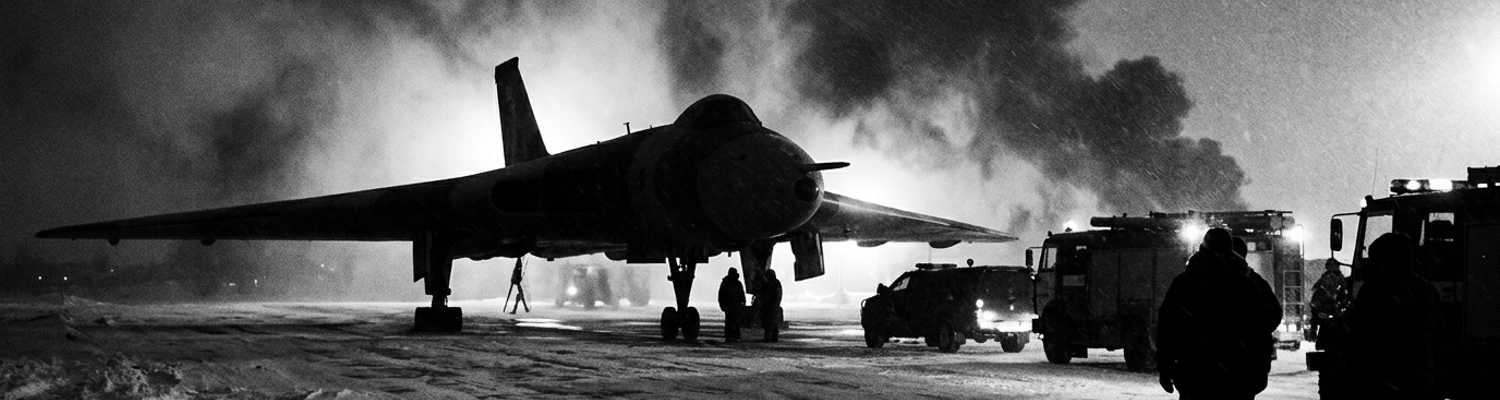

SAC Scramble Mandates and Winter Ground Readiness
Strategic Air Command regulations gave the leadership of the 305th Bombardment Wing exactly fifteen minutes from the klaxon horn sounding to get combat-configured bombers airborne. Aircrews at Bunker Hill Air Force Base lived under this compressed launch cycle. Every second lost on the ground eroded the surviving window against incoming Soviet ballistic missiles. National strategic targeting plans dictated that these aircraft had to clear the runway threshold before forward-deployed sensors detected transpolar warhead signatures. Command staff in central Indiana operated with clocks already running against them. They processed alerts through automated teleprinters that demanded immediate throttle movement regardless of local meteorological warnings. When alert sirens blared across the apron, the stopwatch superseded environmental risk assessments. Flight crews sprinted from the alert shack to cocked aircraft with engines preheated for emergency cartridge starts. They were driven by rigid directives requiring multi-megaton payloads to be moving down active corridors within minutes.
Fifteen minutes left zero margin for operational delays.
Archival evidence shows how General Thomas S. Power dictated a doctrine of continuous deterrence. This locked bomber wings into an uncompromising alert posture throughout central Indiana winter storms. Under SAC Operation Order directives (Document File 64-A-112), one-third of the 305th Bombardment Wing sat on round-the-clock alert status. They were loaded with active weapon configurations that included BLU-27/B fuel pods, B43 thermonuclear bombs, and single large-yield W53 strategic warheads. Operating the Convair B-58 Hustler under these mandates magnified mechanical hazards. The supersonic airframe featured an unusually narrow tricycle landing gear geometry. The tandem dual-wheel main gear bogies offered minimal lateral stabilization on non-dry surfaces. General Electric J79-GE-5B turbojet engines produced violent ground thrust even at idle power settings. This demanded constant braking applications during taxi sequences. Snow accumulation and freezing temperatures dropped flight-line traction to near-zero values. SAC command authorities refused to relax response intervals.
Base commanders risked career termination if alert sortie generation fell below established time milestones.
Aircraft ground movements proceeded as if summer conditions prevailed. They prioritized rapid engine spooling and quick taxi speeds over base-level safety protocols. A close review of operational logs indicates that base airfield management executed superficial ground inspections prior to ordering alert taxi movements across the north-south taxiway network. Airbase operations dispatched civilian-pattern snowplows and rotary wire-brush sweepers along Taxiway Alpha and the approach heading to Runway 23. They cleared loose snow drifts while leaving an undetected underlying sheet of glazed ice directly on the asphalt. Ground reconnaissance personnel relied on informal visual appraisals from enclosed pickup trucks rather than conducting physical decelerometer tests to measure surface friction coefficients. Blowing snow obscured the newly developed surface glaze. Inspection reports forwarded to the wing flight operations officer recorded the movement corridors as cleared and serviceable.
Snow removal teams bypassed critical intersections.
Warm jet exhaust from earlier auxiliary runs had temporarily melted snowpack at these junctions. The water subsequently flash-froze into smooth zero-traction patches under the twenty-degree ambient chill. Air traffic controllers and taxi ground directors received zero notifications regarding the loss of braking action lurking along the operational turnoffs leading onto the primary launch queue. When examining the historical record of December 8, 1964, the countdown to structural catastrophe narrowed precisely between 11:23 and 11:28 AM. Captain Leary Johnson and his crew occupied B-58A serial number 60-1116. They executed standard alert dispersal maneuvers under simulated strike orders. Behind them, another four-engine Hustler advanced its throttles to clear the holding area. This generated high-velocity thermal exhaust plumes across the frozen taxi corridor.
The Five-Minute Sequence on Taxiway Lead 6
When examining the historical record, the alert horn sounded across Bunker Hill Air Force Base at 11:23 AM. This initiated an unscheduled Operational Readiness Inspection for the 305th Bombardment Wing. Flight crews assigned to the alert line broke into dead sprints through sub-freezing crosswinds. They cleared the distance between the alert facility and their dispersal revetments in under ninety seconds. Inside B-58A serial number 60-1116, Captain Leary J. Johnson dropped into the forward pilot station. Captain Manuel Cervantes Jr. strapped into the navigator compartment. Captain Roger L. Hall secured the defensive systems station. Ground crews scrambled to disconnect external ground power cables. They pulled wheel chocks from the tires and dragged metal boarding stairs clear of the titanium airframe. Four General Electric J79-GE-5B turbojets spun up on compressed air cartridges with deafening force.
Johnson released the hydraulic toe brakes at 11:25 AM.
The sixty-ton delta-wing bomber rolled forward into the Minimum Interval Takeoff taxi stream behind five other Hustlers. Tarmac temperatures stood at twenty degrees Fahrenheit. A close review of operational logs indicates that the taxi sequence rapidly deteriorated as the bombers converged toward Runway 23 along Taxiway Lead 6. Strategic Air Command rules mandated strict eight-second spacing between departing airframes to simulate wartime survival departures. Ahead of Johnson and his crew, the fifth aircraft in the departure order reached the holding pad at 11:26 AM. It spooled its engines to high power settings to test nozzle divergence before active runway entry. This run-up pushed horizontal exhaust plumes exceeding three hundred miles per hour straight down the curved access lane.
At 11:27 AM, Johnson swung the nose wheel of aircraft 60-1116 into the left turn on Taxiway Lead 6.
He applied left differential braking and forward throttle to maneuver against the headwind. He entered the throat of the intersection at approximately ten knots. Archival evidence shows that warm exhaust from the preceding bomber had melted surface frost. This produced a glaze of sheet ice over the asphalt that immediately dropped tire traction coefficients to zero. Without lateral grip, the tandem four-wheel main bogies broke sideways under the combined force of the turning vector and the cross-axial jet blast. Johnson applied hard right rudder and mashed the right brake pedal. The eighty-foot delta-wing aircraft continued drifting sideways across the frozen tarmac toward the unpaved northern shoulder.
At 11:27:35 AM, the left main landing gear skidded off the paved edge.
First, the outboard tires sheared off a flush-mounted taxiway light casing. Ten feet farther along the frozen soil, the high-tensile steel gear assembly clipped the edge of a concrete light base. It then struck a reinforced concrete electrical manhole vault projecting six inches above grade. The vertical collision exerted violent shear forces that ripped the left gear trunnion entirely out of the wing box. Ruptured plumbing in the left wet wing dumped thousands of gallons of JP-4 fuel directly onto red-hot engine turbines. This ignited an immediate sustained fire envelope across the belly of the bomber. Under the fuselage hung a lethal payload consisting of four B43 thermonuclear bombs and one BLU-2/B-28 multi-megaton configuration. Inside the smoke-filled cockpit, Johnson and Hall released their canopy latches. They escaped over the burning wing surfaces. Trapped inside the center module, Captain Cervantes pulled the pre-ejection handle of his Stanley escape capsule at 11:28 AM.
Port Landing Gear Shearing and Fuel Ignition
The impact sheared forty-three hundred pounds of high-tensile steel in less than two-tenths of a second. Archival evidence shows that the left main gear assembly of aircraft 60-1116 hit the six-inch raised lip of the concrete manhole vault at an angle of roughly fifteen degrees while moving at nine knots. Designed primarily for vertical loads during touchdown rather than transverse lateral impacts, the eight-wheel bogie could not absorb the sudden horizontal deceleration. Steel trunnion pins securing the forward drag strut to the main wing spar snapped under shear loads exceeding one hundred and eighty thousand foot-pounds. Internal oleo shock struts drove directly upward into the wing rib architecture as a result of the structural failure.
Rib stations twenty-two through twenty-eight buckled immediately.
This tore the lower skin of the delta wing and severed hydraulic lines pressurized at three thousand pounds per square inch. Deprived of lateral support, the entire port gear assembly folded backward beneath the wing root. Dropping thirty-four inches onto the frozen turf, the left wingtip and engine nacelles carved deep trenches into the soil before spinning the airframe ninety degrees across the taxi corridor. Metal met frozen earth without braking surfaces. A close review of operational logs indicates that the centerline pod absorbed the downward kinetic force of the fifty-four-ton bomber as the port gear collapsed. Supported only by its two-component pod assembly, the lower belly of the B-58 rested directly on an aluminum casing. This casing contained twenty-six hundred gallons of JP-4 jet fuel surrounding a central weapons bay.
Crushing contact against the frozen shoulder fractured the lower pod bulkheads.
This peeled open three-sixteenths-inch aluminum skin along the ventral centerline. High-pressure fuel lines and gravity dumped volatile JP-4 across the frozen soil and asphalt at several hundred gallons per second. Vaporizing fuel drifted directly into the lower air intakes and tailpipes of the number one and two General Electric J79 turbojet engines. Operating at ground-idle speeds, the turbine casings maintained internal temperatures between twelve hundred and fourteen hundred degrees Fahrenheit. Titanium wing skin scraping across the gravel margin generated friction sparks that provided a secondary ignition source. Igniting across the port side of the aircraft at 11:27:42 AM, the initial fuel burst created a sustained combustion zone spanning two hundred feet of the taxiway apron.
When examining the historical record, the initial fuel ignition enveloped the fuselage up to the dorsal ridge within four seconds of the pod rupture. Surface winds of fourteen knots pushed burning fuel under the belly of the bomber. This exposed two auxiliary B43 thermonuclear stores on underwing pylons to open flames. Thermal radiation rapidly exceeded the heat tolerances of the weapon casings and aircraft skin panels. Fractured wing cavities absorbed gallons of burning fluid. This ignited seven thousand additional gallons of fuel stored in internal wet-wing cells. Cockpit temperature gauges climbed toward maximum limits as radiant heat blistered the forward canopy plexiglass above the pilot station. Automatic fire detection loops triggered every master caution light on the forward panel. The onboard extinguishing systems could not suppress a free-flowing external fuel pool burning at two thousand degrees Fahrenheit. Runway rescue crews stationed at the crash facility on the south side of Bunker Hill AFB observed thick black smoke rising through the overcast ceiling at 11:28 AM.
B43 Weapon Combustion and High-Explosive Detonation
The thermal environment surrounding the port wing pylons rapidly degraded the structural integrity of the external ordnance. Archival evidence shows that the B-58 carried four B43 Mod 1 thermonuclear gravity bombs. These were mounted on specialized external racks outboard of the primary centerline pod. The B43 casings consisted of spun aluminum and steel alloy components. These materials possessed melting points well below the two thousand degree Fahrenheit sustained temperature of the JP-4 jet fuel fire. The flames enveloped the two port-side weapons completely. Inside the aerodynamic shells, conventional high-explosive lenses surrounded the primary fissile pits. These lenses consisted of PBX 9404, a plastic-bonded explosive highly sensitive to thermal shock.
Heat transfer through the weapon casings initiated a rapid thermal degradation of the explosive compounds.
At 11:29 AM, the high explosives inside the forward port-side B43 weapon reached their auto-ignition threshold. They detonated. This was a conventional chemical explosion. The blast lacked the precise symmetrical timing required to initiate a nuclear chain reaction. The shockwave shattered the weapon casing entirely. It scattered burning fragments of the fissile core across the taxiway and adjacent snowbanks. Base seismographs recorded the blast as a localized seismic event. Shrapnel from the casing punctured the adjacent aft weapon pylon. This exposed the second B43 bomb to direct flame impingement and mechanical shock.
Forty seconds later, the second port-side weapon detonated.
A close review of operational logs indicates that the secondary explosion severed the remaining structural attachments holding the port wing to the fuselage. The blast overpressure knocked responding firefighters off their feet at a distance of three hundred yards. Burning jet fuel sprayed outward in a radial pattern, expanding the combustion zone across Taxiway Lead 6. The high-explosive detonations pulverized the plutonium-239 cores housed within the primary stages of both weapons. The mechanical force of the explosions combined with the extreme thermal updraft to lift the pulverized heavy metals directly into the atmosphere. The blast did not produce a nuclear yield. It produced a radiological dispersal event of severe magnitude.
Plutonium Oxide Aerosolization and Chemical Hazards
When examining the historical record, the combustion zone reached temperatures exceeding two thousand degrees Fahrenheit within eight minutes of the fuel cell rupture. This directly attacked the aluminum and steel shells of the remaining exposed thermonuclear warheads. While the high-explosive lenses inside the forward weapons burned and detonated without achieving critical nuclear yield, the thermal breakdown generated a secondary chemical disaster. Intense heat reduced the weapon pits to molten pools. This caused weapon-grade plutonium-239 to spontaneously oxidize upon contact with open atmospheric oxygen. Sub-micron particles of plutonium dioxide formed immediately inside the convective updrafts of burning JP-4 fuel. Rather than falling to earth as heavy debris, these ceramic particles became suspended in the dense column of soot.
Inhaling an invisible fragment measuring less than three microns delivered irreversible internal alpha radiation damage to lung tissue.
Burning casing components, magnesium structural brackets, and synthetic electrical insulation simultaneously produced toxic clouds of hydrogen chloride and phosgene gas. This saturated the air around Taxiway Lead 6. Combustion converted solid fissile cores into airborne respiratory poison. Archival evidence shows that local surface winds out of the north-northwest at fourteen knots channeled the aerosolized plume across the alert aprons before carrying it toward off-base boundaries. As the column rose roughly two hundred and fifty feet into the overcast Indiana winter sky, turbulent wind shear sheared the smoke corridor horizontally. The cloud crossed the perimeter security wire five minutes after the primary casing ruptured. It blew over frozen cornfields toward U.S. Route 31 and the small community of McGrawsville.
Alpha-emitting particulate settled across the snowpack.
This created an invisible, irregularly shaped contamination footprint running south-southeast across Miami County. On the base itself, the thermal draft pulled particulates into the fresh-air intake plenums of hardened alert structures and dispersal revetments. Crew chiefs attempting to roll nearby auxiliary equipment clear of the taxiway swallowed airborne soot without respiratory protection. They were oblivious to the fact that pure alpha emitters left no thermal or sensory trace on exposed skin. Snowdrifts absorbed the fallout. A close review of operational logs indicates that base operations declared an emergency Broken Arrow at 11:34 AM. This triggered the emergency deployment of the 305th Civil Engineering Squadron disaster response group alongside explosive ordnance disposal personnel.
Initial radiological survey teams arrived at the perimeter fence at 11:41 AM.
They were equipped with portable AN/PDR-27 beta-gamma ratemeters and Eberline alpha survey counters. Alpha particles cannot penetrate clothing, moisture, or snow cover. The instruments registered negligible readings until technicians used their boots to scrape away the surface ice. Once probe faces made direct contact with blackened tarmac slush sixty yards downwind of the burning Hustler, instrument needle dials pegged past the maximum limit of ten thousand counts per minute. Base commanders immediately recognized that conventional fire lines sat dead center within a lethal contamination field. Firefighters were hosing down a radioactive furnace.
Operational commanders ordered survey personnel to draw an emergency containment cordon around the south and east quadrants of the airfield.
Team members marked an initial two-thousand-foot hot zone using yellow plastic barrier tape, red hazard placards, and physical road blockades across all service routes connecting the main runway to the alert compound. Security police wearing canvas M17 field protective masks established outer perimeter checkpoints along base perimeter roads. They denied passage to civilian emergency vehicles and state police cruisers rushing from Peru, Indiana. Inside the warm zone, technicians sprayed water laced with chemical binding agents onto adjacent taxi surfaces. This cemented the radioactive soot against the asphalt before incoming gust fronts could re-aerosolize dried particles. Bioenvironmental personnel stripped responding ground crew members of their arctic parkas and boots at improvised snowline control points. They registered alpha counts over fifty times above permissible occupational exposure thresholds on boot treads that had traversed the wet shoulder. The contamination sector covered approximately two hundred acres of base ground.
Flight Line Medical Triage and Ejection Extraction
Archival evidence shows that flight surgeons from the 305th Tactical Hospital reached the perimeter of Taxiway Lead 6 at 11:32 AM. They located the mangled Stanley escape capsule embedded in the frozen sod five hundred and forty-eight feet northwest of the burning delta-wing bomber. The upward ejection sequence had initiated while the aircraft was tilted fifteen degrees on its collapsed port landing gear. The rocket motor discharged at a severe lateral inclination and zero ground altitude. The capsule followed a low-arc ballistic trajectory rather than climbing into clear airspace. At terminal descent velocity, the metal structure struck the frozen turf before the stabilization parachute or impact attenuation gas bags could fully inflate.
Ground rescue crews equipped with hydraulic spreaders and gas-powered cutting saws tore into the crushed outer clamshell doors.
These doors had buckled inward across the crew bay. Inside the crumpled capsule, navigator Major Richard E. Hoban lay wedged against the instrument bulkhead. The impact crushed the forward survival cell instantly. A close review of operational logs indicates that Major Richard E. Hoban sustained catastrophic traumatic injuries during the off-angle ejection attempt. Extreme deceleration loads exceeding sixty gravities drove the torso directly into the lower control panel before the nylon restraint harness snapped under mechanical strain. Medical personnel documented extensive blunt force trauma across the entire musculoskeletal frame. They noted multiple compound basilar skull fractures, massive cerebral contusions, and complete transection of the upper thoracic spine at the third vertebra.
Hoban suffered bilateral femoral fractures where jagged bone ends breached his flight suit.
He sustained a crushed pelvic girdle and immediate internal exsanguination caused by a transected descending aorta. Thermal energy from the initial ejection rocket ignition had simultaneously charred his lower extremities through his anti-g garment. Flight surgeons detected no radial pulse, spontaneous respirations, or pupillary reflexes upon completing the extrication. Responders wrapped the body in heavy rubberized sheets to isolate contaminated bodily fluids from the surrounding snow. Survival inside the off-axis capsule was biologically impossible. When examining the historical record, flight line triage operations shifted immediately toward managing acute blast trauma, extensive thermal flash burns, and radiological exposure among the remaining aircrew and ground handlers.
Captain Leary Johnson and Captain Roger Hall had evacuated the burning cockpit by manually releasing overhead canopy hatches.
They dropped nine feet onto the frozen, fuel-slicked shoulder. Both men sustained severe second-degree and third-degree thermal burns across their exposed faces, forearms, and necks from the two-thousand-degree JP-4 vapor envelope. Flying debris from exploding tire casings and secondary pressure bursts produced deep penetrating shrapnel lacerations across the chest and abdomen of the pilot. Triage physicians operating behind an improvised snowbank clearing station confronted severe cross-contamination risks. Alpha survey counters registered over eight thousand counts per minute across the flight clothing of both survivors. Responders stripped the injured men down to their thermal undergarments on polyethylene tarps. They flushed open burn wounds and conjunctival tissue with sterile saline to wash away plutonium oxide soot before dressing trauma sites with dry antibacterial bandages.
Every open laceration threatened to absorb airborne alpha emitters.
Medical orderlies transferred the decontaminated survivors into field ambulances for transit to the base hospital. They administered intramuscular morphine for severe pain and intravenous fluids to counter hypovolemic shock. Bioenvironmental health technicians scrubbed the ambulance tires with caustic detergents at the cordon exit on Perimeter Road. They checked litter frames with alpha scintillation probes before clearing vehicles toward the surgical wing. Johnson and Hall arrived in the emergency room at 11:49 AM. Specialized surgical teams placed both aviators into isolated decontamination bays.
Military Information Blackouts and Media Suppression
Archival evidence shows that within twelve minutes of the Broken Arrow declaration, Strategic Air Command synchronized an airtight perimeter containment with the Federal Bureau of Investigation Indianapolis field office. Elements of the 305th Combat Defense Squadron locked down all physical access points along U.S. Route 31 and State Road 218. Security police armed with Colt GUU-5/P carbines established reinforced roadblocks at four-hundred-yard intervals around the airfield perimeter in Miami County. This sealed the flight line from civilian view. SAC provost marshals coordinated directly with FBI special agents to isolate local communication channels. They seized control of the base telephone exchange within forty minutes of the crash. Commercial telephone lines linking the 305th Bombardment Wing to municipal exchanges in Kokomo and Peru were severed or rerouted through monitored military switchboards.
Ground patrols turned away civilian emergency crews, county sheriff deputies, and regional disaster response teams at gunpoint.
State health authorities were blocked. Two radiological specialists from the Indiana State Board of Health spent six hours driving through blizzards only to face armed sentries who denied them entry at the main gate. Secrecy took precedence over civil cooperation. A close review of operational logs indicates that the joint security cordon extended beyond physical gates to intercept technical data before local observers could document the radiological contamination. Federal agents worked alongside Air Force Office of Special Investigations personnel to confiscate photographic film from base personnel and civilian motorists stopped along the highway perimeter. Film canisters exposed to the smoke column rising from Taxiway Lead 6 were seized under the authority of the Espionage Act.
Inside the base hospital, medical officers received strict orders to withhold details regarding radioactive debris or decontamination protocols from regional civilian medical centers.
Hospital telephone logs show that external calls regarding the trauma treatment of Major Richard Hoban were systematically rejected or directed to SAC headquarters at Offutt Air Force Base. Military wire services substituted emergency alert transmissions with boilerplate notices of routine weather closures. FBI agents fanned out across rail depots and bus stations in neighboring Peru to track unvetted communications departing Miami County. This prevented local rumor from spreading to national news wire networks. The official cover story denied any nuclear hazard. When examining the historical record, the Department of Defense executed a coordinated information blackout targeted specifically at independent investigative publications attempting to reconstruct the disaster.
Independent weekly journals submitted detailed formal inquiries regarding rumors of burned thermonuclear hardware and off-base radioactive fallout.
Air Force public information officers responded with sanitized scripts. These scripts categorized the occurrence as a conventional training mishap involving a ground fire and minor aircraft structural damage. Staff editors at The Nation pressed for clarification on weapon payloads. They cited regional reports of radiological survey personnel scanning roadside snowbanks south of the runway. Pentagon censors classified all technical incident records under the Restricted Data provisions of the Atomic Energy Act of 1954. This legally barred personnel from speaking to reporters under threat of federal imprisonment. Inquiries regarding the four B43 weapons and the pod warhead were met with total administrative silence.
National investigative journalists found every Freedom of Information channel sealed by blanket executive exemptions.
This effectively buried the presence of volatile plutonium oxide across northern Indiana. Penalties for leaking reached twenty years in federal prison. Archival evidence shows that intelligence officers tracked the distribution channels of independent anti-nuclear organizations and critical journals to neutralize unauthorized leaks before print runs commenced. Informant networks operated by federal intelligence agencies monitored freelance writers attempting to interview ground-crew mechanics. These mechanics had been transferred from Bunker Hill to alternate SAC bases following the incident. Files maintained on the 305th Bombardment Wing accident were sealed in underground vaults at the Atomic Energy Commission facility in Germantown, Maryland. They were cross-indexed under restricted weapon-custody ledgers rather than flight safety databases. When The Nation prepared broader analyses of Strategic Air Command alert risks in early 1965, background briefings given to major news syndicates omitted the Bunker Hill airframe entirely. Crash recovery inventories listed the pulverized debris as unspecified non-hazardous equipment. The final disposition of the incinerated weapon pits remained buried inside classified AEC serial registers.