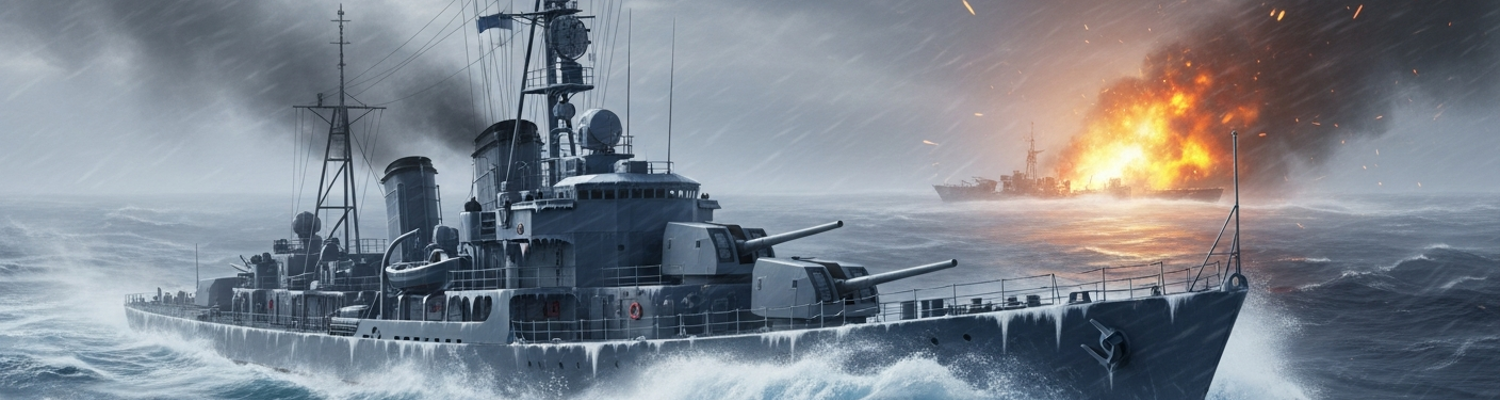

September 14, 1944. The Barents Sea. Thirty merchant hulls comprising Convoy JW-60 fought their way toward the Kola Inlet, a mixed collection of American-built Liberty ships and British tankers. Operational logs show the convoy had reached a particularly exposed stretch of its passage, steaming under a state of heightened alert. The close escort, a formation of more than twenty British and Canadian warships, maintained a vigilant perimeter. Among them, the ships of the fictional Task Group 27.4 were tasked with screening the convoy’s northern flank, a sector considered a likely vector for U-boat attacks originating from occupied Norwegian fjords. The weather was characteristically unforgiving. Rolling swells and intermittent sea spray coated every superstructure in a film of ice, hampering lookouts and degrading radar performance. Despite the heavy escort, which included the escort carrier HMS Campania, a palpable tension gripped the crews. Previous convoys had been savaged in these same waters. Every man aboard knew that a single torpedo could spell disaster.
The psychological strain was particularly acute on the bridges of the escorting destroyers. Archival evidence reveals commanders were operating under a new set of anti-submarine warfare directives (Admiralty Directive ASW-44-11b) that emphasized aggressive, offensive action. The days of merely reacting to an attack were over. The Admiralty, responding to the evolution of U-boat technology like the snorkel, now demanded that any suspected contact be hunted down. This pressure flowed down the chain of command, landing squarely on the shoulders of men like the commanding officer of Destroyer 8. His vessel, a fast, modern warship, was a key asset for Task Group 27.4. The Task Group’s commander had made it explicitly clear in pre-sailing briefings that hesitation would not be tolerated. Any sonar reading, no matter how faint, was to be treated as a confirmed threat until proven otherwise. This doctrine placed the CO of Destroyer 8 in a difficult position, caught between the need to maintain the convoy’s defensive screen and the direct order to break formation and attack.
The moment of decision arrived as a faint, indistinct echo on the asdic operator’s headset. The contact could have been a thermal layer in the water, a whale, or a German submarine. Under older protocols, the destroyer might have simply increased its state of readiness. But the new doctrine demanded more. For the CO of Destroyer 8, the ambiguous signal represented a direct challenge to the standing orders from Task Group 27.4. A decision was made in seconds. The ship’s engine order telegraph clanged, signaling for flank speed. The destroyer’s turbines spooled to their maximum output, and the hull began to vibrate as the ship heeled sharply to starboard, turning out of the convoy’s protective screen.
The flanking maneuver was an act of calculated aggression. The destroyer surged forward, its bow cutting through the Arctic swell and throwing sheets of frigid water across the deck. The plan was to race ahead of the suspected U-boat’s projected course, boxing it in while the destroyer prepared to roll depth charges from its stern racks and fire its forward-throwing Hedgehog mortars. This high-speed dash was a standard anti-submarine tactic, but its execution in this context was a significant risk. It instantly created a gap in the convoy’s northern escort screen. The maneuver also consumed a large quantity of fuel and announced the destroyer’s presence with a massive acoustic signature, blinding the ship’s own sonar to other threats. The vessel was now isolated, committed to a hunt based on a questionable contact.
The operational environment in the Barents Sea deteriorated with shocking speed. Meteorological records from the period highlight the prevalence of sudden, violent polar low-pressure systems that could form with little warning. For Destroyer 8, what began as manageable Arctic chop transformed in less than an hour into a full-blown blizzard. Wind speed escalated to Force 10 on the Beaufort scale, whipping the tops off the mountainous waves and filling the air with a blinding mixture of snow and sea spray. Visibility collapsed to less than the ship’s own length. The air temperature plummeted. With sea temperatures hovering just below 0°C, this spray flash-froze on contact with the cold steel of the superstructure. Within minutes, a thick, heavy coating of ice began to encase the forward gun turrets, the bridge, and the delicate aerials of the Type 271 surface search radar. Lookouts, already hampered by the whiteout conditions, were pulled back from their exposed positions as the ice load on the upper decks became a structural hazard.
The Arctic was no longer a backdrop; it was an active combatant.
This extreme environment pushed the ship’s technology past its designed tolerances. A destroyer’s effectiveness at flank speed was always a trade-off between power and stability. In these conditions, the equation turned negative. Archival analysis of similar destroyer classes shows that their Parsons geared steam turbines were robust, but not indestructible. Driving them at maximum revolutions for a prolonged period, especially while pitching violently in heavy seas, placed enormous strain on turbine bearings and the reduction gearing. In the engine room of Destroyer 8, engineers fought to maintain steam pressure as the demand for power fluctuated wildly with each wave that crashed against the hull. The frigid seawater being drawn in for the condensers risked super-cooling the system, affecting efficiency. The most acute technological crisis, however, was happening in the sonar room. The experimental 'Type 144' asdic set, designed to work with ahead-throwing weapons like the Hedgehog mortar, was operating at its absolute limit. The Barents Sea’s unique water conditions created thermal layers that refracted and scattered the sonar beam, creating shadow zones where a submarine could hide or generating false echoes that plagued the operator.
The tactical decision to continue the maneuver in the face of these compounding failures was a direct consequence of doctrine. The commanding officer was caught between the physical evidence of the storm and the psychological pressure of his orders. He had reports of icing rendering his primary radar and forward weapons useless, engine strain nearing the danger point, and sonar performance becoming highly unreliable. On the other hand, the Admiralty’s directive to aggressively prosecute all U-boat contacts was unequivocal. To turn back would be to let a potential killer escape and risk censure. The sonar operator, likely focused intently on his display, would have insisted the faint contact was still there. In the enclosed world of the sonar hut, the electronic ghost could seem more real than the physical storm outside. The commander, weighing the risk of mechanical failure against the certainty of a U-boat threat, chose to trust the technology. He ordered the helmsman to hold the course, pushing the ship and its crew deeper into the blizzard.
The first system to fail was the most important to the hunt. Operational logs from similar actions show the Type 144 sonar array was acutely vulnerable to the specific conditions Destroyer 8 now faced. The Type 144 was an ahead-throwing weapon director, its quartz transducer housed in a streamlined steel dome beneath the ship’s keel. As the destroyer pounded through the polar storm at flank speed, the sonar dome was subjected to a brutal cycle of temperature extremes. Submerged in the sub-zero Barents Sea, it was then lifted clear by the pitching hull into the far colder arctic air before plunging back into the water. This repeated, violent change induced a state of thermal shock in the delicate quartz components of the transducer. The rapid expansion and contraction from the temperature differential created immense internal stress. Analysis of transducer technology from the period indicates that such stress causes micro-fractures in the quartz, degrading or destroying its piezoelectric ability to generate and receive sound waves. Compounding this was the physical accretion of ice. With each plunge, a new layer of flash-frozen spray built upon the dome, encasing it in a thick, acoustically opaque shroud. The sonar operator, previously tracking a faint but persistent echo, now heard only the roar of the ship’s own passage and a wall of static. The 'ping' of the asdic was being smothered at its source.
The ship was now acoustically blind.
Within twenty minutes of the sonar failure, the ship lost its electronic eyes. The primary surface-search radar, a Type 271 set, was housed in a distinctive 'lantern' radome made of Perspex, located atop the forward mast. While providing a degree of weather protection, the lantern was not designed to withstand a full-blown arctic blizzard at sea. A torrent of freezing spray and wet, heavy snow slammed into the radome. The ice accumulation was rapid and total. Technical assessments from the period show that a heavy ice coating on the exterior of the radome would severely attenuate the 10-centimeter wavelength microwave pulses, blocking the signal. More critically, the sheer weight of the ice forming on the rotating 'double cheese' antenna assembly inside the lantern placed an unmanageable strain on the turning motor. The operator in the radar plot below would have first seen the returns on his A-scope display weaken and fill with clutter, before the bearing indicator seized completely as the motor burned out. The destroyer lost its ability to detect other vessels, low-flying aircraft, or even the massive icebergs that were common in these waters. Without radar, the bridge was thrown back to the technology of a previous century.
This equipment failure plunged Destroyer 8 into a profound sensory void. The aggressive hunter, which had confidently detached to prosecute a contact, was now isolated, deaf, and blind. On the bridge, the commanding officer was faced with a tactical nightmare. His two most advanced pieces of technology had been neutralized not by enemy action, but by the physics of the arctic environment. The ship was alone in a blizzard, its exact position increasingly uncertain without radar fixes on the distant convoy. The suspected U-boat they were hunting could now be anywhere, possibly turning the tables and stalking the crippled destroyer. The pressure to press the attack was now overshadowed by a more primal need: survival.
Blinded by the blizzard and deafened by the failure of its sonar, Destroyer 8 was reduced to relying on the human eye. Through a momentary thinning of the driving snow, a lookout screamed a contact report. It was a dark shape, low in the water, its silhouette distorted by the raging sea. On the bridge, deprived of radar for confirmation, the command team pieced together a terrifying picture from the fleeting visual. The shape appeared to have one funnel and a forward-leaning superstructure, a profile that, in the maelstrom, bore a resemblance to a German Elbing-class torpedo boat. What they were actually seeing was an Algerine-class minesweeper from a separate support group, HMS Bramble. A review of later analysis shows the minesweeper had already suffered heavy storm damage; its mainmast was gone, and a partially collapsed funnel gave it a squat, unfamiliar profile. The ship was struggling to rejoin the main convoy force after being detached for its own repairs. For the commander of Destroyer 8, operating under strict doctrine, the distorted shape in the blizzard was not a vessel in distress. It was the enemy.
The order to engage was given without hesitation.
With the forward gun turrets encased in ice and inoperable, the destroyer’s after 'X' and 'Y' turrets swung to bear. Each housed a QF 4.7-inch Mk XII gun. Gunnery control was entirely local, as the main fire director was also blinded by ice, forcing the gun captains to aim visually through their turret telescopes into the whiteout. This was naval gunnery reduced to its most basic form. The first salvo of 50-pound high-explosive shells screamed into the storm. The destroyer heeled as it changed course, its gunners struggling to compensate for the violent pitching and rolling. Then, a flash on the horizon. The second salvo found its mark. One shell struck the minesweeper’s superstructure just aft of the bridge, its explosion shredding the wireless telegraphy office and sending a spray of lethal shrapnel across the open compass platform. A second shell from the same salvo hit further aft, impacting the minesweeping winch gear. This impact severed steam lines and ignited a fire among the ready-use depth charges and floats stored on the fantail.
The effect on the unprepared minesweeper was catastrophic. The ship, with a standard complement of just over 100 men, was not built to withstand destroyer-caliber gunfire. Post-action reports from similar friendly-fire incidents reveal the efficiency of such an attack. The hit on the bridge superstructure killed or wounded most of the command team and the entire radio crew, instantly silencing any attempt to transmit an identification signal. The blast blew inwards, turning the narrow passageways into a killing zone. The fire on the stern deck, fed by flammable materials, threatened to detonate the remaining depth charges. Within moments, HMS Bramble was crippled, dead in the water, and burning fiercely. An analysis of the incident later confirmed 47 killed and another 28 gravely wounded. The survivors, battling fires and flooding in sub-zero temperatures, were now completely alone. Destroyer 8, convinced it had neutralized a German threat, fired no more shots and melted back into the blizzard.
The truth of the engagement returned to the convoy command not as a confirmed report, but as a growing anomaly on the radar plot. A review of Task Group 27.4’s action log shows the escort commander on HMS Campania tracking a stationary contact burning fiercely, located precisely where Destroyer 8 had reported prosecuting a target. The contact was not sinking. A garbled, desperate signal lamp transmission, sighted by a nearby corvette, identified the vessel as HMS Bramble. The operational directive was immediate. Destroyer 8, its commander now understanding the magnitude of his error, was ordered to break off its return course to the convoy and render assistance to the ship it had just shelled. This command decision, born of the necessity to save the lives of British sailors, sealed a catastrophic tactical vulnerability. The destroyer was forced to reverse course, moving even further away from the main body of Convoy JW-60, its primary duty of anti-submarine screening abandoned for the urgent, unplanned mission of damage control and rescue.
This reversal of course created a gaping wound in the convoy’s northern defensive screen. Convoy doctrine dictated a layered, overlapping field of sonar coverage. Destroyer 8’s assigned sector covered the front-to-port quarter of the convoy, a box of ocean it was meant to sanitize. Its high-speed hunt, mistaken engagement, and now its rescue task had pulled it more than fifteen nautical miles from its station. A gap, at least ten miles wide, was now open. Through this undefended corridor steamed the four merchantmen of the convoy’s port-most column, led by the American-flagged Liberty Ship SS Henry Bacon, its holds filled with 8,000 tons of crated aircraft parts and high-octane aviation fuel for the Soviet front. For a latent U-boat, this was a textbook opportunity.
Archival analysis of German naval operations in the Arctic indicates that Kriegsmarine U-boat command had positioned a wolfpack, codenamed Gruppe Grimm, to intercept JW-60. Lurking beneath the surface, running on silent electric motors just beyond the range of the convoy’s outer screen, was U-482, a Type VIIC submarine. Its commander had been tracking the convoy for hours, listening to the rhythmic pings of the escorts’ sonar and the churning propellers of the thirty merchant ships. The hydrophone operator first detected the high-speed signature of Destroyer 8 as it began its initial hunt. This was followed by the distinct, sharp underwater reports of 4.7-inch gunfire, and then the deeper concussion of shells striking a hull. U-482’s commander surfaced to periscope depth. Through his optics, he saw the distant fire, the crippled minesweeper, and the destroyer moving towards it, away from the convoy. He correctly assessed that a significant portion of the escort screen was now distracted and out of position.
The gap was visible.
U-482 submerged and began its approach, lining up on the lead ship of the exposed column. A firing solution was calculated with cold precision. The outer doors of the forward torpedo tubes were opened. The U-boat fired a fan of two G7e electric torpedoes, their battery-powered motors leaving no wake in the dark water. The first torpedo ran true, striking the SS Henry Bacon amidships on its port side, directly below the bridge. The warhead detonated inside the No. 3 hold, igniting the aviation fuel. A secondary explosion followed almost instantly, a colossal eruption of flame and steel that tore the Liberty Ship in half. The ship’s bow and stern sections rose into the air before vanishing into the Barents Sea in less than a minute. The second torpedo missed, running on to strike the convoy’s second ship, a British tanker, which began to burn. The unintended consequence of a single decision, made hours earlier in a blizzard, had now cascaded into a strategic crisis, marked by the fiery pyres of two merchant ships in the heart of the convoy.