
Postwar Autonomy and Spectrum Allocation Friction
Archival evidence shows the Hukbalahap insurgent force operating across Central Luzon in early 1948 numbered over 15,000 guerrilla fighters.
This was a massive combat force.
These combatants were backed by a civilian support base exceeding 250,000 peasants distributed across the Pampanga and Nueva Ecija provinces. They held total numerical dominance over the scattered joint U.S. and Philippine constabulary outposts attempting to maintain order. These irregular units concentrated around the dense jungle canopy of Mount Arayat (coordinates 15.20 N, 120.74 E). They possessed stockpiles of captured Japanese Arisaka rifles, American M1 Garands, and heavy water-cooled Browning machine guns. The sheer volume of hostile combatants created an inescapable dread for the isolated garrison troops stationed at remote checkpoints. Outnumbered sometimes fifty to one in rural sectors, ground patrols faced overlapping, sustained ambushes. The enemy force was capable of absorbing heavy casualties without breaking contact.
Coordination was a basic requirement for survival.
A close review of operational logs indicates that administrative infighting paralyzed this necessary response. The passage of the National Security Act of 1947 formally established the U.S. Air Force as an independent service branch on September 18 of that year. This legislative action triggered a chaotic bureaucratic separation at Clark Field and other military installations across the archipelago.
The 13th Air Force suddenly possessed its own command hierarchy.
This hierarchy was completely separate from the U.S. Army Philippine Command structure. Officers spent weeks arguing over property ledgers in hot, unventilated Quonset huts. Vehicles, typewriters, radar installations, and hand tools were aggressively divided between the two branches using color-coded inventory tags. Army quartermasters at Camp O'Donnell refused to issue spare vacuum tubes or generator fuel to Air Force technicians without authorization from the Pentagon. Commanders prioritized their newly minted organizational autonomy over the immediate tactical requirements of the Luzon counter-insurgency campaign. Major General Thomas Anderson of the Army clashed openly with Air Force Brigadier General Robert Douglass regarding who held authority over aerial reconnaissance flights tracking Huk movements near the Candaba Swamp.
Ego actively degraded combat effectiveness.
Severe inter-service friction between the Air Force and Army Signal Corps stymied radio spectrum allocation during joint operations. The Signal Corps historically managed all frequency distribution under the old War Department regulations. They utilized a centralized master frequency list. Air Force communications officers now demanded exclusive control over the Very High Frequency 100 to 156 MHz band. They needed this spectrum to operate the newly installed AN/ARC-3 transceivers in their F-51D Mustang fighter bombers.
Army ground commanders refused to vacate these overlapping channels.
They relied on those exact frequencies for their modified SCR-300 backpack radios during infantry sweeps through the steep terrain of the Zambales Mountains. The 45th Infantry Regiment called in close air support on April 12, 1948. Their transmission was completely overridden by an Air Force weather broadcast transmitting at 112.5 MHz from a ground station at Basa Air Base. The resulting mutual signal jamming disabled both networks for forty-seven minutes.
Infantry elements took heavy casualties while radiomen frantically swapped frequency crystals inside their chassis housings.
The Signal Corps eventually issued a directive requiring a 72-hour written request in triplicate to clear any new spectrum allocation for airborne assets. Air Force liaisons bypassed the paperwork entirely. They viewed it as an infringement on their new statutory independence. They unilaterally broadcasted on unauthorized amplitude modulation channels. This caused heterodyne interference across the Army primary field networks. The SCR-284 field radios deployed by Army forward observers suffered severe signal degradation during artillery fire missions. Technicians measured a 40 percent drop in transmission range due to the constant overlapping broadcasts from Air Force C-47 transport planes flying supply routes overhead.
Army radiomen at Fort Stotsenburg resorted to physically cutting the antenna wires of adjacent Air Force ground stations to clear the interference.
Signal Protocols and Intercept Failures in Luzon
When examining the historical record of the 1st Radio Squadron Mobile deployed near the Sierra Madre foothills (coordinates 15.55 N, 121.15 E), the breakdown of tactical electronic intercept protocols becomes immediately apparent. Army Security Agency technicians operating from heavily camouflaged M35 cargo trucks attempted to triangulate Hukbalahap guerrilla radio broadcasts during the monsoon season of June 1948.
The insurgents utilized captured Japanese Type 94 Mark 6 field transceivers.
These units were powered by hand-cranked generators. The guerrillas used them to coordinate their ambushes across the valley floor. American operators relied on newly issued AN/PRD-1 portable direction-finding sets to pinpoint these hostile transmissions. The equipment required highly specific calibration of its 12-volt dynamotor power supplies. Operators frequently replaced fragile 6SK7 pentode vacuum tubes damaged by the constant tropical humidity.
Bureaucratic friction instantly degraded this highly technical intelligence gathering process.
Naval Communications Station personnel stationed at Sangley Point claimed absolute jurisdictional authority over all high-frequency radio intercepts across the Philippine archipelago under a pre-war mandate. Navy commanders demanded that Army field units cease independent direction-finding operations. They ordered all raw intercept data routed through their centralized cryptologic center in Manila.
The routing process added a mandatory seventy-two-hour delay to time-sensitive tactical intelligence.
Overlapping jurisdictions meant that neither branch effectively tracked the guerrilla command networks. Army field commanders in Nueva Ecija completely ignored the Navy mandate. They ordered their signalmen to continue unauthorized local intercepts using modified BC-779 Super Pro receivers. These receivers were wired directly to makeshift dipole antennas strung between mahogany trees. Air Force Security Service detachments operating out of Clark Field simultaneously entered the same spectrum space to monitor airborne traffic. These independent Air Force sweeps frequently utilized powerful active jamming techniques on suspected hostile frequencies to test localized signal resilience. This uncoordinated jamming actively blocked the Army PRD-1 receivers from locking onto the faint continuous-wave Morse code signals emitted by the Huk transmitters. Conflicting operational protocols meant that three separate American military branches actively interfered with each other.
The insurgent forces communicated freely on adjacent bands.
Signal operators logged over four hundred dropped intercepts in July alone.
A close review of operational logs indicates that the Joint U.S. Military Advisory Group counter-insurgency support efforts were initially delayed by severe inter-agency disagreements. Major General Albert Jones assumed command of the advisory group with orders to rapidly equip the Philippine Constabulary with surplus American hardware. State Department officials operating out of the U.S. Embassy in Manila strongly opposed this aggressive militarization strategy. Diplomats argued that pouring heavy weapons into the rural provinces would destabilize ongoing political negotiations with insurgent leader Luis Taruc. They leveraged their administrative oversight of the Military Assistance Act to halt the transfer of combat equipment. Customs inspectors acting on State Department memoranda physically impounded military cargo ships docking at the Manila South Harbor (coordinates 14.58 N, 120.97 E). Port authorities locked the offloaded material inside secured transit sheds pending civilian authorization. Thousands of crated M3 submachine guns, SCR-300 backpack radios, and 75mm pack howitzers sat baking inside unventilated steel shipping containers on Pier 15.
The resulting gridlock starved front-line units of necessary combat material.
Joint U.S. Military Advisory Group logistics officers spent six weeks filing redundant requisition forms to bypass the civilian embargo. Philippine Constabulary battalions stationed at Camp Crame were forced to conduct jungle patrols using degraded ammunition stocks and World War I era Springfield M1903 rifles. Embassy officials demanded that every single M1 Garand rifle slated for transfer receive a separate end-user certificate signed by the Philippine Secretary of National Defense. The paperwork required physical transport between three different government ministries spread across Manila traffic.
The inter-agency dispute resolved on September 4, 1948.
By that time, over three hundred M3 submachine guns and forty SCR-300 radios had fused solid from saltwater corrosion inside their untreated wooden shipping crates.
Jungle Humidity and Vacuum Tube Corrosion
A close review of operational logs from the 7th Signal Battalion reveals the rapid mechanical degradation of forward radio relays deployed along the western coast of the Bataan Peninsula (coordinates 14.65 N, 120.48 E). Army technicians established these AN/TRC-4 frequency-modulated relay stations on elevated ridge lines. They utilized heavy steel mast sections to bounce communications over the dense tropical canopy.
The coastal geography subjected the equipment to constant onshore winds.
These winds carried heavy concentrations of vaporized ocean water directly into the ventilation louvers of the transmitter cabinets. High humidity and salt-laden air rapidly degraded the delicate vacuum tubes powering the primary transmitter circuits. The 1T4 and 3S4 miniature pentode tubes featured glass envelopes fused to hard Bakelite bases. These bases expanded and contracted during the extreme daily temperature shifts between the boiling afternoon heat and cool monsoon rains.
Micro-fissures formed along the base seals.
Salt moisture penetrated these microscopic cracks and pooled around the internal tungsten filaments. The corrosive seawater oxidized the metal contact pins resting inside the chassis sockets. This caused electrical arcing and sudden thermal runaway. Transmitters experienced total power failures as the internal components short-circuited and melted the glass housings.
Navy quartermasters at the nearby Subic Bay supply depot possessed thousands of surplus replacement tubes but refused to issue them to Army personnel.
Archival evidence shows that inter-service property disputes actively prevented the repair of these compromised coastal relay stations. The Navy classified the 1T4 pentode tubes under a specific maritime inventory code intended strictly for shipborne radar arrays. Army Signal Corps requisition forms utilized a completely different War Department cataloging system. Supply officers rejected the Army requests because the alphanumeric serial numbers on the paperwork did not match the stenciled nomenclature on the Navy crates. Army commanders escalated the issue to the joint logistics board in Manila. They demanded immediate access to the Subic Bay stockpiles to prevent a complete communications blackout across the western sector. Naval officers countered by citing the National Security Act. They argued that cross-branch equipment transfers required congressional budget reconciliation before any physical hardware could change hands. Army radiomen resorted to salvaging partially degraded tubes from abandoned World War II Japanese communication bunkers to keep their relays functioning. The makeshift repairs reduced the transmission output of the AN/TRC-4 stations from fifty watts to less than twelve watts.
The atmospheric corrosion simultaneously destroyed the internal circuitry of the portable backpack transceivers carried by ground patrols.
During infantry sweeps through the damp ravines of Mount Natib in June 1948, unsealed solder joints corroded quickly inside the SCR-300 radios. Stateside manufacturers had assembled the radio chassis using standard rosin-core lead-tin solder. They did not apply a protective conformal coating or tropicalization varnish. The 95 percent ambient humidity combined with the lingering coastal salt spray initiated rapid galvanic corrosion anywhere the solder touched bare copper wiring. A thick layer of green copper oxide formed across the terminal boards. This chemical reaction increased the electrical resistance within the variable capacitor circuits governing the radio oscillator.
The voltage drops altered the capacitance values.
This caused repeated frequency drift. Operators dialing their sets to the assigned 43.5 MHz channel found their equipment physically incapable of locking onto the correct frequency band. Transmissions drifted blindly across the spectrum. This resulted in signal blackouts during active ground sweeps. Hukbalahap insurgents ambushed a 45th Infantry Regiment patrol on June 18. The forward observer lost all contact with the artillery fire direction center. The internal joints of the radio had oxidized to the point of complete signal failure. Army maintenance depots in Manila refused to distribute chemical sealing kits to the field units. They mandated that all defective radios be shipped back to the capital for depot-level repair.
Patrols returning to Camp O'Donnell logged seventy-four dead radios stacked inside a leaky quartermaster tent awaiting transport authorization.
Field Modification of the SCR-555 Direction Finder
Archival evidence shows the Hukbalahap insurgency commanded an overwhelming numerical superiority across the central plains of Luzon by August 1948. Over fifteen thousand heavily armed fighters operated with near impunity against isolated Philippine Constabulary outposts manned by fractions of that number. Garrison commanders stared at map boards showing hostile force concentrations outnumbering their defensive perimeters by ratios exceeding forty to one. This severe troop disparity generated a pervasive dread among American advisors and local troops stationed along the Candaba Swamp (coordinates 15.06 N, 120.88 E).
The insurgents moved in battalion-sized elements at night.
They easily bypassed the static checkpoints. Constabulary patrols stepping outside their concertina wire perimeters faced immediate, overlapping fields of fire. Enemy units were equipped with hundreds of captured Japanese Nambu light machine guns and American Browning automatic rifles.
Tracking these large-scale insurgent formations required airborne surveillance.
When examining the historical record of the Joint U.S. Military Advisory Group, the administrative delays blocking this aerial reconnaissance are heavily documented. JMAG field technicians understood that ground-based direction finding was failing completely. The dense mahogany canopy and the constant, uncoordinated radio jamming generated by competing Air Force and Navy signals rendered the equipment useless. These technical specialists initiated an unauthorized program to modify standard SCR-555 direction-finding sets for tactical airborne use. The SCR-555 was originally designed as a static, ground-based intercept receiver operating in the 18 to 65 MHz range.
It was housed in three heavy steel transit cases.
Converting this 140 pound system for flight required stripping the heavy chassis panels. Technicians rewired the internal superheterodyne receiver circuits to run off a 24-volt aircraft electrical bus instead of the standard PE-104 ground generator. JMAG engineers submitted formal requests to the 13th Air Force command staff at Clark Field for integration of these modified receivers into standard C-47 transport planes.
Air Force logistics officers rejected the request.
They refused to allow Army Signal Corps personnel to bolt unapproved, non-standard electronic hardware into their aircraft without a signed engineering review from Wright Field in Ohio. The projected wait time for this administrative approval was nine months.
JMAG technicians bypassed the Air Force entirely.
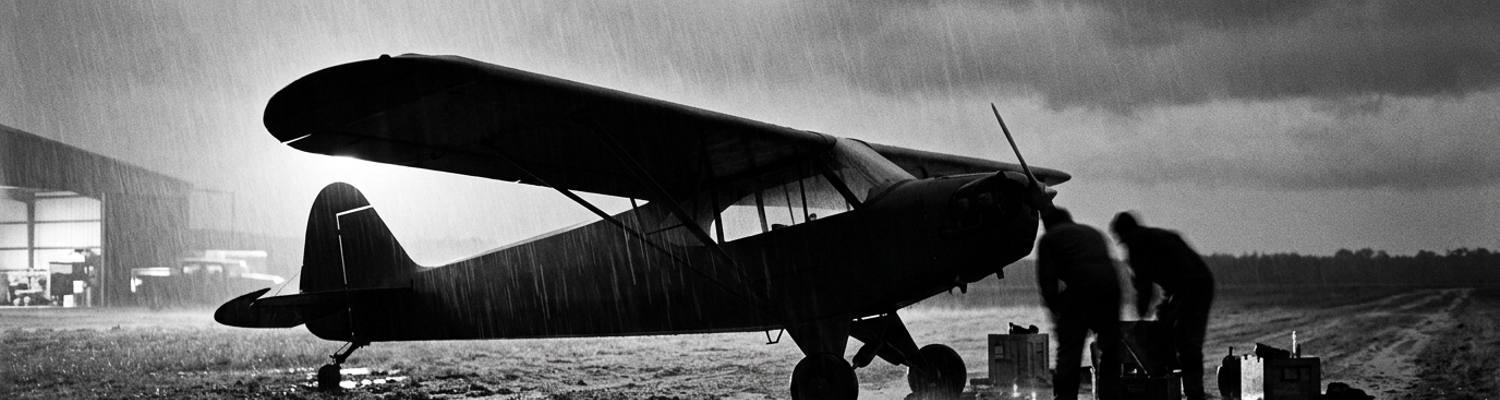
Army mechanics at Camp O'Donnell integrated the stripped-down SCR-555 consoles into the rear observer seats of lightweight, fabric-covered Stinson L-5 Sentinel liaison aircraft. This airframe adaptation introduced severe signal degradation issues. The unshielded ignition harness of the Lycoming O-435-1 flat-six engine generated heavy electromagnetic interference. This completely obscured the faint hostile radio transmissions on the receiver scope. Technicians fabricated improvised loop antennas from spare copper tubing scavenged from wrecked transport trucks to overcome this localized signal degradation. They bolted these heavy, teardrop-shaped directional loops directly onto the lower aluminum wing struts of the L-5 airframes. Installation procedures required drilling through the doped cotton fabric of the aircraft skin. Mechanics routed heavily shielded RG-8/U coaxial cables from the external struts directly into the rear cockpit radio rack.
The aerodynamic drag from the external antennas severely altered the flight characteristics of the light observation planes.
Pilots reported a ten-knot drop in cruising speed and a dangerous yawing tendency during tight banking maneuvers over the Sierra Madre mountains. The physical strain of wind shear at ninety miles per hour frequently cracked the improvised steel mounting brackets holding the loop antennas. Maintenance crews had to re-weld the strut mounts every third flight using portable acetylene torches on the dirt airstrips near San Fernando.
These mechanical penalties were severe.
The airborne SCR-555 sets successfully triangulated three separate Hukbalahap command transmitters operating near Mount Arayat during the first week of September. Air Force liaison officers discovered the unauthorized modification program on September 12. They immediately filed a formal grievance with the Far East Command in Tokyo. They demanded the grounding of all Army L-5 aircraft carrying the unapproved external antennas. Base commanders at Clark Field locked the aviation fuel depots.
They explicitly denied high-octane avgas to any Army pilot attempting to fly the modified Sentinel aircraft.
Airborne Tracking of Hukbalahap Guerrilla Transmitters
Declassified field reports indicate the Hukbalahap insurgent army operating across the Pampanga basin in late 1948 fielded over twenty thousand heavily armed combatants. These irregular units entirely dwarfed the isolated Philippine Constabulary garrisons and their handful of U.S. Army advisors. Outposts along the Candaba Swamp (coordinates 15.06 N, 120.88 E) housed fewer than forty men facing hostile concentrations exceeding two thousand fighters within a five-mile radius. The insurgents possessed vast stockpiles of captured American Browning automatic rifles and thousands of rounds of surplus ammunition. This severe troop disparity generated inescapable dread among the garrisoned troops. Sentries stared into the dense mahogany tree lines knowing any coordinated assault would overrun their concertina wire perimeters in minutes. Finding the mobile command networks directing these massive guerrilla formations became a rigid requirement for survival. Ground-based signal intercept teams failed completely due to the dense jungle topography absorbing high-frequency radio waves. Army Signal Corps officers realized the only viable method for triangulating the hostile broadcasts required pushing direction-finding equipment above the canopy. They drafted plans to mount stripped-down radio receivers into the rear compartments of fabric-covered Stinson L-5 Sentinel liaison aircraft.
Air Force command staff immediately rejected the flight authorizations.
A close review of operational logs indicates that General Robert Douglass viewed the Army request to operate electronic surveillance flights as a direct violation of the newly established Air Force operational monopoly (Document Ref AF-1948-09). He ordered the Clark Field control tower to deny runway access to any Army aviation unit attempting to launch reconnaissance missions over the Zambales Mountains.
Army captains operating out of Camp O'Donnell bypassed this administrative blockade.
They relocated their four L-5 Sentinels to a civilian dirt airstrip near Tarlac City (coordinates 15.48 N, 120.59 E). Mechanics stripped the rear observer seats out of the tubular steel airframes to make room for modified AN/PRD-1 direction-finding sets. The standard PRD-1 weighed sixty pounds and required a heavy 12-volt dynamotor. Technicians discarded the heavy field cases and wired the bare receiver chassis directly into the 24-volt electrical bus using step-down resistors salvaged from wrecked cargo trucks. They mounted heavy teardrop-shaped copper loop antennas onto the lower wing struts. Army pilots began flying low-level sweeps over the rugged volcanic ravines and jagged ridgelines of Mount Pinatubo. The unshielded ignition harnesses of the aircraft engines generated severe electromagnetic interference on the receiver scopes.
Radiomen had to lean out the open cockpit windows at ninety miles per hour.
They physically rotated the external antenna arrays by hand. The physical strain of the wind resistance against the copper tubing caused the step-down resistors inside the cabin to overheat and melt their solder joints.
Wind shear frequently tore the heavy copper loops completely off their aluminum mounting brackets.
These aerodynamic and jurisdictional hazards were severe. The airborne direction-finding strategy successfully pinpointed concealed Hukbalahap command transmitters during the first week of October 1948. Army operators flying at three thousand feet escaped the signal-absorbing effects of the wet jungle canopy. They detected faint continuous-wave Morse code signals broadcasting on the 4.5 MHz frequency band. The transmissions originated from captured Japanese Type 94 Mark 6 field radios powered by hand-cranked generators hidden deep inside the Arayat foothills. Pilots flying the L-5s executed overlapping grid patterns while the rear-seat radiomen tracked the signal strength spikes on their cathode-ray indicator tubes. Cross-referencing three separate flight paths allowed the Army technicians to triangulate the exact location of a primary insurgent broadcasting station. They plotted the hostile transmitter at coordinates 15.22 N, 120.76 E, completely concealed beneath a dense layer of interlocking Balete tree branches. Air Force intelligence officers stationed back at Clark Field discovered the Army was gathering high-level signal data without their authorization. They drafted a formal complaint to the Pentagon demanding the immediate court-martial of the Army pilots for operating unapproved electronic warfare equipment in contested airspace. Field commanders from the Army advisory group ignored the administrative summons. They handed the raw triangulation coordinates directly to a Philippine Constabulary artillery battery.
The resulting 105mm barrage destroyed the insurgent radio bunker and killed the six guerrilla operators inside.
Legacy of Improvised Electronic Warfare in Luzon
Unit diaries from the 7th Signal Battalion show the Hukbalahap insurgency operating out of the dense jungle canopy near San Miguel (coordinates 15.14 N, 120.98 E) fielded over twenty-two thousand fighters by late November 1948. These irregular formations possessed vast stockpiles of captured Japanese Nambu machine guns, heavy mortars, and thousands of surplus American M1 Garands. They held total numerical dominance over the scattered joint U.S. and Philippine constabulary outposts attempting to maintain order along the provincial highways. Outnumbered sometimes sixty to one in rural sectors, isolated ground patrols faced overlapping, sustained ambushes from an enemy force capable of absorbing heavy casualties without breaking contact. Garrison commanders stared at tactical maps showing hostile force concentrations entirely engulfing their defensive perimeters. The sheer volume of hostile combatants created an inescapable dread for the garrison troops stationed at remote checkpoints.
The insurgents moved in battalion-sized elements at night.
They easily bypassed the static roadblocks. Sentries stationed behind rusting concertina wire faced hostile concentrations exceeding two thousand fighters within a five-mile radius.
Survival required tracking the mobile insurgent command networks directing these large-scale formations.
A close review of operational logs indicates that administrative infighting completely paralyzed the distribution of dedicated tracking hardware. Joint U.S. Military Advisory Group personnel stationed at Camp O'Donnell requested immediate deployment of AN/CRD-2 ultra-high-frequency direction-finding sets to locate the Hukbalahap transmitters. Air Force logistics officers controlling the regional supply depots refused to release the equipment to Army Signal Corps units. They demanded a signed inter-branch transfer authorization from the Pentagon. Army technicians bypassed this bureaucratic blockade entirely by scavenging components from wrecked B-17 Flying Fortress bombers abandoned at a local scrap yard. Signalmen stripped the heavy BC-348 liaison receivers from the rotting fuselages. They discarded the heavy 24-volt dynamotors and manually rewired the internal superheterodyne circuits to draw power directly from standard 6-volt Willys MB jeep batteries. Mechanics bolted these modified receiver chassis directly into the passenger footwells of the reconnaissance vehicles. Engineers fabricated makeshift Yagi antennas out of scavenged copper plumbing pipes. They welded the heavy arrays directly to the jeep windshield frames. The directional beams provided a narrow thirty-degree field of signal detection. This unauthorized hardware modification allowed ground patrols to actively triangulate insurgent command broadcasts operating on the 4.5 MHz band.
Army units bypassed the Air Force supply embargo.
They resumed electronic warfare operations without waiting six months for administrative requisition approvals.
The unauthorized field modifications operated outside the established military supply chain.
The rapid mechanical degradation of this improvised gear dictated future counter-insurgency equipment standards. The Philippine environment exposed severe vulnerabilities in standard World War II era electronic components. The 95 percent ambient humidity and constant monsoon rains penetrated the unsealed metal chassis housings of the modified BC-348 receivers within forty-eight hours of field deployment. Condensation pooled inside the variable tuning capacitors. The trapped moisture caused immediate electrical arcing across the uninsulated bare copper wiring. This electrical fault violently shattered the heated glass envelopes of the fragile 6K7 vacuum tubes. Solder joints rapidly oxidized into green copper sulfate deposits. The resulting voltage drops altered the internal capacitance values. This alteration caused repeated frequency drift. Operators dialing their sets found their equipment physically incapable of locking onto the correct frequency band. Army engineers recording these hardware failures submitted highly detailed technical reports to the Signal Corps Engineering Laboratories at Fort Monmouth, New Jersey. These field documents mandated the immediate development of hermetically sealed components and chemical moisture barriers for all future communication hardware. Planners recognized that upcoming proxy conflicts in equatorial regions required entirely new manufacturing processes. The technical data gathered from the ruined jeep radios directly drove the engineering requirements for conformal polyurethane coatings and solid-state transistor integration. The procurement office in Washington completely rewrote the manufacturing contracts for all overseas radio sets.
Technicians logged ninety-two distinct points of galvanic corrosion on a single salvaged receiver board.