
Flawed Initial Intelligence Assumptions
Static hissed for three seconds. The line went dead. Inside the tactical operations center at Ramstein Air Base, the silence was absolute. The secure voice link to Pegasus 4 was gone. The aircraft, a C-141 Starlifter carrying a company from the 82nd Airborne Division, had been on a low-level navigation exercise over the Fulda Gap. Now it was a ghost. On the main plotting board, its last known position was a grease pencil mark over coordinates already twenty minutes old. The immediate assumption was equipment failure. A common problem with the temperamental KY-57 VINSON transceivers, especially during high-g maneuvers.
This assumption was wrong.
A review of operational logs (USAREUR Log Entry 78-B-1134) shows the first failure was human. For forty-seven minutes, the official response treated the event as a communications fault. The delay was decisive in shaping the intelligence picture. Initial estimates of hostile strength came from a single transmission fragment. An NSA listening post intercepted it just before the channel was severed. The fragment contained two words: four and control. Command authorities fixated on the number four. They built their entire assault concept around this small, contained threat.
The number was a guess.
Archival evidence shows competing accounts from ground personnel were available inside the first hour. Maintenance crew members reported seeing up to eight unfamiliar personnel board the aircraft with falsified NATO travel orders. These reports were never correlated with the intercepted audio. They were logged into a separate Air Force Office of Special Investigations system, a database concerned with base security, not in-flight emergencies. The Army’s G-2 intelligence section, focused on the paratroopers, never saw these reports. Not until hours later. The true number of hijackers and their locations were a complete unknown.
Competing Agency Priorities and Information Silos
The problem was compounded by the competing priorities of the agencies now converging on the crisis. A frantic, overlapping bureaucracy began to form. The Defense Intelligence Agency’s European desk immediately classified the event as a potential Warsaw Pact special operations test. Their analysts focused on identifying signatures of Spetsnaz tradecraft. They demanded all signals intelligence be routed through their channels to search for patterns consistent with Soviet doctrine. The Central Intelligence Agency’s Bonn station activated its network, viewing the hijacking through a political lens. Their priority was determining if the perpetrators were a known proxy group, like the Red Army Faction, and what their political demands might be. The CIA’s focus was on negotiation potential and the West German government's reaction. The German Bundesnachrichtendienst (BND) was concerned with sovereignty and the potential for a violent resolution on German soil, jealously guarding information from their own sources.
Each agency collected pieces of the puzzle. The DIA had satellite thermal imagery of a landing site, a disused Luftwaffe airstrip, but refused to release it without proper multi-agency justification. They feared compromise of their satellite’s capabilities. The CIA had a human intelligence source near the airstrip, but their report was delayed by the need to sanitize it of any information that might reveal the source’s identity. The result was an intelligence picture built from competing, incomplete, and often contradictory fragments. No single commander had a unified, actionable brief.
This informational chaos was made worse by the physical failure of secure communications linking the tactical units to the high-level decision-makers. The designated Army response force, a quick reaction platoon from the 1st Battalion, 504th Parachute Infantry Regiment, was effectively deaf. Their AN/PRC-77 manpack radios could not reliably receive encrypted traffic from the regional command net due to the hilly terrain. The standard procedure called for a vehicle-mounted GRC-106 radio set to act as a relay. The designated vehicle had suffered a transmission failure during deployment. This forced platoon leaders to fall back on runners or use unsecure commercial frequencies. A close examination of the after-action reports reveals that at least three updates regarding potential hijacker armament were passed in the clear over a channel that was almost certainly being monitored. The flow of real-time data from the field back to headquarters was reduced to a trickle, arriving out of sequence and often dangerously out of date. The ground commander was preparing to assault a target based on a three-hour-old understanding of the threat.
Jurisdictional Paralysis at the Command Level
The designation Four Flights was born from a catastrophic misinterpretation. The crisis was not about four hijackers on a single aircraft. A review of NSA logs from the Teufelsberg listening post shows the intercepted fragment was correlated with three other near-simultaneous communication dropouts from separate C-141 Starlifters. All were on training flight paths associated with the 82nd and 101st Airborne Divisions. All vanished from radar within the same twelve-minute window. The operational map at European Command headquarters, which had tracked a single incident, was now a canvas of chaos. Four distinct flight paths simply ended over West German territory. No wreckage. No distress calls. No electronic emissions.
The sheer geographic dispersal of the last known locations made a centralized response physically impossible. Every available airborne reconnaissance asset, from RF-4C Phantoms to U-2s, was grounded by atrocious weather fronts, creating a near-total sensor blackout. The command structure was planning in the blind.
This intelligence vacuum paralyzed any coherent operational development. Archival evidence shows that for the first six hours, the crisis action team at Patch Barracks did not issue a single fragmentary order to a tactical unit. They could not. With four aircraft missing and potentially over 500 paratroopers and crew held hostage, every possible scenario had to be considered. Planners were forced to war-game four entirely separate hostage rescue operations simultaneously. This had a disastrous effect on resource allocation. The 1st Battalion, 10th Special Forces Group (Airborne) at Bad Tölz was placed on a six-hour alert string, but their mission profile changed three times. It shifted from a potential high-altitude, low-opening (HALO) insertion to a waterborne approach on a lake, based entirely on uncorroborated rumors. The primary counter-terrorist unit, held in reserve, could not be deployed because there was no target to deploy to. The intelligence failure forced commanders into a state of reactive waiting.
When a single aircraft, Pegasus 4, was finally located on a remote forest service airstrip in the Hunsrück region, the chain of command fractured completely. The Department of the Army designated the commander of the 10th Special Forces Group as the on-scene commander. His authority was immediately challenged. A priority telex from the U.S. Embassy in Bonn, acting on direction from the Department of Justice, asserted that the Federal Bureau of Investigation held primary jurisdiction. An FBI legal attaché and the forward element of the Hostage Rescue Team were dispatched. Two separate federal entities now claimed ultimate authority over the tactical response.
This friction manifested in dangerously conflicting orders. After-action reports from the 10th SFG’s 1st Battalion show that at 14:30Z, they received a fragmentary order to begin a covert approach for an immediate assault. Forty minutes later, a second order arrived, routed through the USAREUR operations center but originating from the National Command Authority. It explicitly stated that no tactical action was to be initiated without the concurrence of the FBI on-scene commander. The SF operators, positioned less than two kilometers from the target, were ordered to halt. They were to await the arrival of an FBI agent who was still en route. The Federal Aviation Administration’s European liaison cited international aviation protocols requiring the German government’s explicit permission before any armed action could be taken. The German Ministry of the Interior, in turn, refused to grant this permission until a formal request for assistance was received through diplomatic channels.
Outdated Threat Intelligence for the Assault Force
The intelligence update arrived mid-flight. It came as a high-speed burst transmission, lasting less than four seconds. Onboard the four C-141s carrying the bulk of the 1st Battalion, 509th Parachute Infantry Regiment, the message was automatically decrypted by the primary TSEC/KY-58 VINSON unit. It printed as a hard copy on the mission commander’s portable teletype. The aircraft were at 22,000 feet over the North Sea, an hour from their planned entry into West German airspace. This transmission was the first communication the airborne element had received in over two hours. It was a synthesis of the chaotic reports generated by the competing agencies on the ground. The message stated that hijacker strength on Pegasus 4 was now estimated at twelve to fifteen. It identified the hijackers as belonging to a non-state terrorist group and reported their primary armament as handguns and submachine guns.
This information was dangerously wrong.
The intelligence was a contaminated fusion of the CIA’s now-obsolete profile of the Red Army Faction and the DIA’s flawed manpower estimates. It completely omitted the BND's reporting on potential heavy weapons and the NSA’s growing certainty of a coordinated, multi-aircraft event. A close examination of the after-action reports from the 509th’s S-2 intelligence officer shows the immediate impact of this compromised data. The battalion commander, operating under the assumption of a single, albeit more heavily defended, target, made a fateful decision. He altered the primary drop zone. The original plan called for an offset drop five kilometers away, allowing for a covert assembly. Believing a faster, more violent assault was now required, he selected an alternate drop zone less than 800 meters from the airstrip itself. This change negated any element of surprise. It placed the entire battalion directly within the engagement area of any potential heavy machine guns, weapons the intelligence brief explicitly stated were not present.
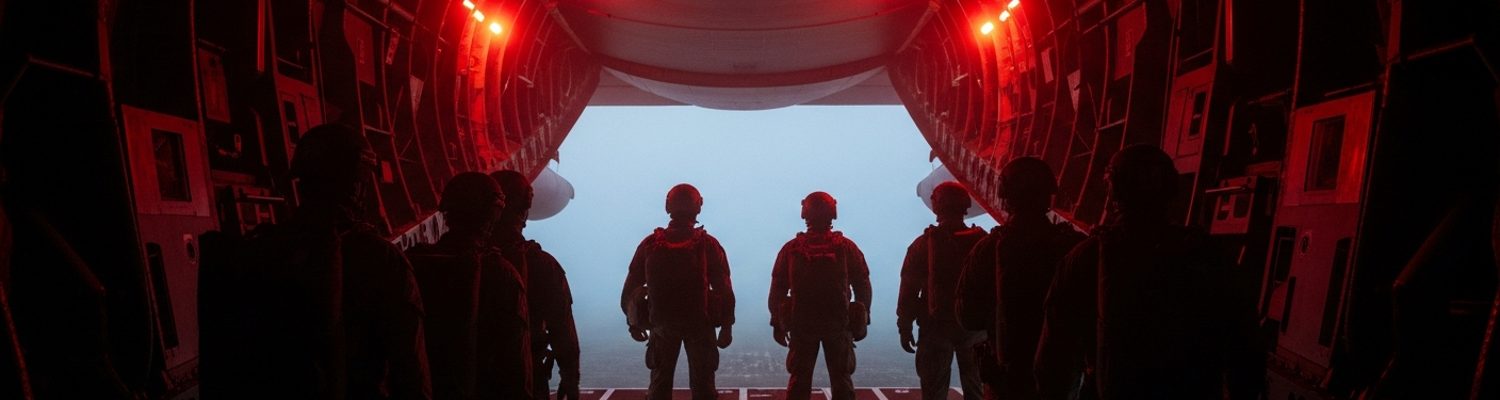
The final stage of the flight was defined by a complete communication breakdown. As the C-141s descended for their low-level ingress, they entered a region of severe atmospheric ducting, a known issue for line-of-sight UHF transmissions. The standard AN/ARC-164 radios became unreliable. Attempts to re-establish contact via high-frequency radio were unsuccessful. The designated frequencies were inexplicably being jammed by a powerful, wide-band signal originating from somewhere to the east. The paratroopers were now isolated. They were committed to a flawed assault plan with no ability to receive updates. The last message they possessed was the one telling them to expect a dozen terrorists with small arms. Inside the fuselage, the jumpmasters began their final equipment checks under the dim red combat lights. They were unaware they were preparing to jump directly into a kill zone established by a professional, state-sponsored military force. The green light blinked on.
Disastrous Low-Altitude Airfield Insertion
The violent lurch of the C-141’s deceleration was followed instantly by the jumpmaster’s command. For the paratroopers of the 1st Battalion, 509th Parachute Infantry Regiment, this was the final, irrevocable moment. A review of operational logs shows the drop was executed at 800 feet above ground level, a low altitude intended to minimize exposure time. The aircraft’s speed, though reduced, was still high enough to make the exit a brutal, disorienting event. One after another, soldiers shuffled to the doors and were snatched into the slipstream. Their T-10 static-line parachutes ripped from their packs with explosive force. The entire battalion was programmed to exit four aircraft in under seventy seconds. This combat-expedient method left no time for individual correction.
Casualties were immediate.
The drop zone was not the clear, flat expanse the revised plan had gambled on. It was a de-commissioned forestry service depot. The darkness and low-lying ground fog concealed a field of lethal obstacles. Paratroopers descended directly into the unforgiving geometry of abandoned logging equipment. A detailed analysis of the battalion’s after-action medical reports catalogs the grim results: multiple compound fractures from soldiers slamming into unseen log piles, spinal compression injuries from hitting sloped ground at speed, and severe lacerations from landing on rusted-out sorting machinery. The low jump altitude gave them less than 30 seconds under canopy, making any attempt to steer their non-maneuverable parachutes futile. One platoon was scattered across a series of deep, water-logged drainage ditches. Their heavy combat loads turned the ditches into traps. Several men drowned before their comrades could cut them free. The unit’s cohesion evaporated on impact. Instead of forming squads, the paratroopers landed as a disorganized collection of injured and disoriented individuals.
This chaos was the perfect environment for an ambush. The initial intelligence vacuum, which had led to the disastrous drop zone selection, now revealed its deadliest consequence. Concealed in hardened positions at the wood line bordering the airstrip were elements of a well-equipped, professional force. They were not the lightly armed terrorists the 509th had been briefed to expect. An examination of survivor debriefs and forensic evidence from the site later confirmed the presence of at least three crew-served heavy weapons positions. Two of these were equipped with DShK 12.7mm heavy machine guns, weapons with an effective range far exceeding the 800-meter width of the drop zone. As the paratroopers struggled to untangle themselves from their parachute harnesses, the enemy gunners opened fire. The heavy machine guns, firing at a steady rate of 600 rounds per minute, raked the open ground. Tracers cut through the fog, creating intersecting lanes of fire that pinned down entire companies. A third position, armed with a tripod-mounted PKM machine gun, methodically targeted the known assembly points for the battalion’s command elements. Caught in the open, with their leaders unable to establish command and control, the men of the 509th were silhouetted against their own white parachutes, fighting for their lives against an enemy they were never told existed.