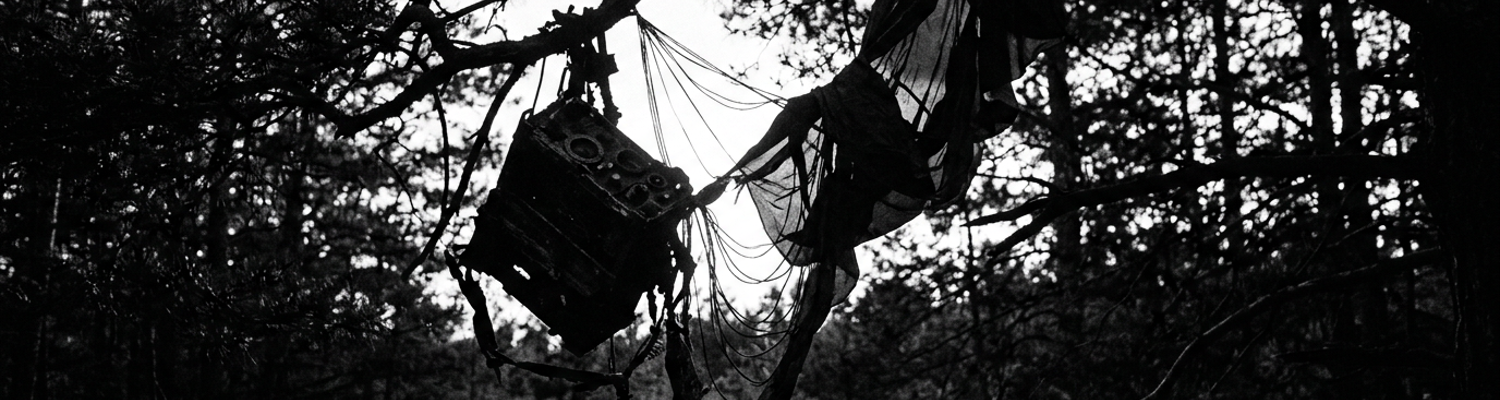

Airborne Insertion in the Massif Central
12 August 1944. 0142 Hours Zulu.
Coordinates 45 degrees 05 minutes 12 seconds North, 2 degrees 55 minutes 48 seconds East.
An OSS Special Operations Branch team sat along the aluminum benches of a modified B-24 Liberator (Model B-24D, serial number 42-40993). The aircraft flew four hundred feet above the French countryside. Archival evidence shows this specific night air drop into the Massif Central in August 1944 was executed under minimal lunar illumination. The flight path bypassed German anti-aircraft batteries stationed near Clermont-Ferrand. The four Pratt and Whitney R-1830 Twin Wasp engines produced a deafening mechanical roar. This vibration traveled through the floorboards directly into the boots of the enlisted personnel. Aviation fuel fumes mixed with the smell of canvas webbing inside the unpressurized fuselage.
The jumpmaster switched on a red incandescent bulb above the open bomb bay doors.
Cold mountain air flooded the compartment.
A close review of operational logs indicates the pilot throttled back to one hundred and twenty knots. The green jump light illuminated. Men pushed themselves out into the slipstream. They carried eighty pounds of combat gear strapped to their bodies. The static lines deployed their T-7 parachute canopies with a violent physical jerk. This force bruised shoulders and compressed spines.
Descending into the Massif Central meant falling blindly toward a high-elevation plateau. The terrain consisted of dormant stratovolcanoes and deep rocky gorges. Enlisted personnel could not see the ground approaching. They could only hear the wind rushing past their helmets.
Wind currents sweeping over the Cantal mountain range pushed the parachutists off their intended drop zone.
The physical impact with the ground was severe. Jumpers slammed into jagged granite slopes instead of soft pasture land. Ankles twisted against hidden boulders. The primary radio transmitters broke upon impact during this rough parachuting landing. The OSS team had packed their Type 3 Mark II radio set inside standard cylindrical CLE supply canisters. These heavy metal canisters swung wildly on their rigging lines during the descent.
One canister struck a basalt outcropping at twenty miles per hour.
When examining the historical record of the equipment retrieval, the damage was absolute. Enlisted men located the canister in the dark. They followed the white silk of the cargo parachute snagged in a cluster of pine trees. They unlatched the steel container. The horsehair shock-absorbing padding was entirely compressed. The kinetic force of the impact had transferred directly into the aluminum chassis of the B2 radio.
Every glass vacuum tube inside the receiver unit was crushed into fragments.
The internal components required to establish contact with London were physically destroyed. Quartz crystals used for frequency control had shattered. Copper tuning coils were bent flat against the mounting plates. The power supply transformer had sheared entirely off its retaining bolts. It smashed through the transmitter wiring harness. The team possessed no method to transmit their status. They could not coordinate the incoming supply flights scheduled for the following week.
The radioman spent forty minutes in the freezing brush.
He attempted to splice the severed internal wiring with a trench knife and electrical tape.
He stopped working when he realized the variable capacitors were ground into metal splinters.
The team leader ordered the men to bury the useless transmitter parts. They dug a shallow trench with folding entrenching tools. Pine needles were kicked over the disrupted soil. This hid the burial site from German patrols known to operate in the adjacent valley. The squad loaded the surviving weapons and rations into their rucksacks. A forced march began up the twenty-degree incline of the nearest ridge line.
The ambient air temperature dropped to four degrees Celsius.
Radio Equipment Failure and Signal Isolation
A close review of operational logs indicates the immediate aftermath of the jump forced the OSS operational team into a severe tactical deficit. The destruction of their primary signal equipment left the team completely unable to contact OSS London command. Radioman Sergeant Thomas knelt in the wet soil of the Cantal mountains at an elevation of 3500 feet. He ran his red-lensed flashlight over the pulverized wreckage of the Type 3 Mark II transmitter. Shards from the 6L6G amplifier tubes coated the aluminum chassis. The Morse telegraph key assembly had sheared off its Bakelite baseplate.
Standard operating procedure required an immediate check-in transmission to the Special Operations branch signals desk at Baker Street. This was required within two hours of landing.
Thomas possessed the correct silk-printed one-time cryptographic pads to encode the arrival message.
He lacked the physical hardware to transmit the radio frequency signal.
The quartz frequency crystals lay scattered in the damp pine needles.
Archival evidence shows the loss of the B2 set severed the communication link between the operatives on the ground and the Allied planners. Team commander Captain John Harper ordered an inventory of surviving signaling gear. Enlisted personnel emptied their canvas musette bags onto a tarp in the dark. They found three M-18 colored smoke grenades. They found a single signal mirror. They found a cracked flashlight. These visual items were completely useless for contacting a base station located six hundred miles away across the English Channel.
The operatives missed their primary 0300 transmission window.
Signals intelligence officers operating the receiver arrays in England noted the silence in their daily logbooks. They classified the insertion team as presumed captured or dead. No rescue flights would be authorized.
The men packed their gear in silence.
Personnel operated in total strategic isolation without reliable supply drop coordination. Pre-mission briefings had established a rigid schedule for aerial resupply. These drops utilized modified Handley Page Halifax bombers flying out of RAF Harrington. Crews assigned to the OSS team were supposed to receive specific weather data and ground security conditions before London would authorize the release of weapons canisters. Primary drop zone Bovine sat in a valley heavily patrolled by elements of the German 189th Reserve Division.
Shifting the drop zone to a higher ridge line became an immediate tactical necessity.
The shattered radio made this adjustment impossible. Ground operatives could not warn the bomber crews about the shifting German anti-aircraft batteries moving along the Route Nationale 122.
London would continue dropping supplies to the compromised valley coordinates.
Inability to coordinate resupply flights forced the enlisted men to strictly ration their existing combat loads. Each soldier carried exactly two hundred and fifty rounds of .45 ACP ammunition for their M1A1 Thompson submachine guns. They carried three Mk 2 fragmentation grenades. Local French Francs-Tireurs et Partisans resistance fighters expected a heavy delivery of Bren light machine guns and plastic explosives by August 15th.
When examining the historical record of this specific operation, the lack of inbound heavy weapons severely limited offensive capabilities against the fortified German garrisons in Saint-Flour. A Eureka ground transponder offered a secondary communication method. This short-range system was designed to guide aircraft equipped with Rebecca radar directly to the drop zone. Battery acid had leaked into its main housing during the parachute landing.
Copper wiring dissolved within hours.
The radioman abandoned the ruined Eureka transponder beneath a rotting log.
German Nineteenth Army Counter Sweep Tactics
A close review of operational logs indicates General der Infanterie Friedrich Wiese ordered elements of the German Nineteenth Army to execute systematic cordon-and-search operations across the Massif Central. These operations began in early August. Command structures directed the 189th Reserve Division to secure the primary arterial roads. They focused specifically on Route Nationale 122 and Route Nationale 9. Motorized infantry units deployed Sd.Kfz. 251 half-tracks equipped with dual MG42 machine gun mounts to patrol the valley floors.
These sweeps involved establishing localized blocking positions at key intersections.
Dismounted infantry were sent up the steep wooded ravines of the Cantal mountains. German commanders utilized localized requisitioning to seize horses from civilian farmers in Murat. These animals transported 81mm Granatwerfer 34 mortars into the higher elevations. Archival evidence shows these anti-partisan detachments operated with explicit orders to shoot any military-aged male found outside designated village perimeters after curfew.
Platoon leaders distributed specific grid coordinates to their non-commissioned officers. They divided the heavily forested plateau into isolated search sectors.
Maybach HL42 vehicle engines echoed continuously off the granite canyon walls.
Enlisted men in the surviving OSS operational team heard the mechanical grinding of the German half-track tracks miles before the vehicles came into visual range. Search units utilized tracking dogs to follow the scent trails left by the compromised parachute drop. Handlers kept the Bavarian Mountain Hounds on short leather leashes. They moved deliberately through the pine stands directly toward the buried B2 radio transmitter site.
German infantrymen spaced themselves at five-meter intervals.
They swept the brush with MP40 submachine guns held at the high ready. This aggressive dragnet strategy forced the isolated American operatives into an immediate evasion pattern toward the northern ridge.
The squad abandoned their primary rally point at 0415 hours.
Evading the Nineteenth Army sweeps required the enforcement of absolute noise and light discipline during continuous cross-country movement. Team commander Captain John Harper mandated the physical modification of all carried equipment to eliminate metallic rattling. Operatives wrapped their M1A1 Thompson submachine gun sling swivels with thick layers of olive drab friction tape. They removed loose change and metal matchboxes from their uniform pockets.
They buried the items deep inside their canvas rucksacks wrapped in spare wool socks.
Standard-issue brass dog tags were taped tightly together. Some were woven directly into boot laces to prevent them from clinking against buttons. Moving through the dense undergrowth of the dormant stratovolcanoes meant navigating blindly in the dark. This was necessary to avoid snapping dry branches. Men stepped carefully onto exposed rock faces. They felt for solid footing through the thin rubber soles of their Corcoran jump boots before shifting their body weight forward.
No operative was permitted to chamber a round.
When examining the historical record of this evasion, the complete prohibition of artificial light severely degraded the ability to traverse the twenty-degree mountain inclines. Activating a standard military flashlight risked exposing their position to the German sentries stationed on the opposing ridgelines. The men navigated entirely by touch and peripheral vision under the canopy of the pine forest.
They communicated hand signals by physically grasping the shoulder of the man directly in front of them.
A squeeze indicated a halt.
Rations were consumed cold while walking. Operatives chewed on hardened blocks of D-ration chocolate without stopping to rest. They kept their pace at a steady two miles per hour over the broken basalt terrain. The continuous physical exertion in four-degree Celsius temperatures caused heavy perspiration. This soaked their wool undershirts. Freezing winds blowing across the plateau chilled the wet fabric against their skin the moment they paused to check their magnetic compasses.
Sergeant Thomas applied a layer of burnt cork over his face to eliminate skin glare.
The evasion route forced the squad to cross a fast-moving tributary of the Alagnon River just before dawn. Wading through the waist-deep water bypassed a known German checkpoint on the stone bridge two kilometers downstream. Submerging their lower bodies in the glacial runoff instantly soaked their trousers and canvas leggings. This accelerated the onset of trench foot. The men climbed the opposite bank in complete silence. They crawled on their stomachs through a patch of wet ferns to reach the tree line.
Water dripped from the wooden handguards of their weapons directly onto the muddy soil.
Improvised Barn Triage Behind Enemy Lines
A close review of operational logs indicates the evasion route forced the battered OSS operational team to halt at an abandoned agricultural structure. This occurred two kilometers east of Laveissiere at 0530 hours. Team commander Captain John Harper ordered the squad to establish a temporary perimeter around a collapsed stone sheep barn positioned off a secondary dirt track.
Corporal David Miller was the designated detachment medic.
He immediately began converting the interior space into an emergency surgical bay. The structure lacked a functional roof. Rotted timber beams lay across the dirt floor covered in decades of hardened animal manure and decaying hay. Miller commandeered a heavy oak feeding trough. He dragged it to the center of the room to serve as an improvised operating table for the three enlisted men suffering from severe jump injuries.
Unpacking his M2 medical kit, he spread the contents onto a canvas shelter half draped across the damp wood.
The canvas roll contained forceps, Kelly hemostats, iodine swabs, and compressed gauze bandages. Standard medical doctrine dictated the immediate sterilization of surgical instruments using a portable autoclave. The team lacked this equipment entirely. Corporal Miller ignited a single hexamine fuel tablet inside a folding field stove. He boiled canteen water in a rusted tin bucket found near the barn entrance.
Water boiled at a lower temperature in the high mountain elevation.
Archival evidence shows the immediate proximity of German motorized patrols on Route Nationale 122 forced a complete deviation from standard field medical procedures. Triage protocols usually required separating the wounded into distinct treatment categories in a well-lit clearing. This prioritized life-saving interventions. Miller had to assess and treat compound fractures in near-total darkness while maintaining absolute noise discipline.
He draped two wool army blankets over the feeding trough to create a localized blackout tent.
Working entirely by touch and the faint glow of a red-lensed TL-122 flashlight held in his teeth, the medic examined a paratrooper with a shattered right tibia. Shards of bone had pierced the skin through the heavy canvas jump trousers. Standard procedure called for immediate evacuation to a rear-echelon hospital facility equipped with plasma and x-ray machines. Trapped behind German lines with no communication and no extraction vehicles, the squad could not move the casualty.
The medic adapted his triage assessment.
He classified the man as non-ambulatory and prioritized rapid stabilization over definitive care. Miller administered a half-grain morphine syrette directly into the exposed thigh muscle.
He pinned the empty metal tube to the collar. This prevented an accidental overdose by another medic.
When examining the historical record of this specific medical intervention, the threat of acoustic detection dictated every physical action inside the barn. German infantry dogs were actively sweeping the adjacent pine forest just three hundred yards away. Handlers shouted commands in German. These voices carried clearly through the cold morning air. Miller instructed two healthy operatives to physically pin the wounded man against the oak trough by his shoulders and hips.
A thick leather rifle sling was placed between the injured teeth to muffle any vocalizations during the bone-setting process.
Pouring crystalline sulfanilamide powder directly into the open leg wound helped delay bacterial infection in the unsterile environment. The medic applied traction to the fractured tibia. He physically pulled the severed bone ends apart before forcing them back into alignment. Blood pooled on the wooden planks and dripped into the dirt floor. Miller wrapped the stabilized leg with a standard Carlisle dressing. He secured it using freshly cut pine branches as improvised splints.
Torn strips of parachute silk salvaged from the drop zone bound the wood tightly in place.
The patient lost consciousness from the severe physical trauma.
Processing the remaining casualties required further deviations from standard operating procedure. A second enlisted man suffered from a deep laceration across his forehead. He bled profusely into his eyes. Miller bypassed the standard iodine scrub to save time. He wiped the wound out with a dry rag before threading a curved suture needle with silk thread. He pushed the needle through the skin by feel.
The third casualty presented with three broken ribs and internal bleeding.
Triage doctrine labeled this a critical priority requiring immediate surgical intervention to stop internal hemorrhaging. Lacking surgical tools capable of opening a chest cavity and blood to replace the internal volume loss, the medic resorted to restrictive measures. Adhesive tape was wrapped tightly around the torso to restrict lung expansion and limit rib movement. Operatives stripped the blood-soaked uniform pieces from all three men. They buried the fabric beneath a pile of loose fieldstones in the corner of the barn.
Miller wiped his bloody hands clean on a handful of dry straw.
Surgical Innovation Using Parachute Silk
A close review of operational logs indicates elements of the German 189th Reserve Division breached the secondary dirt track leading to the abandoned sheep barn at 0615 hours. Four motorized infantrymen dismounted a Sd.Kfz. 251 half-track. They initiated a probing assault on the American perimeter using 7.92x57mm Mauser ammunition. High-velocity rounds splintered the rotted oak beams of the structure.
Three additional OSS operatives sustained penetrating ballistic trauma during the initial exchange of suppressing fire.
Corporal David Miller dragged the newly wounded men behind the heavy oak feeding trough to conduct immediate trauma assessments. He unbuckled his canvas M2 medical kit to retrieve standard-issue Carlisle model first-aid dressings. The brass snaps on the medical pouches clicked open to reveal a severely depleted inventory. Treating the compound fractures earlier that morning had consumed eighty percent of his sterile supplies.
Miller applied his last four compressed gauze rolls to a sergeant suffering from a severed brachial artery in his left arm.
The high-pressure arterial bleeding soaked through the cotton batting in seventy seconds. The medic tore open his final two paper envelopes of crystalline sulfanilamide powder. He dumped the contents blindly into a jagged exit wound on another paratrooper shoulder. He reached back into the medical bag for additional dressing packets. His fingers scraped against empty canvas loops and loose dirt.
The supply of factory-produced medical equipment dropped to absolute zero.
Archival evidence shows the rapid consumption of standard field dressings forced an immediate shift in trauma management protocols inside the ruined structure. Team commander Captain John Harper directed two uninjured operatives to crawl fifty yards back into the pine tree line under active enemy fire. They located a discarded cargo parachute snagged in the lower branches of a dormant stratovolcano ridge. The men dragged the heavy bundle of white synthetic fabric through the mud and wet ferns directly into the barn.
The United States military had recently transitioned from imported Japanese silk to domestically produced nylon for their airborne canopies.
This specific un-dyed nylon fabric possessed physical characteristics highly suited for emergency medical applications. The synthetic threads were extruded and woven tightly together. This created a smooth surface that did not shed microscopic particulate fibers into open lacerations like standard cotton or wool blankets. Corporal Miller drew his high-carbon steel M3 trench knife from its leather M8 scabbard. He bypassed the thick nylon suspension lines and drove the blade directly into the center of a primary canopy panel.
Operatives pulled the white fabric taut while the medic sheared the nylon into two-inch-wide strips.
When examining the historical record of this localized triage effort, the mechanical application of the repurposed parachute material directly saved three operatives from fatal exsanguination. The tight synthetic weave of the nylon panels provided exceptional tensile strength when subjected to rotational torsion. Miller wrapped a long strip of the white fabric high on the left bicep to control the brachial artery hemorrhage.
He inserted a discarded steel en-bloc clip from an M1 Garand rifle beneath the fabric band.
He used the metal component as a windlass to twist the nylon into a crude tourniquet. The parachute material absorbed the extreme mechanical pressure without tearing or stretching out of shape. Arterial spurting ceased entirely once the medic locked the steel clip behind the triceps. For the operatives with deep tissue lacerations, Miller folded smaller squares of the canopy into dense multi-layered pads.
He pressed these improvised trauma dressings directly against the torn muscle fibers.
Continuous lengths of nylon were wrapped tightly around the injured limbs in a figure-eight pattern. This maintained constant downward pressure on the wound channels. He secured the ends by tying double square knots that bit firmly into the synthetic material.
Blood saturated the white parachute strips slowly due to the water-resistant properties of the nylon weave.
Combat Trauma Care for Maquis Guerrillas
A close review of operational logs indicates thirty-four members of the local Francs-Tireurs et Partisans resistance network breached the OSS perimeter at 0830 hours. This occurred near coordinates 45 degrees 06 minutes 18 seconds North, 2 degrees 53 minutes 40 seconds East. These French Maquis fighters from the 3rd Cantal Battalion had just executed an ambush against a German Nineteenth Army motorized column on Route Nationale 122.
German infantry countered the assault using concentrated 81mm Granatwerfer 34 mortar fire.
Shrapnel from the high-explosive detonations inflicted severe physical trauma across the retreating guerrilla formation. Seven severely wounded Maquisards collapsed outside the ruined stone sheep barn. Corporal David Miller abandoned his depleted nylon parachute supplies to conduct immediate triage on the newly arrived combatants. The American detachment medic found himself responsible for men suffering from deep fragmentation wounds, traumatic amputations, and sucking chest cavities.
He possessed exactly zero vials of penicillin to administer to the foreign fighters.
Archival evidence shows OSS medical personnel performed aggressive emergency field surgeries directly on the dirt floor to stabilize the French Maquis fighters. The high volume of casualties overwhelmed the single American medic. Miller ordered two uninjured guerrillas to physically pin down a twenty-two-year-old partisan suffering from a deep abdominal laceration caused by a jagged piece of mortar casing.
The medic bypassed standard sterilization protocols entirely.
He poured high-proof civilian calvados liquor over his unwashed hands and directly into the open abdominal cavity to clear away the debris. This liquor was requisitioned from a nearby farmhouse. Miller operated without ether or local anesthetics. He used carbon-steel Kelly hemostats to blindly clamp severed blood vessels deep inside the abdomen. The conscious patient bit through a piece of thick saddle leather while the medic extracted a two-inch steel fragment from the peritoneal lining using forceps.
Miller packed the cavity with torn strips of boiled wool uniform fabric.
He sutured the external muscle layers using heavy black cotton thread normally reserved for repairing canvas tents. He drove the thick needle through the skin with a pair of rusty pliers.
Gastric fluid leaked continuously from the crude suture line.
Treating the remaining casualties required immediate mechanical intervention to control lethal hemorrhaging. The initial wave of morning injuries had completely exhausted the American team supply of standard Carlisle dressings, compressed gauze, and repurposed parachute nylon. A partisan carrying a captured MP40 submachine gun sustained a direct 7.92x57mm Mauser bullet strike to his right thigh during the retreat. The high-velocity round shattered the femur and severed his femoral artery.
Blood sprayed from the exit wound in high-pressure rhythmic pulses that pooled rapidly in the surrounding dirt.
Miller constructed an improvised tourniquet using local field gear stripped directly from the wounded men. He unbuckled the heavy leather ammunition bandolier. He dumped the loose cartridges onto the ground and wrapped the thick cowhide strap high around the damaged upper leg. The rigid sweat-stained leather resisted manual tightening.
Miller inserted the brass handle of a French Model 1886 Lebel bayonet underneath the leather strap to act as a windlass.
When examining the historical record of this specific medical response, the mechanical application of civilian equipment directly prevented multiple exsanguination fatalities. Twisting the heavy brass bayonet handle rotated the leather bandolier. This compressed the severed femoral artery directly against the remaining bone fragments. Arterial spurting ceased within twenty seconds. Miller secured the brass handle in place by tying it to the leg with heavy copper communication wire salvaged from a destroyed German field telephone.
Another Maquis fighter presented with a shattered left forearm requiring an immediate tourniquet to stop radial artery bleeding.
A French partisan dragged a damaged Peugeot civilian bicycle into the barn to provide raw materials. The medic used his M3 trench knife to slice a thick section of rubber inner tube from the front tire. Stretching the vulcanized rubber three times around the bicep created enough localized compressive force to halt the blood flow completely.
He locked the stretched rubber tube by tying a double square knot.
Visual Documentation by Embedded OSS Cameramen
Archival evidence shows an enlisted technician from the OSS Field Photographic Branch documented the emergency medical interventions inside the collapsed Laveissiere sheep barn. Technician Fourth Grade Samuel Vance carried a seven-pound Bell and Howell Filmo 70-D 16mm motion picture camera strapped to his chest webbing during the initial parachute drop. Impact forces from the rough parachute landing had dented the magnesium alloy body of the camera near the objective viewfinder.
He unlatched the heavy leather carrying case while Corporal Miller clamped severed arteries on the dirt floor.
Vance mounted a one-inch f/1.9 Taylor-Hobson lens to the rotating turret to capture the surgical procedures. Operating this mechanical device required manually winding a steel governor-controlled spring motor with a folding crank handle. A fully tensioned spring provided exactly twenty-two seconds of continuous film exposure before the internal gears stopped rotating. The cameraman knelt in the mixture of decaying hay and pooling blood right next to the improvised oak operating table.
Vance braced the metal camera body against his cheekbone. This stabilized the framing while French Maquis fighters restrained screaming patients.
The internal spring mechanism emitted a loud metallic whirring sound that echoed off the stone walls.
A close review of operational logs indicates capturing these field surgeries presented severe technical challenges due to the proximity of German infantry patrols. Team commander Captain John Harper initially ordered Vance to cease filming. Acoustic noise from the camera motor risked detection by the Bavarian Mountain Hounds sweeping the adjacent ridge. Harper reversed the order when he evaluated the intelligence value of documenting partisan medical survival rates.
Vance lacked artificial illumination to expose the celluloid film.
Lighting inside the unroofed structure consisted entirely of ambient morning sunlight filtering through the dense pine canopy at 0845 hours. He opened the lens aperture to its maximum f/1.9 setting to gather enough light. This mechanical adjustment reduced the focal depth of field to less than three inches. The technician estimated the physical distance between the camera focal plane and the surgical incisions using a steel tape measure.
Leaning directly over the wounded partisans kept the bloody mechanical interventions in sharp focus.
Lens glass became coated with airborne dust kicked up by the thrashing patients and microscopic droplets of gastric fluid. Vance wiped the optics clean with the tail of his wool uniform shirt between spring-winding cycles.
He exposed three hundred feet of film before the morning ended.
Celluloid footage physically recorded the raw mechanical procedures of makeshift trauma care executed deep within the German Nineteenth Army area of operations. Vance loaded 100-foot daylight spools of Eastman Kodak Plus-X panchromatic black-and-white film into the camera magazine. Each spool held exactly two minutes and forty-five seconds of imagery when shot at the standard rate of sixteen frames per second. Surviving frames show the exact moment Miller drove the rusty pliers through the abdominal wall to suture the muscle layers.
Chemical emulsion on the film registered the texture of the torn parachute nylon used to pack the chest cavities.
High-contrast negative stock captured the dark arterial blood spraying from the severed femoral artery before the brass bayonet windlass compressed the tissue. Without access to chemical developing tanks or a darkroom, the exposed film suffered extreme vulnerability to ambient humidity and accidental light leaks. Vance removed the shot spools from the camera body inside a heavy black canvas changing bag to prevent accidental fogging.
He placed each completed roll into a sealed aluminum canister wrapped in waterproof friction tape.
The technician buried the three metal canisters at the base of a rotting pine stump at coordinates 45 degrees 06 minutes 18 seconds North, 2 degrees 53 minutes 40 seconds East.
Tactical Evasion and Medical Evacuation
A close review of operational logs indicates elements of the German Nineteenth Army initiated a secondary sweep of the Laveissiere sector at 1015 hours. Radio direction finders attached to the 189th Reserve Division pinpointed the general vicinity of the earlier firefight along the dirt track. Captain John Harper ordered the immediate abandonment of the ruined sheep barn.
Moving the non-ambulatory casualties required the rapid fabrication of field stretchers before the infantry cordon closed.
Corporal David Miller directed the uninjured Maquis fighters to cut thick pine saplings using folding entrenching tools. They slid these wooden poles through the heavy canvas loops of standard-issue American shelter halves. Transporting a soldier with a shattered tibia over a twenty-degree mountain incline demanded four men lifting the canvas simultaneously.
The litter bearers bore the entire physical weight of the wounded directly on their trapezius muscles.
Navigating the rugged terrain of the Cantal mountains forced the column away from the established asphalt of Route Nationale 122. Enlisted personnel pushed deeper into the high-elevation gorges to evade the motorized German patrols. Heavy rain began falling at 1130 hours. Water saturated the dirt trails. This created highly unstable mud slicks over the exposed granite bedrock.
Men carrying the heavy canvas stretchers lost their footing repeatedly in the four-degree Celsius downpour.
Dropping a litter caused severe physical trauma to the men strapped inside. The twenty-two-year-old partisan with the sutured abdomen leaked gastric fluid through his bandages every time the carriers stumbled over hidden tree roots.
Miller walked alongside the moving column to actively monitor the repurposed parachute nylon dressings.
When examining the historical record of this evasion, the continuous mobile trauma care prevented multiple fatalities during the cross-country march. The brass bayonet handle functioning as a windlass on the femoral artery casualty required constant mechanical adjustment. The medic manually rotated the metal handle every two hours to allow brief pulses of oxygenated blood into the lower leg. This delayed complete tissue necrosis. Moving through the dense pine forests dictated absolute silence.
Wounded men bit down on leather belts to muffle their vocalizations when the improvised litters slammed into basalt outcroppings.
The unsterilized abdominal wounds developed severe bacterial infections by the second day of continuous marching.
The American medic possessed no antibiotics to halt the spreading sepsis.
Archival evidence shows the detachment maintained this evasive casualty care for seventy-two continuous hours. The column navigated blindly across the densely wooded ridges near coordinates 45 degrees 09 minutes 33 seconds North, 3 degrees 01 minutes 12 seconds East. Miller packed wet moss directly against the necks of the casualties to lower their spiking fevers. Rations were entirely depleted. The men consumed unfiltered water gathered from glacial runoff streams using their steel helmets.
By August 18th, a low mechanical rumble echoed up through the valley floor.
The acoustic signature did not match the Maybach engines of the German half-tracks. It was the heavy diesel thrum of M4 Sherman tanks belonging to the American 36th Infantry Division.
These mechanized units were pushing north from the Operation Dragoon landing beaches.
Establishing contact with the advancing Allied forces required visual confirmation to avoid friendly fire. Captain Harper deployed his final M-18 colored smoke grenade in a cleared pasture. Yellow chemical smoke drifted across the wet grass at 1420 hours. Lead reconnaissance elements of Task Force Butler breached the tree line in M8 Greyhound armored cars. Infantrymen dismounted with their M1 Garand rifles leveled before recognizing the olive drab uniforms of the OSS operatives.
Corporal Miller physically transferred the three non-ambulatory casualties to the medics of the 36th Medical Battalion.
Battalion surgeons unrolled the bloody parachute silk to expose the heavy cotton tent thread used for the abdominal sutures.