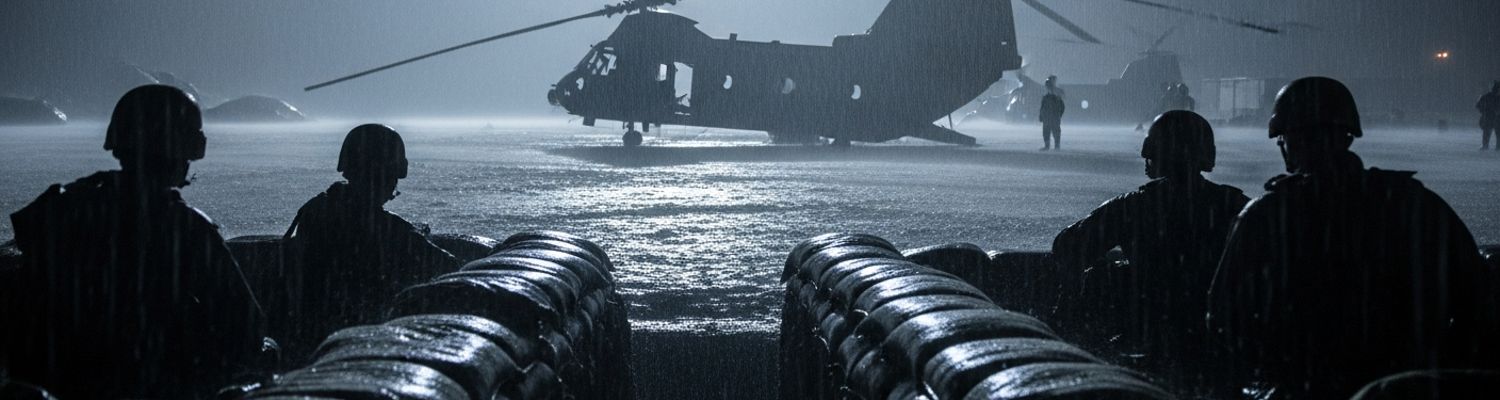

A strained voice cut through the tactical net’s static. The transmission, stripped of all protocol, reported multiple heavy-caliber impacts directly on the landing zone. The crisis had begun.
By June 1968, the 3rd Battalion, 4th Marines, was committed to a dispersed and aggressive forward operating posture defining American strategy in northern I Corps. The battalion did not concentrate in large, heavily fortified bases. It was broken down, spread across a series of rugged, isolated outposts and fire support bases perched on key terrain south of the Demilitarized Zone (DMZ). A close review of operational logs indicates individual rifle companies, often just platoons, were responsible for manning these positions. The outposts were frequently miles apart, connected only by foot patrols through dense jungle and helicopter resupply routes. This posture was a deliberate choice, designed as a screen to detect and intercept North Vietnamese Army (NVA) units infiltrating southward. Each position was a self-contained fortress in miniature, with sandbagged bunkers, trench lines, and fields of concertina wire. Their true strength lay in the ability to call down overwhelming supporting arms. The entire system was predicated on the assumption that any Marine unit could fix an enemy force in place until massive firepower could be brought to bear.
This reliance on external support, particularly aviation, was both the posture’s greatest strength and its most significant vulnerability.
This operational stance was a direct response to the challenges of the I Corps strategic interdiction zone. The northernmost region of South Vietnam was a geographic funnel for NVA logistics and manpower flowing from the DMZ and the trail complex in neighboring Laos. The terrain was exceptionally difficult, a landscape of steep, jungle-clad mountains, sharp-ridged valleys, and unpredictable rivers like the Cua Viet. The strategic objective for the 3rd Marine Division was not to hold territory but to sever these infiltration routes. American strategy centered on using high mobility to strike at identified NVA supply lines, base camps, and troop concentrations. Operation Robin, initiated in early June, embodied this doctrine. The 4th Marine Regiment, including the 3rd Battalion, was tasked with conducting airmobile operations deep into the Vietnam Salient to locate and destroy a newly detected NVA supply road. This involved inserting troops by helicopter into landing zones like Loon and Crow, establishing artillery positions on captured hilltops, and conducting aggressive patrols.
The June 1968 deployment order sent 3/4 Marines directly into this environment as part of Operation Robin North. On June 2nd, following extensive preparatory bombardment, waves of CH-46 and CH-53 helicopters began lifting elements of the battalion into landing zones southeast of Khe Sanh. Archival evidence shows the 4th Marines headquarters was established at Landing Zone Robin on June 4th. Artillery from the 1st Battalion, 12th Marines arrived to create a fire support base. The operation was a high-stakes application of airmobile tactics, with rifle companies leapfrogging from one objective to the next. The fighting was immediate. On June 6th, a People’s Army of Vietnam (PAVN) battalion launched a major assault on Landing Zone Loon, which was repulsed after a two-hour battle that left 154 PAVN soldiers dead. The discovered enemy road network was well-constructed, up to 18 feet wide and camouflaged from the air, confirming the scale of the NVA’s logistical effort.
This aggressive push coincided with dire intelligence forecasts. S-2 intelligence summaries identified major enemy units, including regiments of the 308th and 320th NVA Divisions, moving into the area. These were not local guerrillas but disciplined main-force units. Simultaneously, military meteorologists predicted the imminent onset of the southwest monsoon. It would bring torrential rains, thick fog, and dangerously low cloud ceilings. These weather conditions were known to severely hamper, and often completely halt, aviation operations. Helicopters, the lifeline for resupply, medical evacuation, and tactical movement, would be grounded. The NVA routinely exploited the monsoon’s cover for major movements and offensives. The decision to commit 3/4 Marines to a forward, helicopter-dependent operation, just as their air support was about to be blinded by weather, represented a hazardous gamble.
The decision by III Marine Amphibious Force (III MAF) to push units like 3/4 Marines deep into NVA-dominated territory on the eve of the monsoon was rooted in the complex realities of 1968. From a purely tactical standpoint, the commander of the 3rd Marine Division, Major General Rathvon M. Tompkins, was executing a high-risk strategy. Operational records show that Tompkins, a decorated and aggressive commander from World War II, favored a forward-leaning posture to keep PAVN forces off balance. The strategy depended on using helicopter-inserted units as bait, fixing enemy formations so they could be destroyed by overwhelming air and artillery power. This doctrine, however, was predicated on the availability of aviation, the very asset the impending monsoon threatened to neutralize. The high command was not ignorant of this. Meteorological forecasts were dire. Yet, the pressure to maintain the initiative following the bloody Tet Offensive earlier that year was immense. The choice was made to accept the risk that the weather would hold just long enough, or that ground units could sustain themselves if isolated, to disrupt the enemy’s own monsoon offensive preparations.
Every military action in Vietnam was a signal broadcast to a global audience. For the Johnson administration, the period after the Tet Offensive was one of profound crisis. The offensive, though a tactical disaster for the Communists, was a strategic political victory for Hanoi, shattering American public confidence. In this context, offensive operations like Robin North were a deliberate projection of strategic resolve. Washington needed to demonstrate to Hanoi, Beijing, and Moscow that the American will to fight had not been broken. Withdrawing forces into defensive postures ahead of the monsoon would have been interpreted as weakness, confirming Hanoi’s belief that its fight-talk strategy was succeeding. A close review of diplomatic cables from the period shows a leadership in Washington desperate to enter potential peace negotiations from a position of strength. By continuing to push aggressively into enemy staging areas, III MAF and MACV were sending an unambiguous message: American military power in South Vietnam remained undiminished. The 3/4 Marines were, in effect, a geopolitical instrument, their perilous mission designed to underscore American commitment.
The strategic calculus extended far beyond Southeast Asia, deeply enmeshed in the shifting tectonics of the Cold War. By 1968, the monolithic Communist bloc was a fiction. The Sino-Soviet split had devolved into open hostility, with both Beijing and Moscow competing for influence over Hanoi. American strategists were keenly aware of this dynamic. China, which provided North Vietnam with enormous amounts of aid and logistical support, was wary of a negotiated peace that might increase Soviet influence. The Soviet Union, a supplier of sophisticated military hardware, was also navigating a complex relationship with the United States, particularly as the events of the Prague Spring were beginning to unfold. The Soviet invasion of Czechoslovakia in August 1968 would later reveal the limits of Moscow's tolerance for deviation. By maintaining relentless military pressure in Vietnam, the United States was subtly exploiting these fissures. A display of American staying power served notice to Moscow that its resources would continue to be drained by the conflict, while also signaling to Beijing that the U.S. was not abandoning the region.
The strategic gamble failed almost immediately. The southwest monsoon arrived not as a gradual increase in rainfall but as a meteorological hammer blow. In mid-June 1968, the skies over the I Corps Tactical Zone opened, unleashing a deluge that rarely ceased. A review of operational logs from the period shows that weather became the single most dominant factor in all planning. Torrential rains were accompanied by thick fog and cloud ceilings that dropped to less than 300 feet, rendering aviation support impossible. The fleet of CH-46 Sea Knight and CH-53 Sea Stallion helicopters, the logistical and tactical foundation of the 3/4 Marines' dispersed posture, was grounded for days at a time. This atmospheric blindness was a condition the North Vietnamese Army expertly exploited, using the impenetrable cloud cover to mask major troop and supply movements. For the isolated Marine firebases, the ceaseless rain was the sound of their aerial lifeline being severed.
On the ground, the battlefield dissolved. The red clay earth of Quang Tri Province transformed into a thick, clinging morass of mud that became its own kind of enemy. A review of unit diaries from Operation Robin North details the effect on mobility and equipment. The mud was inescapable, flooding fighting holes, collapsing trench lines, and turning firebases like LZ Loon into nearly uninhabitable swamps. Foot patrols, the only remaining method of maintaining contact between outposts, slowed to a grueling pace. Companies struggled to cover a few hundred meters in an entire day.
The effect on weaponry was disastrous. The M16 rifle proved highly susceptible to malfunction as fine grit worked its way into receivers and gas tubes. Crew-served weapons were even more vulnerable; M60 machine guns would jam, and mortar teams found it impossible to establish stable firing positions as their baseplates sank into the semi-liquid ground with every round fired.
The battalion was no longer an offensive weapon.
This environmental collapse translated directly into a degradation of combat effectiveness. A Marine’s individual load, normally around 60 pounds, swelled with water-soaked gear. Medically, the conditions were ruinous. Cases of immersion foot, where the skin breaks down after prolonged exposure to wetness, became rampant, incapacitating soldiers as surely as any enemy bullet. Unit aid stations were overwhelmed with non-combat casualties suffering from fungal infections, dysentery, and exposure. With MEDEVAC helicopters unable to fly, the wounded and sick had to be kept in the squalid conditions of the firebases, a severe blow to unit morale. A close examination of logistical records shows a force starved for essentials. Batteries for the PRC-25 radios died, silencing communications between platoons and their command. Ammunition, food, and even potable water ran dangerously low. The 3/4 Marines, inserted to hunt the enemy, found themselves trapped and fighting a more immediate war against the environment itself.
Bureaucratic planning for Operation Robin North assumed conditions that ceased to exist the moment the monsoon broke. A review of the 4th Marine Regiment’s logistical annexes shows a plan entirely dependent on high-sortie-rate helicopter support. Planners had calculated the required daily tonnage of Class I (food and water), Class III (fuel), and Class V (ammunition) supplies with precision. The system relied on a steady stream of CH-46 and CH-53 helicopters flying from main combat bases to the forward fire support bases. These aircraft were not just for supply; they were the sole method for tactical maneuver, troop replacement, and medical evacuation. When the weather turned in mid-June, the plan became instantly obsolete. Aviation assets were grounded completely for consecutive days. The logistical pipeline did not just constrict; it snapped shut.
Standard operating procedure had no answer.
After-action reports detail how dry-season manuals and materiel were inadequate for the monsoonal environment. The M16 rifle suffered reliability problems as a mixture of fine red mud and water worked its way into the actions. Marines found their rifles jamming after firing only a few rounds. M60 machine gun teams reported frequent stoppages, while mortar crews could not secure their baseplates in the viscous earth. The very tools of war were failing. Beyond weaponry, basic equipment broke down. The PRC-25 radios, a platoon’s link to supporting arms, were powered by batteries with a finite life. With no resupply flights, a dead battery meant total isolation.
With resupply cut off, commanders instituted strict rationing. C-rations were portioned out. Potable water disappeared. Marines were forced to drink from bomb craters and collected rainwater, leading to widespread outbreaks of dysentery. The most severe blow, however, fell on casualty evacuation. The guarantee of prompt MEDEVAC for the wounded was a cornerstone of Marine morale. That promise was now broken. Wounded men at forward positions like LZ Crow could not be flown out. They were kept in flooded bunkers, cared for by corpsmen running out of bandages and morphine. Watching their wounded comrades suffer without hope of evacuation was a devastating psychological blow.
This paralysis extended up the chain of command. At the 4th Marines' headquarters on LZ Robin, commanders were effectively blind. As the batteries of forward units' PRC-25s died, the flow of information from the isolated rifle companies stopped. The lack of reliable communications made it impossible to form an accurate picture of the battalion’s status. It was unknown which positions were still viable or what their remaining combat strength was. The 3/4 Marines were not just cut off from their supplies; they were cut off from each other.
The environmental collapse created a perfect breeding ground for disease. Medical records from the war show that disease rates peaked with the rains. For the Marines in northern I Corps, this meant contending with a host of pathogens. The most significant threat was malaria, particularly the aggressive Plasmodium falciparum strain, which could incapacitate a man for over a month. Front-line infantry units suffered the highest rates of infection. The breakdown in sanitation was total. With no way to dispose of waste and a reliance on contaminated water sources, outbreaks of diarrheal diseases and infectious hepatitis were inevitable. These conditions ravaged units. The constant dampness also fostered a range of aggressive fungal infections and skin diseases, collectively known as jungle rot.
Of all the non-combat afflictions, none was more widespread than immersion foot, or trench foot. The condition became rampant. Archival medical accounts detail the process: constant exposure to mud and water caused the skin on the feet to become waterlogged and numb. After days, the skin would begin to break down, turning a mottled white and grey as tissue died. If left untreated in perpetually wet jungle boots, the condition progressed to open sores and eventually gangrene, which could require amputation. A Marine suffering from advanced trench foot was completely non-functional. The pain made it impossible to walk or stand a watch. Battalion aid stations were overwhelmed by Marines hobbling in with the condition, crippled without suffering a single wound.
The cumulative effect of disease, exposure, and environmental breakdown was brutal. A close examination of unit diaries from Operation Robin reveals a force being systematically debilitated. The physical state of the men deteriorated rapidly. A Marine in a fighting position on an outpost like LZ Loon was often simultaneously suffering from dysentery, a fever from a developing malarial infection, and the constant pain of immersion foot. His clothing, like his skin, never dried. His physical misery was compounded by the psychological stress of isolation. The failure of radios silenced contact with higher command. The grounding of helicopters removed the guarantee of medical evacuation. Wounded and sick men could not be moved, forced to lie in the same flooded bunkers from which their comrades had to fight. This spectacle pushed morale to the breaking point. The 3/4 Marines were no longer executing a strategic interdiction; they were engaged in a primitive struggle for individual survival.
The aviation component of the 3rd Marine Division was rendered almost entirely impotent by the atmospheric conditions. Aviation logs show the southwest monsoon’s arrival brought cloud ceilings below 300 feet and fog that reduced visibility to nearly zero. This effectively grounded the CH-46 and CH-53 helicopters that formed the logistical backbone for Operation Robin North. The NVA used the weather as a screen for troop movements and to emplace extensive anti-aircraft defenses around the isolated Marine positions. For helicopter pilots, flying meant navigating through steep valleys with no clear view of the terrain or the enemy. They were forced to fly low and slow, directly into the engagement envelope of NVA 12.7mm machine guns. The technical limitations of the aircraft were also a factor; the CH-46 was known for its engines being susceptible to power loss in the hot, humid air.
Despite the official grounding of most aviation assets, desperate attempts were made to break through. A declassified regimental report from the 4th Marines notes that between June 8th and June 18th, an average of 51 helicopter sorties were still attempted each day. Pilots from squadrons like HMM-165 flew contour-following missions, navigating by memory and momentary breaks in the fog. These flights represented an extreme risk. The NVA had seeded the valleys and ridges around key landing zones with heavy machine guns, creating lethal funnels of interlocking fire. The danger was constant. The culmination of this desperation came during the evacuation of LZ Loon, when the last HMM-165 CH-46 to lift off was struck by anti-aircraft fire and crashed, killing all 13 men aboard.
Even when a helicopter managed to reach a besieged position, its effectiveness was limited. Intense enemy fire often made landing impossible. Instead, crews conducted 'kicker' drops, flying low and fast over the perimeter while pushing pallets of supplies out the rear ramp. These drops were notoriously inaccurate. Supplies frequently fell outside the wire or directly into enemy hands. The official logistical summary for Operation Robin South shows that 1,600,790 lbs of supplies were delivered by helicopter over an eleven-day period. This figure was a fraction of the required tonnage to sustain multiple battalions in heavy combat. The inability to deliver heavy equipment, replacement parts for mortars, or sufficient medical supplies meant the combat power of the 3/4 Marines was steadily degrading.
The promise of rapid medical evacuation was a central pillar of Marine Corps doctrine. The monsoon broke that promise. For the pilots of Marine Medium Helicopter Squadron (HMM) 165 and other units, the mission became a perilous exercise in contour flying. They hugged the jungle-clad hills with almost no visibility, flying low and slow into pre-set engagement zones of NVA anti-aircraft gunners. Archival evidence shows the NVA had expertly seeded the approaches to firebases like LZ Loon and LZ Crow with 12.7mm heavy machine guns.
It was a flight into a kill box.
A pilot attempting a medevac run had to navigate by memory and fleeting glimpses of the ground. A single burst of machine-gun fire could sever a hydraulic line on his CH-46 Sea Knight and lead to a catastrophic failure. These missions often ended in failure, turned back by weather that was a solid, impenetrable wall. When they did get through, landing was often not an option. They would attempt harrowing hoist extractions for the wounded, holding the helicopter in a stationary hover just above the trees, a perfect target. The human cost was high. The most visceral example occurred during the evacuation of LZ Loon on June 6, 1968. As the last CH-46 from HMM-165, bureau number 152533, lifted off the besieged hilltop, it was struck by NVA anti-aircraft fire. The aircraft tumbled into a ravine and exploded, killing all 13 men aboard.
On the ground, the inability to evacuate the wounded had a devastating effect. Men with grievous combat wounds lay in flooded bunkers, cared for by Navy corpsmen who were running out of plasma and morphine. Unit diaries describe the psychological toll of watching comrades suffer and die from wounds that would have been survivable. This breakdown was compounded by the epidemic of non-combat afflictions. Immersion foot, dysentery, infectious hepatitis, and malaria gutted the combat effectiveness of the isolated platoons. The total U.S. losses for the three days at LZ Loon alone were 24 dead and 37 wounded, a figure that does not fully capture the hundreds more incapacitated by disease and exposure.