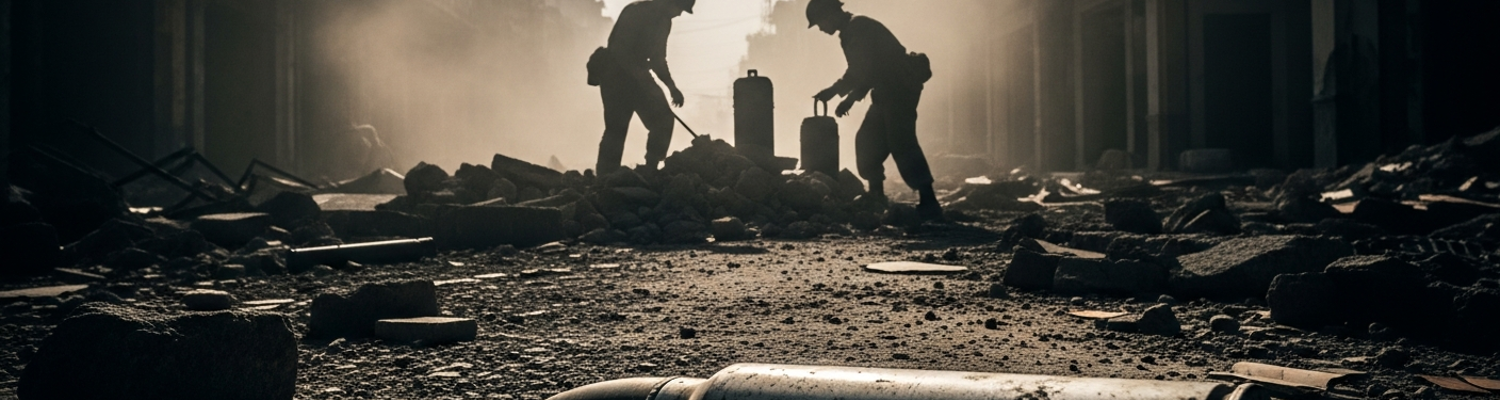

The Citadel: A Perfect Killing Ground
February 1968. Retaking the northern half of Huế was a tactical nightmare. Ten thousand North Vietnamese Army (NVA) and Viet Cong (VC) soldiers had spent weeks preparing the ancient fortress for defense. This was not open jungle. It was a labyrinth of stone, brick, and packed earth engineered centuries prior to bleed an attacking army dry.
A review of the operational environment reveals a nearly perfect defensive battlespace. The Old City, the Citadel, was a massive square enclosure. Its perimeter walls stretched roughly two kilometers on each side, ringed by a wide moat fed by the Perfume River. Built in the early 19th century using Vauban-style military engineering, the primary walls were a composite of brick and earth, up to 6.6 meters high and 21.5 meters thick. Inside this outer fortress lay the Imperial City (Hoàng thành), with its own 4-meter high brick walls and protective moat. Deeper still was the Tử cấm thành, the Purple Forbidden City, a third walled enclosure. The NVA’s 6th Regiment integrated their forces into this maze. They established machine gun nests and anti-tank rocket positions in watchtowers, tunneled through residential garden walls to create hidden pathways, and positioned snipers in pagodas and family homes. The city's narrow, winding streets became a weapon, channeling advancing troops into pre-registered fields of fire.
The fighting was a close-quarters affair.
U.S. Marines from the 1st Battalion, 5th Marines, were accustomed to jungle warfare, not the room-by-room slog of an ancient city. Initial rules of engagement, intended to preserve cultural heritage, severely restricted heavy artillery and air support. This forced Marines to rely on direct-fire weapons in a painstaking advance. A typical engagement involved a squad pinned by interlocking fire while attempting to cross a street. To breach a single building, Marines used M72 LAW rockets or 106mm recoilless rifles to blow a hole in a wall, avoiding booby-trapped doors, then cleared the interior with grenades and rifle fire. The NVA defenders proved disciplined, often falling back through pre-planned routes to secondary positions. The wounded-in-action rate during this phase soared to 44.4 per 1,000 men per day. As the battle wore on, fire support restrictions were lifted. M48 tanks were brought forward to systematically destroy fortified structures, while CS tear gas was employed to drive NVA soldiers from their bunkers.
Tens of thousands of civilians were caught within this maelstrom. Out of a city population of 140,000, an estimated 100,000 were rendered homeless, with many trapped inside the Citadel itself. They hid in cellars, family tombs, and churches, enduring weeks without consistent food, clean water, or medical aid. Their presence created an impossible situation for the advancing forces. The Viet Cong, in particular, operated without uniforms, making it difficult to distinguish combatant from non-combatant. After-action reports indicate that civilians attempting to flee were often caught in crossfire. Simultaneously, the occupying NVA and VC forces began a systematic purge, executing thousands of civilians identified as government officials, intellectuals, and sympathizers. These actions left the remaining population terrified of both the occupiers and the incoming shellfire of the liberators.
Task Force X-Ray and EOD Doctrine
Operational logs for Task Force X-Ray, the command element for U.S. Marine Corps operations in southern Huế, show an organization struggling to adapt. Attached to its infantry battalions, primarily from the 1st and 5th Marine Regiments, were specialist detachments. Among these were Explosive Ordnance Disposal (EOD) teams. These were small, highly trained units, typically a handful of technicians, whose function was the methodical neutralization of unexploded ordnance. Their inclusion was standard procedure, anticipating dud grenades, mortar rounds, and artillery shells. Their equipment was for deliberate, careful work: diagnostic kits, render-safe tools, and specialized explosives for controlled detonations. They were a technical asset, designed to solve isolated, complex problems, not to function as a frontline element.
The NVA and VC forces had spent weeks seeding their defensive positions with a lethal density of explosive traps. This was not a random effort; captured documents later revealed that NVA sappers had received intensive training in urban street-fighting and the creation of improvised explosive devices (IEDs). The narrow streets and shattered buildings of Huế became an integral part of their defensive scheme. Archival evidence shows NVA doctrine focused on channeling advancing Marine units into kill zones where command-detonated explosives could be used with maximum effect. These devices were frequently constructed from captured or dud American munitions, including massive 105mm artillery shells, wired to a hidden observer. Tripwires, connected to Chinese-made stick grenades or American M26 fragmentation grenades, were strung across doorways and concealed in debris. Anti-personnel mines and repurposed mortar rounds were hidden under floorboards, turning every step into a calculated risk. The effect on morale was severe, forcing lead Marine elements to slow their advance to a crawl while under constant fire.
This volume of explosive hazards made conventional EOD protocols impossible. Standard procedure was time-consuming: upon discovery of a device, infantry would establish a security cordon, EOD technicians would be brought forward, and they would begin the slow process of analysis and neutralization. In the house-to-house fighting of Huế, this was a non-viable strategy. A single city block might contain dozens of devices. Following protocol would have halted the entire advance for days, all while infantry remained exposed. There were not enough EOD technicians available; at the height of the war, fewer than 300 EOD personnel were deployed in all of South Vietnam. The secure rear area needed to perform delicate render-safe procedures did not exist. The front line was fluid, often measured in meters. The need for momentum overrode the established doctrine of safety. The EOD mission had to adapt or become irrelevant, forcing a tactical shift away from neutralization and toward rapid clearance by any means necessary.
The Weight of Combat
The operational environment within Huế subjected every Marine to a level of stress that degraded combat effectiveness. For EOD technicians, who relied on fine motor skills and intense concentration, it was debilitating. A near-constant and unpredictable barrage of high-explosive rounds defined daily existence. NVA artillery included 122mm rockets and 82mm mortars, answered by American naval gunfire and land-based batteries. This created a terrifying auditory landscape. The physical concussion from these blasts, even non-direct hits, was a documented source of combat stress reaction. A review of medical records from the period (NARA Record Group 112) shows a rise in such cases, characterized by dissociation, slowed reaction times, and an inability to focus. All were catastrophic symptoms for a technician attempting to disarm a complex device. There was no safe area.
This pressure was compounded by the horrific civilian situation. Advancing Marine units and their attached EOD specialists were confronted by a humanitarian disaster. Streams of terrified refugees clogged the narrow streets, complicating movement and fire control. Worse, the Marines began to uncover evidence of systematic executions carried out by the occupying forces. Dozens of mass graves were eventually found, containing the bodies of thousands of civilians who had been bound, tortured, and in some cases, buried alive. For an EOD team trying to clear a path, this meant operating in a landscape of human suffering. The discovery of these atrocities added a layer of rage and horror to the high levels of combat stress.
The operational challenges were severe. NVA and Viet Cong sappers had booby-trapped everything from doorways and rubble piles to the bodies of the dead. Captured flags and abandoned weapons were rigged to explosives. A common tactic involved rigging captured American 105mm artillery shells to command-detonators, turning a dud round into a massive, remotely operated mine. The EOD teams attached to infantry units like the 1st Battalion, 5th Marines, were not equipped for this scale of clearance. Their mission was the careful neutralization of individual ordnance, a process requiring time and a secure perimeter. In Huế, neither was available. Working under constant sniper fire and mortar attacks, with civilians fleeing through their operational area, the technicians were forced to abandon painstaking render-safe procedures. The primary method of clearance became demolition in place, a fast but crude solution that involved placing a counter-charge to destroy the device. This required a high-risk calculation, weighing the need for forward momentum against the danger of causing further destruction in the dense urban landscape.
A Garbled Transmission
Command and control during the house-to-house fighting was nearly impossible. Operational logs from the 1st Battalion, 5th Marines confirm this. For an EOD team attached to Delta Company, operating near the heavily contested East Gate, it manifested as a catastrophic communications failure. The team was equipped with the standard AN/PRC-25 radio, a man-portable transceiver that was the lifeline for coordinating movements. The "Prick-25" was susceptible to the chaos of an urban battlefield. The dense masonry of the old city, combined with the shriek of artillery, created a hostile electromagnetic environment. At approximately 14:30 on February 15th, a crucial transmission from the battalion command post crackled through the EOD team leader’s handset. The message was broken and drowned in static, a consequence of multi-path interference as radio waves bounced erratically off structures. Only fragments were intelligible: "...sector south of your position...is hot...repeat, cleared hot for..." The rest was lost in a surge of signal noise.
The message was dangerously ambiguous. It concerned the clearance status of an adjacent sector, a grid square on the tactical map covering a block of buildings along Mai Thuc Loan street. The term "cleared hot" could have two drastically different meanings. It could signify that the area was cleared of all friendly forces and designated for an artillery strike or a large demolition. For an EOD team, this was an instruction to prepare for a large-scale explosive event. Alternatively, it could mean that Marine infantry had already swept and cleared the sector of NVA resistance, making it active for follow-on units like EOD to begin ordnance removal. One interpretation meant the area was about to be obliterated; the other meant it was their next worksite. Moving into a sector mistakenly believed to be secure could walk the team into an NVA ambush. The presence of thousands of trapped civilians added another layer of lethal uncertainty.
This single, broken transmission paralyzed the EOD team. The team leader, a staff sergeant, refused to act on partial intelligence. He demanded clarification. The radio operator frantically worked the handset, attempting to re-establish a stable connection with the battalion net, but the airwaves were a cacophony of overlapping transmissions from multiple units in desperate firefights. Each attempt was met with static or the clipped voices of other platoons calling for support. An agonizing wait began. For the next 45 minutes, the EOD team remained in their covered but exposed position, a partially destroyed storefront offering concealment but little protection from the 82mm mortar rounds that periodically rained down. Every minute spent static increased their vulnerability. NVA snipers were known to scan for stationary targets, especially Marines with antennas. The team was trapped, unable to advance or fall back, dependent on a clarification that seemed impossible to obtain.
The Unnatural Stillness
Attempts to break through the battalion command net failed. The radio operator worked the AN/PRC-25’s frequency dial, ghosting up and down from the designated channel in a search for a clear signal. Each attempt to transmit was either swallowed by static or overridden by the high-priority traffic of other units. The calls were a fragmented chorus of contact reports, ammunition requests, and casualty evacuation notices. The staff sergeant was left with an impossible choice based on the fragmented message. The wait for clarification stretched into nearly an hour, a lifetime on a battlefield where stationary troops were targets.
Then the noise stopped.
It was not peace. It was a profound and deeply unnerving absence of sound that settled over their small sector of the city. For weeks, the Marines had operated inside a bubble of continuous, violent noise. The crack of rifles, the roar of M48 tank cannons, the whistle of incoming 82mm mortar rounds, and the ground-shaking concussion of artillery. The human brain adapts to this auditory baseline. Its sudden removal had an immediate, disorienting effect. The silence was heavy, unnatural, tactical. Every member of the team became acutely aware of sounds previously masked by the combat. The scrape of a boot on loose rubble, the sigh of wind moving through the skeletal remains of a building, the distant, lone dog barking. Each sound was amplified and carried an implied threat. This auditory vacuum stretched the nerves of the waiting Marines taut. Experience taught them that a coordinated silence on the part of the NVA was often the prelude to a complex ambush. The stillness was not a reprieve; it was a warning.
The team’s collective training informed their assessment. The silence was a threat. A close examination of NVA sapper doctrine reveals a pattern of using lulls in combat to execute their most dangerous work. The EOD technicians understood this quiet period was likely being used by the enemy to emplace new threats. The primary fear was a command-detonated device. Their exposed position could easily be observed from any number of surrounding buildings, and the NVA were known to have wired large-caliber artillery shells to act as massive, remotely triggered mines. The team leader scanned the rubble-strewn street, his eyes tracing potential wires and searching for the glint of a hidden observer. The threat of a secondary device was also a distinct possibility; NVA forces often set smaller, anti-personnel traps around a larger piece of ordnance, specifically targeting the EOD personnel called to clear it. The stillness gave the unseen enemy time to observe, to aim, and to prepare the trigger.
A Five-Minute Window
After-action reports from Marine EOD teams in Huế (USMC History Division, Box 44) show a pattern of forced adaptation. The team with Delta Company, 1st Battalion, 5th Marines, faced a problem that defied their training: a command-detonated IED built from a captured American 105mm M101 artillery shell. NVA sappers had partially buried it in a pile of collapsed masonry on Mai Thuc Loan street, its position calculated to collapse adjacent structures onto any advancing Marine platoon. Standard procedure, a demolition with C4, was removed by a single piece of distorted intelligence. A belief, passed down from a company command post struggling with the city’s chaotic radio environment, held that a large group of civilians was sheltering in a cellar directly in the blast radius. This information, later proven false, was a product of the extreme confusion of the urban battle.
The decision was made to disarm the device manually.
This initiated a critical five-minute window. The EOD staff sergeant, accepting the faulty intelligence as fact, determined a manual render-safe procedure was the only course of action. The unnatural stillness was his working environment. He and one other technician moved forward from their covered position, leaving the rest of the team to provide security. Their only tools were what they could carry: a standard EOD pouch with wire cutters, pliers, a non-magnetic probe, and electrical tape. The primary threat was the command wire. NVA sappers were adept at concealing the thin, often black-lacquered wires amidst the debris, running them back hundreds of meters to a hidden observer. The first two minutes were spent on a slow, deliberate visual sweep, tracing the path of the wire from the device back towards a shattered building facade. The wire was their only connection to an enemy who could be watching them through a scope.
The process itself was a sequence of high-stress mechanical actions. Once the command wire was located, the staff sergeant began the hands-on work. He used a small brush to clear dirt from the fuze well, exposing the crude connections. The device was an electrical IED; the sappers had wired a blasting cap directly into the fuze threads, connecting it to the long command wire. The next ninety seconds were spent carefully cutting the tape and insulation away to expose the two electrical leads. Every movement was precise. A slip of the hand could complete the circuit. A secondary, victim-activated switch was a constant possibility, forcing the second technician to scan the immediate area, his rifle ready.
The final minute was the most hazardous. The staff sergeant had to cut the wires. The NVA were known to sometimes wire their devices so that cutting the wire would complete the circuit, not break it. The technician made a calculated risk based on the typical design of their command-detonated systems. Using rubber-handled cutters, he severed the two leads in a single motion. He then physically pulled the wires away from the detonator assembly, creating a visible air gap. Only then did he begin backing the crude, improvised electric blasting cap out of the artillery shell’s fuze well. The entire operation, from the moment the team left cover to the moment the detonator was clear of the main charge, consumed less than five minutes. The massive IED was inert. The civilian shelter they had risked everything to protect was later found to be an abandoned storage basement, empty for weeks.
The Chain Reaction
Disarming the M101 shell produced less than a minute of relief. NVA sapper doctrine reveals a sophisticated understanding of layered ambushes. The large, buried artillery shell was bait.
Its purpose was not necessarily to detonate, but to fix a high-value enemy asset, an EOD team, and by extension, the infantry platoon providing its security, in a known location. The NVA observer, concealed in a third-story window 200 meters away, saw the American technicians complete their work. He understood his primary device was neutralized.
He initiated the second phase.
The observer did not fire on the exposed EOD team. His target was bigger. Instead, he triggered a pre-arranged signal, a single green flare that arced silently into the gray sky. This was the command for a coordinated barrage. Within seconds, multiple NVA 82mm mortar teams, positioned in defilade behind the walls of the Imperial City, began dropping high-explosive rounds on pre-registered targets. Simultaneously, Type 24 heavy machine guns, hidden in spider holes and sandbagged emplacements in the flanking buildings, opened up. Their interlocking fields of fire were not aimed at the IED location but at the covered positions where Delta Company’s 1st Platoon had been waiting. The disarming action, born of faulty intelligence, had held the Marines in a static position for too long. It gave the NVA observers ample time to confirm their dispositions and finalize the targeting for the secondary trap. The IED was a tool to create a target. The quiet disarming procedure gave the enemy the perfect opportunity to spring their real attack.
The result was an instantaneous collapse of the tactical situation. The mortar rounds fell across the entire block. Explosions walked up and down Mai Thuc Loan street, shattering building facades and sending geysers of brick dust and shrapnel into the air. While the cellar the EOD team had worked to protect was empty, dozens of other civilians were hiding in other basements throughout the block, and the barrage fell indiscriminately upon them. The very outcome the team had risked their lives to prevent was triggered by their success. Delta Company’s 1st Platoon was caught in a perfectly designed kill zone. Pinned by machine-gun fire from the flanks, they had no escape from the mortar rounds raining down. Command and control vanished in the chaos as platoon and squad leaders were hit.
The advance was over. It became a rout. The surviving Marines were forced into a desperate fighting withdrawal, abandoning the ground they had spent the entire day bleeding for. They carried their wounded through the same rubble-choked streets they had just cleared, suffering more casualties as they fell back. A close analysis of after-action reports indicates that in less than ten minutes, the platoon lost over a third of its strength in killed and wounded. The entire eastern flank of the 1st Battalion, 5th Marines' push into the Citadel was now compromised, forcing a full stop and reorganization. The tactical setback was absolute.