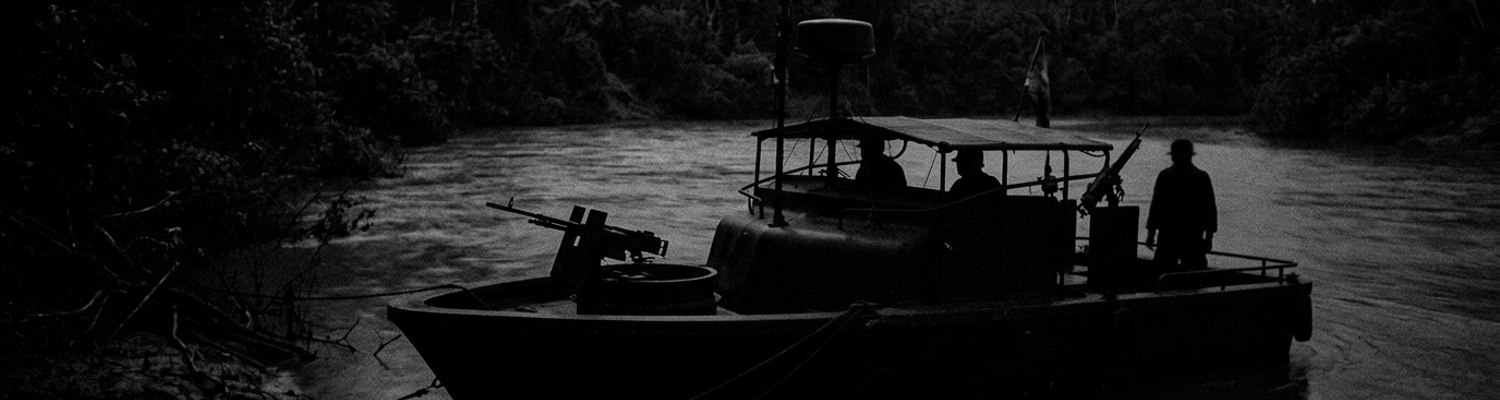

Operation Giant Slingshot and Border Interdiction Doctrine
During the initial eight months of naval interdiction along the Cambodian border, river patrol boat crews sustained cumulative casualty rates of 42.3 percent.
They absorbed enemy rocket, mortar, and small arms fire across more than two hundred separate combat engagements every thirty days.
On December 6, 1968, Vice Admiral Elmo R. Zumwalt Jr. formally activated Operation Giant Slingshot.
The naval command aimed this operational thrust directly at the Parrot's Beak.
This wedge of Cambodian territory projected deep into South Vietnam toward Saigon.
Intelligence analysts estimated that the Viet Cong 5th and 9th Divisions moved dozens of metric tons of Chinese manufactured armaments across this border zone each week.
Task Group 194.9 established continuous maritime containment along the Vam Co Dong and Vam Co Tay river systems.
Naval planners projected that twenty-four-hour surface patrols could intercept these supply lines before hostile units stockpiled materiel in base areas throughout Tay Ninh and Hau Nghia provinces.
Doctrine presupposed total radar control over the water.
When examining the historical record, the standard tactical sequence taught at naval training facilities in Mare Island depended on clear conditions.
High-resolution Raytheon Pathfinder radars would detect low-profile communist sampans crossing open water.
This allowed patrol officers to direct coordinated air strikes and concentrated naval gunfire from a distance.
Archival evidence shows that this theoretical control collapsed upon arrival at the narrow upper reaches of the Vam Co Dong.
The river channel frequently contracted to widths under eighty yards.
Thick growth of nipa palm and sharp cut-banks flanked the water.
These geographical features generated extensive radar ground clutter.
Water hyacinth mats clogged the twin Jacuzzi 14YJ waterjet propulsion pumps of the thirty-one-foot fiberglass PBRs.
This reduced water intake and forced propulsion diesels to overheat within minutes.
Ambush ranges routinely shrank to under twenty-five yards.
Instead of radar-vectored standoff engagements, boat crews executed point-blank acoustic panic drills against entrenched B-40 and RPG-7 rocket positions.
Reinforced mud bunkers concealed these weapons.
Geography dictated the operational tempo.
To sustain round-the-clock interdiction across this hostile geography, the naval command established austere forward support nodes directly along the firing line.
River Division 132 moved its Mark II patrol boats into Advanced Tactical Support Bases at Tra Cu and Ben Keo.
These bases sat along the middle and upper loops of the Vam Co Dong.
A close review of operational logs indicates that neither location offered standard military infrastructure.
Tra Cu occupied a flood-prone former French border post and Special Forces camp.
Unstable mud berms and concertina wire surrounded the perimeter.
Ben Keo lay further north.
It sat barely ten kilometers southeast of Tay Ninh.
Continuous 82mm mortar and 107mm rocket bombardments launched from nearby jungle sanctuaries targeted the facility.
Mechanics worked in open river mud.
They serviced twin Detroit Diesel 6V53N engines under intermittent sniper fire.
They attempted to patch hull breaches caused by shrapnel and shaped-charge warheads.
Moored alongside floating pontoons and reinforced ammi barges, the crews lived on diesel-stained rations.
They faced constant exposure to river-borne sapper attacks utilizing floating mines and delayed satchel charges.
Supplies arrived only by heavily escorted river convoys.
Patrol craft departed these two bases in two-boat pairs.
They drifted with engines throttled back or shut down entirely.
Crews attempted to run silent night ambushes along suspected crossing points.
Darkness destroyed tactical alignment.
Under moonless skies, crews mistook floating debris for approaching sampan columns.
They discharged twin forward .50 caliber heavy machine guns and M79 grenade launchers into empty riverbank foliage.
River Division 132 patrol reports document multiple friendly crossfire incidents.
Panic-stricken crews opened fire across opposing riverbanks against adjacent patrol sectors.
Survival depended on rapid trauma triage conducted inside cramped engine compartments under blind darkness.
The boats accelerated at maximum throttle back toward the aid station at Ben Keo.
On January 15, 1969, an ambush five miles north of Tra Cu left PBR 751 burning.
Two dead sailors and three severely wounded crew members lay pinned beneath severed steering cables.
PBR Mark II Capabilities and Mare Island Doctrine
Naval Inshore Operations Training Center records show that boat crews trained for a mechanical war that existed only in northern California.
Archival evidence shows that Uniflite engineered the thirty-one-foot Mark II patrol boat primarily for high-speed intercept across broad estuary channels.
Constructed from fire-retardant fiberglass-reinforced plastic, the vessel carried a dry displacement of fourteen thousand four hundred pounds across an eleven-foot-seven-inch beam.
Power originated from two Detroit Diesel 6V53N six-cylinder marine engines.
These two-stroke powerplants were rated at two hundred sixteen shaft horsepower apiece.
These engines drove twin Jacuzzi Brothers 14YJ mixed-flow waterjet pumps rather than conventional underwater propellers and rudders.
Running wide open, the pumps pulled river water through cast-iron bottom intake grates.
They discharged pressurized water through steerable directional nozzles to achieve twenty-five knots across shallow flats.
Draft measured only nine inches while planing.
Steering depended entirely on the hydrodynamic thrust vector exiting the jet nozzles.
Idling engines eliminated directional authority instantly.
Floating vegetation choked the intake grates within seconds.
This produced pump cavitation, violent engine vibrations, and cylinder head temperatures climbing past two hundred thirty degrees Fahrenheit.
Inboard mechanics had to shut down engines under direct fire.
They crawled into the aft bilge.
They cleared crushed hyacinth stems from the inspection cleanout ports with hand-held reaming hooks.
Mare Island instructors treated propulsion failure as a rare emergency rather than a standard environmental certainty.
When examining the historical record at Mare Island Naval Amphibious Base, student crews spent dozens of training cycles executing simulated nighttime vector intercepts.
These exercises took place across the open expanses of San Pablo Bay and the Sacramento River delta.
Tactical curriculum focused heavily on the Raytheon 2502 Pathfinder surface-search radar mounted on the boat canopy mast.
Classroom training drilled forward radar observers to locate maritime contacts at ranges exceeding two thousand yards on the ten-inch cockpit plan position indicator scope.
The doctrine specified a clinical operational sequence.
Radar operators plotted communist sampans traversing clear river mouths.
They calculated intercept headings.
They maintained continuous electronic surveillance while the coxswain positioned the boat outside acoustic detection range.
Naval tactical manuals mandated that crews illuminate targets with mast-mounted searchlights only when closing to three hundred yards.
This coordinated simultaneous fires from the forward dual .50-caliber machine gun turret and the aft M60 station.
Open-water radar calibration runs in California ignored the reflective signatures generated by dense jungle riverbanks.
Delta exercises never exposed students to channels under one hundred yards wide.
Mangrove thickets and bamboo canopies overwhelmed the cathode-ray tube with continuous green clutter in Vietnam.
Radar sweeps could not distinguish an armed crossing from a muddy river embankment.
A close review of operational logs indicates that the standard electrical systems installed on the Mark II suffered catastrophic degradation during prolonged tropical night operations.
The Raytheon radar unit drew twenty-four volts of direct current from the boat primary battery bank.
It competed directly with high-output communication radios, cockpit instrumentation, and auxiliary bilge pumps.
Salt corrosion and intense humidity degraded the radar waveguide connections.
This produced false contact echoes and blind arcs across the forward thirty degrees of azimuth.
Armor plating around the forward twin Browning .50-caliber heavy machine gun turret offered sixty degrees of elevation.
It offered zero traverse suppression against shoreline targets lower than the boat gunwales at close quarters.
Ammunition feeds jammed when spent brass casings bounced off the unpadded deck and wedged into the rotating turret ring.
Mechanics at Ben Keo routinely discovered that the Jacuzzi 14YJ impeller shafts wore out after fifty operating hours.
River silt ground through the rubber cutless bearings.
By mid-1969, River Division 132 operated with half of its installed radar scopes disabled by burnt magnetron tubes and damaged antenna drive gears.
Riverine Environmental Hazards and Radar Blindness
Naval Warfare Publication 37 mandated that river patrol craft maintain sustained cruising speeds of fifteen to twenty knots.
This minimized vulnerability to unguided rockets.
Crews relied on radar sweeps to detect obstructions beyond visual range.
Archival evidence shows that this tactical baseline failed completely across the tortuous bends of the upper Vam Co Dong between Go Dau Ha and Hiep Hoa.
In this sector, the river looped through severe oxbows.
Channel widths shrank below sixty yards.
Eight-foot cut-banks and overhanging nipa palm hemmed in the water.
When a PBR Mark II entered these hairpin curves, the mast-mounted Raytheon 2502 Pathfinder antenna swept directly into solid mud banks rather than open water.
Radar energy from the three-centimeter transceiver reflected off the saturated soil and dense vegetation.
This painted the cockpit plan position indicator scope with total ground clutter.
The display obscured the waterway entirely.
Turning through an oxbow at doctrine-mandated speeds meant steering blind into potential crossfire ambushes without radar warning.
Coxswains had to throttle back their Detroit Diesel engines to idle drift.
They lost the hydrodynamic waterjet pressure required to maintain steerage around the sandbars.
Channel geometry negated electronic detection systems.
When examining the historical record, drifting masses of water hyacinth created an equally destructive sensor failure for River Division 132 crews.
Dense vegetation clusters broke away from swampy tributaries during seasonal tide shifts.
They drifted south toward the Mekong shipping lanes in floating mats measuring up to fifty feet across.
These fibrous root systems and broad leaves produced radar return signatures.
These signatures matched the radar cross-section of low-profile wooden sampans.
To eliminate these false targets, radar operators dialed back the receiver gain controls.
Lowering the sensitivity erased actual enemy craft from the cathode-ray display.
Viet Cong logistics teams capitalized directly on this technical limitation.
Transport cadres lashed their supply-laden sampans to the leeward edges of the drifting hyacinth mats.
They drifted silently past anchored Navy patrol craft.
The physical mass and constant rustling of the floating foliage absorbed engine vibrations and paddle splashes.
This neutralized the listening watches kept by forward gunners in total darkness.
Propulsion failures regularly left vessels drifting powerless into prepared kill zones.
A close review of operational logs indicates that water hyacinth caused immediate mechanical breakdowns inside the Jacuzzi 14YJ mixed-flow pump assemblies.
The intake grates on the hull bottom featured narrow steel bars.
Engineers designed these bars to keep large rocks out of the internal impellers.
Fibrous hyacinth stalks wrapped around these bars.
They formed an impenetrable barrier that cut off water induction into the jet housings within sixty seconds of contact.
Without raw water cycling through the system, the pump impellers cavitated violently.
They stripped their rubber bearings and threw metal fragments into the steerable directional nozzles.
Starved of coolant flow, the heat exchangers failed.
Engine block temperatures drove past two hundred thirty degrees Fahrenheit.
This triggered automatic alarm buzzers.
To restore steerage, an inboard crewman had to strip off his flak jacket.
He crawled into the narrow bilge compartment between the twin exhaust manifolds.
He inserted a steel cleanout rod through the inspection ports.
He chopped the tangled root clumps away by hand.
On March 4, 1969, PBR 124 suffered dual pump blockages while rounding an oxbow south of Ben Keo.
The boat drifted sixty yards downstream into a concealed Viet Cong machine gun bunker before the crew could clear the starboard intake.
Waterborne Guard Posts and Night Ambush Tactics
Archival evidence shows that in early 1969, Task Group 194.9 commanders altered night interdiction doctrine.
They ordered River Division 132 to establish stationary Waterborne Guard Posts along the narrow river loops between Tra Cu and Hiep Hoa.
Standard operating procedures dictated that two-boat patrols shut down their twin Detroit Diesel 6V53N engines thirty minutes before astronomical twilight.
The boats drifted under residual momentum toward the outer bank.
Sailors standing on the forward gun decks leaned over the gunwales with boathooks.
They grabbed saturated branches to haul the thirty-one-foot hulls directly into overhanging nipa palm canopies.
Deck crews secured nylon mooring lines from the bow and stern cleats directly around submerged nipa root clusters and mangrove trunks.
This tied the fiberglass craft tight against the muddy cut-banks.
It positioned the forward twin .50-caliber gun tubs flush with the shoreline brush.
Naval planners assumed these stationary hide sites would allow crews to conceal their radar and thermal signatures along suspected Viet Cong infiltration trails leading out of the Parrot's Beak.
Lashing the gunboats to riverbank vegetation eliminated their ability to maneuver under immediate hostile contact.
When examining the historical record, cutting the propulsion diesels introduced severe mechanical vulnerabilities that Mare Island tactical syllabi never anticipated.
Shutting down the engines stopped the raw-water intake cycling through the cooling jackets.
This caused engine block temperatures to heat-soak past two hundred forty degrees Fahrenheit in the enclosed aft bilge.
Restarting the six-cylinder powerplants required high electrical draw from twenty-four-volt battery banks.
Running radio receivers and infrared scopes had already depleted these batteries.
If an engine failed to turn over instantly during an ambush, the crew sat immobilized against the foliage.
Falling river tides presented an equal hazard.
Along the Vam Co Dong, six-foot tidal drops drained water out of shoreline shallows within three hours.
This left the nine-inch draft hulls grounded in deep mud berms.
In this position, the cast-iron intake grates of the Jacuzzi 14YJ jet pumps rested directly on river silt.
Packed sediment choked the impellers before the starters could even spin.
Darkness imposed total sensory isolation across the water.
A close review of operational logs indicates that patrol officers enforced total light and acoustic blackouts aboard the moored craft for periods lasting up to eight continuous hours.
Boat captains taped over all red instrument dial lights.
They removed bulb filaments from indicator panels.
They forbade the use of matches or flashlights across the deck.
Voice transmissions over the AN/PRC-25 tactical radios were banned.
Radio operators communicated with adjacent guard posts and the Ben Keo support base solely by clicking the microphone button twice to confirm perimeter integrity.
Gunners stood four-hour shifts behind their weapon mounts.
They scanned the black water without moving their boots against the fiberglass deck.
Swarms of river gnats and mosquitoes coated exposed skin.
Commanders prohibited insect repellent because Viet Cong reconnaissance scouts could detect the chemical scent drifting across the humid river surface.
Listening watches focused on subtle water disturbances.
They distinguished floating nipa debris from wooden paddles cutting through the current.
On the night of March 22, 1969, PBR 121 sat lashed to the tree line four miles south of Tra Cu.
The forward lookout detected muffled voices forty feet away on the opposing shore.
The forward gunner pressed the mechanical butterfly trigger.
He fired five hundred armor-piercing rounds blind into the dark tree line before receiving an order to disengage.
Communication Breakdowns and Riverine Fratricide Incidents
Archival evidence shows that tactical signal propagation died completely within five hundred yards of the riverbanks.
A close review of operational logs indicates that River Division 132 relied on AN/VRC-46 vehicular sets and portable AN/PRC-25 manpack VHF-FM transceivers.
These radios connected patrol boats with the Tactical Operations Centers at Tra Cu and Ben Keo.
Operating across the 30.00 to 75.95 megahertz band, these radios depended strictly on direct line-of-sight ground wave transmission.
Saturated double-canopy jungle and dense, wet nipa palm stands along the Cambodian frontier absorbed the frequency bands.
Radio frequency output dissipated before signals could reach forward retransmission towers.
Along the upper reaches of the river near the Parrot's Beak border wedge, patrol craft operated within fifteen hundred yards of Cambodian territory.
Twisting loops dipped behind elevated cut-banks and dense forest lines.
These geographical features produced total dead zones.
Salt encrustation corroded the AS-1729 whip antenna base springs.
Tropical moisture seeped past the rubber gaskets of the H-138 handsets.
This grounded out the carbon microphone diaphragms.
The lack of land-based repeater towers along the contested frontier meant that even a slight bend in the river dropped reception below operational thresholds.
Patrol officers attempting to broadcast urgent contact reports squeezed their push-to-talk switches only to hear dead static.
They were isolated from fire support aircraft, medevac helicopters, and flanking gunboats.
Silent drift destroyed spatial awareness across the oxbows.
When examining the historical record, River Division 132 divided the Vam Co Dong into tightly stacked five-kilometer patrol blocks.
They assigned two-boat buddy teams to monitor specific crossing corridors between Go Dau Ha and Ben Keo.
Six-foot tidal shifts pushed drifting patrol pairs outside their designated sectors without the crews realizing their displacement.
Operating under total light blackouts with taped-over instrument dials and extinguished running lights, coxswains used dead reckoning to estimate their position along uniform stretches of cut-bank foliage.
Night ambushes shattered this fragile coordination.
When a forward boat opened fire on suspected movement in the darkness, the violent detonation of green tracer fire and muzzle flashes from twin forward .50-caliber machine guns reflected off the water surface.
Adjacent patrol pairs operating downstream saw the sudden bursts through the brush.
They misinterpreted the rapid muzzle flash signatures as Viet Cong sampans or heavy machine gun bunkers firing across the channel.
Gunners opened fire before radio confirmation could clear the channel.
On the night of May 11, 1969, three miles south of Hiep Hoa, PBR 127 engaged moving shadows along the eastern shore with sustained automatic weapons fire.
The crew discharged four hundred rounds of .50-caliber ball ammunition and five 40mm high-explosive grenades into the tree line.
Positioned five hundred yards around a blind riverbend, PBR 131 rounded the loop at maximum throttle.
The crew observed the tracer trajectories cutting low across the water.
They immediately directed their forward twin mount and aft M60 into the firing position.
Armor-piercing incendiary rounds punched directly through the fiberglass gunwales of PBR 127.
The rounds severed the throttle control cables and struck the forward gun tub.
By the time visual recognition pyrotechnics were discharged into the air, two American gunners were incapacitated with penetrating torso wounds.
Three unguided rounds had shattered the boat primary electrical distribution block.
Close-Quarters Ambush Dynamics along River Banks
Hostile engagement ranges across the upper Vam Co Dong routinely collapsed to less than fifteen yards.
Archival evidence shows that local Viet Cong elements constructed concealed firing positions directly into the water-level cut-banks.
These units belonged primarily to the 269th and 271st Regiments operating out of Base Area 354.
Communist combat cadres positioned Chinese-manufactured DH-10 directional fragmentation mines in the lower forks of overhanging nipa palm trees.
They angled the concave steel faces downward toward mid-stream channels.
These command-detonated munitions packed four to ten pounds of cast TNT behind hundreds of steel scrap fragments and chopped wire rods.
Wires ran directly to dry-cell battery detonators buried fifty yards inland in reinforced earth spider holes.
When a thirty-one-foot patrol craft motored into the kill zone, the electrical impulse triggered a directional blast.
The explosion peppered the unarmored gunwales with high-velocity fragments.
Exposed lookouts were decapitated instantly.
External throttle linkages were shredded.
Synchronized with these mine detonations, shore-based gunners fired Type 56 B-40 shoulder-fired rockets from entrenched positions eight to twelve yards off the boat beam.
The eighty-millimeter PG-2 shaped-charge warheads detonated against the three-eighths-inch fiberglass hull plating.
This generated superheated molten copper jets.
The jets burned through the fiberglass laminate.
They ignited twenty-four-volt wiring harnesses and detonated spare .50-caliber ammunition cans stored beneath the cockpit deck plates.
Fiberglass hulls offered zero ballistic protection against shaped-charge warheads.
When examining the historical record, River Division 132 counter-ambush doctrine mandated immediate, broadside suppression rather than evasive maneuvering.
The moment an explosion flashed along the shore, standard operating procedures dictated that the coxswain jam both throttle levers fully forward.
The coxswain turned the bow directly toward the ambush line to present the smallest target cross-section.
Forward gunners immediately depressed the dual-mounted Browning M2HB .50-caliber heavy machine guns into the tree trunks.
They fired continuous belts of alternating armor-piercing and incendiary ammunition at cyclic rates of five hundred rounds per minute.
Aft deck gunners manned either the stand-mounted Mk 18 Mod 0 manual 40mm grenade launcher or the single-shot M79.
They pumped high-explosive fragmentation projectiles into the immediate foliage at point-blank range.
These mechanical weapons systems suffered severe failures under the violent vibration of point-blank broadside fire.
Spent .50-caliber brass casings bounced off the steel gun tub deck.
They wedged beneath the traverse ring and locked the twin guns on fixed bearings.
Sustained automatic fire expanded the gun barrels.
This caused headspace and timing tolerances to slip and induced catastrophic shell-casing ruptures inside the chambers.
At the aft station, high-explosive 40mm rounds fired inside fifteen yards failed to clear their thirty-meter arming distance.
They struck the dense brush as inert metal slugs.
The concussive muzzle blast of twin heavy machine guns stripped away all tactical voice control across the boat.
A close review of operational logs indicates how rapidly these close-quarter mechanics unraveled during an ambush south of Ben Keo on June 18, 1969.
While patrolling within ten miles of the border, PBR 139 took a direct B-40 strike to the port engine bay from an earthen dugout twelve yards away.
The blast sheared the copper oil lines and blinded the forward gunner with burning hydraulic fluid.
The secondary blast of a directional mine severed the rudder cables and peppered the aft deck with steel shrapnel.
This incapacitated the grenade gunner before a single 40mm round could be armed.
The port Jacuzzi pump died.
The starboard engine overheated to two hundred fifty degrees.
The patrol officer fired his personal sidearm into the riverbank brush.
The coxswain steered the burning hull using differential thrust from the surviving jet nozzle.
Operational after-action reports recorded that thirty-eight armor-piercing rounds from the forward mount struck the mud parapet before a ruptured extractor jammed the right-hand gun.
Bilge Trauma Triage and Riverine Casualty Evacuation
Shrapnel wounds inside a fiberglass hull left no room for clinical margin.
Archival evidence shows that when an RPG warhead or directional mine breached the thin gunwales of a PBR Mark II, the wounded dropped directly into the unarmored bilge.
Standing barely forty inches deep between the roaring twin Detroit Diesel 6V53N blocks, lone Navy hospital corpsmen had to conduct trauma surgery while the boat maintained combat throttle.
The footing was precarious.
Bilge spaces filled rapidly with a mixture of salt water, 30-weight lubricating oil, raw diesel fuel, and pooled arterial blood.
Corpsmen worked entirely in darkness to deny shore snipers an illuminated target.
They relied strictly on tactile evaluation to locate severed femoral arteries and catastrophic limb trauma.
Hull vibrations shook bone fragments loose.
The corpsman shoved his fingers into open wounds to find bleeding vessels.
He clamped them with stainless-steel Kelly hemostats before wrapping canvas tourniquets around mangled limbs.
Tourniquet bands were cinched down with wooden windlasses and lashed tight with parachute cord to halt exsanguination.
Medical packs were stripped of sterile field dressings within ninety seconds.
This forced corpsmen to jam petroleum gauze and battle dressings directly into jagged exit wounds caused by secondary spall.
If an engine manifold cracked from shrapnel, superheated exhaust gases filled the compartment.
This burned the corpsman's face while he held manual direct pressure against an exposed brachial artery.
Stabilizing a hemothorax in a fuel-slicked hull meant nothing if the casualty could not leave the river.
When examining the historical record, transferring trauma patients from River Division 132 hulls to Army 45th Medical Company UH-1H Dust Off helicopters introduced severe tactical hazards.
The upper Vam Co Dong offered no prepared landing zones.
Helicopter pilots had to extract wounded personnel directly from shifting mud cut-banks or the open river surface in complete darkness.
To create an extraction point, the coxswain drove the PBR bow directly into the riverbank mud.
He ran the Jacuzzi jet pumps at half-throttle to pin the vessel against the bank against five-knot tidal currents.
Total acoustic and visual discipline had to be broken the instant the turbine engine approached.
Viet Cong mortar crews stationed within eight hundred yards plotted their firing solutions based solely on the rhythmic thumping of the two-bladed rotor systems.
Deck crews could not use white signal lights.
They guided the aircraft using single shielded red-lens flashlights or infrared chemical light sticks visible only through night vision devices.
Setting the aircraft down was impossible along the unstable cut-banks.
Pilots held a one-skid hover.
They rested a single metal runner against the greasy mud berm while keeping full torque applied to avoid rolling the airframe into the water.
Rotor wash transformed the immediate riverbank into an active hazard.
A close review of operational logs indicates that the downwash from the forty-eight-foot main rotor blades tore loose branches from nipa palms.
Heavy organic debris and swamp mud blew across the open PBR deck.
Airborne debris blinded the forward gunners and risked choking the raw-water intake grates of the idling waterjet pumps.
Corpsmen and deckhands had to balance across narrow, wet gunwales.
They lifted heavy wire-mesh Stokes litters overhead toward the hovering cargo door under the spinning blades.
Any sudden rocket attack forced the helicopter to break away instantly.
This threatened to dump litter casualties into the river current.
On September 14, 1969, six kilometers north of Tra Cu, PBR 133 attempted an emergency extraction of two gunners who had sustained blast amputations during an ambush.
While the UH-1H held a one-skid hover over the bow, three 82mm mortar rounds impacted thirty yards downstream in the channel.
The helicopter commander pulled maximum collective pitch to clear the tree line.
The corpsman was left sprawled across the aft deck plates holding a torn IV line in the dark as small-arms rounds struck the fiberglass transom.