
### Trieste Free Territory Tensions
A fine coat of grease covered the hands of a corporal from the 351st Infantry Regiment. He meticulously cleaned contacts on a radio relay panel inside a maintenance shed. This was a routine task, made essential by the damp, salt-heavy air rolling off the Adriatic. The rhythmic scrape of his wire brush was the only sound, a mundane counterpoint to the city simmering just beyond the perimeter wire of the American compound. A string of sharp pops echoed from the city below. They were too rapid and clustered for celebratory firecrackers. The corporal paused. He glanced towards the window. A moment later, the field telephone on the workbench let out a piercing shriek, a sound signaling the abrupt end of routine.
The instability had been assembled piece by piece since the war's end. At the heart of the issue was the unresolved dispute over Venezia Giulia, a territory claimed by both Italy and the Federal People's Republic of Yugoslavia. On May 1, 1945, Josip Broz Tito's Yugoslav 4th Army had raced into Trieste, just ahead of the Allied 2nd New Zealand Division. An uneasy, confrontational joint occupation followed. British Lieutenant General William Morgan drew a line on a map. The Morgan Line was intended to reduce friction by separating the Allied and Yugoslav military administrations. This line snaked some 70 miles from the coast south of Trieste northwards toward Austria, becoming a hard frontier. It carved up the jagged terrain of the Karst Plateau, splitting villages and farms. Archival evidence (NARA Record Group 218) shows frequent, tense encounters between patrols. A US patrol from an outpost manned by Trieste United States Troops (TRUST) might find itself face-to-face with a Yugoslav patrol across a narrow valley. Such standoffs were broken only by a mutually agreed-upon withdrawal. The creation of the Free Territory of Trieste by the United Nations in 1947 did not dissolve this tension. It merely formalized it, splitting the territory into the Allied-administered Zone A and the Yugoslav-administered Zone B. For the soldiers of the US 351st Infantry Regiment and the British Element Trieste Force (BETFOR), this meant manning a series of 16 fortified border outposts, staring down their Yugoslav counterparts.
The local border was a direct reflection of the much larger global fracture. Trieste was a southern anchor of the Iron Curtain, a potential flashpoint between East and West. The initial American and British presence, composed of units like the 351st Infantry and the 24th Guards Brigade, was a direct counter to Yugoslav ambitions, which were at first backed by Moscow. A close review of operational logs from 1947 indicates a state of high alert. Forces were prepared for anything from civil unrest to a full-scale incursion from Zone B. The entire strategic calculus shifted dramatically in mid-1948 with the Tito-Stalin split. Yugoslavia’s expulsion from the Cominform turned Tito from a Soviet proxy into an independent communist leader. This introduced a new, complicated variable for Western planners. Was Tito's army still a threat, or was it now a potential bulwark against Soviet expansion into the Balkans? This uncertainty paralyzed diplomacy and kept the military garrisons in place. The United States funneled aid to Yugoslavia through programs like the Marshall Plan, even as American troops in TRUST headquarters at Miramare Castle planned for a potential defense of the city against that very same nation’s army.
This environment of military standoff and political ambiguity made Trieste a natural breeding ground for covert operations. The city’s crowded port and winding medieval streets became a theater for a shadow war waged by American, British, Soviet, and Yugoslav intelligence services. Declassified reports from the US Counter Intelligence Corps (CIC) detail a constant stream of activity. They tracked agents from Yugoslavia’s OZNA and its successor, the UDBA. They attempted to recruit defectors from the Yugoslav consulate. They ran counter-surveillance against Soviet operatives who used the city as a gateway to Italy and Western Europe. Beyond simple espionage, stay-behind networks like Operation Gladio were being established by the CIA and NATO, using Italy as a base to create clandestine resistance cells in case of a Soviet invasion. This plan involved recruiting local assets and caching weapons, adding another layer of armed, secretive activity. For any operative on the ground, distinguishing friend from foe was a persistent and dangerous challenge.
Covert SIGINT Reconnaissance Compromise
The mission’s formal objective, documented in classified annexes, was dangerously simple. A small, three-man team from the 48th Army Security Agency (ASA) Detachment, operating under the administrative cover of the 351st Infantry Regiment, was tasked with building a complete electronic order of battle for the Yugoslav People's Army units garrisoned in Zone B. A close review of operational logs indicates their primary targets were the command-and-control radio nets of the Yugoslav 15th and 20th Divisions. Using a network of covert listening posts hidden in the hills overlooking the Morgan Line, these SIGINT specialists employed AN/PRD-1 direction-finding sets and Collins R-390A receivers. They intercepted, logged, and pinpointed the origin of Yugoslav military transmissions. The work was a painstaking process of mapping call signs to specific headquarters, identifying patterns in radio traffic that might signal a heightened state of alert, and listening for any deviation from normal broadcast routines. Their intelligence was the tripwire, designed to provide the main TRUST command with hours of warning of any planned incursion across the border.
The ASA detachment worked in direct, albeit unacknowledged, coordination with a CIA Special Operations Group operating from a safe house in the city. The Agency team was not large. It consisted of a single case officer who held a diplomatic post at the local consulate, a technical specialist from the Office of Technical Service, and two locally recruited Italian assets with intimate knowledge of the Karst Plateau’s smugglers' trails. While the ASA team handled the passive collection of signals from fixed positions, the CIA’s role was active and high-risk. They were responsible for emplacing assets. This involved physically crossing into the fringes of Zone B to plant unattended sensors or to conduct close-target reconnaissance of specific Yugoslav installations. The team provided a layer of deniability. If caught, they were civilians engaged in unsanctioned activity, not US soldiers violating the border. The two groups were symbiotic. ASA’s electronic intelligence would cue a CIA physical reconnaissance mission, and intelligence gathered on the ground by the Agency team would in turn help the ASA specialists refine their targeting priorities.
The system broke down on a moonless Tuesday night. A joint team, consisting of the CIA’s lead technical officer and a single, highly experienced ASA sergeant, was returning from a mission. They were replacing a battery in an unattended acoustic sensor hidden near the village of Basovizza, just inside the Allied zone. Their unmarked Willys M38 jeep struck a Yugoslav-made TMA-3 anti-tank mine planted on a dirt track thought to be clear. The explosion was devastating. It tore the front axle off the vehicle and threw the engine block nearly twenty feet. The ASA sergeant, who was driving, suffered a catastrophic injury to his lower left leg, nearly severed by the blast. Shrapnel from the jeep’s floor pan ripped through the CIA officer’s torso and right arm. Both men were alive, but incapacitated and bleeding heavily. Sprawled in the wreckage was the real prize. The team was carrying a prototype device designated the T-11 Chirp, an experimental high-frequency receiver. It was designed to detect and record the unique electronic signature, pulse repetition frequency, and scan patterns of new Soviet-supplied radar systems being tested by the Yugoslavs. The device contained proprietary circuitry and the one-time pad codes for its burst transmission protocols. Its capture would not only expose the specific technical capabilities of US intelligence but would hand the Yugoslavs, and by extension, their Soviet technical advisors, a key to unlock a whole segment of American SIGINT operations in the region.
Critical Asset Recovery Dilemma
The immediate aftermath of the mine detonation presented the TRUST command staff at Miramare Castle with a catastrophic failure cascade. From a medical standpoint, the situation was dire. Field reports from the first-response team described the ASA sergeant’s injury as a sub-total traumatic amputation of the lower left leg, complicated by massive hemorrhaging. The CIA officer had multiple penetrating shrapnel wounds to the abdomen and chest, indicative of severe internal bleeding. Both men were in profound hypovolemic shock. Standard procedure dictated an urgent aeromedical evacuation. The principle of the golden hour was well understood. The local 7th Station Hospital was a small facility, capable of stabilization but completely unequipped for the complex vascular and thoracic surgery required. The nearest capable military treatment facility was Landstuhl Regional Medical Center in Germany, a multi-hour flight away. A helicopter evacuation was the only viable option to meet the urgent timeline. The sound of an approaching American chopper, however, would carry for miles across the border, acting as an unmistakable announcement of an ongoing incident and drawing immediate Yugoslav attention to the precise location.
The incident’s political ramifications were explosive. The relationship between the United States and Yugoslavia was a delicate, high-stakes balancing act. Following the 1948 Tito-Stalin split, American foreign policy was heavily invested in keeping Tito’s Yugoslavia independent from the Soviet bloc. The discovery of a US Army and CIA team conducting espionage on the border, a team that included a prototype SIGINT device, would be a profound humiliation for Tito. It would give pro-Soviet hardliners within his own government the perfect justification to argue for a return to Moscow’s orbit. For the Soviet Union, it would be a massive propaganda victory, exposing American hypocrisy and providing their own technical experts with access to the captured T-11 Chirp receiver. The crisis extended to Western allies. The British Element Trieste Force (BETFOR), who shared responsibility for Zone A, would be incensed by a unilateral and disastrous American black operation that could destabilize the entire territory. The architecture of Western strategy in the northern Adriatic was at risk of collapsing over the wreckage of a single jeep.
Faced with this matrix of medical and political pressures, conventional crisis management was impossible. A review of available diplomatic and military protocols shows they were unsuited for this scenario. There were no back-channels for discussing a compromised joint CIA-Army espionage mission. Admitting the facts to the Yugoslav government was unthinkable. It would require confessing to a flagrant violation of the fragile understandings governing the Free Territory. Such a confession would force the Yugoslavs to react with public outrage, seize the American personnel for a show trial, and hand over the captured T-11 technology to their own intelligence services. The men on the ground would be sacrificed. A top-tier intelligence asset would be irretrievably lost. Any overt diplomatic or military action was a non-starter. It would confirm everything the operation was designed to conceal. The commanders at TRUST headquarters were trapped. They had to rescue their men and recover the classified equipment without alerting the Yugoslavs that anything out of the ordinary had occurred just meters from their border posts.
Improvised Clandestine Extraction Plan
The decision made in the frantic minutes following the incident report was a direct violation of every established protocol. A review of TRUST operational directives (Directive 14-2, Border Incident Response) shows a clear, tiered response system. It began with an immediate flash message to the Allied Military Government headquarters and the BETFOR command. The on-duty operations officer at Miramare Castle, a US Army Colonel with service dating back to the Anzio landings, bypassed all of it. He made a single, unauthorized phone call. Invoking NATO or even the formal Allied command structure was deemed an unacceptable risk. Any such communication would create a formal paper trail, obligating a conventional, overt response that would alert the Yugoslavs. A standard aeromedical evacuation request would have placed a noisy Bell H-13 helicopter directly over the crash site, broadcasting the crisis for miles. The political cost of admitting to a joint CIA-Army SIGINT mission gone wrong was considered far greater than the military risk of a non-standard recovery. The official chain of command was deliberately broken.
An ad-hoc team was assembled not by unit designation but by individual skillset. The first call went to the commander of the 7th Station Hospital, not for an ambulance crew, but to request the presence of a single Major, a surgeon who had honed his skills in the aid stations of the Korean War. He was instructed to bring a field surgical kit equipped for a traumatic amputation. Two combat medics were pulled from the duty roster of the 351st Infantry’s Able Company, chosen because their patrol sector bordered the incident area and they possessed an intimate, ground-level knowledge of the local terrain. From the 48th ASA Detachment itself, a single senior NCO was roused from his bunk. He was the unit’s lead technical specialist on the R-390A receiver and one of only three individuals in the territory who understood the inner workings of the T-11 Chirp prototype. His presence was non-negotiable. Finally, for security and navigation, two plainclothes agents from the 430th Counter Intelligence Corps (CIC) Detachment were added to the roster, selected for their fluency in local Italian and Slovene dialects and their experience running clandestine assets through the web of smugglers' trails crisscrossing the Karst Plateau.
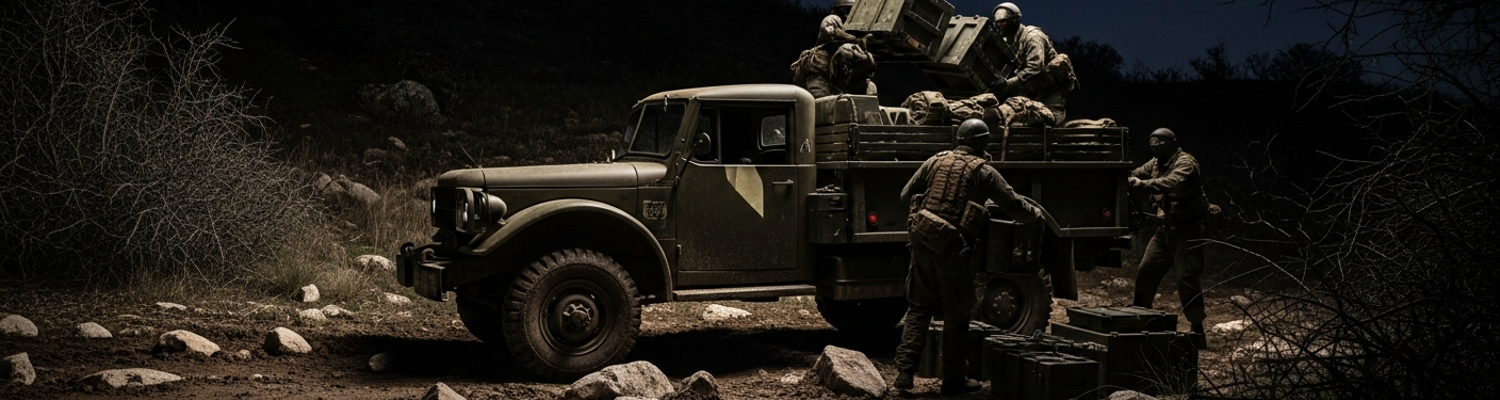
Resource allocation was stripped down to the bare essentials required for a deniable, low-signature infiltration and extraction. Archival motor pool logs (88th Quartermaster, Log 51-304) indicate a standard M151 jeep or M35 truck was explicitly denied. The team was instead assigned a single Dodge M37 ¾-ton cargo truck. This vehicle was chosen because its lower-revving engine was quieter and its profile was common enough in the agricultural region to potentially be overlooked at a distance. Before leaving the motor pool, its military-tread tires were swapped for a set of civilian ones to avoid leaving identifiable tracks. The medical supplies loaded into the back were not a standard aid station loadout. They consisted of twelve units of whole blood, a crate of plasma expanders, and enough morphine to sedate both casualties for hours. The ASA technician carried no weapon. His kit consisted of a set of fine-tipped electronic tools and a compact, 2.5-pound AN-M14 TH3 thermite charge. His orders, delivered verbally by the operations officer, were clear: recover the T-11 device intact. If the device could not be moved, or if the team was at risk of imminent capture, he was to use the thermite charge to melt it into an unrecognizable block of slag. This priority superseded the evacuation of the wounded personnel. The route itself was the final resource, a hand-drawn map provided by the CIC agents that relied exclusively on farm tracks and dry creek beds.
High-Stakes Border Crossing Execution
The extraction began with the grinding protest of the Dodge M37 truck’s transmission. A reconstruction of the route shows the team avoided all paved roads, opting instead for a winding series of farm tracks that climbed into the jagged limestone terrain of the Karst Plateau. The civilian tires, selected to avoid leaving military tracks, proved dangerously inadequate on the sharp, rain-slicked rock. Twice, the truck lost traction on a steep incline. It slid backward until the rear bumper stopped it inches from a deep gully. The smell of the overworked clutch filled the cab, a clear signal the vehicle was operating at its absolute mechanical limit. Forty minutes into the tense drive, the right rear tire went flat, punctured by a sliver of limestone. The team was forced to perform a tire change in less than five minutes, working in near-total darkness. The sounds of their hurried labor were muffled by blankets held up by two of the men. Every clink of the lug wrench risked discovery.
Operational security depended entirely on silence and the CIC agents’ knowledge of the terrain. The team maintained absolute radio silence. Their only communication was a series of hushed commands and hand signals. A close review of the mission debrief reveals a near-catastrophic encounter approximately two kilometers from the crash site. The driver, alerted by a flicker of movement from one of the CIC agents, killed the engine. He coasted the truck into a thicket of scrub oak. Seconds later, a three-man Yugoslav border patrol emerged from the gloom. Their conversation and the scrape of their hobnail boots on the gravel track were clearly audible. The American team remained frozen for ten agonizing minutes. The patrol stopped less than fifty meters away for a cigarette break. The brief flare of a match seemed as bright as a searchlight in the darkness. The Yugoslav soldiers were oblivious, eventually moving on down the path. The recovery team waited another five minutes, the scent of the hot engine and burning clutch a source of extreme anxiety, before cautiously restarting their journey.
Upon reaching the designated 400-meter rally point, the team dismounted and moved forward on foot. The scene at the crash site was one of controlled chaos. The surgeon and his two medics immediately triaged the casualties. The CIA officer was unconscious but stable enough for transport. The ASA sergeant's condition was worse. His lower leg was attached by only shreds of tissue. The field dressings applied by the first-response team were soaked through with blood. The surgeon, working by the dim red light of a filtered flashlight, made the decision on the spot. His report indicates that performing a formal amputation was impossible, but he completed the separation of the already destroyed limb to prevent further tearing and control the bleeding. He applied a heavy compression dressing and a high-and-tight tourniquet. As the medics administered morphine and prepared the casualties for a rough evacuation, the ASA technician went to work on the T-11 Chirp receiver. With one of the CIC agents standing guard, the technician carefully extracted the device from the jeep’s mangled dashboard. He inspected the casing for breaches, confirmed the integrity of the crypto-key housing, and then secured the 30-pound device in its lead-lined transport case. The thermite charge remained unused. The two injured men and the recovered device were loaded into the back of the M37. The team began its slow, perilous return journey, slipping back into the American compound through a service gate just as the first light of dawn broke over the Adriatic.
Post-Operation Strategic Justification
A review of the after-action analysis submitted to TRUST headquarters reveals a stark validation of unconventional methods. The entire improvised extraction rested on a deliberate rejection of established protocols for border incidents, which mandated immediate notification of Allied and British commands. Had the on-duty Colonel followed this directive, the crisis would have escalated through formal channels, necessitating an overt response. A doctrinal aeromedical evacuation would have involved a Bell H-13 helicopter, its distinctive sound acting as a beacon for Yugoslav border patrols. This would have confirmed a major American incident at the precise location of a compromised black operation. Instead, the use of a modified Dodge M37 truck, the hand-picked team of specialists operating outside their designated roles, and the reliance on clandestine CIC routes proved effective. The success became its own justification. It demonstrated that in the unique political landscape of Trieste, deniability and low visibility were more important assets than the speed and resources of a conventional military response.
The operation succeeded because key individuals made high-risk, unauthorized decisions. The initial choice by the TRUST operations officer to bypass the entire formal chain of command and instead make a single, deniable phone call was an act of calculated insubordination. He correctly assessed that the political fallout from a public incident outweighed the career risk of acting unilaterally. In the field, the surgeon’s decision to perform a partial field amputation by flashlight was a significant medical gamble, a procedure far outside standard peacetime protocols but one that stabilized the ASA sergeant for the rough evacuation. Similarly, the ASA technician, whose primary order was to destroy the T-11 if recovery was compromised, exercised critical judgment. Assessing the device as intact and the immediate area as clear of Yugoslav patrols, he chose to recover the invaluable asset rather than follow the destructive failsafe order. Each choice was a departure from the rulebook, predicated on the experience and nerve of the individual on the ground rather than a pre-approved crisis action plan.
This entire episode was a product of the Cold War’s strange operational environment. The mission of TRUST was officially to maintain order, but the reality was a state of constant, low-intensity conflict. The political tightrope created by the 1948 Tito-Stalin split defined every action. The United States was simultaneously providing Yugoslavia with aid to keep it independent from Moscow while aggressively spying on its military. A conventional military operation, perfectly acceptable in a declared war, was impossible in Trieste because it would have shattered this fragile, contradictory policy. The discovery of a joint CIA-Army spy mission would have given pro-Soviet factions within Yugoslavia a powerful weapon and handed Moscow a major propaganda victory. Therefore, the greatest threat was not a firefight on the border but exposure itself. The justification for the clandestine extraction, for breaking rules of engagement and falsifying motor pool records, was that the operation had to remain invisible. It was a black operation conducted within a gray political space. The official report, scrubbed of any mention of the CIA or the T-11, listed the event as a vehicle accident during a routine training exercise.
Intelligence Community Operational Learnings
The after-action review was a closed-door affair. A board of senior officers from the Army Security Agency and the CIA’s Directorate of Operations convened not at TRUST headquarters, but in a secure conference room in Rome to dissect the mission’s failures and improbable success. A close review of the findings, which remained classified for decades, reveals a sharp internal conflict. The board formally condemned the series of procedural violations: the unauthorized joint-agency mission parameters, the failure of pre-mission route reconnaissance that led to the mine strike, and the TRUST operations officer’s deliberate circumvention of the established Allied command structure. It was an organizational disaster that risked a major international incident. Yet, an unofficial addendum to the report, circulated only at the highest levels, praised the very actions it condemned. The on-the-ground initiative and calculated insubordination were credited with preventing a far worse outcome. The recovery was successful not because of doctrine, but in spite of it. This created a stark dichotomy in the official record, a formal reprimand for the procedures and a quiet, informal endorsement of the results.
The Trieste incident directly impacted future covert mission adaptations, particularly for joint military-intelligence operations in politically sensitive environments. The near-loss of the T-11 Chirp receiver sent a shockwave through the Agency’s Office of Technical Service and the ASA. The reliance on a technician carrying a thermite charge was deemed an unacceptable point of failure. A directive was issued to accelerate the development of remote-wipe capabilities and miniaturized, integrated self-destruct mechanisms for all high-value SIGINT and sensor equipment. The mission also led to the creation of what became known as deniable support packages. Instead of relying on ad-hoc solutions, pre-staged kits were developed containing sterilized civilian vehicles, non-standard medical supplies for treating traumatic injuries, and communications gear that could not be easily traced back to US military inventories. These adaptations acknowledged the reality that in certain Cold War scenarios, avoiding a diplomatic incident was a higher priority than adhering to standard military procedure.
The legacy of the Trieste extraction cemented an unwritten doctrine within the intelligence community. The successful recovery became an internal case study, passed down verbally in training courses at facilities like Camp Peary. It served as an example of how creative insubordination could be not just forgiven, but rewarded, if it led to mission success. A review of training curricula from the period shows a new emphasis on scenario-based exercises designed to force operators to choose between rigid protocols and unconventional solutions to save a compromised mission. This event reinforced a culture that prized individual judgment and nerve under extreme pressure, shaping the selection and training of clandestine officers for a generation. It validated the idea that in the shadow war against the Soviet Union and its proxies, the most effective weapon was often an operator willing to ignore the official plan. The official report on the Trieste incident, filed under TRUST-AAR-51-04B, was closed on October 29, 1951. Its final entry cited a simple vehicle training accident.