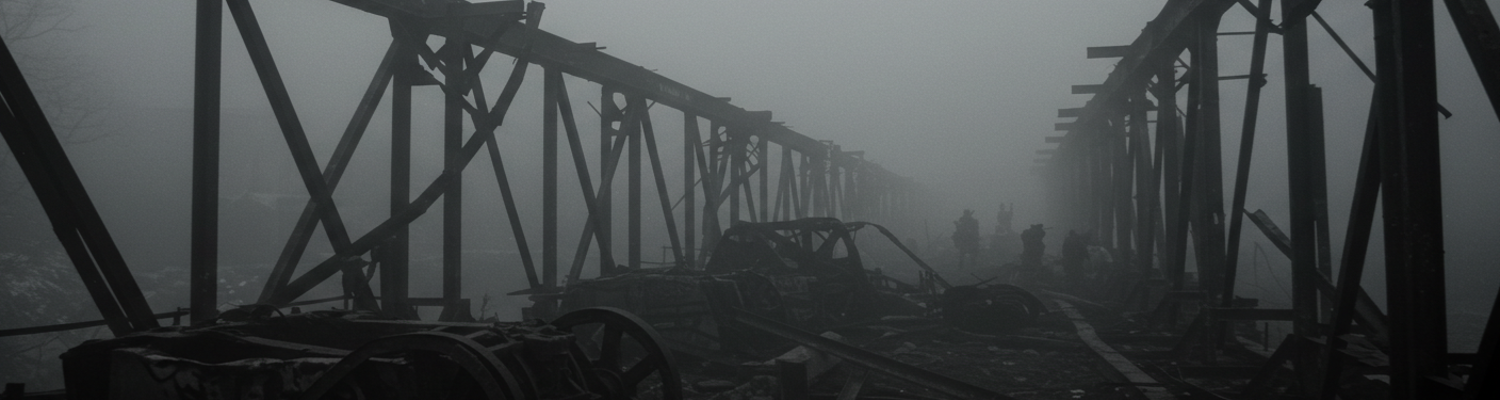

The Korean peninsula’s transportation grid had ceased to exist. Within the first year of the war, combatants destroyed over 1,400 highway bridges and nearly 600 railroad bridges. This systematic destruction defined the conflict for military engineers. Their role became a desperate cycle of demolition and reconstruction, dictated by the wild swings of advance and retreat. The war quickly exposed the limits of established doctrine and the effectiveness of infrastructure denial in a theater defined by its unforgiving geography.
A review of operational doctrine reveals that U.S. Army engineer units entered Korea organized under a framework heavily influenced by World War II. The core formation was the Engineer Combat Battalion, composed of roughly four companies designed to support an infantry division. Field Manual FM 5-5 outlined their dual mission: facilitate the movement of friendly forces while impeding that of the enemy. In the offense, this meant road repair, breaching minefields, and bridging. Battalions were equipped with M2 Bailey Bridges and various ponton systems to cross the rivers of a conquered landscape. In the defense, their role inverted to demolition, cratering roads, and laying minefields. This doctrine assumed a conventional, front-line war. Korea would be anything but.
The war of movement became a war against infrastructure.
This was apparent in the widespread application of infrastructure denial. The Korean peninsula’s geography, dominated by a steep central mountain range and numerous rivers, made every bridge and tunnel a chokepoint. During their initial southward blitz in June 1950, the North Korean People’s Army (NKPA) systematically destroyed infrastructure to protect its flanks. This strategy was mirrored by the Republic of Korea (ROK) army. In a bid to slow the NKPA advance on Seoul, ROK engineers detonated the main Hangang Bridge over the Han River at 2:30 a.m. on June 28, 1950. The demolition occurred without adequate warning, killing an estimated 500 to 800 soldiers and civilians still crossing. The blast disrupted the NKPA’s momentum but also stranded friendly units, including the entire ROK 5th Division, north of the river. The responsible engineer officer was later executed.
The rapid advances and retreats of 1950 and 1951 placed an impossible burden on engineer units. During the breakout from the Pusan Perimeter in September 1950, battalions like the 8th and 14th Engineer Combat Battalions were suddenly tasked with bridging rivers like the Naktong under fire. The 14th Engineers recorded using over 8,000 pounds of explosives for a single demolition on the Naktong River line before being forced to reverse course. The operational whiplash was severe. Following the Chinese intervention in October 1950, the situation reversed. During the withdrawal from the Chosin Reservoir, engineers of the 1st Marine Division and attached Army units had to fight as infantry while keeping a single mountain road open in sub-zero temperatures. When Chinese forces destroyed a key trestle bridge in the Funchilin Pass, the escape route for 10,000 men was cut. The solution was unprecedented. Eight C-119 Flying Boxcar transports dropped 2,500-pound sections of an M2 Treadway bridge by parachute. Six were recovered and assembled by engineers to allow the column to escape.
The psychological front of the Korean War was as contested as its physical terrain. North Korean and Chinese propagandists waged a relentless campaign against UN forces, a battle fought with leaflets, loudspeakers, and radio waves. This offensive was a sophisticated operation that adapted its messaging to target the specific vulnerabilities of its audience. For the over-tasked and exposed U.S. Army engineer units, these messages were engineered with precision, aiming to turn physical strain into a psychological breaking point.
Propaganda often zeroed in on the nature of the engineers' mission. Mobile loudspeaker teams, sometimes mounted on M4 Sherman tanks for protection, would creep into no-man’s-land to broadcast demoralizing scripts. A review of operational logs indicates these broadcasts frequently questioned the purpose of the engineers’ labor. Messages highlighted the futility of building bridges that would be blown up in the next retreat. One leaflet depicted a tired GI eating cold rations with a caption pointing out that he might have to run, fight, or die in an unjust war. These themes were acutely resonant for engineer battalions who directly experienced the war’s destructive cycle. They were the ones placing demolition charges on a bridge they had built months earlier, a tangible symbol of the conflict’s back-and-forth momentum. The psychological impact was compounded by the fact that these units often worked in small, isolated detachments, making them feel forgotten and vulnerable to both physical attack and verbal assaults.
A central feature of this psychological warfare was the use of captured American voices. North Korean radio, primarily Radio Pyongyang, weaponized the voices of American prisoners of war to lend authenticity to their broadcasts. These broadcasts were scheduled for the evening, typically between 9:30 PM and 10:15 PM, when soldiers were exhausted and most susceptible to homesickness. The most infamous broadcaster was Anna Wallis Suh, an American missionary from Arkansas who had remained in Seoul after the 1950 invasion. Dubbed “Seoul City Sue” by GIs, her nightly programs on Radio Seoul mixed taunts with a soft speaking voice. She would suggest that soldiers were better off at home and that their girlfriends would not wait. In one psychologically damaging tactic, Suh would read names and serial numbers from dog tags taken from the bodies of dead American soldiers, warning listeners that their names could be next. The effect of hearing a familiar American accent delivering messages of defeat was profoundly disturbing.
Beyond attacking the mission, the propaganda sought to exploit internal divisions. Leaflets and broadcasts contrasted the hardships of the front line with imagined luxuries back home. The messaging was designed to make soldiers feel they were risking their lives for “big shots” in Florida. Another line of attack targeted racial divisions within the still-segregated U.S. military. The 1951 film Steel Helmet fictionalized this, with a North Korean officer probing these tensions by asking a Black medic why he fought for a country that denied him full rights. This was based on real propaganda themes that aimed to splinter the solidarity of UN forces. For soldiers from minority groups, these messages, while crude, struck at genuine injustices and added another layer of psychological stress.
The UN defeats in the winter of 1950 were rooted in a flawed intelligence apparatus, one crippled by personality and policy. A review of operational logs from October and November 1950 reveals a fatal divergence between the intelligence assessments from General MacArthur’s Far East Command (FEC) in Tokyo and the raw information from frontline units. MacArthur’s intelligence chief, Major General Charles A. Willoughby, operated an information fiefdom that consistently downplayed the scale of Chinese intervention. While the newly formed Central Intelligence Agency (CIA) reported significant Chinese troop movements across the Yalu River, Willoughby’s G-2 section insisted the enemy consisted of a few scattered “volunteers.” Even as the Eighth Army captured Chinese prisoners, Willoughby’s briefings dismissed the evidence. He doctored intelligence to conform to MacArthur’s belief that the war would be over by Christmas. The Tokyo headquarters estimated Chinese forces at a fraction of their actual strength, ignoring warnings from allies. This created a command environment where the supreme commander operated from a different set of facts than the soldiers on the ground.
Faulty intelligence bred operational paralysis.
This disconnect created friction in battlefield decisions, especially in demolition orders. During the UN retreat from Seoul in January 1951, the decision to destroy the pontoon bridges across the Han River became a bureaucratic nightmare. Lieutenant General Matthew B. Ridgway, having recently taken command of a shattered Eighth Army, was determined to prevent a repeat of the panicked ROK demolition of the main Hangang bridge. He instituted a policy of controlled withdrawals. This meant engineer units on-site, with detonators in hand, could not act without explicit orders that traveled up a complex chain of command. The request had to go from company to battalion, regiment, division, and then to corps headquarters, which then had to get approval from Eighth Army command. The order to execute then had to travel all the way back down. This process was agonizingly slow, hampered by intermittent radio communications. For the engineers of I Corps waiting to blow the bridges, every hour of delay increased the risk of being overrun.
The intelligence failure was a self-imposed disaster. General MacArthur had viewed the CIA, like its predecessor the Office of Strategic Services (OSS), as an unwelcome civilian intrusion. He actively stonewalled the agency, restricting its access and refusing to allow its representatives to participate in preparing intelligence estimates for the Eighth Army. This forced the CIA to operate through backchannels, sharing intelligence that was often ignored by Willoughby’s staff. The result was an intelligence structure with no cross-verification. MacArthur’s command was blinded not by a lack of information, but by its refusal to listen. Only after the calamitous retreat of the Eighth Army did the dynamic change. One of General Ridgway’s first acts upon taking command was to finally bring the CIA into the theater, ensuring an alternative intelligence viewpoint.
The UN retreat south from the Chongchon River in late November 1950 was a frantic affair. Following the full-scale intervention of Chinese People’s Volunteer Army (PVA) forces, the Eighth Army’s “Home-by-Christmas” offensive collapsed. The U.S. 2nd Infantry Division and its organic 2nd Engineer Combat Battalion held the line near Kunu-ri to cover the withdrawal. A task in this rear-guard action fell to the engineers: the demolition of a key highway bridge spanning the Chongchon. This would deny its use to the advancing PVA. A detachment from the 2nd Engineer Combat Battalion was dispatched to prepare the bridge for destruction. The environment was chaotic. Security was almost nonexistent. With PVA units swarming the area, the engineers worked under direct threat. They placed their demolition charges, blocks of TNT and composition C-3, onto the bridge’s structural members. The job was rushed. The engineers were effectively on their own.
The retreat was a vortex of bad information. A close review of after-action reports reveals a catastrophic breakdown in command and control. The engineers on the bridge were awaiting the signal to detonate, a signal that was supposed to come only after the last friendly elements had crossed. A covering force of American infantrymen was positioned near the bridge to provide security. They were the final line of defense. In the confusion of the retreat, a mistaken order was passed. The exact nature of the miscommunication remains clouded by the chaos of the battle. The signal to blow the bridge was given prematurely. The engineer team, believing the last of the covering force was clear, triggered the firing mechanism.
The explosion was devastating, but not as intended. The premature detonation caught the friendly covering force in the open. The blast wave and shrapnel ripped through their position, killing or wounding men who believed they were under the protection of a functioning rear guard. The very soldiers tasked with protecting the demolition team became its victims. Compounding the tragedy was the operational failure of the demolition itself. In the haste to place the charges, the engineers had either miscalculated the load required or failed to place the explosives on the most vulnerable structural points. When the smoke and dust cleared, the bridge, though damaged, remained standing. It was not destroyed. The PVA, after a brief delay, were able to push their forces across the still-usable structure, continuing their pursuit.
A review of operational logs reveals a foundational disconnect in command technology. The various arms of the United States military arrived in Korea speaking different electronic languages. U.S. Army ground units were built around a new generation of rugged, line-of-sight FM radios. Portables like the AN/PRC-6 “Handie Talkie” and vehicle-mounted sets like the AN/GRC-9 were designed for short-range tactical nets. The U.S. Air Force, however, operated in a different electromagnetic sphere. Its aircraft, from F-86 Sabre jets to F-51 Mustang close support fighters, were equipped with older, longer-range AM radios, a legacy system from World War II. The technical divide was absolute. An Army platoon leader with an FM AN/PRC-6 could not speak directly to an Air Force pilot in an F-80 flying overhead. This incompatibility was a result of divergent service priorities in the years after 1945. The result on the Korean battlefield was a dangerous silence between forces on the ground and forces in the air.
This electronic gulf made the coordination of artillery and air support a convoluted process. A ground commander needing an air strike had to initiate a request that would crawl up a ladder of communication relays. The call would start on the Army’s FM network, going from the frontline company to battalion headquarters. From there, it had to be relayed, often by runner or telephone landline, to a division or corps headquarters where a specialized team was located. This was the Tactical Air Control Party, or TACP. These small teams, typically consisting of an Air Force pilot, a radio operator, and a mechanic in a radio-equipped jeep, were the only units on the front lines that possessed the multiple radio sets needed to speak to both worlds. They had the Army’s FM radios to listen to ground troops’ requests and the Air Force’s AM radios to speak to airborne forward air controllers or the strike aircraft. This relay system was fraught with delay and potential for error. In a fluid battle, the average time from an initial request to an actual air strike could be 45 minutes or longer. The TACP jeeps themselves were high-priority targets for enemy artillery.
The direct impact of this fractured communication system was measured in lost ground and lives. For units in crisis, the inability to make an emergency call for immediate air or artillery support was catastrophic. Archival evidence shows that field artillery forward observers often could not communicate directly with Air Force aircraft. A platoon pinned down by machine-gun fire could see friendly Corsair fighters circling above, but the calls for help from their FM radios were unheard static to the pilots operating on AM frequencies. The request had to travel the full route: platoon to company, company to battalion, battalion to the TACP, and finally from the TACP to the aircraft. By the time the request was approved, the original tactical situation had often changed for the worse. This friction meant that ground commanders could not rely on airpower in moments of sudden crisis.
The winter of 1950 descended upon the Korean peninsula with an operational ferocity that crippled men and machines. For engineer units in the fighting withdrawal south from the Chongchon River, the weather became another enemy. A review of operational logs from late November 1950 details the frequent formation of dense, freezing fog in the narrow mountain valleys. This was not merely a visual obstruction. The supercooled water droplets coated demolition equipment, truck engines, and weapon mechanisms in a sheath of ice. For an engineer detachment from a unit like the 2nd Engineer Combat Battalion, tasked with preparing a bridge for destruction near Kunu-ri, this condition was catastrophic. Standard procedure required precise placement of TNT blocks and C-3 plastic explosives, a task made nearly impossible by numb fingers and equipment slick with frost. The moisture rendered electrical blasting caps unreliable and saturated priming cord, forcing a reliance on slower time fuses. Batteries for radios and vehicles died quickly in the sub-zero temperatures. The fog was a physical wall, reducing visibility to less than 20 feet.
The fog was a perfect ally for the enemy. Archival evidence shows that PVA forces were masters of infiltration, using darkness and poor weather to their advantage. PVA doctrine favored moving small units at night through valleys and streambeds to bypass front-line positions and establish ambushes in the enemy’s rear. The freezing fog that blanketed the valleys south of Kunu-ri created ideal conditions for these tactics. An isolated and stationary engineer demolition team was a uniquely vulnerable target. PVA patrols, often armed with submachine guns and grenades, could move with relative impunity, their approach masked by the dense vapor. American units, tied to roads by their vehicle-heavy structure, became predictable targets. For the engineers, the first indication of an enemy presence was often the sudden eruption of close-quarters battle. This forced the engineers to split their focus between complex demolition tasks and fighting as infantry.
This sensory deprivation rendered American firepower useless. The entire system of combined arms depended on observation. In the white-out conditions of the Korean winter, that system collapsed. An artillery forward observer attached to an engineer security element could not see a target to call in a fire mission. A request for artillery support would be met with a denial from the gun line; firing blindly into a fog-shrouded valley containing scattered friendly units was a recipe for friendly fire. An incident from November 14, 1950, with the 31st Field Artillery Battalion, illustrates the problem; the extreme cold altered the propellant properties of their gunpowder, causing initial rounds to fall far short until recalculations were made. Air support was equally nullified. Pilots of F-80s or F-51s could not identify targets on the ground, and the radio incompatibility already made timely communication difficult. Trapped in the fog, the engineers were cut off from the very assets designed to protect them, left to face concealed enemy patrols with only the rifles in their hands.
A review of psychiatric evaluations and after-action debriefs from the Korean War exposes a deep psychological scarring among the junior officers who led combat engineer units. For a young lieutenant in a unit like the 2nd Engineer Combat Battalion, the chaotic retreat from the Chongchon River in late 1950 was a crucible of moral injury. The responsibility for demolishing a bridge was compounded by the knowledge that friendly units were still crossing. The decision to detonate, often made in the absence of clear orders, carried the weight of a tactical failure and the personal burden of potentially killing one's own men. The premature demolition at the Chongchon, which killed the very infantry element tasked with protecting the engineers while failing to stop the enemy, became a recurring trauma. Studies of veterans revealed higher rates of anxiety, depression, and post-traumatic stress disorders linked to the severity of combat and the weight of command responsibility at a low rank.
The operational failures that produced such psychological trauma were frequently the direct result of systemic inter-service friction. A fundamental disconnect was the incompatibility of radio equipment between the U.S. Army and the U.S. Air Force. Army ground units operated on FM frequencies, while Air Force fighter-bombers used AM radios. An engineer platoon leader being overrun could see friendly F-80 Shooting Stars overhead but could not speak to them. The request for air support had to be relayed up the Army chain of command to a specialized Tactical Air Control Party (TACP). Only this small team possessed the multiple radios needed to bridge the electronic gap, a process that could take an eternity in a firefight. This communications gulf meant that airpower was often unavailable in moments of acute crisis, a failure rooted not in the sky, but in pre-war procurement decisions.
These hard-learned lessons directly prompted long-term adjustments in American military doctrine. The failures in coordinating air and ground assets in Korea spurred a series of post-war reforms. The ad-hoc system of TACPs was formalized and expanded. This led to the development of joint terminal attack controllers (JTACs) as a dedicated military specialty. A major focus of post-war development was on technology. The services were pushed to develop and procure standardized communication equipment, such as radios that could operate on both AM and FM frequencies, to prevent a repeat of the electronic isolation that had plagued frontline units. The Goldwater-Nichols Act of 1986, while enacted decades later, can be seen as the culmination of this doctrinal shift, legally mandating jointness in command, training, and procurement as a direct institutional response to the friction and failures that characterized conflicts like Korea.