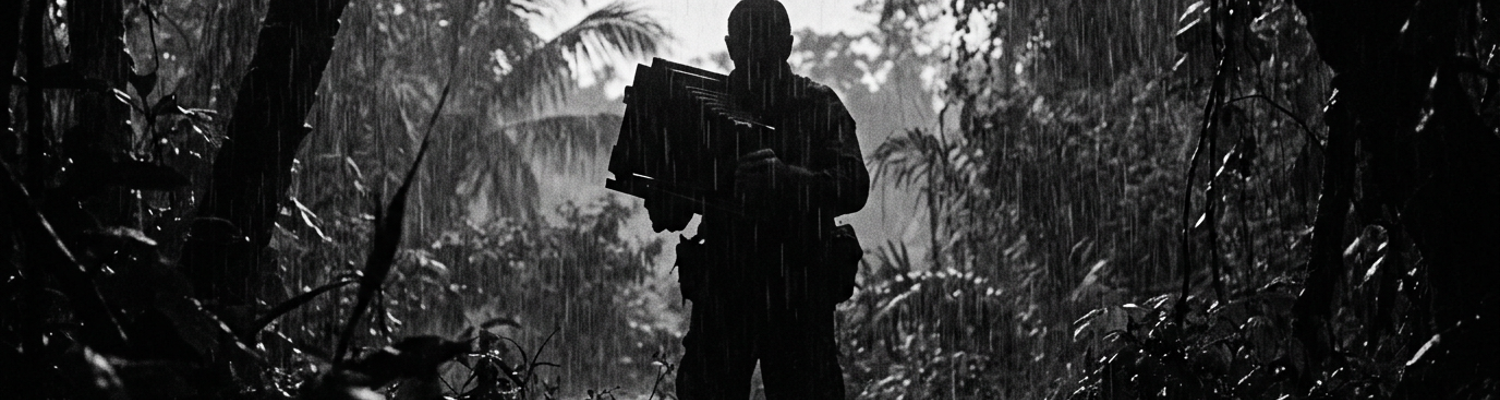

December 1944 Joint Chiefs Intelligence Directive
Rain fell in heavy sheets. The volcanic ash of the Marianas and the coral atolls of the Central Pacific turned into an inescapable paste. Ambient temperatures regularly exceeded one hundred degrees Fahrenheit with ninety percent humidity. Canvas gear rotted within weeks. Unprotected metal oxidized rapidly. Stagnant pools of brackish water bred malarial mosquitoes alongside coastlines battered by relentless saltwater spray. A close review of operational logs indicates that these exact atmospheric conditions destroyed optical equipment faster than supply chains could replace it. Wind-driven sand scored the glass of precision lenses. Freezing rain during nighttime squalls induced rapid hypothermia among men forced to lie motionless in the surf. Enlisted personnel tasked with surveying these forward islands endured chronic dysentery. Severe dehydration and jungle rot stripped the skin from their feet. They carried eighty pounds of gear through knee-deep mud while exposed to the elements.
Not by choice. By direct order.
In December 1944, the Joint Chiefs of Staff authorized covert Office of Strategic Services intelligence gathering across the Pacific Ocean Area. Planners in Washington recognized that existing aerial reconnaissance flown at ten thousand feet failed to identify submerged coral heads. Tide-dependent sandbars and reinforced concrete pillboxes hidden under jungle canopies remained invisible from the air. General William Donovan lobbied the military leadership to deploy small teams of operatives directly into the theater controlled by Admiral Chester Nimitz. Command decisions formalized during these December meetings granted the OSS permission to infiltrate the Pacific Ocean Area specifically to acquire ground-level photographic intelligence. Target coordinates stretching from the Caroline Islands at 7 degrees North latitude up to the Ryukyus at 26 degrees North latitude required immediate survey. Enlisted men paddled heavy inflatable rubber rafts through freezing nighttime surf to photograph these heavily fortified coastlines. The authorization mandated that these units function independently of established theater supply lines to avoid draining Navy resources. Field operatives received only the combat rations they could carry in waterproof bags. Survival during these deployments depended entirely on unproven infiltration tactics. The Joint Chiefs explicitly ordered the collection of oblique-angle shore photography to map the exact elevation of defensive seawalls.
The doctrine forced enlisted photographers to operate alone in the dark.
The Office of Strategic Services established specialized reconnaissance units to bypass traditional naval intelligence constraints. Joint Intelligence Center Pacific Ocean Areas heavily restricted the distribution of target data. They relied almost exclusively on standard Navy photographic squadrons flying F6F Hellcats. Naval intelligence protocol dictated that submarines remain in deep water to avoid acoustic detection. This prevented the close-shore insertion of scouts. The OSS countered this rigid doctrine by forming experimental maritime detachments designed to operate outside the standard Navy chain of command. Technicians in Washington modified standard issue 4x5 Speed Graphic cameras with custom rubberized waterproofing. These vulcanized canvas bags frequently tore open on jagged coral reefs during insertion. Enlisted photographers swam through heavy surf zones carrying these bulky modified cameras to document beach gradients and defensive gun emplacements. Saltwater breached the housings during seventy percent of the initial training drops off the California coast. The specialized units deployed to the Pacific with the defective gear anyway. Field commanders authorized the insertion of these small teams via modified Elco PT boats. These vessels could approach the shoreline under the cover of coastal radar blind spots. Mechanics stripped the mufflers from the Packard V-12 marine engines to increase top speed. This modification deafened the crews.
Quartermasters issued each photographer a Fairbairn-Sykes fighting knife, a waterproof compass, and a sealed tin containing one hundred sheets of high-speed panchromatic film. The film degraded rapidly if exposed to the ambient humidity of the staging bases on Saipan.
OSS Field Photographic Branch Embedment Strategy
Archival evidence shows that high-level planners at the Office of Strategic Services recognized the severe limitations of standard naval aerial photography. To acquire the necessary ground-level intelligence for the upcoming amphibious assaults, command directives in early January 1945 mandated a highly unorthodox operational structure. The OSS Field Photographic Branch embedded enlisted cameramen directly into clandestine Army reconnaissance detachments. This integration bypassed standard theater chain of command protocols entirely. Planners specifically targeted the Sixth U.S. Army Special Reconnaissance Unit. These soldiers were commonly known as the Alamo Scouts. They operated out of a forward staging base on Fergusson Island at 9 degrees 50 minutes South latitude and 150 degrees 40 minutes East longitude. General Walter Krueger designed these Army scout teams to penetrate deep behind Japanese lines in New Guinea and the Philippines to gather raw tactical data. Adding an OSS photographer burdened with forty pounds of specialized optical gear generated immediate friction. Army team leaders argued that the bulky camera housings would compromise their camouflage and slow down their jungle patrols. The OSS command structure overruled these objections through direct orders issued from Washington. Enlisted photographers found themselves abruptly transferred to the Pacific theater. Many had been drafted directly from Hollywood camera crews or civilian newspaper desks. They were assigned to six-man Army scout teams preparing to infiltrate the heavily defended coastlines of Leyte and Luzon.
Army quartermasters refused to issue standard combat webbing to the OSS personnel.
A close review of operational logs from the Fergusson Island training center details the grueling preparation required to keep these integrated teams alive. Teams received specialized training in silent movement, rapid extraction, and covert visual documentation techniques. Instructors forced the enlisted cameramen to navigate through dense mangrove swamps at night while carrying their modified 4x5 Speed Graphic cameras. The primary focus rested on eliminating all acoustic signatures during approach and infiltration. Men learned to step heel-to-toe through thick jungle underbrush without snapping dry branches or splashing in stagnant water. The training regimen required photographers to operate their complex camera mechanisms entirely by touch in pitch-black conditions. They practiced estimating focal distances and adjusting aperture settings while lying prone in the mud. Covert visual documentation techniques demanded that the enlisted men expose their high-speed panchromatic film using only ambient moonlight or highly experimental infrared flash systems. Standard flashbulbs would instantly reveal their position to enemy sentries. Mechanics wrapped the camera bodies in thick layers of vulcanized rubber to muffle the mechanical snap of the focal-plane shutter.
Saltwater corrosion frequently jammed the brass film-advance levers during these nighttime exercises.
Rapid extraction drills proved even more physically demanding than the silent infiltration phases. Planners calculated that Japanese coastal defense forces would detect the reconnaissance teams within minutes of any photographic flash or accidental noise. The training doctrine required the Army scouts and their assigned OSS cameraman to sprint across jagged coral reefs under simulated hostile fire. They practiced launching heavy LCR-class inflatable rubber rafts through breaking surf zones. Instructors timed these extractions down to the second. If the team failed to paddle past the breaker line within a four-minute window, umpires declared the entire unit killed in action. The photographers had to secure their exposed film magazines inside sealed waterproof canisters while simultaneously paddling the raft against strong outward rip currents. Extraction protocols mandated a precise rendezvous with a modified Elco PT boat idling two miles offshore with its engines cut. The crews communicated using heavily shielded directional infrared signaling lamps to avoid visual detection from the shore.
Missing the scheduled extraction window meant the PT boat would abandon the team.
Historical records from a late January 1945 training exercise demonstrate the extreme physical toll of this embedment strategy. A combined Alamo Scout and OSS Photographic team attempted a mock infiltration on a simulated enemy beachhead on the northern coast of Fergusson Island. Heavy squalls pushed their rubber raft three miles off the designated landing coordinates. This forced the men to abandon their primary approach vector and paddle directly into the teeth of an outgoing tidal rip current. The raft capsized. The enlisted cameraman lost his grip on the primary waterproof equipment bag when a ten-foot wave struck the port side. He spent two hours diving in the dark to recover the eighty-pound canvas sack from the reef floor. The team then executed a five-mile forced march through dense jungle canopy while maintaining absolute radio silence. Upon reaching the target objective, the photographer successfully documented three simulated bunker positions using entirely tactile camera adjustments.
The men completed the extraction swim with bleeding hands and severe coral lacerations.
Speed Graphic Camera Use in Jungle Reconnaissance
A close review of operational logistics from early 1945 reveals that OSS planners in Washington mandated the standard issuance of the Anniversary model 4x5 Speed Graphic camera for all ground-level Pacific reconnaissance. This civilian press camera consisted of a mahogany body covered in black leather. It featured dual shutter systems and an uncoupled Kalart rangefinder. High command required the large 4x5-inch negative format to guarantee high-resolution enlargements of Japanese coastal defenses for the intelligence officers planning the amphibious assaults. Enlisted men assigned to the Alamo Scouts carried this bulky optical equipment into operational zones defined by extreme heat, ninety-five percent ambient humidity, and continuous exposure to corrosive salt spray. The camera dimensions measured roughly seven by eight by four inches when folded. This created a rigid, sharp-edged box that dug into the ribs of photographers crawling through coastal mud. Moving through the dense foliage of Leyte at 11 degrees North latitude required operators to hold the delicate apparatus above their heads while wading through chest-deep brackish swamps. Direct sunlight frequently pushed daytime temperatures past one hundred and ten degrees Fahrenheit.
The heat was relentless.
These conditions immediately degraded the structural integrity of the specialized gear. A fully equipped Speed Graphic loaded with six double-sided wooden film holders weighed exactly nine and a half pounds. The physical mechanics of operating this specific camera during covert nighttime infiltrations proved highly restrictive. Enlisted photographers had to manually cock the focal-plane shutter. They calculated exposure values without light meters and pulled the protective dark slide from the film holder entirely by touch. Attempting these precise sequential actions while shivering from hypothermia in the surf zone caused frequent operator errors. Command decisions explicitly banned the use of flashbulbs near enemy positions. This forced the men to brace the heavy camera against tree trunks to execute multi-second exposures in the ambient moonlight.
The brass focusing tracks oxidized and seized within forty-eight hours of exposure to the Pacific atmosphere.
Archival evidence shows that tropical environmental degradation routinely ruined the sensitive photographic materials and jammed the mechanical shutters in the field. The Speed Graphic utilized a rear focal-plane shutter constructed from rubberized cloth with horizontal slits of varying widths. Extreme humidity caused this cloth curtain to swell and warp inside the camera body. It absorbed everything. When operators pressed the shutter release, the swollen material dragged against the internal metal guides. This resulted in uneven exposures or complete mechanical failure. Salt spray from the insertion rafts crystallized inside the front Compur lens shutters. This effectively locked the delicate aperture blades together. During a mid-February 1945 patrol along the Lingayen Gulf, an OSS photographer positioned himself forty yards from a camouflaged Japanese concrete pillbox to document the firing arcs. He triggered the shutter mechanism. The crystallized salt prevented the blades from opening. The film remained completely unexposed. The operator attempted to force the secondary focal-plane shutter. He snapped the internal tension spring. This rendered the camera entirely inoperable for the remainder of the fourteen-day patrol.
Technicians at the forward staging bases resorted to packing the camera bodies with dehydrated rice to absorb the trapped moisture.
The high-speed panchromatic film issued to these units suffered equally severe degradation before the men could even return to the extraction points. Kodak Super-XX emulsion consisted of a gelatin layer suspended on a cellulose acetate base. Sustained exposure to the jungle heat caused the gelatin to soften and adhere directly to the wooden dark slides inside the film holders. The chemical layers melted. When the photographer yanked the slide out to take a picture, the friction physically stripped the emulsion off the acetate base. Any moisture penetrating the supposedly waterproof canvas bags activated the chemical development process prematurely. This fogged the unexposed sheets. Stagnant water and sweat dripped into the unsealed seams of the film magazines during forced marches through the interior ridges of Luzon. Quartermasters logging the returning equipment noted that the wooden film holders warped so severely in the humidity that they lost their light-tight seals.
Development of these exposed negatives in the Fergusson Island darkrooms frequently yielded entirely blank sheets of film.
Visual Mapping of Japanese Defensive Infrastructure
Archival evidence shows that intelligence officers at the Joint Intelligence Center Pacific Ocean Areas demanded precise visual confirmation of Japanese engineering tactics prior to the spring 1945 amphibious assaults. Enlisted OSS photographers attached to the Alamo Scouts received coordinates for the coastal perimeters of Luzon at 16 degrees 30 minutes North latitude. Their primary objective required mapping a heavily fortified three-mile stretch of beach. Imperial Japanese Army engineers had constructed an interlocking network of subterranean bunkers there. These positions were entirely invisible from standard aerial reconnaissance flights. The cameramen crept within fifty yards of the tree line to document camouflaged pillboxes constructed from reinforced concrete, palm logs, and packed coral sand. Japanese defensive doctrine dictated that Type 98 twenty-millimeter machine cannons and Type 4 fifteen-centimeter howitzers be recessed deep into the hillside. They were completely hidden. The weapons fired through narrow horizontal slits covered by woven palm fronds and living vegetation transplanted daily by the defenders. Photographers had to expose their high-speed panchromatic film at specific oblique angles to capture the faint shadows cast by the weapon barrels protruding from these spider holes.
The men operated their bulky Speed Graphic cameras while lying flat in the coastal mud to avoid detection from enemy sentries.
A close review of operational logs from late February 1945 details the mechanical strain of documenting these subterranean bunker networks. Command directives forced the enlisted personnel to map the exact locations of the ventilation shafts protruding from the underground complexes. Locating these six-inch steel pipes required the photographers to crawl through dense brush and photograph the terrain using specialized infrared flash systems. The experimental flash equipment weighed an additional twelve pounds. It relied on fragile glass bulbs that shattered frequently against the sharp coral outcroppings. When a bulb broke inside the reflector housing, the operator had to extract the jagged base from the socket using a rusted multi-tool in complete darkness. The brass focusing tracks of the cameras collected wet sand during these low crawls. This ground the gears down and prevented the operators from locking their lenses into the correct focal positions.
Cutting their hands on the shattered glass meant risking severe blood poisoning from the stagnant jungle water.
Photographic reconnaissance occurred alongside chaotic island civilian evacuations. This severely complicated visual target identification for the embedded OSS teams. As the American naval bombardment intensified along the coastal ridges, thousands of displaced residents fled their villages. They poured onto the very beaches the scouts were attempting to survey. The sudden influx of non-combatants created a dense, unpredictable wall of human movement that physically blocked the camera lenses. Enlisted men trying to focus on the azimuths of hidden artillery emplacements found their uncoupled Kalart rangefinders tracking terrified families carrying wooden carts and livestock instead. Japanese infantrymen frequently discarded their uniforms and blended directly into these fleeing columns. This allowed them to reposition their heavy machine guns without drawing offshore naval fire. The raw visual data was compromised. Planners in Washington had entirely failed to account for this mass migration in their tactical briefings.
The operators had to distinguish between genuine refugees and disguised combatants through a piece of ground glass measuring exactly four by five inches.
This rapid civilian movement overwhelmed the mechanical limitations of the modified civilian press cameras. The operators needed a shutter speed of at least one-two-hundredth of a second to freeze the motion of the evacuating crowds and clearly capture the static bunker positions behind them. The swollen, rubberized cloth of the focal-plane shutters dragged against the internal metal guides. This slowed the exposure times and resulted in heavily blurred negatives. Field commanders issued direct orders forbidding the reconnaissance teams from interfering with the evacuation or attempting to halt the civilians for clearer sightlines. Any interaction with the locals risked exposing the covert positions of the Alamo Scouts to nearby Japanese patrols. An OSS photographer stationed near the village of San Fernando attempted to document a camouflaged mortar pit while surrounded by hundreds of fleeing locals. He spent forty-five minutes waiting for a gap in the crowd large enough to frame the concrete emplacement.
A panicked water buffalo stepped directly onto his primary canvas equipment bag, crushing three exposed wooden film holders deep into the volcanic ash.
Counter Patrol Evasion and Operational Security Constraints
A close review of operational logs from the Luzon campaign indicates that Japanese 14th Area Army commanders deployed dedicated pursuit squads to intercept American reconnaissance elements in March 1945. These counter-patrol sweeps operated heavily along the Agno River basin at 15 degrees 59 minutes North latitude. Enemy infantrymen advanced in staggered lines through the dense cogon grass. They utilized trained tracker dogs and strung trip-wires attached to Type 97 fragmentation grenades across known game trails. Enlisted OSS photographers embedded with the Alamo Scouts found themselves hunted relentlessly through this terrain. Survival depended entirely on absolute noise and light discipline. The primary threat came from the specialized optical equipment itself. A standard 4x5 Speed Graphic camera consisted of hundreds of moving metal parts that rattled against each other during forced marches. Photographers wrapped every exposed brass hinge and locking lever in heavy friction tape. They discarded their steel canteens in favor of canvas water bags to eliminate sloshing sounds. When Japanese patrols closed within fifty yards, the American teams dropped into the deep mud of the drainage ditches and stopped breathing.
The mechanical snap of an unsuppressed focal-plane shutter echoed for two hundred yards through the still jungle canopy.
Operating the camera in these proximity-evasion scenarios required operators to disable the internal flash synchronization contacts completely. Any accidental electrical discharge would instantly trigger a blinding flashbulb ignition and reveal their exact coordinates to the enemy sweeps. Command directives explicitly forbade the use of any artificial illumination, even red-lens flashlights, to check equipment settings. Enlisted men learned to calculate their focal distances by dragging their fingertips across the serrated edges of the focus knobs. They adjusted the aperture blades by counting the tiny mechanical clicks of the dial in pitch blackness. During a specific evasion sequence on March 14, an OSS cameraman lay pinned beneath a rotting mahogany log for six hours. A Japanese squad established a temporary listening post directly above him. He had to slowly tape the dark slide of his film holder to his chest to prevent the thin sheet metal from scraping against the camera track.
Operators smeared thick layers of black grease across the polished camera chassis to kill any ambient moonlight reflections.
Evasion routes frequently forced these heavily burdened teams to abandon the established jungle trails and navigate directly through deep, fast-moving waterways. Fording the Pampanga River under the threat of enemy ambush introduced severe chemical preservation challenges. OSS planners often required the enlisted men to carry their own field-expedient darkroom supplies. They needed to verify the quality of the intelligence before initiating a radio call for extraction. The standard operational loadout included glass vials of powdered Kodak D-76 developer, crystalline acetic acid for the stop bath, and heavy tins of sodium thiosulfate fixer. These compounds degraded rapidly in the ninety-five percent humidity. They became entirely volatile if exposed to the river currents. Photographers spent their brief rest periods applying heated paraffin wax to the threaded caps of every chemical container. They sealed their exposed high-speed panchromatic negatives inside custom-fabricated rubberized bladders. Mechanics back at the Fergusson Island staging area had vulcanized these rubber sleeves using heavy industrial presses. The jagged rocks of the riverbeds routinely tore them open.
A single drop of brackish river water penetrating the canvas supply bags instantly oxidized the powdered developer into a useless brown sludge.
Archival evidence shows the extreme physical toll of protecting these volatile chemicals during contested crossings. On March 22, a four-man reconnaissance element entered the Agno River at 0200 hours to break contact with a pursuing Japanese infantry platoon. The current immediately pushed the men under the surface. The OSS photographer carried a sixty-pound canvas rucksack containing forty exposed glass plate negatives and the sealed chemical development tins. He had to tread water using only his legs while holding the primary waterproof bag high above his head to prevent the river from breaching the wax seals. Tracers from a Type 92 heavy machine gun impacted the water around them. The team drifted two miles downstream before making landfall on a muddy embankment. The photographer collapsed in the reeds and inspected his gear in the dark. A sharp submerged branch had sliced through the outer canvas layer of his rucksack. It punctured the rubberized bladder containing the sodium thiosulfate.
The rushing river water dissolved the fixer crystals and flooded the protective film magazine, permanently fusing twelve sheets of exposed emulsion to the wooden dark slides.
Tactical Value of Enlisted Reconnaissance Imagery
A close review of operational logs from April 1945 indicates that the physical extraction of exposed film from the Ryukyu Islands directly dictated the landing coordinates for the XXIV Army Corps. Enlisted OSS photographers returning from nighttime reconnaissance patrols off the Hagushi beaches handed their warped wooden film holders directly to naval intelligence technicians aboard the command ship USS Eldorado. The development process occurred inside cramped, unventilated steel compartments deep within the hull of the amphibious flagship. Technicians agitated the high-speed panchromatic negatives in stainless steel tanks filled with heated Kodak D-76 developer. They fought the constant pitch and roll of the vessel. The resulting four-by-five-inch glossy prints provided the first clear, ground-level intelligence of the Japanese defensive preparations along the western coast of Okinawa. Planners examining the imagery under magnifying loupes identified a continuous line of submerged coral heads sitting exactly three feet below the low-tide mark.
These jagged formations were completely invisible to standard Navy aerial photography squadrons flying at ten thousand feet.
The developed reconnaissance film forced immediate alterations to the upcoming amphibious assault planning. Intelligence officers used the exact angles of the captured seawalls to calculate the necessary beach gradients for the incoming landing craft. A specific series of photographs taken by an embedded Alamo Scout cameraman at 26 degrees 22 minutes North latitude revealed that the primary assault sector contained a reinforced concrete barrier measuring eight feet in height. This structure would permanently halt the forward momentum of standard shallow-draft LCVP Higgins boats. Command staff immediately ordered the reallocation of specialized LVT-4 Water Buffalo tracked landing vehicles to this specific beach sector. The treads on these amphibious tractors could climb the documented concrete grade.
The visual evidence prevented an entire infantry battalion from stalling in the surf zone under enemy mortar fire.
Archival evidence shows that the visceral photographs captured during these ground-level infiltrations aggressively shaped Pacific theater tactical doctrine for the remainder of the war. The images did not present clean, sanitized overviews of the terrain. They documented the raw conditions of the coastal kill zones. Enlisted men exposed their film while lying inches away from the shattered remains of previous reconnaissance teams and the rusted hulks of destroyed landing craft. One specific negative recovered from a flooded camera housing near the Machinato Airfield showed the exact firing arc of a Japanese Type 1 47-millimeter anti-tank gun. The weapon was recessed deeply into a coral cave. It was angled to strike the thin side armor of American amphibious tractors as they crossed the reef margin. Planners used this visual data to rewrite the standard operating procedures for preliminary naval bombardments.
High-angle plunging fire from offshore battleships could not penetrate these horizontal cave mouths.
The raw photographic intelligence demanded a shift toward direct-fire suppression tactics. Navy destroyers received orders to advance within two thousand yards of the shoreline. They fired their five-inch guns on a flat trajectory directly into the documented bunker slits. The ground-level imagery also revealed the extensive use of reverse-slope defense networks by the Japanese 32nd Army. Photographers captured detailed shots of communication trenches and mortar pits positioned on the inland side of the coastal ridges. These positions were completely shielded from the incoming naval shells. Infantry commanders studying the four-by-five prints realized that their troops would face intact, fully supplied enemy formations the moment they crested the first line of hills. They restructured their squad-level advance protocols to include heavy reliance on portable flamethrowers and satchel charges. They could not wait for artillery support that could not reach the reverse slopes.
Quartermasters issued an additional four hundred M2 flamethrowers to the assault divisions based entirely on these specific reconnaissance negatives.