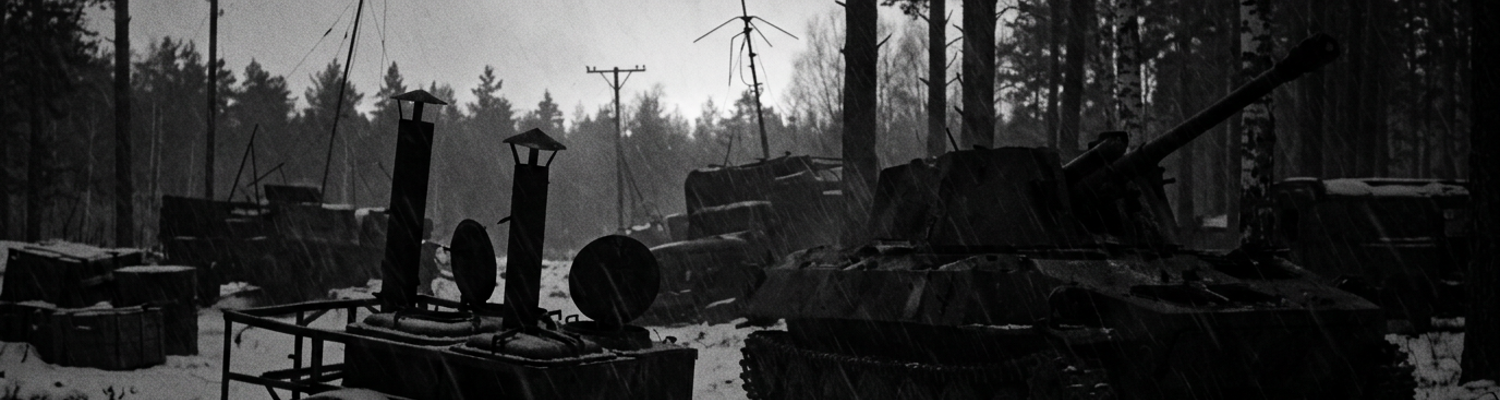

106th Infantry Division Position in the Schnee Eifel
Between December 16 and December 19 of 1944, roughly 6,800 American soldiers of the 106th Infantry Division surrendered to German forces. This resulted in the total mechanical write-off of fifty-five artillery pieces and thousands of small arms. Archival evidence shows this loss stemmed directly from deployment geometry. The 106th Infantry Division occupied extended defensive positions along the rugged Schnee Eifel ridge in early December. The Schnee Eifel is a densely forested elevation straddling the Belgian and German border. The 422nd and 423rd Infantry Regiments physically occupied abandoned Westwall fortifications. Infantrymen sat inside damp concrete pillboxes. The division inherited a compromised tactical footprint from the outgoing 2nd Infantry Division. The positions were entirely static. They relied on pre-registered artillery coordinates and fixed field telephone wires buried just inches below the freezing mud. Signal corps personnel strung hundreds of miles of W-110B communication wire through the dense pine trees. This created a fragile network highly vulnerable to falling branches and snow accumulation.
Unit commanders in St. Vith sat twelve miles away from these forward dugouts.
A close review of operational logs indicates that Major General Alan W. Jones established his headquarters inside a local schoolhouse. He operated through a delayed paper reporting system. Messages from the 422nd command post traveled through manual switchboards at Schonberg before reaching division headquarters. Platoon leaders miles away filed handwritten status updates. Runners carried these updates to battalion command posts. Clerks encoded these messages and transmitted over degraded landlines. The headquarters staff read status reports typed six to eight hours earlier. These officers sat completely detached from the physical breakdown of equipment occurring on the ridge. Geographic separation created profound isolation for the commanders making blind strategic decisions miles away from the front. The division switchboard processed over two thousand calls daily. The actual tactical picture reaching Jones consisted of outdated coordinate plots and delayed casualty figures.
The physical copper wire snapped under the weight of accumulating ice.
When examining the historical record regarding troop deployment, the underlying mathematical failure becomes obvious. Green troops were stretched thin across a front twice the recommended distance for standard division coverage. U.S. Army doctrine in 1944 dictated a maximum defensive frontage of roughly five miles for a full-strength infantry division. The 106th was assigned a sector spanning twenty-two miles from the Losheim Gap in the north to the Our River in the south. The soldiers manning these scattered foxholes had never seen combat. Drafted primarily from the disbanded Army Specialized Training Program, these men arrived in the Ardennes sector directly from transport ships in late November. They lacked basic winter survival training. They possessed no practical experience maintaining weapons or vehicles in subzero conditions. M1 Garand operating rods froze solid because the men applied standard summer lubricating oil. Field kitchens broke down due to frozen fuel lines and cracked gaskets. Frontline squads ate cold rations while standing in half-frozen water. The 424th Infantry Regiment anchored the southern flank in Winterspelt with physical gaps of over four hundred yards between rifle companies.
Night patrols failed to cover the vast empty spaces separating the isolated outposts.
Platoon leaders requested additional SCR-300 backpack radios to bridge the dead zones between the disconnected pillboxes. Division logistics officers denied the requisitions because the regional supply depots in Liege held no surplus radio inventory. The 14th Cavalry Group possessed only light armored cars and dismounted troopers to guard a five-mile corridor. Their M8 Greyhound armored cars lacked the traction to climb the icy logging trails leading up the Schnee Eifel ridge.
The 106th division quartermaster recorded a daily deficit of three thousand gallons of winterized motor oil.
Field Kitchen Immobilization and Rations Collapse
A close review of operational quartermaster logs indicates that the 106th Quartermaster Company deployed seventy-two standard M1937 field ranges. These units were meant to provide hot meals to the frontline infantrymen. These 400-pound portable stoves operated on pressurized gasoline burners. They were transported in the beds of 2.5-ton GMC CCKW trucks or towed in one-ton cargo trailers. The heavy clay soil of the Schnee Eifel ridge trapped these utility vehicles along the narrow logging roads connecting Schonberg to the forward dugouts. Nighttime temperatures plunged. The deep ruts of mud turned into solid ice blocks. This locked the truck axles in place. Mechanics attempted to chip the frozen earth away from the tires using entrenching tools. Surprise German artillery bombardments initiated by 15cm sFH 18 howitzers struck the rear staging areas before the cooks could ignite the burner units for the morning mess. Shrapnel from airbursting shells shredded the canvas mess tents. The fragments punctured the pressurized fuel tanks of the immobilized field kitchens. Gasoline leaked out into the frozen dirt. Cooks abandoned the half-prepared vats of dehydrated potatoes and powdered eggs to seek shelter in nearby drainage ditches.
Artillery fragments destroyed sixteen complete field range units within the first hour of the barrage.
Frontline soldiers in the 422nd and 423rd Infantry Regiments lost their primary source of caloric intake just as the weather deteriorated into subzero sleet. Supply clerks at the battalion command posts hastily distributed wooden crates of Type C-rations to the rifle squads holding the Westwall pillboxes. These emergency meals consisted of six cylindrical tin cans per man. They contained either meat and beans, meat and vegetable hash, or meat and vegetable stew. The B-unit cans containing hardtack biscuits and compressed sugar cubes offered little nutritional relief. Extreme winter weather rapidly froze the high water content of the canned stews into solid blocks of ice. Temperatures dropped to ten degrees Fahrenheit by nightfall. Infantrymen huddled in flooded foxholes attempted to thaw the sealed tins using standard trioxane heating tablets. Gale-force winds and driving sleet blew out the weak blue flames of the chemical tabs almost instantly. Some men resorted to hacking the frozen meat hash apart with their M1 bayonets. They chewed the ice-caked chunks raw. Archival evidence shows that a high percentage of these specific C-ration batches had degraded in open supply dumps in Liege prior to distribution. The freezing and thawing cycle compromised the tin seals. This caused the meat mixtures to spoil. Soldiers consuming the tainted hash developed severe dysentery within forty-eight hours.
Medical officers recorded hundreds of men incapacitated by gastrointestinal illness before the German infantry even reached their positions.
The physical distance between the immobilized kitchens and the starving riflemen widened as the German assault severed the logging trails. Runners dispatched to locate the missing mess trucks found the 2.5-ton vehicles abandoned in the frozen ravines. Quartermasters in St. Vith logged requests for replacement stoves and dry provisions over the surviving field telephones. Division headquarters ignored these specific supply requisitions. Officers operating the switchboards twelve miles away possessed no transport capable of navigating the iced roads. They ordered the forward units to hold their positions and wait for armored resupply columns that did not exist. Soldiers trapped on the ridge burned empty wooden ration crates inside the unventilated concrete bunkers to generate temporary heat. The resulting smoke inhalation forced the men back out into the subzero sleet. Platoon sergeants documented men losing ten to fifteen pounds of body weight in three days due to the total absence of digestible carbohydrates. Sleet accumulated in two-inch layers over the discarded tin cans littering the defensive perimeter.
A single intact M1937 field range recovered near Auw contained eighty frozen gallons of unserved coffee.
Signal Corps Wire Destruction and Environmental Fog
A close review of operational logs indicates that at exactly 0530 hours on December 16, the German Sixth Panzer Army initiated a large-scale artillery bombardment. They utilized 15cm sFH 18 howitzers and 17cm K 18 heavy guns directed squarely at the Losheim Gap. This specific five-mile corridor was defended by the lightly armed 14th Cavalry Group. The 106th Signal Company had previously strung over three hundred miles of W-110B field wire through the dense pine canopies. This connected the forward cavalry outposts in Manderfeld and Roth directly to the main switchboards in Schonberg. This wire consisted of four steel strands and three copper strands encased in a heavy rubber and woven cotton insulation. German high-explosive shells detonated directly in the treetops above the American positions. The gunners utilized mechanical time fuzes to maximize downward fragmentation. Shrapnel from these airbursts sheared the elevated communication lines into thousands of disconnected fragments within the first ten minutes of the barrage. Primary Signal Corps landline communications across the Losheim Gap collapsed entirely.
A single 15cm shell impact obliterated forty yards of suspended communication wire.
Signal corps linemen received immediate orders to locate and repair the severed connections along the logging trails. These two-man teams carried TL-13 lineman pliers and heavy rolls of friction tape into the active impact zones. Artillery fire continuously ripped new gaps in the W-110B lines. The technicians attempted to splice the broken copper ends together in the freezing mud. Falling pine branches crushed the secondary field wire buried just beneath the snow. The destruction of the physical network completely isolated the 14th Cavalry Group from the 106th Infantry Division headquarters in St. Vith. Major General Alan W. Jones sat inside his schoolhouse command post staring at silent EE-8 field telephones. These devices required uninterrupted physical circuit continuity to transmit electrical voice signals. Switchboard operators continuously cranked the hand generators on their BD-71 field switchboards attempting to ring the forward outposts. They received only dead static in return. Forward observers manning the concrete pillboxes on the Schnee Eifel ridge lost all ability to call in defensive artillery fire coordinates.
The headquarters staff operated entirely on outdated coordinate plots from the previous evening.
Archival evidence shows that a dense ground fog settled over the Ardennes sector concurrently with the artillery strikes. Meteorological data from December 1944 confirms a severe temperature inversion trapped heavy moisture directly against the freezing terrain of the Schnee Eifel. The ambient air temperature hovered at twenty-eight degrees Fahrenheit. The ground temperature dropped significantly lower. This created a persistent radiation fog. Visibility fell to less than fifteen yards in the dense pine forests. This environmental factor rendered all visual signaling impossible. Platoon leaders attempting to coordinate defensive maneuvers between the disconnected Westwall bunkers could not utilize their standard M-227 signal lamps. The thick white vapor absorbed the directed incandescent light beams almost immediately. Frontline officers resorted to dispatching runners across the snow-covered ravines to carry handwritten messages. These messengers quickly became disoriented in the low visibility. They wandered directly into advancing German infantry columns.
Moisture saturated the internal vacuum tubes of the surviving SCR-284 radio sets.
The fog completely grounded all scheduled aerial reconnaissance missions across the Ardennes sector. Pilots attached to the IX Tactical Air Command sat in their briefing rooms. Their F-6 Mustang reconnaissance aircraft sat parked on the icy tarmac at advanced landing grounds. The 366th Fighter Group stationed at airfield Y-29 near Asch possessed P-47 Thunderbolts equipped with synchronized aerial cameras. Flight commanders scrubbed all morning sorties because the cloud ceiling hovered at zero feet. Ground crews at Y-29 attempted to scrape the rime ice off the aluminum fuselages using wooden paddles. The freezing precipitation instantly reformed. Division headquarters in St. Vith relied heavily on these daily aerial photographs to track enemy troop movements behind the dense tree lines. The absence of this visual intelligence left the American command staff entirely blind to the massing of two full German Panzer divisions just three miles east of their positions. Jones and his staff officers continued to issue hold-in-place orders based on the false assumption that the Losheim Gap held secure.
Ice accumulation on the grounded aircraft wings exceeded two inches by mid-afternoon.
The Communication Blackout Across the Losheim Gap
A close review of operational logs indicates that a total information vacuum developed between forward regiments and division command elements within four hours of the initial German artillery barrage. By 0930 on December 16, the command post of Major General Alan W. Jones in St. Vith received zero incoming electrical signals from the 14th Cavalry Group stationed in the Losheim Gap. The physical copper lines connecting the BD-71 switchboards in Schonberg to the forward outposts in Manderfeld lay in disconnected pieces. Signal officers attempted to establish emergency wireless contact using vehicle-mounted SCR-284 radio sets. They failed. The heavy pine canopy and the steep elevation changes of the Schnee Eifel ridge physically blocked the amplitude-modulated radio waves. Cold destroyed the remaining equipment. Battery units powering portable SCR-300 backpack radios drained completely within thirty minutes in the ten-degree Fahrenheit ambient temperatures. Condensation from the freezing fog coated the internal vacuum tubes of the surviving transmitters. Operators keyed their microphones and triggered immediate electrical shorts. Division intelligence officers staring at situation maps inside the St. Vith schoolhouse possessed no mechanical means of tracking the German 18th Volksgrenadier Division pushing through the five-mile corridor. Staff clerks continued to log the sector as secure based solely on the absence of distress calls.
The division switchboard operators sat in total silence for six consecutive hours.
Frontline commanders in the 422nd and 423rd Infantry Regiments initiated standard contingency protocols. They dispatched human runner couriers to bridge the severed communication gaps. Platoon leaders wrote exact enemy coordinate plots and severe ammunition deficit reports on standard acetate map overlays using grease pencils. Enlisted men folded these overlays into their M-1943 field jackets. They stepped out of their bunkers and attempted to cross the dense logging trails connecting the forward dugouts to the rear battalion command posts. The physical geography of the Losheim Gap consisted of narrow ravines heavily obscured by low-hanging radiation fog. Visibility dropped below twenty yards. Runners sank up to their knees in snowdrifts while attempting to bypass the main arterial roads blocked by abandoned 2.5-ton utility trucks. Officers at the 14th Cavalry Group headquarters in Manderfeld ordered mechanized messengers to drive Willys MB jeeps down the N-63 highway toward Schonberg to hand-deliver urgent withdrawal requests. Mechanics hastily wrapped snow chains around the smooth rubber tires. The vehicles rolled forward into the whiteout conditions.
Sleet immediately accumulated over the jeep windshields and blinded the drivers.
Archival evidence shows that runner couriers sent through the Losheim Gap were repeatedly intercepted or killed by advancing German patrol units moving west under the fog cover. Advance elements of the 3rd Fallschirmjager Division bypassed the static American pillboxes entirely. These paratroopers established physical ambush positions at the primary trail intersections behind the U.S. lines. German infantrymen equipped with MG42 machine guns and MP40 submachine guns engaged the isolated American messengers at point-blank range as they stumbled through the low visibility. Willys MB jeeps attempting to descend the icy downhill grades of the N-63 highway presented highly visible targets. Armor-piercing 7.92mm rounds penetrated the unarmored engine blocks and standard fuel tanks of the dispatch vehicles. The drivers died instantly. The chassis burned in the snow. Couriers moving on foot through the thick pine stands encountered dismounted German reconnaissance patrols numbering up to forty men. The frozen operating rods on the Americans M1 Garand rifles prevented them from returning defensive fire during these sudden meeting engagements. German intelligence officers systematically stripped the handwritten acetate overlays and frequency codes from the bodies of the dead messengers. The captured documents provided the German Sixth Panzer Army with an exact map of the compromised American artillery positions.
Graves registration units operating in the sector three months later located twenty-two courier remains clustered around a single logging crossroad near Krewinkel.
Headquarters Isolation at Bastogne
A close review of operational logs indicates that Major General Troy H. Middleton established the VIII Corps command center deep inside the subterranean levels of the Caserne Heintz in central Bastogne. This concrete bunker complex sat thirty-five miles west of the primary engagement zones along the Schnee Eifel ridge. Heavy steel blast doors and thick masonry walls physically insulated the command staff from the subzero temperatures and driving sleet. Signal corps personnel routed primary telephone circuits from the forward divisions through a massive BD-110 multiple-position switchboard located in the basement. The heavy multi-pair trunk lines stretching east along the N-84 highway toward St. Vith and Wiltz snapped under the weight of accumulating rime ice. VIII Corps Headquarters in Bastogne operated under severe situational blindness due to missing casualty and position reports. The geographical distance combined with the severed W-110B copper wires created a total information vacuum. Divisional commanders could not transmit standard WD AGO Form 1 Morning Reports back to the centralized command post. These daily paper forms provided the exact mathematical count of available riflemen and mechanical write-offs. Without these physical documents, the headquarters staff possessed no data regarding the rapid disintegration of the forward infantry companies. Battalion runners carrying handwritten casualty sheets died in the snowdrifts miles before reaching any functioning communication relay station.
The G-1 personnel section registered exactly zero killed-in-action reports from the 106th Infantry Division during the first forty-eight hours of the offensive.
Archival evidence shows that intelligence clerks assigned to the VIII Corps G-2 section continued to plot American defensive positions using data transmitted on the evening of December 15. Draftsmen stood before large-scale topographical maps pinned to the damp bunker walls. They drew blue grease pencil markings on transparent acetate overlays to represent the 422nd and 423rd Infantry Regiments holding the Westwall fortifications. Staff officers in Bastogne relied on these outdated overlays and inaccurate estimations of frontline combat effectiveness. They calculated combat readiness using standard War Department tables designed for heavily supplied veteran units. These mathematical tables assumed the frontline units possessed functioning M1 Garands and uninterrupted hot ration deliveries. The officers inside the Caserne Heintz possessed no mechanical means to verify the physical condition of the drafted replacements freezing in the flooded foxholes. Planners assumed the 106th Infantry Division could maintain a cohesive defensive line based strictly on the rigid geometric shapes drawn on their acetate sheets. They ignored the unrecorded mechanical breakdowns and the complete absence of digestible carbohydrates at the front. Operations officers drafted strict hold-in-place orders and dispatched them down the chain of command.
Radio technicians transmitting on the 3.2 megacycle amplitude-modulated frequency broadcasted continuous encrypted directives into dead air.
When examining the historical record regarding the 14th Cavalry Group, the total structural failure of the Bastogne headquarters becomes highly visible. Middleton and his chief of staff operated under the assumption that the five-mile Losheim Gap corridor held secure. The physical destruction of M8 Greyhound armored cars and the abandonment of forward observation posts never registered on the Caserne Heintz situation boards. Without accurate position reports, the command staff tracked nonexistent formations moving across their maps. Clerks continued to calculate daily ammunition resupply tonnages for 105mm artillery batteries. The Sixth Panzer Army had physically overrun those exact batteries at 0800 hours on December 16. Logistics officers in the G-4 section drafted motorized transport manifests allocating thousands of high-explosive shells to specific staging areas near Schonberg. Supply trucks loaded with these heavy munitions received written orders to drive directly east along the N-62 highway to resupply the nonexistent American gun pits.
German Tiger II tanks belonging to the 506th Heavy Panzer Battalion occupied those exact grid coordinates by mid-afternoon.
Delayed Relief Orders and Strategic Miscalculations
A close review of operational logs indicates that Major General Troy H. Middleton and his VIII Corps intelligence staff completely misread the scale of the morning assault on December 16. G-2 section clerks working inside the Caserne Heintz bunker in Bastogne classified the heavy German artillery bombardment as a localized counterattack. First U.S. Army headquarters located forty-five miles further north in Spa reinforced this specific analytical failure. Lieutenant General Courtney Hodges and his intelligence chief had recently distributed a threat assessment estimating German reserves in the Eifel sector at just four understrength infantry divisions. Fragmented reports of enemy contact finally reached Bastogne through the degraded BD-110 switchboards. Staff officers cross-referenced the incoming coordinates against these faulty First Army estimates. They identified the advancing elements of the 18th and 62nd Volksgrenadier Divisions as minor patrol units conducting spoiling attacks to disrupt American troop rotations. The G-2 situation maps displayed no markers for the Sixth Panzer Army or the Fifth Panzer Army. Planners operating entirely on outdated radio intercepts assumed the heavy armor elements of the Wehrmacht sat parked in reserve near Cologne. Clerks inside the Caserne Heintz manually filed the initial contact reports from the 14th Cavalry Group under routine patrol clashes rather than major offensive action. The physical distance from the front insulated these officers from the sounds of the 17cm K 18 heavy guns pulverizing the forward lines.
Intelligence officers confidently logged the total enemy offensive capability in the Schnee Eifel sector at fewer than three thousand men.
Archival evidence shows this severe intelligence failure directly paralyzed the tactical decision-making process regarding the 422nd and 423rd Infantry Regiments. Major General Alan W. Jones sat in his St. Vith schoolhouse headquarters realizing his forward units faced immediate encirclement. He initiated a formal request to withdraw his troops from the exposed Westwall pillboxes back to a defensible line along the Our River. U.S. Army doctrine required corps-level authorization for any divisional retreat exceeding two miles. Jones drafted the withdrawal request on standard message pads and handed it to his signal officers at 1000 hours on December 16. The severed W-110B landlines forced the transmission onto the fragile M-209 mechanical cipher machines. Signal corps clerks manually turned the six rotating cipher wheels to encrypt the text letter by letter. They sent it over an SCR-399 mobile radio set mounted in the back of a 2.5-ton truck. Atmospheric interference and heavy ground fog delayed the reception at Bastogne by over four hours. Cryptographers in the VIII Corps basement struggled to decode the garbled morse code transmissions. Middleton finally received the decrypted request mid-afternoon and immediately rejected it based on the earlier localized counterattack theory.
He ordered the two isolated regiments to hold their static positions on the ridge.
When examining the historical record regarding this specific denial, the physical disconnect between the Bastogne bunker and the forward dugouts becomes absolute. Middleton possessed no physical method to verify the heavy infantry formations bypassing the 106th Division flanks. He discussed the situation over a crackling long-distance telephone trunk line with First Army command in Spa later that evening. Both generals agreed the German activity represented a minor diversionary tactic designed to draw American reserves away from the Roer River dams further north. They decided to evaluate the Schnee Eifel front again the following morning. This effectively tabled the withdrawal authorization for another twelve hours. During this administrative delay, the 18th Volksgrenadier Division pushed directly through the undefended Losheim Gap. They dragged 75mm Pak 40 anti-tank guns behind half-tracks and swung south. The 62nd Volksgrenadier Division simultaneously penetrated the porous lines of the 424th Infantry Regiment near Winterspelt and turned north. These two German columns physically converged at the primary bridge over the Our River in the village of Schonberg at 0830 hours on December 17. The pincer movement trapped over six thousand American infantrymen behind enemy lines without access to food or artillery support. Bastogne headquarters finally transmitted the approved withdrawal authorization to St. Vith at 0945 hours on standard 3.2 megacycle frequencies.
The decrypted radio message arrived exactly seventy-five minutes after the German infantry completely severed the only paved retreat route.
Regimental Encirclement and Field Survival Tactics
A close review of operational logs indicates that by 1600 hours on December 17, the 422nd and 423rd Infantry Regiments found themselves completely sealed inside a tight geographical pocket east of Schonberg. Converging columns of the 18th and 62nd Volksgrenadier Divisions severed the final logging trails leading back to the 106th Division headquarters in St. Vith. Standard 250-gallon Ben Hur water trailers stationed at the battalion command posts had frozen solid during the previous night temperature inversion. German artillery batteries positioned around the village of Auw maintained a continuous barrage of 15cm sFH 18 howitzer fire directly onto the American defensive perimeters along the Schnee Eifel ridge. High-explosive shrapnel tore through the thin steel walls of the water tanks. The remaining ice blocks drained into the muddy soil. Enlisted men trapped in these isolated pocket strongpoints rapidly exhausted the one-quart capacity of their individual M1910 aluminum canteens. Platoon leaders ordered the riflemen to scrape loose surface snow into their metal canteen cups to generate emergency drinking water. The men huddled inside damp Westwall concrete pillboxes and attempted to melt the packed precipitation using nothing but their own body heat. Soldiers unbuttoned their M-1937 wool shirts. They placed the freezing aluminum cups directly against their bare skin. The ambient air temperature outside the bunkers hovered at twelve degrees Fahrenheit while heavy sleet continued to fall.
Ingesting the unmelted snow directly caused core body temperatures to plummet and triggered immediate gastrointestinal cramping.
Archival evidence shows that staff officers at VIII Corps headquarters in Bastogne possessed no mechanical awareness of this localized dehydration crisis. Division commanders operating blind thirty-five miles away calculated daily water resupply requirements using standard War Department quartermaster tables. These administrative charts assumed the forward regiments retained uninterrupted access to motorized water purification units operating along the banks of the Our River. The actual river crossings now sat heavily guarded by German mechanized infantry equipped with MG42 machine guns. American frontline troops received strict hold-in-place orders transmitted over the few surviving SCR-284 radio sets. The continuous airburst artillery barrage forced the drafted infantrymen to stay pinned at the bottom of their flooded foxholes and unventilated concrete bunkers. German gunners utilized mechanical time fuzes. They set the 15cm shells to detonate exactly fifty feet above the ground. Men attempting to crawl outside the defensive perimeter to gather cleaner snow from the undisturbed tree lines were routinely killed by downward-projecting shell fragments. The heavy pine canopy covering the Schnee Eifel functioned as a natural fragmentation multiplier. Tree bursts showered the trapped American units with jagged wooden splinters and hot steel casing fragments.
Medical officers operating the regimental aid stations documented severe dehydration in eighty percent of the active riflemen by the third day of the encirclement.
When examining the historical record regarding field survival tactics, the total absence of winterized clothing forced extreme physical adaptations within the isolated strongpoints. Drafted replacements manning the defensive pockets near Hill 576 wore standard poplin field jackets entirely unsuited for subzero sleet. Exhausted frontline troops began burning wooden supply crates and destroyed equipment for minimal warmth while holding their assigned defensive sectors. Squad leaders authorized the physical destruction of empty Type C-ration boxes and shattered M1 Garand rifle stocks. Infantrymen stacked the splintered wood inside the concrete Westwall bunkers alongside torn canvas webbing and discarded cotton bandoliers. They ignited these makeshift fuel piles using standard-issue matches or sparks generated from their metal Zippo lighters. The burning canvas and thick lacquered wood produced dense black smoke that rapidly filled the confined subterranean spaces. The abandoned German pillboxes lacked functioning ventilation shafts or mechanical exhaust flues. Soldiers choked on the heavy carbon monoxide. They were forced to rotate out into the freezing exterior communication trenches every fifteen minutes simply to breathe. The weak flames generated barely enough thermal energy to thaw the frozen operating rods of their jammed small arms before dying out completely. Planners in Bastogne falsely assumed these men possessed heavy M-1943 winter coats and insulated shoepacs.
A single burning ration crate provided exactly three minutes of localized heat before reducing to ash.
Command Isolation Lessons from the Ardennes Campaign
A close review of operational logs indicates that the Schnee Eifel catastrophe exposed the lethal dangers of redundant communication failures embedded within static defense doctrines. United States Army Field Manual 100-5 dictated that entrenched infantry units like the 422nd and 423rd Regiments rely entirely on centralized artillery support directed from rear-echelon headquarters. This rigid geometric doctrine required uninterrupted signal continuity across the twenty-two-mile sector. Division planners in St. Vith assumed their overlapping communication networks provided fail-safe redundancy. They were wrong. German 15cm sFH 18 howitzer barrages severed the primary W-110B copper landlines suspended in the dense pine canopy within ten minutes of the opening assault. Signal officers immediately switched to their secondary system. They powered up amplitude-modulated SCR-284 vehicle radios and portable SCR-300 backpack sets. Subzero temperatures and freezing radiation fog drained the BA-38 dry cell batteries within thirty minutes. Moisture short-circuited the fragile internal vacuum tubes. Frontline commanders then executed their tertiary backup by dispatching human runner couriers through the ice-choked ravines of the Losheim Gap. Advancing elements of the 18th Volksgrenadier Division intercepted and killed these messengers at logging trail intersections near Krewinkel. The simultaneous collapse of wire, wireless, and physical courier systems left the forward battalions completely blind. Static defense doctrine offered no contingency for isolated rifle companies to maneuver or call for localized mortar fire without division approval. Infantrymen sat trapped in their flooded Westwall pillboxes waiting for orders that physical geography and shattered copper wire prevented from arriving.
The 106th Infantry Division switchboard processed zero outgoing artillery fire missions for the encircled regiments after 1400 hours on December 16.
Archival evidence shows that post-war U.S. Army operational analysis directly addressed these command paralysis events by mandating decentralized field command protocols. The General Board of the United States Forces in the European Theater convened in Bad Nauheim in late 1945 to dissect the structural breakdown at Bastogne and St. Vith. Investigators interviewed surviving junior officers recovered from the Schnee Eifel pocket. They found a fatal procedural flaw. Rigid top-down command structures forced platoon leaders to wait for withdrawal authorizations from Major General Troy H. Middleton while German Tiger II tanks bypassed their flanks. The board issued Study No. 17. This document rewrote tactical doctrine to grant battalion and company commanders autonomous maneuver authority when severed from their parent divisions. Officers commanding isolated strongpoints received new standing orders to displace their units and coordinate organic heavy weapons without requesting permission from rear-echelon generals. The Caserne Heintz bunker isolation proved that headquarters staff operating thirty-five miles away could not accurately assess frontline degradation using outdated acetate map overlays. Planners recognized that physical distance generated an information vacuum that directly killed drafted replacements.
New manual revisions required division commanders to physically relocate their command posts within five miles of the primary engagement zone during winter operations.
When examining the historical record regarding the mass starvation and equipment freezing, the General Board also forced the implementation of heavily improved winterized logistics systems. The total immobilization of the 400-pound M1937 field ranges and the freezing of high-water-content Type C-rations forced quartermasters to redesign frontline caloric distribution. The Army Quartermaster Corps developed smaller squad-level M-1950 multi-fuel stoves. These compact units operated on leaded gasoline or diesel and fit inside a standard canvas rucksack. Ordnance departments analyzed the frozen M1 Garand operating rods recovered from the Ardennes battlefields. The forensic results dictated immediate chemical changes. Technicians replaced standard summer-weight petroleum lubricants with LAW (Lubricating Oil, Aircraft, Weapons). This synthetic compound maintained mechanical viscosity at forty degrees below zero. Logistics officers overhauled the entire European supply chain to prevent the physical isolation seen along the N-62 highway. Supply depots in Antwerp and Liege received strict directives to stockpile specialized winter gear prior to October 15 each year. Quartermasters distributed insulated rubber-bottomed shoepacs, thick woolen socks, and layered M-1943 field jackets to replace the inadequate poplin summer uniforms.
Quartermaster planners allocated three million gallons of subzero antifreeze compound to forward staging areas in Germany by the winter of 1946.