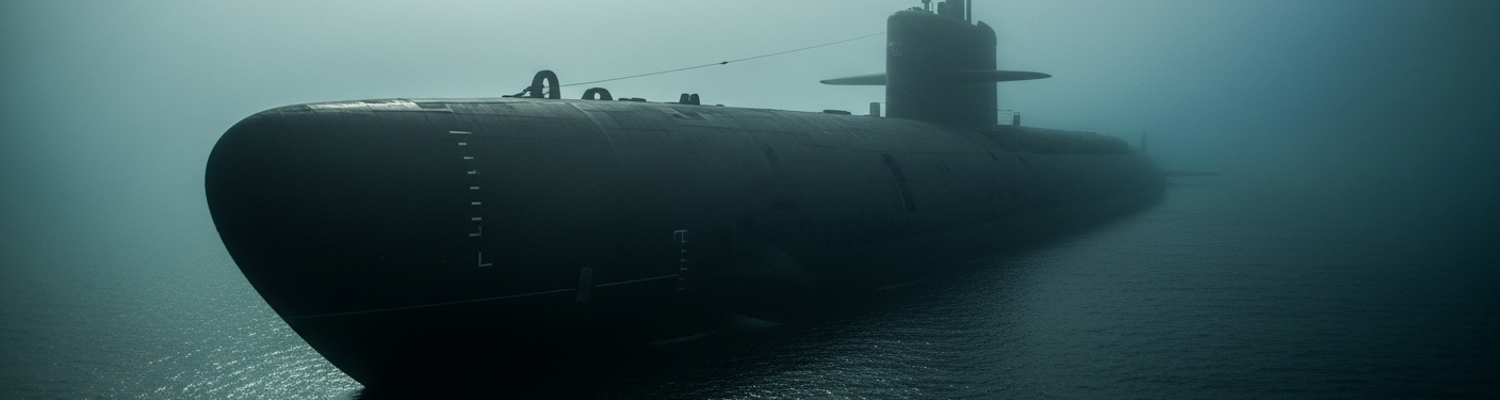

Cold War Clandestine SAR Mission
At 02:17 Zulu on November 14, 1976, near grid coordinates 55° 32' N, 11° 49' E, the USS Halibut (SSN-587) reduced speed to three knots. The submarine’s official tasking was direct. It was to conduct a search and rescue operation for the four-man crew of a United States Air Force T-39 Sabreliner, reported missing during a courier flight over the Kattegat. The aircraft, callsign Reno 14, had disappeared from radar without a distress signal. Its last known position placed its probable wreckage field in the shallow, heavily trafficked waters east of the island of Anholt. Halibut’s mission was to locate the fuselage and recover the crew.
This was the cover story.
A close review of operational logs (per COMSUBLANT Directive 76-11B) shows USS Halibut was never a standard search platform. The vessel was a purpose-built instrument of clandestine undersea intelligence collection. Following a significant 1965 conversion, the submarine bore little resemblance to its fast-attack counterparts. Its engineering spaces were crowded with auxiliary machinery supporting a large, free-flooding hangar integrated into the aft third of its hull. From this hangar, the sub could deploy two 2.5-ton remotely operated vehicles, wire-guided drones known colloquially as fish. These machines, equipped with side-scan sonar, high-resolution cameras, and manipulator arms, were designed for intricate work on the seabed. To support this, Halibut possessed a complex saturation diving system, allowing aquanauts to live and work at extreme depths for extended periods, deploying from one of two vertical access trunks or moon pools. Precision maneuvering near the ocean floor, impossible for other submarines, was achieved through a system of bow and stern thrusters. Halibut’s primary function was not hunting other submarines but finding, examining, and manipulating objects of high strategic value resting in the deep ocean. The submarine was a specialized tool for recovering Soviet missile debris and tapping undersea communications cables.
The official search for Reno 14 was a necessary fiction.
The operational environment itself presented an almost insurmountable challenge to any clandestine activity. The Danish Straits were not open ocean. They were a narrow, constricted, and aggressively monitored chokepoint. A shallow waterway, averaging only 30 to 40 meters in depth, it served as the sole maritime gateway for the entire Soviet Baltic Fleet to access the Atlantic. Warsaw Pact surveillance was layered and constant. East German and Polish fast-attack craft ran incessant patrols. Soviet intelligence trawlers, bristling with antennas and radomes, lingered just outside Danish territorial waters, their hydrophones listening for the distinct acoustic signature of a NATO submarine. The seabed itself was reportedly seeded with fixed Soviet sensor arrays, designed to detect the magnetic anomaly and noise of any submerged vessel attempting a covert passage. On the opposite side, NATO forces maintained their own suffocating watch. Danish, West German, and American SIGINT stations lined the coasts, while maritime patrol aircraft flew continuous tracks overhead. The sheer density of commercial shipping, from ferries to container ships, cluttered the acoustic environment, making passive sonar detection a nightmare of false positives and masking noise.
Catastrophic Hydrophone Array Failure
Operational logs from November 1976 detail a mission unraveling not from external threats, but from a critical internal systems failure. The acoustic integrity of the USS Halibut depended entirely on its AN/BQR-2B passive sonar system. This array, a collection of sensitive hydrophones housed in a distinctive chin mount beneath the forward torpedo room, was the submarine’s primary means of silently listening to the underwater environment. It was designed to detect the faintest sounds. The churning of a distant propeller. The flow of water over another submarine’s hull. The tell-tale clicks and whines of enemy machinery. Deep within the Halibut’s sonar room, a sudden and unrecoverable hardware malfunction occurred within the BQR-2B’s signal processing racks. The exact component failure, likely a cascade of blown preamplifiers or a fatal error in the analog beamforming console, rendered the entire passive array inoperative. Technicians attempted frantic resets and diagnostic checks. The system remained dark. The faint traces of sound that painted a picture of the world outside the hull vanished, replaced by inert silence.
Halibut was acoustically blind.
This single failure was a tactical disaster. A submarine without passive sonar is deprived of its most essential survival sense. In the open ocean, this is a severe handicap. In the constricted and hostile waters of the Danish Straits, it was a potential death sentence. The crew could no longer hear the approach of Warsaw Pact fast-attack craft running patrols out of Rostock. They could not detect the low-frequency signature of a Soviet intelligence trawler lurking just outside Danish waters, its own hydrophones sweeping the channel. Any hostile submarine, specifically the quiet diesel-electric boats of the Polish or East German navies perfectly suited for these shallow waters, could now approach undetected. The constant noise from dense commercial shipping, previously a challenge to filter, now became an impenetrable wall of sound that masked everything. The very premise of a clandestine mission, to hear but not be heard, was nullified. The Halibut was now merely a 3,655-ton submerged liability, deaf to the dangers closing in all around it.
The command staff aboard the Halibut faced an impossible choice. Aborting the mission was the safe and logical option, but the pressure to complete the clandestine objective was immense. The only remaining sensor capable of detecting submerged or surface contacts was the AN/BQS-4 active sonar system. To use active sonar on a covert mission was a violation of fundamental submarine warfare doctrine. A passive submarine listens; an active submarine shouts. Each ping from the BQS-4’s projector would send a powerful burst of acoustic energy radiating for miles, instantly revealing the submarine’s presence, bearing, and existence to every hostile listening post in the region. Yet, with no other way to detect potential threats, the Halibut’s commander gave the order. The sonar room, once a place of quiet listening, was filled with the electronic charge-up whine of the active system. The first ping echoed from the hull, a desperate gamble that announced the spy submarine’s location to the entire Baltic.
Delayed Command Authorization
The active sonar ping was an admission of failure. Standard operating procedure following such a breach of noise discipline, let alone the complete loss of passive sonar, was rigid. The boat was to hold its position, minimize all machinery noise, and await instructions. For the Halibut, this initiated a tense, three-day ordeal. A review of submarine communications doctrine from the period shows the difficulty in this. To receive orders, the submarine had to establish a link with command authorities, likely COMSUBLANT. In the shallow, high-threat environment of the Danish Straits, this was almost impossible to do safely. The boat could not simply surface and raise a high-frequency antenna. That would guarantee detection. The only viable options involved deploying a trailing wire antenna or a towed communications buoy, such as the AN/BRA-8, to just below the surface to listen for Very Low Frequency (VLF) broadcasts. These VLF signals could penetrate the first dozen meters of seawater, but the data rate was agonizingly slow, often just 50 baud. This was suitable only for transmitting short, encrypted code groups, not detailed discussions. Each attempt to deploy this fragile antenna increased the submarine’s vulnerability, creating a minute surface signature that could be spotted by patrol aircraft or the sophisticated radars of nearby Warsaw Pact vessels.
The Halibut was trapped.
Complicating this already perilous situation were the deliberate and persistent efforts of Soviet electronic warfare assets. The Baltic Sea was one of the most heavily monitored bodies of water on the planet, and a primary mission of the Soviet Baltic Fleet was to suppress NATO communications. Archival evidence shows that by the 1970s, the Soviets had shifted from simple radar jamming to a fully integrated electronic warfare doctrine aimed at disrupting command and control links. From shore-based facilities in Kaliningrad and intelligence trawlers loitering in international waters, Soviet EW technicians would have blanketed the VLF and LF spectrums with powerful noise jamming. This was not a subtle interference. It was a brute-force electronic assault. The effect on the Halibut’s sensitive receivers would have been profound. Instead of a clean data stream from a TACAMO command aircraft or a naval broadcast station, the submarine’s radiomen would have heard only a wall of static. The intermittent nature of the jamming made it even more maddening. The Soviets would jam for hours at a time, then cease, goading NATO forces into transmitting and thus revealing their positions, only to resume the electronic attack moments later. For the Halibut, attempting to receive a multi-part coded message under these conditions was a nightmare of repeated, failed attempts and broken signals.
The resulting 72-hour wait for a coherent go/no-go signal created a tactical paralysis. Deep inside the hull, the command staff was cut off. The decision to use active sonar had been a field-expedient choice born of desperation, but it required immediate clarification from the operational commander who held the bigger strategic picture. Was the primary mission scrubbed? Was the Halibut now to attempt a high-risk escape from the Straits, or hold its position under the cover of the falsified search-and-rescue story? These were questions that could not be answered from within the submarine. The rigid, top-down command structure of Cold War submarine operations meant the boat’s captain had limited autonomy in the face of such a drastic change in mission parameters. The crew could only run the quietest systems possible, listen to the jamming-choked frequencies, and wait. The psychological pressure mounted with each passing hour, the silence inside the hull a stark contrast to the electronic storm raging outside. They were deaf, exposed, and now, effectively mute.
Crew Psychological Strain and Isolation
The 72-hour period of enforced silence aboard the USS Halibut subjected its 100-man crew to a level of psychological pressure rarely documented in Cold War submarine operations. A review of naval medical records from the era shows that even under normal patrol conditions, prolonged submergence in a confined environment degraded mood and cognitive function. The Halibut, however, was not on a normal patrol. It was deaf, cornered, and broadcasting its existence with every pulse of its active sonar. The very routines designed to maintain order and morale became sources of profound stress. Sonar technicians, trained for the complex task of passive acoustic analysis, were left staring at dead equipment or monitoring the crude, revealing pings of their own active system. Engineers in the reactor spaces and engine room, accustomed to the predictable hum of a boat on a steady course, now contended with the minute but perceptible vibrations and power fluctuations required to hold the submarine in a static position against currents. A state known as hovering. Every unexpected noise, normally dismissed, became a potential threat.
The air itself became a stressor.
Life inside a submarine is a closed system. The atmosphere is manufactured, a carefully balanced mix of oxygen bled from storage tanks and scrubbed of carbon dioxide by lithium hydroxide canisters. Aboard the Halibut, stationary and running on minimal power, the air quality would have slowly degraded. The constant, low-level headache from slightly elevated CO2 levels, the metallic tang of recycled air, and the ever-present odor of diesel fuel, hydraulic fluid, and unwashed bodies created a physically oppressive environment. There was no escape. The normal rhythm of life, 18-hour days broken into three six-hour watch rotations, dissolved. With the mission paralyzed, off-watch sailors had nothing to do but wait in the cramped berthing areas. These spaces were so tight that hot-racking, where sailors share the same bunk on different schedules, was standard. The lack of privacy was absolute. Even a curtained bunk offered no real solitude from the palpable tension that filled the steel tube. Rumors would have spread with viral speed through the mess decks and crew quarters, quiet speculation about Soviet hunter-killer groups converging on their position.
This was not the quiet, professional monotony of a deterrent patrol. It was the anxiety of sitting in a fixed, known location while being actively hunted.
The communication blackout had a uniquely corrosive effect on crew morale. Under normal circumstances, submariners relied on heavily censored, 15-word family-grams transmitted over VLF frequencies as their only link to the outside world. It was a fragile connection, but a vital one for mental well-being. The Halibut’s inability to receive these broadcasts, due to a combination of its compromised state and powerful Soviet jamming, severed this last thread of human contact. A review of submarine communications from the period confirms that VLF was the backbone for one-way traffic to submerged boats, but it was slow and susceptible to interference. The constant static heard by the radiomen was more than just electronic noise. It was an audible manifestation of their total isolation. This uncertainty extended to the command team. The captain was not only cut off from his superiors at COMSUBLANT, unable to receive clarifying orders, but he and his officers were also cut off from their own families. This dual burden, professional paralysis and personal disconnection, created a specific and severe form of command stress. The ethos of the submarine service was Ship, Shipmate, Self, a mantra emphasizing team cohesion above all. Yet, that cohesion is built on shared purpose and forward momentum, two things the Halibut had lost completely.
Near-Fratricide Event in the Straits
The 72-hour communications blackout ended not with an order, but with a new, immediate threat. The USS Halibut’s continued use of its AN/BQS-4 active sonar had an unavoidable consequence. A review of North Atlantic naval operations from the period shows that a lone submarine broadcasting powerful, repetitive sonar pings in a congested chokepoint was an acoustic anomaly that could not be ignored. At 05:41 Zulu on November 17, 1976, the Halibut’s sonar operators registered a new contact. It was a surface vessel, moving fast, its course directly intersecting their own. The contact was clearly a warship, its speed and sharp maneuvering inconsistent with any commercial traffic. It was actively hunting them. It was homing in on the very sonar pulses the Halibut was using to see. Inside the submarine’s control room, the tactical plot showed the surface ship closing the distance with professional speed. Its predicted track placed it directly overhead within minutes.
The Halibut had no way to determine its allegiance.
This intelligence failure was a direct result of the loss of the AN/BQR-2B passive hydrophone array. A functioning passive sonar system provides a rich, detailed acoustic picture, allowing trained operators to perform precise target identification. They could distinguish the unique sound signature of a Soviet Krivak-class frigate’s gas turbine engines from the different machinery noise of a West German Type 122 frigate. They could identify the specific propeller design of a Danish corvette by the frequency and pattern of its cavitation. This process, cross-referencing detected sounds against a library of known acoustic signatures (per document JANAP 142), was the cornerstone of submarine target classification. With the BQR-2B system completely inoperative, the Halibut’s sonar room was deprived of this capability. The only data available came from the crude echoes of their own active sonar. This provided range, bearing, and a rough estimate of the target’s speed, but it offered no identifying characteristics. The contact was a simple blip on a screen. The command team was faced with an impossible ambiguity. The approaching warship could be a friendly NATO anti-submarine warfare patrol responding to their strange transmissions, or it was a Warsaw Pact hunter-killer group that had just been handed the submarine’s exact location.
A review of NATO anti-submarine warfare doctrine from the 1970s clarifies the actions of the surface vessel. From the perspective of the unidentified warship’s captain, the situation was dangerously clear. An unknown submarine was operating in a covertly aggressive manner in a strategically sensitive waterway. Standard procedure was to challenge the submerged contact using underwater telephone systems, known as Gertrude devices, transmitting coded signals to ask for identification. Any lack of a proper response from the submarine would immediately escalate its classification from unknown to hostile. The Halibut, isolated by its communications failure and unable to coordinate its actions with regional NATO forces, would not have been able to provide the correct countersign. The surface ship, its own crew at action stations, began to maneuver for an attack. Onboard the Halibut, the tactical crisis was now absolute. The faint, ambient noise detectors that still functioned would have picked up the tell-tale sounds of the surface ship’s acceleration and the high-pitched whine of its own weapon systems being activated.
The distinct, high-frequency chirps of a fire-control sonar began to strike the Halibut’s hull. This was the unambiguous sound of a targeting lock. The NATO vessel, having failed to receive a friendly identification, had initiated its final attack protocols. On its deck, an ASROC launcher would have been trained in the submarine’s direction, its launch sequence armed. Below the waterline, its torpedo tubes would have been flooded, the gyros on the weapons inside spinning up to speed. For the men inside the Halibut, this was the ultimate moment of operational failure. They were being actively targeted not by their declared Soviet enemy, but by an allied warship operating under its own rigid rules of engagement.
Compromised SAR Window
The captain of the USS Halibut chose survival. An order was given for an emergency blow of the main ballast tanks. A deafening roar shook the submarine as high-pressure air forced thousands of gallons of water out, pitching the 3,655-ton vessel into a steep, uncontrolled ascent. Simultaneously, the reactor was ordered to flank speed. The massive propeller spun up with such force that it created cavitation, a furious boiling of water that generates a massive acoustic signature. The submarine, designed for stealth, became one of the loudest objects in the Baltic Sea. This single action demolished the mission’s cover story. The pretense of a slow, methodical Search and Rescue operation for the downed T-39 was irrevocably shattered. A searching submarine moves at three knots, carefully mapping the seabed. It does not rocket to the surface and flee at over 20 knots. Every Warsaw Pact hydrophone array and every NATO listening post in the region would register the same unmistakable event: a submarine in distress or in flight.
The SAR window was slammed shut.
This desperate maneuver exposed the brutal realities of signal integrity in the fog of war. A close examination of underwater acoustic principles shows that an event like the Halibut’s emergency evasion leaves a long-lasting and easily trackable acoustic scar in the water. The combined noise of the emergency blow and the intense propeller cavitation creates a disturbance that lingers long after the submarine has passed, a trail for other anti-submarine assets to follow. The very act of survival made the Halibut profoundly vulnerable. Furthermore, the signal of its existence was now hopelessly corrupted. To the NATO ASW commander on the surface ship, the submarine’s sudden, violent maneuver after being targeted might look like the opening move of an attack. To the Soviet intelligence trawlers listening in, the sequence of events could be interpreted in a dozen different ways, none of them accurate. The Halibut, still unable to transmit and explain its actions, had lost control of its own signature. It was no longer a ghost; it was a monster of unknown origin and intent, thrashing blindly in the dark.