
Post-Capitulation Collapse Across Swabia
A close review of operational logs indicates that at 1418 hours on April 27, 1945, an artillery severed trunk line between the Seventh Army command post at Goppingen and forward units dropped dead. This completely isolated field elements pushing into the Hohenzollern wedge. Forward detachments operating along the primary north-south axes discovered their SCR-399 radio trucks were blocked by the jagged topography. Static filled the frequency bands.
The connection stayed dead for thirty-six hours.
US Seventh Army Provost Marshal detachments entering Hohenzollern found a broken front rather than an organized surrender. Disoriented Wehrmacht stragglers belonging to Army Group G poured out of the spruce forests around Hechingen and Balingen. Retreating rear echelon commands followed them. German soldiers dumped Kar98k rifles directly into drainage ditches. They discarded gas mask canisters and unspent panzerfausts along the road shoulders. These men actively sought out American jeeps to turn themselves over. Provost marshals had anticipated handling scattered squads of deserters. Three-man Military Police patrols found themselves absorbing entire battalion strength columns. These columns marched without officers or orders. The sheer physical bulk of these groups jammed the narrow two-lane asphalt arteries. Provost detachments possessed neither the transport to relocate them nor the field rations to feed them.
Archival evidence shows that the jagged limestone escarpment of the Swabian Jura broke American movement to a crawl.
The Albtrauf ridge rose hundreds of meters above the valley floor. This forced American rear echelons onto twisting switchbacks with gradients exceeding twelve percent. Heavy GMC CCKW two and a half ton supply trucks (Ordnance Department inventory manifest 44-A) repeatedly burned out their clutches. They stripped transfer cases on the damp asphalt. Rain turned the secondary dirt tracks across the karst plateau into deep limestone slurry. This mud swallowed quarter-ton trailers up to their axles. Radio propagation died inside the narrow limestone defiles. Supply convoys drove blindly into sectors where French First Army units were asserting conflicting administrative claims. French armor units operating under General Jean de Lattre de Tassigny regularly commandeered road space without coordinating with American rear guards. They blocked fuel convoys. Entire Seventh Army sectors went unsupplied for days at a time.
No coordination existed between the two allied commands on the ground.
Elements of the 100th Infantry Division found themselves pinned under the human weight of this influx. Division rear guards had zero engineering allocations for formal prisoner camps. Line companies from the 398th Infantry Regiment resorted to requisitioning cattle fencing from agricultural supply depots in Tailfingen. They used this material to pen incoming prisoners into open air fields. Soldiers pounded makeshift wooden stakes into wet rye acreage. They unrolled rusted agricultural wire to form temporary perimeter fences across five acre plots. Heavy spring downpours quickly converted the interior grounds into ankle deep mud. Thousands of Wehrmacht troops stood in this mire without overcoats or blankets. Medical personnel attached to the division ran out of sulfa powders before the third day. Guards watched over crowded pens where dysentery was already spreading among thousands of exposed men.
100th Infantry Division Supply Failures
When examining the historical record of late April, the 100th Infantry Division G-4 section faced an immediate breakdown in Class I supply distribution within forty-eight hours of occupation. Forward supply dumps operated by the Seventh Army Quartermaster at Goppingen halted all truck movements south due to acute gasoline shortages. This cut off standard field ration deliveries to forward holding pens across the Danube basin. Division quartermasters carried fewer than eight thousand Type C field rations in reserve. This inventory was earmarked exclusively for frontline American combat battalions. Captured Wehrmacht personnel received no standard American rations at all. US guards distributed quarter rations of captured dry zwieback biscuits. They handed out dried legumes retrieved from abandoned German army warehouses in Mengen. This provided fewer than six hundred calories daily per captive.
Potable water distribution collapsed simultaneously.
The division possessed only five trailer mounted M-1940 mobile water purification units for the entire sector. Mechanical pump impellers repeatedly seized after ingesting limestone silt from local mountain creeks. Water trailers suffered punctured canvas bladders along the unpaved forest trails. Pintle mounts sheared off completely. Field engineers attempted to pump untreated water directly from the Danube River. Local industrial waste and upstream runoff rendered the supply foul.
Supply lines dried up completely by the first week of May.
Archival evidence shows that mounting detention numbers forced field commanders from the 399th Infantry Regiment to seize regional civilian infrastructure. They did this to prevent total encirclement by their own captives. Major General Withers A. Burress authorized the immediate requisition of dairy farms and cultivated rye fields along the river valley floor east of Sigmaringen. Provost marshal detachments served seizure notices directly onto local German municipal authorities. They confiscated private agricultural land across five separate tracts totaling over one hundred acres. Line infantrymen commandeered the abandoned freight yards of the Deutsche Reichsbahn rail terminal at Sigmaringen. This included three parallel marshaling spurs that had previously serviced freight trains traveling toward Tuttlingen. Soldiers drove seventy-two rusted two-axle wooden boxcars together along the dead-end tracks. They strung concertina wire through the open sliding doors to convert the rail siding into an impromptu processing compound. Two machine gun emplacements were bolted directly into the rail bed gravel at the junction switches. More than twelve thousand disarmed Wehrmacht soldiers were packed into these damp gravel beds. They were enclosed on three sides by unrolled rolls of civilian farm wire lashed to telegraph poles.
No transit corridors were cleared to evacuate the sick.
Unseasonable atmospheric depressions drove freezing rain across the Swabian Jura throughout the second week of May. Nocturnal temperatures dropped near freezing. The open air enclosures around Sigmaringen possessed no barracks or corrugated roofing panels. Captives stood directly on heavy clay soils. This dirt converted within hours into a thick liquefied mire reaching past their ankles. Without overcoats or dry ground, hundreds of men rapidly succumbed to acute hypothermia. Sanitary infrastructure broke down entirely. Slit trenches excavated along the northern fences flooded under the torrential downpours. Raw sewage overflowed back into the sleeping areas where detainees attempted to rest on wet gravel. Waterborne pathogens spread instantly among the malnourished population. Widespread outbreaks of bacillary dysentery afflicted over forty percent of the interned personnel. Damp socks and ruined combat boots accelerated severe trench foot. This produced black ischemic necrosis of the toes and plantar surfaces. Medical officers from the 325th Medical Battalion recorded seventy-four amputations from exposure and dehydration within a single forty-eight hour operational window ending on May 12. Thirty-eight men died during that same period.
Doctrinal Failures of Allied Intelligence Profiling
A close review of operational logs indicates that US Seventh Army G-2 intelligence teams stationed near Balingen and Sigmaringen operated under rigid academic questionnaires formulated thousands of miles away. Advisory groups at the War Department had developed interrogation rubrics influenced by sociological research into Prussian military caste structures. Intelligence officers were instructed to categorize incoming German personnel through structural matrices designed to detect Junker nobility ties. They looked for Imperial cadet lineages and formal General Staff college accreditations. Evaluators treated every surrendered officer as an operative of a centralized aristocratic military apparatus. Questionnaires required detailed genealogical breakdowns. They demanded aristocratic land registry records and ideological evaluations going back to the Weimar era. Seventh Army interrogation teams spent hours demanding historical ancestry documentation from junior combat commanders who had never set foot east of the Elbe River. Interrogators became bogged down in tracing whether a captain had a grandfather with an estate in East Prussia. They failed to identify immediate security threats or sabotage networks.
The doctrinal model bore no relation to the broken army standing in the mud.
Archival evidence shows that these dogmatic classification templates failed entirely when applied to the actual demographics inside the Hohenzollern enclosures. Seventh Army intake stations received hundreds of elderly Volkssturm conscripts. They processed sixteen year old boys mobilized three weeks earlier. Female typists evacuated from regional administrative depots in Mengen flooded the intake lines. Scattered throughout the perimeter were hundreds of foreign auxiliaries. This included Soviet Osttruppen and Polish mechanics. Italian labor drafts from Organization Todt who spoke no German and carried no formal military paperwork sat in the mud. American screening rubrics contained no operational codes for non-German forced laborers wearing dyed Wehrmacht field tunics. Evaluators possessed no authority to deviate from standard questionnaires. They forced bewildered teenagers and Ukrainian railway laborers to answer eighty-four complex questions regarding their pre-war political activities inside the National Socialist party. Men who had never fired a weapon were classified under provisional security holds alongside active frontline combatants. This happened simply because their military identity booklets lacked official demobilization stamps.
Dockets piled up faster than intelligence officers could type.
When examining the historical record of detention operations during mid-May, the Seventh Army interrogation annex at Tailfingen had only eleven qualified German linguists to process over twenty-two thousand detainees. Each individual interrogation required three carbon copied copies of Form W-110 (European Theater of Operations standard operating procedure 11-B). These were typed manually on portable Remington typewriters. Field evaluators ran out of mimeograph fluid within forty-eight hours of opening the intake office. Carbon paper and blank filing jackets disappeared just as fast. Interrogation officers averaged only eight completed security profiles per day per team. This created an administrative bottleneck that left thousands of detainees waiting three to four weeks behind barbed wire fences for an initial five minute hearing. Suspects flagged for minor clerical discrepancies remained locked in open fields alongside identified Gestapo and Waffen-SS personnel. The broken screening process failed to isolate the actual threats. By May 19, over seventeen thousand unprocessed security files sat soaked in unsealed wooden crates stacked against the brick walls of the Sigmaringen freight depot. Line companies from the 100th Infantry Division continued to deliver four hundred new captives every twenty-four hours.
OSS T-Force Operations and Scientific Detainees
A close review of operational logs indicates that Task Force Alsos prioritized securing Kaiser Wilhelm Institute physicists in nearby Hechingen over any standard tactical screening. They operated in direct coordination with Office of Strategic Services T-Force personnel. The recovery group pushed south along the edge of the Black Forest ahead of Sixth Army Group infantry. They needed to secure research facilities before French combat units reached the district. German researchers had evacuated the Kaiser Wilhelm Institute for Physics and Chemistry from Berlin during the bombing campaigns of 1944. They relocated laboratories into a repurposed textile factory and brewery basements along Zillhausen Street. Alsos personnel focused specifically on taking custody of Carl Friedrich von Weizsacker and Karl Wirtz. They also targeted Erich Bagge and chemist Otto Hahn. Tactical vehicles assigned to the extraction group included Dodge WC-54 trucks and two armed jeeps equipped with ring mounted Browning machine guns. Operatives sealed the textile mill buildings. They confiscated experimental logbooks and theoretical research papers. Technical drawings detailing uranium reactor designs were seized immediately. Recovery technicians gathered drums of heavy water and refined uranium metal blocks from nearby cellar vaults. They loaded the classified scientific materiel directly into transport crates for transfer to Heidelberg.
Scientific targets superseded tactical containment.
Archival evidence shows that T-Force operatives intentionally bypassed standard provost marshal intake procedures to seize high value laboratory scientists without CIC notification. Standard theater security protocols dictated that every surrendered German specialist pass through division level enclosures. They required fingerprinting and biometric filing. Documentation on War Department detainee rosters was mandatory. Scientific recovery officers discarded these requirements entirely. Operatives removed nine key physicists from private homes across Hechingen without presenting detention warrants. They did not inform the 970th Counter Intelligence Corps Detachment responsible for sector screening. Field agents from the local CIC office learned of the operation hours later when discovering broken security seals on the laboratory doors. Military police guards at Seventh Army checkpoints along Highway 27 attempted to stop the outbound extraction convoy for lacking transport clearance manifests. T-Force officers presented executive clearance directives bearing War Department authorization codes that overrode regional provost commands. Operatives refused to log the scientists on local prisoner tallies. They refused to deliver them to the Sigmaringen enclosures. The prisoners were transferred directly to secure holding sites outside Seventh Army administrative jurisdiction.
Authority fragmented across the administrative boundary.
When examining the historical record of detention disputes, contested authority over laboratory custody created severe procedural disputes between tactical interrogators and specialized scientific recovery teams. Seventh Army tactical intelligence evaluators arrived in Hechingen on April 26 intending to subject all captured technical personnel to standard denazification questionnaires. Armed Alsos sentries stationed at the entrance of the institute secondary laboratory annex barred line division G-2 officers from entering the facility. Tactical interrogators argued that removing suspects without vetting violated theater intelligence standing orders. They noted that several institute administrators maintained verified connections to state research councils and industrial syndicates. Scientific recovery teams refused to allow tactical personnel to question the detained physicists. They claimed that front line interrogators lacked the security classification required to handle personnel involved in strategic nuclear physics projects. Formal jurisdictional complaints submitted to the Seventh Army Inspector General stalled in regional administrative channels without resolution. Recovery officers ignored field protests. They transferred the detained physicists to an auxiliary landing strip near Goppingen for air transport to France on May 2.
The tactical dossier on the Hechingen laboratory was closed without an entry.
French Demands Over Sigmaringen Collaborators
Archival evidence shows that the French First Army liaison mission drove into the 100th Infantry Division sector on May 8 to demand the unilateral surrender of French collaborators. They were dispatched under the direct authority of General Jean de Lattre de Tassigny. The French delegation targeted senior members of the Vichy governmental commission who had fled Schloss Sigmaringen during the Allied encirclement. French staff officers presented a priority capture roster containing Fernand de Brinon and former Vichy Information Minister Jean Luchaire. Key Milice paramilitary organizers detained in American rear areas were also on the list. Two camouflaged Citroen Traction Avant sedans carrying armed French gendarmes and intelligence personnel halted directly in front of the makeshift US provost headquarters at the Sigmaringen rail terminal. Representatives from the French mission asserted absolute sovereign authority over these detainees. They demanded their immediate physical transfer to Paris for trial before the High Court of Justice. They dismissed American operational jurisdiction out of hand. They refused to file formal extradition requests or present standard Allied paperwork. The French colonels declared that treason against the French state was a domestic legal matter that superseded front line coalition procedures.
The Americans refused to open the gate.
A close review of operational logs indicates that special agents from the 970th Counter Intelligence Corps Detachment intervened to block every French custody claim. Theater directives issued by Supreme Headquarters Allied Expeditionary Force mandated that no political suspect be transferred to foreign jurisdiction prior to complete American intelligence screening. American CIC investigators wanted the Vichy officials interrogated about German stay behind sabotage organizations. They needed data on hidden financial assets and links to the Reich Main Security Office. Interrogators insisted that every captive undergo biographical cross referencing against the Central Registry of War Criminals and Security Suspects master index. Agents stationed in a requisitioned municipal building along Karlstrasse typed twenty-eight page Form W-110 intelligence profiles on portable Underwood machines. Biometric cards were matched against captured Amt VI foreign intelligence registries to identify French fascists slated for post war covert actions. American counterintelligence officers viewed the French handover demands as an effort to execute key witnesses before the United States could extract their strategic value. Until the security dockets were cross indexed and countersigned by Seventh Army intelligence officers, the prisoners were classified as non releasable assets.
Neither side conceded administrative territory.
When examining the historical record of mid-May, escalating friction between French military liaisons and US camp administrators brought all prisoner processing to a complete halt. French liaison missions filed formal protests with Sixth Army Group headquarters in Heidelberg. Local American provost marshals excluded French personnel from entering detention compounds. Guards from the 399th Infantry Regiment received orders to load their M1 carbines if French officers tried to breach the inner security perimeter. Standard release authorizations required five separate endorsements spanning three military commands. This included provost, division G-2, theater CIC, and French liaison desks. A missing carbon copy stamp on a custody voucher froze entire detainee manifests for days. Suspects remained locked in wet freight cars along the Sigmaringen rail spur while staff officers argued over fuel allocations and signed prisoner receipts. American camp administrators refused to acknowledge French military passes that lacked joint Allied command stamps. This created a wall of conflicting clearance forms. By May 22, forty-six high profile Vichy figures sat stranded behind American concertina wire while their administrative files gathered damp in division inbox trays.
The transfer dockets were filed without resolution.
Werwolf Hysteria and Perimeter Fratricide
A close review of operational logs indicates that Seventh Army G-2 intelligence bulletins circulating throughout the Swabian redoubt triggered extreme paranoia among frontline guards during the first weeks of May. Theater headquarters repeatedly broadcast alarmist warnings describing Operation Werwolf as an active decentralized insurgent apparatus. They were reportedly preparing to execute hit and run ambushes against Allied detention facilities. Intelligence summaries issued to the 100th Infantry Division warned that SS-Jagdverband commandos had established hidden arms caches across the rugged limestone defiles of the Swabian Jura. They were supposedly reinforced by fanatical Hitler Youth partisans. Interrogation teams told regimental guards that stay behind elements planned to cut field phone cables and poison water cisterns. They warned of garroting attacks against isolated sentries under cover of darkness. American provost units guarding the perimeters around Sigmaringen and Balingen operated under orders to treat any unannounced movement outside the barbed wire as an assault by Nazi death squads. Line infantrymen from the 398th Infantry Regiment spent their watches expecting silenced weapon ambushes and panzerfaust strikes against their command posts.
Fear transformed the dark pine forests into an active battleground.
Archival evidence shows that chronic sleep deprivation and severe weather eroded the judgment of American perimeter sentries. Seventh Army provost companies were understaffed by more than sixty percent. Division commanders kept combat infantrymen on seventy-two hour continuous perimeter rotations with no sleep relief. Sentries stood inside muddy open topped slit trenches along the Sigmaringen secondary enclosures. They were battered by near freezing nocturnal temperatures and soaking sleet. Heavy atmospheric inversions trapped dense radiation fog across the Danube and Starzel river basins each night between 2100 hours and sunrise. This dropped line of sight visibility down to three yards. Exhausted soldiers suffered auditory and visual hallucinations. They mistook wind blown spruce boughs and grazing cattle for approaching saboteurs. Field telephone lines between outpost foxholes and regimental tactical command posts repeatedly failed because damp earth corroded the terminal jacks of EE-8 field phones. Guards kept their M1 Garand rifles and Browning M1919A4 machine guns chambered with safeties disengaged. They tracked phantom shapes through the dense white vapor.
Tension snapped the line.
When examining the historical record of May 11, this hair trigger alert status culminated in lethal fratricide along the secondary access trails west of Laucherthal. A motorized reconnaissance platoon from the French 1st Armored Division pushed three M8 Greyhound armored cars and two Dodge weapons carriers toward the Sigmaringen perimeter to reconnoiter disputed roads. They were operating under General Jean de Lattre de Tassigny. Driving under complete blackout conditions to avoid suspected sniper fire, the French column advanced along the narrow gravel curves with only hooded cat eye marker lamps illuminated. French commanders had failed to transmit route clearances or operational coordinates to Seventh Army provost marshals. At 0240 hours, the lead French scout car approached an unmapped American roadblock manned by a squad from the 399th Infantry Regiment. Blinded by the thick karst fog and convinced they were under surprise attack by a Werwolf armored spearhead, American sentries opened fire without hailing the approaching column.
A Browning M2 fifty caliber heavy machine gun mounted on a sandbag revetment raked the lead French vehicle at forty yards.
Armor piercing incendiary rounds punched through the Greyhound unarmored open top and thin hull plating. This detonated forty rounds of 37mm canister ammunition stowed in the interior racks. American infantrymen hurled fragmentation grenades and pumped three rounds of 60mm high explosive mortar fire into the trail. They struck the trailing French Dodge truck before the French cavalrymen could deploy recognition panels or fire green liaison flares into the night sky. The exchange lasted less than ninety seconds. Two French troopers died instantly inside the burning scout car. Four French cavalrymen sustained severe shrapnel wounds before the American squad leader recognized the tricolor insignia painted on the mangled chassis and ordered an immediate cease fire.
The burnt out hull was pushed into a drainage ditch at dawn.
Administrative Reorganization and Containment Lessons
A close review of operational logs indicates that theater command intervened on May 24, 1945. They stepped in to halt the escalating administrative paralysis between Seventh Army intelligence desks and French liaison officers at Sigmaringen. Sixth Army Group Headquarters under Lieutenant General Jacob L. Devers issued a binding directive creating unified tripartite screening commissions. These mixed boards integrated investigators from the US 970th Counter Intelligence Corps Detachment and French Deuxieme Bureau officers. British 21st Army Group liaisons joined them to form single table tribunals. The new mechanism scrapped the unmanageable War Department Form W-110 requirement and canceled dozens of overlapping questionnaires. Evaluators processed detainees across three joint desks stationed at the freight depot. They shared a consolidated master suspect list instead of running competing background investigations on manual typewriters. Each tripartite docket received a single universal registry number. This terminated the circular loops where French officers rejected American release chits and American provost marshals turned away French extradition convoys.
Tripartite panels eliminated over forty administrative steps in a single afternoon.
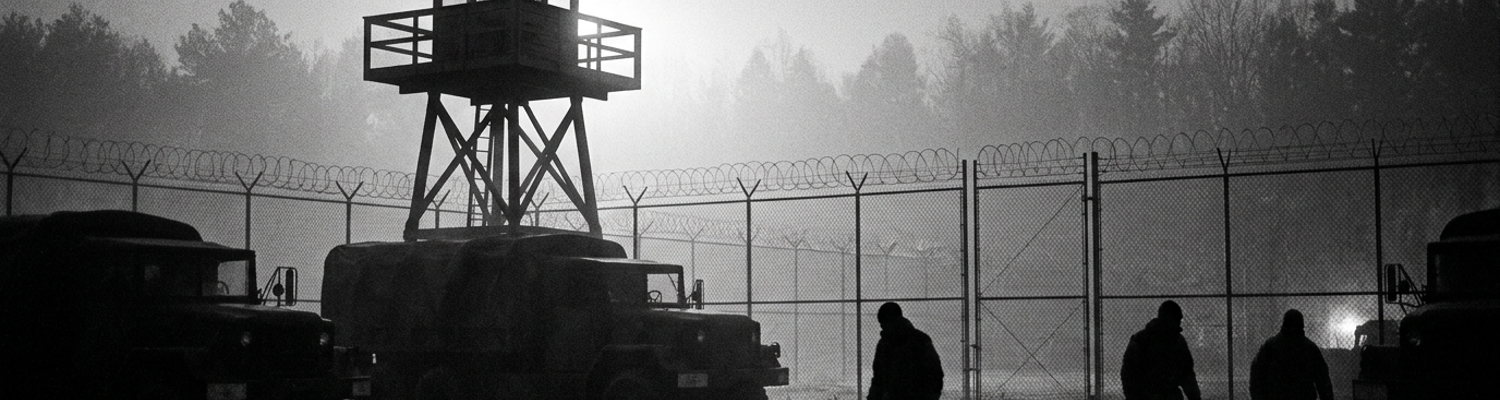
Archival evidence shows that Seventh Army Provost Marshal Colonel William H. Maglin initiated a physical restructuring of all rear area cantonments across the Swabian Jura during the final week of May. Field engineers from the 100th Infantry Division carved the sprawling holding yards at Sigmaringen and Balingen into segregated barbed wire cantonments to dismantle the mixed camps. German general rank officers, Gestapo operatives, and high ranking Nazi party functionaries were isolated behind double apron concertina fences. These were reinforced with wooden watchtowers at Sector Alpha near the Sigmaringen rail terminal. Standard Wehrmacht conscripts were reclassified as Disarmed Enemy Forces. They moved to open field bivouacs along the Danube floodplains where basic sanitation trenches and tent cantonments could be constructed. French targets were transferred to an isolated compound under joint Franco American military police guard. This included forty-six detained Milice paramilitaries and Vichy officials like Fernand de Brinon. Provost marshals assigned armed patrols from the 398th Infantry Regiment to run perimeter checkpoints along Highway 27. This ensured that intelligence targets remained physically isolated from standard line soldiers awaiting demobilization.
Segregated compounds stopped the spread of camp wide panic and localized violence.
When examining the historical record of military governance, the systemic breakdown inside the Hohenzollern enclosure system directly drove Supreme Headquarters Allied Expeditionary Force to draft revised operating protocols for handling mass displaced personnel. Staff officers at Sixth Army Group compiled daily field logs detailing dysentery epidemics and uncoordinated allied detentions. They added the perimeter fratricide reports into a technical white paper distributed to Allied Military Government planners in Frankfurt. The catastrophic supply failures experienced by the 100th Infantry Division demonstrated that tactical combat units could not function as administrative detention authorities without dedicated civil affairs engineering brigades. Allied planners immediately incorporated Hohenzollern operational data into Technical Manual 2100-3. This established mandatory calorie baselines of fifteen hundred units per day for surrendered enemy personnel. It required pre allocated water purification assets prior to enclosure establishment. It dictated standardized multi language transit passes for French and American border corridors. Operational control of long term detention shifted away from front line combat regiments to specialized theater provost cantonments. These new sites were equipped with pre fabricated latrines, medical triage trailers, and joint liaison detachments.
Combat infantry regiments were permanently relieved of mass containment duties.
Operational records from early June 1945 confirm that the newly established theater transfer corridors cleared eighteen thousand Wehrmacht personnel out of the temporary mud yards along the Danube rail siding. Motorized transport echelons from the 332nd Quartermaster Truck Depot moved long term detainees to permanent cantonments in Heilbronn and Ludwigsburg. Engineers dismantled the makeshift concertina wire lines across the civilian rye fields in Tailfingen. They returned confiscated agricultural tracts to regional municipal councils. The final twenty-two Vichy political prisoners were formally signed over to French custody at the Kehl bridgehead on June 12 under tripartite receipt manifest 44-B.